Maharashtra State Board Class 10 Geography Solutions Chapter 5 Natural Vegetation and Wildlife
Class 10 Geography Chapter 5 Natural Vegetation and Wildlife Textbook Questions and Answers
S.No | Type of forest | Characteristics | Regions in India | Regions in Brazil |
1 | Tropical Forests | Broad-leaved evergreen trees. | ||
2 | Semi arid thorny vegetation | 1. | ||
3 | Savannah | Scanty bushes and shrub like trees and rain resistant grass. | ||
4 | Tropical | Mixed type vegetation. | ||
5 | Grasslands | Grassland region like the Pampas of Argentina. |
S. No. | Type of forest | Characteristics | Regions in India | Regions in Brazil | ||||||||||||||||||||||||||||||||||||||||||||||||
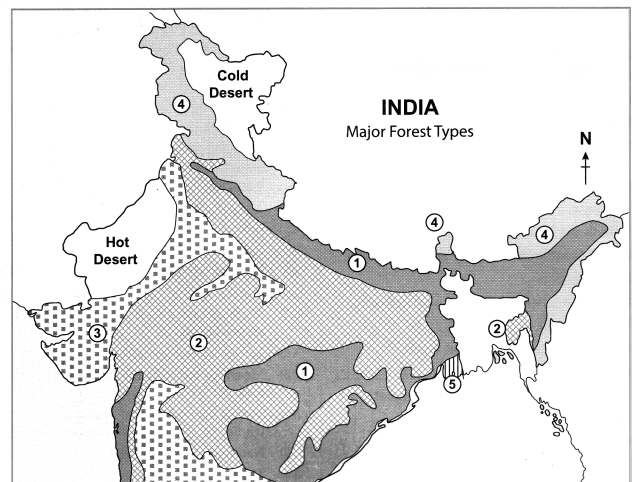
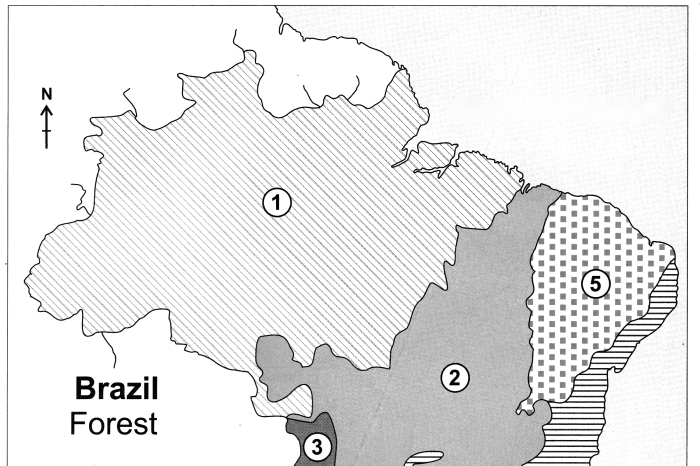
(1) | Tropical Forests | Broad-leaved evergreen trees. | Andaman and Nicobar Islands, the Western Ghats. Some parts of North East India. | Amazon Basin, Guyana Highlands. | ||||||||||||||||||||||||||||||||||||||||||||||||
(2) | Semi arid thorny vegetation | (a) Thorny and shrub type vegetation. | Gujarat, Rajasthan, Parts of Madhya Pradesh and Uttar Pradesh. | North-Eastern part of Brazil. | ||||||||||||||||||||||||||||||||||||||||||||||||
(3) | Savannah | Scanty bushes and shrub like trees and rain resistant grass. | Brazilian Highland. | |||||||||||||||||||||||||||||||||||||||||||||||||
(4) | Tropicalsemi-deciduous | Mixed type vegetation. | Central India and South India. | Parana Basin and South Eastern part of Brazil. | ||||||||||||||||||||||||||||||||||||||||||||||||
(5) | Grasslands | Grassland region like the Pampas of Argentina. | Foothills of Shiwalik hills and Assam. | Southern Brazil. 2. Identify the odd man out: Question a. Question b. Question c. Question d. 3. Match the Column:
Answer: 4. Answer in short: Question a.
Question b. (ii) Grasslands of Brazil like the Savannah and the deciduous forest of India have a large number of herbivores and carnivores. (iii) The dense evergreen forests of India in the west, north east India and the Amazon Basin of Brazil are a home to a large variety of birds, insects, reptiles along with the herbivores and the carnivores. (iv) Coastal forests and swampy areas of Pantanal and Sunderbans have mangroves, a variety of birds, fishes and reptiles like crocodiles, alligators and the anacondas in Brazil. (v) Vegetation provides food and shelter to wildlife but if vegetation is limited like in the Thar desert or the Caatinga it will also limit the variety of animals species. Question c. Question d. (ii) To ensure continuous food supply to meet the needs of the ever increasing population, more and more area needs to be brought under agriculture. For the expansion of agricultural land, forest areas are being cut down. (iii) In both India and Brazil, forests are being cut down for firewood and for other domestic needs. (iv) Slash and Burn agriculture which is also known as Roca in Brazil and Jhum in India is responsible for deforestation. (v) Apart from all the above reasons, forest fire, pollution, overgrazing, etc. are also responsible for the degradation of forests. Question e. 5. Give geographical reasons: Question a. Question b. Question c. Question d. (ii) Expansion of cities to accommodate the growing population is leading to cutting down of the valuable forest which leads to the loss of the habitat of wildlife. (iii) Also the problem of pollution has become severe due to urbanisation. Various types of pollution have threatened the lives of many of the species. (iv) Poaching of wildlife species have also led to the loss of wildlife in India. (v) Agricultural practices like shifting cultivation has also reduced the forest cover leading to loss of wildlife habitat. Question e. (ii) Trees are being cut down to obtain wood, leading to large scale deforestation in both countries. (iii) Also the problem of pollution has become severe due to urbanisation. Various types of pollution have threatened the lives of many of the species. (iv) Agricultural practices like slash and burn agriculture (roca) has reduced the forest cover in Brazil. (v) Like India, the problem of illegal smuggling of animals has affected Brazil too. (vi) Hence there is a need for conservation of forests in both Brazil and India. Class 10 Geography Chapter 5 Natural Vegetation and Wildlife Intext Questions and Answers Observe the images given below and discuss on the basis of the following points and answer the followingquestions:
Question 2
Maharashtra Board Solution
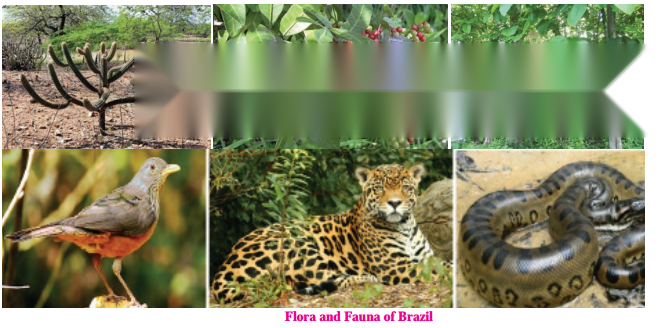
Where have you seen these plants before?
Solution & Step-by-Step Answer:
Brazil.
Question 3
Maharashtra Board Solution
Name the fauna shown in the image.
Solution & Step-by-Step Answer:
Rufous bellied thrush, leopard, green anaconda.
Question 4
Maharashtra Board Solution
Where have you seen them before?
Solution & Step-by-Step Answer:
On the internet and in movies.
Question 5
Maharashtra Board Solution
In which country do you find a greater diversity of vegetation? What is the reason behind it?
Solution & Step-by-Step Answer:
Brazil has a greater diversity of vegetation because of the variation in climatic conditions.
Colours Of Both
Question 1
Maharashtra Board Solution
In which country do equatorial forests occupy a greater area? What could be the reason behind it?
Solution & Step-by-Step Answer:
Equatorial forests occupy a greater area in Brazil. This is because the Equator passes through northern part of Brazil. Hence, the climate is generally hot throughout the year. Moreover, this region receives heavy rainfall throughout the year.
Question 2
Maharashtra Board Solution
Which type of forests found in India are not found in Brazil?
Solution & Step-by-Step Answer:
Himalayan forests are found in India and not in Brazil.
Question 3
Maharashtra Board Solution
Which type of forests found in Brazil are found in India too?
Solution & Step-by-Step Answer:
Evergreen forests, deciduous forests, and thorny shrub type vegetation are found in both Brazil and India.
Question 4
Maharashtra Board Solution
In which country a greater diversity of vegetation is found? What is the reason behind it?
Solution & Step-by-Step Answer:
Brazil has a greater diversity of vegetation because of the equatorial climate, ample sunlight, heavy rainfall, and vast forest expanse.
Question 5
Maharashtra Board Solution
Considering the climate and vegetation types, in which country will forest-based occupations flourish?
Solution & Step-by-Step Answer:
Forest-based occupations will flourish more in Brazil.
Activity
Question 1
Maharashtra Board Solution
Correlate geographical conditions and the flora and fauna there? (India)
Solution & Step-by-Step Answer:
Depending upon favourable geographical conditions, we find a variety of flora and fauna in India.
(i) In the snow-capped regions of Himalayas where precipitation occurs in the form of snow, we find alpine vegetation. Animals like snow leopards and yaks are found who can sustain the extreme cold of the Himalayas. (ii) The evergreen forest in the Western Ghats have hot and humid conditions with a temperature of 28°C and annual rainfall more than 2000mm. In such are as animals like lions, tigers, elephants, and a variety of birds are seen. (iii) The coastal forest are home to many turtles, crocodiles, and gavials, etc. One-horned rhinoceroses are found in the swampy, marshy lands of Assam. Mangrove vegetation is found in the saline waters. (iv) In areas where the climate is hot and dry and the rainfall is low, thorny scrub vegetation is found. Animals like wild ass and camels are common here. (v) In the regions of medium rainfall. We find deciduous forest, wide variety of animals and birds.
Question 2
Maharashtra Board Solution
Do you know some other animals too ?
Solution & Step-by-Step Answer:
Four-horned antelope, black buck, Tibetan yak, giant squirrel (shekaru).
Use your Brain:
Question 1
Maharashtra Board Solution
Find out in which parts of India agricultural practices like the ‘Roca’ is found? By what names are they called?
Solution & Step-by-Step Answer:
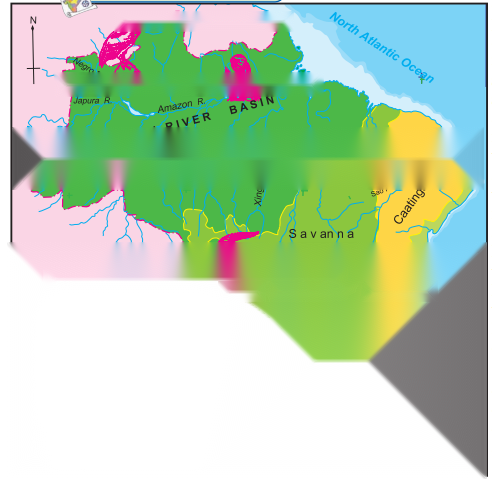
Answer the following questions on the basis of map given:
Question 2
Maharashtra Board Solution
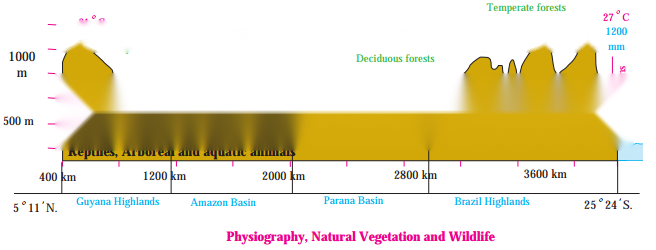
How much rainfall does equatorial forests receive?
Solution & Step-by-Step Answer:
Equatorial forests receive 2000 mm of rainfall.
Question 3
Maharashtra Board Solution
Name the types of forests shown in figure.
Solution & Step-by-Step Answer:
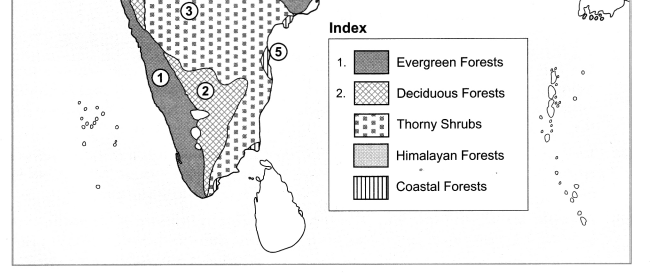
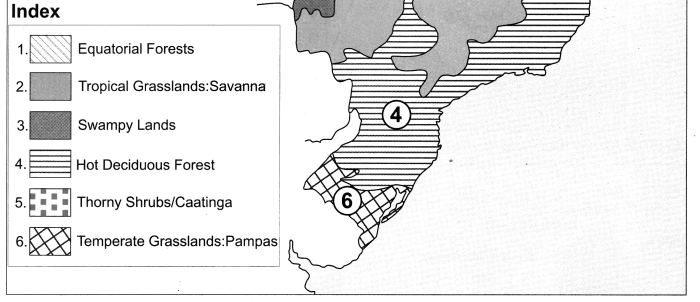
Tropical forests, Equatorial forests, Deciduous forests and Temperate forests are shown in the above figure.
Question 4
Maharashtra Board Solution
Where are tropical and equatorial forests found in Brazil?
Solution & Step-by-Step Answer:
Tropical and equatorial forests are found in Guyana Highlands and Amazon basin respectively.
Question 5
Maharashtra Board Solution
Where are deciduous forests and temperate forests found in Brazil?
Solution & Step-by-Step Answer:
Deciduous forests and Temperate forests are found in Parana Basin and Brazilian Highlands respectively.
Question 6
Maharashtra Board Solution
What kind of wildlife is seen in Brazilian Highlands?
Solution & Step-by-Step Answer:
Reptiles and grassland animals are seen in Brazilian Highlands.
Question 1
Maharashtra Board Solution
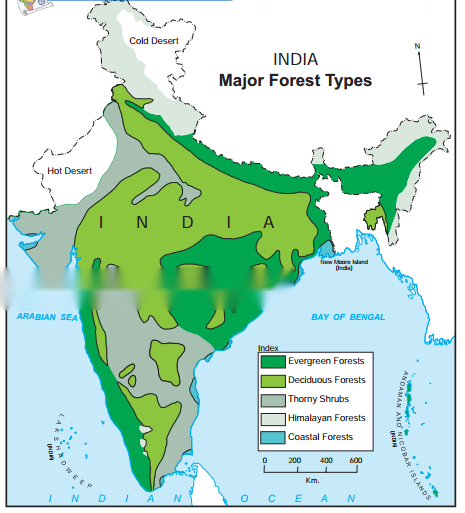
Which forests are found in western snow¬capped regions?
Solution & Step-by-Step Answer:
Himalayan Forests are found in western snow-capped regions.
Question 2
Maharashtra Board Solution
On which coast do you mainly find the coastal vegetation?
Solution & Step-by-Step Answer:
The coastal vegetation is mainly found along the Eastern Coast.
Question 3
Maharashtra Board Solution
Which type of forests occupy maximum area in India ? Why?
Solution & Step-by-Step Answer:
Deciduous forests are found in the regions receiving rainfall between 1000 mm to 2000 mm Since most of India has rainfall in that range, deciduous forests dominate the Indian subcontinent.
Question 4
Maharashtra Board Solution
Where do you find thorny and shrub vegetation in India and why?
Solution & Step-by-Step Answer:
Semi arid areas of Gujarat, Rajasthan, Madhya Pradesh, Chhattisgarh, Uttar Pradesh Maharashtra, Karnataka, Andhra Pradesh, Tamil Nadu and Haryana are the places where thorny and shrub vegetation are found. The thorny forests are found in these regions as the rainfall is less than 500 mm.
Question 1
Maharashtra Board Solution
Name the species shown on the map.
Solution & Step-by-Step Answer:
Some of the major species shown on the map are condor, golden lion tamarin, anaconda, crocodile, sword fish, flamingoes, macaw, parrots, rufous bellied thrush.
Question 2
Maharashtra Board Solution
In which regions are these animals found? Why are their habitats found in these forests?
Solution & Step-by-Step Answer:
Question 3
Maharashtra Board Solution
Classify the forest regions in Brazil with reference to their extent.
Solution & Step-by-Step Answer:
Mark the following on the map of India with the given information: Answer:
Class 10 Geography Chapter 5 Natural Vegetation and Wildlife Additional Important Questions and Answers Choose the correct option and rewrite the statements:
Question 1
Maharashtra Board Solution
In Brazil, _____ varies due to physiography. (a) soil (b) rainfall (c) agriculture (d) mineral availability
Solution & Step-by-Step Answer:
(b) rainfall
Question 2
Maharashtra Board Solution
In most parts of the _____ region, it rains throughout the year. (a) temperate (b) tropical (c) grasslands (d) equatorial
Solution & Step-by-Step Answer:
(d) equatorial
Question 3
Maharashtra Board Solution
As one moves away from the Equator, _______ decreases. (a) altitude (b) forest (c) rainfall (d) snowfall
Solution & Step-by-Step Answer:
(c) rainfall
Question 4
Maharashtra Board Solution
The _______ forests are found where there is rainfall throughout the year. (a) tropical (b) thorny (c) evergreen (d) temperate
Solution & Step-by-Step Answer:
(c) evergreen
Question 5
Maharashtra Board Solution
Brazil has the/a ______ number of vegetation species in the world. (a) moderate (b) largest (c) low (d) smallest
Solution & Step-by-Step Answer:
(b) largest
Question 6
Maharashtra Board Solution
The rainforests are rightly called the _______. (a) lungs of the world’ (b) ’limbs of the world’ (c) ’heart of the world’ (d) ’veins of the world’
Solution & Step-by-Step Answer:
(a) lungs of the world’
Question 7
Maharashtra Board Solution
Highest biodiversity is found in _____ forests. (a) thorny (b) deciduous (c) evergreen (d) coastal
Solution & Step-by-Step Answer:
(c) evergreen
Question 8
Maharashtra Board Solution
In regions receiving rainfall between 1000 mm to 2000 mm in India, ______ forests are found. (a) thorny (b) evergreen (c) deciduous (d) tropical
Solution & Step-by-Step Answer:
(c) deciduous
Question 9
Maharashtra Board Solution
In regions receiving less than 500 mm of rainfall that experience dry summers for a long time in India, ______ and shrub like vegetation are found. (a) equatorial (b) evergreen (c) grasslands (d) thorny
Solution & Step-by-Step Answer:
(d) thorny
Question 10
Maharashtra Board Solution
In _____ areas, coastal type of vegetation is found. (a) peninsular (b) mountainous (c) rocky (d) swampy
Solution & Step-by-Step Answer:
(d) swampy
Question 11
Maharashtra Board Solution
Coastal type of vegetation is called ____ in India. (a) Bangar (b) Sunderbans (c) Pantanal (d) Terai
Solution & Step-by-Step Answer:
(b) Sunderbans
Question 12
Maharashtra Board Solution
The wood found in Sunderbans is _____ light and durable. (a) dry (b) fragile (c) oily (d) soft
Solution & Step-by-Step Answer:
(c) oily
Question 13
Maharashtra Board Solution
In areas located in the ____ altitude of Himalayas, seasonly flowering trees are found. (a) highest (b) lowest (c) plains (d) medium
Solution & Step-by-Step Answer:
(a) highest
Question 14
Maharashtra Board Solution
In regions with medium altitude of Himalayas, ______ trees are found. (a) rubber (b) evergreen (c) rose wood (d) coniferous
Solution & Step-by-Step Answer:
(d) coniferous
Question 15
Maharashtra Board Solution
At foothills of the Himalayas _____ forests are found. (a) mixed (b) teak – (c) coniferous (d) pine
Solution & Step-by-Step Answer:
(a) mixed
Question 16
Maharashtra Board Solution
The proportion of ________ trees is higher at the foothills of the Himalayas. (a) sal (b) deodar (c) rosewood (d) pine
Solution & Step-by-Step Answer:
(a) sal
Question 17
Maharashtra Board Solution
Teak is mainly found in the _______ type of forest. (a) Coastal (b) Thorny and bush (c) Coniferous (d) Deciduous
Solution & Step-by-Step Answer:
(d) Deciduous
Question 18
Maharashtra Board Solution
A greater diversity of wildlife is found in ________ than any other country in the world. (a) India (b) Russia (c) Australia (d) Brazil
Solution & Step-by-Step Answer:
(d) Brazil
Question 19
Maharashtra Board Solution
In the swampy areas of Pantanal, _______ are found. (a) cobras (b) vipers (c) huge anacondas (d) Indian pythons
Solution & Step-by-Step Answer:
(c) huge anacondas
Question 20
Maharashtra Board Solution
Among fish varieties, ______ is found in seas of Brazil (a) mackerel (b) king fish (c) sword fish (d) pink dolphins
Solution & Step-by-Step Answer:
(c) sword fish
Question 21
Maharashtra Board Solution
In Brazilian rivers, pink dolphins and ______ are found. (a) gold fish (b) piranhas (c) king fish (d) mackrels
Solution & Step-by-Step Answer:
(b) piranhas
Question 22
Maharashtra Board Solution
One of the major bird species found in Brazil includes _______. (a) ostrich (b) flamingoes (c) kiwi (d) duck
Solution & Step-by-Step Answer:
(b) flamingoes
Question 23
Maharashtra Board Solution
Slash and bum agriculture is also called ______ in Brazil. (a) kumri (b) roka (roca) (c) dry farming (d) bewar
Solution & Step-by-Step Answer:
(b) roka (roca)
Question 24
Maharashtra Board Solution
Hot and humid forests are a home for _______ (a) tiger (b) elephants (c) dogs (d) leopard
Solution & Step-by-Step Answer:
(b) elephants
Question 25
Maharashtra Board Solution
One horned rhinoceroses are found in swampy and marshy lands of ______. (a) Assam (b) Madhya Pradesh (c) Telangana (d) Tamil Nadu
Solution & Step-by-Step Answer:
(a) Assam
Question 26
Maharashtra Board Solution
Indian bisons, deers, monkeys are found in the _____ region. (a) Himalayan (b) Western Ghats (c) Peninsular (d) Deccan
Solution & Step-by-Step Answer:
(c) Peninsular
Question 27
Maharashtra Board Solution
The only country where both lions and tigers are found is ______. (a) Brazil (b) India (c) Australia (d) America
Solution & Step-by-Step Answer:
(b) India
Question 28
Maharashtra Board Solution
______ which are huge in size fly high in the Brazilian sky. (a) Macaws (b) Kingfishers (c) Condors (d) Pheasants
Solution & Step-by-Step Answer:
(c) Condors
Match the Column:
Question 1
Maharashtra Board Solution
|
Column ’A’ | Column ‘B’ |
1. Evergreen Forests | (a) Major portion of Madhya Pradesh |
2. Deciduous forests | (b) Arunachal Pradesh |
3. Thorny shrubs | (c) Sundarbans |
4. Himalayan forests | (d) Western Ghats |
5. Coastal forests | (e) Gujarat |
(f) Cold desert in Jammu and Kashmir | |
(g) Hot desert in Rajasthan |
1 – d
2 – a
3 – e
4 – b
5 – c
Question 2
Maharashtra Board Solution
Solution & Step-by-Step Answer:
1 – d
2 – c 3 – b 4 – e 5 – a Identify the odd man out:
Question 1
Maharashtra Board Solution
With reference to Fauna in India. (a) Anaconda (b) Elephants (c) Lion (d) Tiger
Solution & Step-by-Step Answer:
(a) Anaconda
Question 2
Maharashtra Board Solution
With reference to Flora of Brazil. (a) Pau Brazil (b) Rubber (c) Mahogany (d) Deodar
Solution & Step-by-Step Answer:
(d) Deodar
Question 3
Maharashtra Board Solution
With reference to Himalayan Forests. (a) Seasonal flowering plants (b) Orchids (c) Pine (d) Mixed Forests
Solution & Step-by-Step Answer:
(b) Orchids
Question 4
Maharashtra Board Solution
With reference to birds found in Brazil. (a) Condors (b) Flamingoes (c) Macaws (d) Peacocks
Solution & Step-by-Step Answer:
(d) Peacocks
Question 5
Maharashtra Board Solution
With reference to birds found in India. (a) Peacock (b) Kingfisher (c) Duck (d) Condors.
Solution & Step-by-Step Answer:
(d) Condors.
Question 6
Maharashtra Board Solution
With reference to protection of wildlife, Government of India has setup. (a) Museums (b) Biosphere reserves (c) National Parks (d) Wildlife sanctuaries
Solution & Step-by-Step Answer:
(a) Museums
Answer the following questions in one sentence:
Question 1
Maharashtra Board Solution
Where does it rain throughout the year?
Solution & Step-by-Step Answer:
It rains throughout the year, in most parts of the equatorial region.
Question 2
Maharashtra Board Solution
As one moves away from the Equator, does the rainfall increase?
Solution & Step-by-Step Answer:
No, the rainfall decreases as one moves away from the Equator.
Question 3
Maharashtra Board Solution
Where are evergreen forests found?
Solution & Step-by-Step Answer:
Evergreen forests are found in the area where it rains throughout the year.
Question 4
Maharashtra Board Solution
What effect does rainfall have on vegetation?
Solution & Step-by-Step Answer:
As the rainfall decreases, the density of the vegetation also decreases.
Question 5
Maharashtra Board Solution
What kind of vegetation is found in places of less rainfall?
Solution & Step-by-Step Answer:
Various types of grass, short shrubs and thorny vegetation is found in places of less rainfall.
Question 6
Maharashtra Board Solution
Where are the largest number of vegetation species found in the world?
Solution & Step-by-Step Answer:
Brazil has the largest number of vegetation species in the world.
Question 7
Maharashtra Board Solution
What kind of trees are found in Brazil?
Solution & Step-by-Step Answer:
Trees like Pau Brasil, rubber, mahogany, rosewood and a variety of orchids are found in Brazil.
Question 8
Maharashtra Board Solution
Why are the evergreen forests called the ‘lungs of the world’?
Solution & Step-by-Step Answer:
Evergreen forests are called the lungs of the world because they release large amount of oxygen in the environment which helps to reduce the carbon dioxide levels.
Question 9
Maharashtra Board Solution
Describe the leaves of trees found in evergreen forests.
Solution & Step-by-Step Answer:
The leaves of trees found in evergreen forests are broad and green.
Question 10
Maharashtra Board Solution
What quality of wood is found in evergreen forests?
Solution & Step-by-Step Answer:
The wood found in evergreen forests is hard, heavy and durable.
Question 11
Maharashtra Board Solution
In which regions are deciduous forests found?
Solution & Step-by-Step Answer:
Deciduous forests are found in the regions receiving an average amount of rainfall ranging between 1000mm to 2000mm in India.
Question 12
Maharashtra Board Solution
Which trees are found in deciduous forests?
Solution & Step-by-Step Answer:
Trees like teak, bamboo, banyan, peepal, etc. are found in deciduous forest.
Question 13
Maharashtra Board Solution
Which regions experience dry summers for a long time in India?
Solution & Step-by-Step Answer:
Regions that receive less than 500 mm of rainfall experience dry summers for a long time in India.
Question 14
Maharashtra Board Solution
Which kind of vegetation is found in regions receiving less than 500 mm of rainfall?
Solution & Step-by-Step Answer:
Thorny or shrub like vegetation is found in regions receiving less than 500 mm of rainfall.
Question 15
Maharashtra Board Solution
How are the leaves of trees in the region where there is less than 500 mm of rainfall?
Solution & Step-by-Step Answer:
The leaves of trees are small in the region where there is less than 500 mm of rainfall.
Question 16
Maharashtra Board Solution
Where is coastal vegetation found?
Solution & Step-by-Step Answer:
Coastal vegetation is found in swampy areas, estuaries and lagoons near coastal areas.
Question 17
Maharashtra Board Solution
What is coastal vegetation called in India?
Solution & Step-by-Step Answer:
Coastal vegetation is called mangroves or Sunderbans in India.
Question 18
Maharashtra Board Solution
How is the wood of trees found in coastal vegetation?
Solution & Step-by-Step Answer:
The wood of trees found in coastal vegetation is oily, light and durable.
Question 19
Maharashtra Board Solution
How many types of forests are there in the Himalayas?
Solution & Step-by-Step Answer:
There are three types of forests in the Himalayas based on their altitude.
Question 20
Maharashtra Board Solution
Which kind of trees are found in regions of high altitude in the Himalayas?
Solution & Step-by-Step Answer:
Seasonally flowering trees are found in regions of high altitude.
Question 21
Maharashtra Board Solution
Which type of trees are found in regions with medium altitude in the Himalayas?
Solution & Step-by-Step Answer:
In regions with medium altitude, coniferous trees like pine, deodar and fir are found.
Question 22
Maharashtra Board Solution
Where are mixed forests found in India?
Solution & Step-by-Step Answer:
Mixed forest are found at the foothills of the Himalayas.
Question 23
Maharashtra Board Solution
Where is greater diversity in wildlife found in the world?
Solution & Step-by-Step Answer:
A greater diversity in wildlife is found in Brazil than any other country in the world.
Question 24
Maharashtra Board Solution
Which animal is found in the swampy areas of the Pantanal?
Solution & Step-by-Step Answer:
Huge anacondas are found in the swampy areas of Pantanal.
Question 25
Maharashtra Board Solution
Which are the other animals found in Brazil?
Solution & Step-by-Step Answer:
Animals like guinea pigs, crocodiles, alligators, monkeys, pumas, leopards, etc. are found in Brazil.
Question 26
Maharashtra Board Solution
Which is the main variety of fish found in the Brazilian sea?
Solution & Step-by-Step Answer:
Sword fish is mainly found in the Brazilian sea.
Question 27
Maharashtra Board Solution
Which varieties of fish are found in the rivers of Brazil?
Solution & Step-by-Step Answer:
Piranhas are found in the rivers of Brazil.
Question 28
Maharashtra Board Solution
What kind of birds are seen in the Brazilian sky?
Solution & Step-by-Step Answer:
Condors, parrots, macaws, and flamingoes are found in the Brazilian skies.
Question 29
Maharashtra Board Solution
Why is degradation of environment happening in Brazil?
Solution & Step-by-Step Answer:
Degradation of environment is happening in Brazil due to illegal smuggling of wild animals, slash and bum agriculture (roka), deforestation, and pollution.
Question 30
Maharashtra Board Solution
Where are elephants found in India?
Solution & Step-by-Step Answer:
Elephants are found in hot and humid forests of India.
Question 31
Maharashtra Board Solution
Where are one homed rhinoceroses found?
Solution & Step-by-Step Answer:
One homed rhinoceroses are found in the swampy and marshy lands of Assam.
Question 32
Maharashtra Board Solution
Which animals are found in the arid lands of India?
Solution & Step-by-Step Answer:
Wild ass and camels are found in the arid lands of India.
Question 33
Maharashtra Board Solution
Which animal is found in the snow capped regions of Himalayas?
Solution & Step-by-Step Answer:
Snow leopards are found in the snow capped regions of the Himalayas.
Question 34
Maharashtra Board Solution
Which animals are found in the peninsular region of India?
Solution & Step-by-Step Answer:
Indian Bisons, deer, antelopes, and monkeys are found in the Peninsular region of India.
Question 35
Maharashtra Board Solution
Which is the only country where both lions and tigers are found?
Solution & Step-by-Step Answer:
India is the only country where both lions and tigers are found.
Question 36
Maharashtra Board Solution
Where are turtles, crocodiles and gharials found in India?
Solution & Step-by-Step Answer:
Turtles, crocodiles and gharials are found in rivers, estuaries, and coastal areas of India.
Question 37
Maharashtra Board Solution
Which birds are found in the forests and wetlands of India?
Solution & Step-by-Step Answer:
Birds like peacocks, Indian bustard, kingfishers, peasants, ducks, parakeet, cranes, and pigeons are found in the forests and wetlands of India.
Question 38
Maharashtra Board Solution
What measures are taken by the Government of India for the protection of wildlife and forests of India?
Solution & Step-by-Step Answer:
The Government of India has set up a number of national parks, wildlife sanctuaries, bird sanctuaries, and biosphere reserves for the protection of wildlife and forests in India.
Question 39
Maharashtra Board Solution
Name some plants found in regions having less than 500 mm of rainfall in India.
Solution & Step-by-Step Answer:
Catechu, acacia, khejri and a variety of cactus like aloevera and agave are found in regions having less than 500 mm of rainfall in India.
Name the following:
Question 1
Maharashtra Board Solution
The region where it rains throughout the year.
Solution & Step-by-Step Answer:
Equatorial region.
Question 2
Maharashtra Board Solution
The forests which are found where it rains throughout the year.
Solution & Step-by-Step Answer:
Evergreen forests.
Question 3
Maharashtra Board Solution
Kind of vegetation found in places of less rainfall.
Solution & Step-by-Step Answer:
Grass, short shrubs, thorny vegetation.
Question 4
Maharashtra Board Solution
Country where the largest number of vegetation species in the world is located.
Solution & Step-by-Step Answer:
Brazil.
Question 5
Maharashtra Board Solution
The types of trees found in Brazil.
Solution & Step-by-Step Answer:
Pau Brasil, rubber, mahogany, rosewood and variety of orchids.
Question 6
Maharashtra Board Solution
Other name for rain forests.
Solution & Step-by-Step Answer:
‘The lungs of the world.’
Question 7
Maharashtra Board Solution
Trees found in deciduous forests.
Solution & Step-by-Step Answer:
Teak, bamboo, banyan, peepal.
Question 8
Maharashtra Board Solution
Type of vegetation found in regions having less than 500 mm of rainfall.
Solution & Step-by-Step Answer:
Thorny and shrub-like.
Question 9
Maharashtra Board Solution
Plants found in regions having less than 500 mm of rainfall.
Solution & Step-by-Step Answer:
Catechu, acacia, khejri and varieties of cactus.
Question 10
Maharashtra Board Solution
Kind of vegetation found in swampy areas.
Solution & Step-by-Step Answer:
Coastal type.
Question 11
Maharashtra Board Solution
Another name of coastal type of vegetation in India.
Solution & Step-by-Step Answer:
Mangroves or sunderbans.
Question 12
Maharashtra Board Solution
Kind of trees found in forests located on higher altitudes in the Himalayas.
Solution & Step-by-Step Answer:
Seasonally flowering trees.
Question 13
Maharashtra Board Solution
Kind of trees which have grown in forests located on medium altitudes in Himalayas. Coniferous trees like Pine, Deodar and Fir.
Solution & Step-by-Step Answer:
Region where mixed forests are found in Himalayas.
Question 14
Maharashtra Board Solution
Foothills of Himalayas.
Solution & Step-by-Step Answer:
Animal found in the swampy areas of Pantanal.
Question 15
Maharashtra Board Solution
Huge anacondas.
Solution & Step-by-Step Answer:
Any two varieties of animals found in Brazil. Guinea pigs and crocodiles.
Question 16
Maharashtra Board Solution
Kind of fishes found in seas of Brazil.
Solution & Step-by-Step Answer:
Sword fish.
Question 17
Maharashtra Board Solution
Fish varieties found in the rivers of Brazil.
Solution & Step-by-Step Answer:
Pink dolphins and Piranhas.
Question 18
Maharashtra Board Solution
Any two species of birds found in Brazil.
Solution & Step-by-Step Answer:
Condors and macaws.
Question 19
Maharashtra Board Solution
Causes for degradation of environment.
Solution & Step-by-Step Answer:
Illegal smuggling of wild animals, roka, deforestation and pollution
Question 20
Maharashtra Board Solution
Region where elephants are found in India.
Solution & Step-by-Step Answer:
Hot and humid forests.
Question 21
Maharashtra Board Solution
Animal which is found in the swampy and marshy lands of Assam.
Solution & Step-by-Step Answer:
One horned rhinoceroses.
Question 22
Maharashtra Board Solution
Animals which are found in arid lands of India.
Solution & Step-by-Step Answer:
Wild ass and camels.
Question 23
Maharashtra Board Solution
Animals which are found in the snowcapped mountain of Himalayas.
Solution & Step-by-Step Answer:
Yaks and snow leopards.
Question 24
Maharashtra Board Solution
Animals found in the Peninsular region of India.
Solution & Step-by-Step Answer:
Indian bisons, deer, antelopes and monkeys.
Question 25
Maharashtra Board Solution
Country where both lion and tigers are found.
Solution & Step-by-Step Answer:
India.
Question 26
Maharashtra Board Solution
Animals found in rivers, estuaries and coastal areas of India.
Solution & Step-by-Step Answer:
Turtles, crocodiles and garials.
Question 27
Maharashtra Board Solution
Measures taken by the Government of India to protect wildlife.
Solution & Step-by-Step Answer:
Setting up of National parks, bird sanctuaries, wildlife sanctuaries and biosphere reserves.
Question 28
Maharashtra Board Solution
National animal of India.
Solution & Step-by-Step Answer:
Tiger.
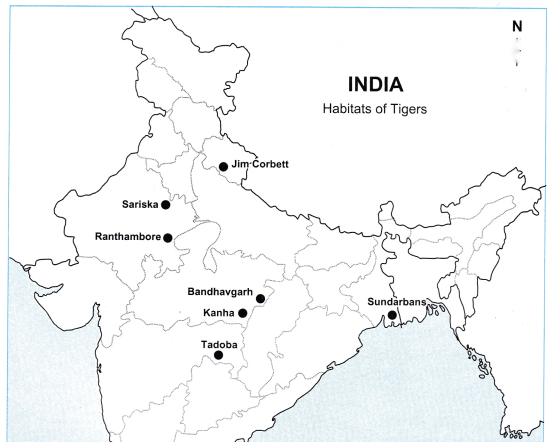
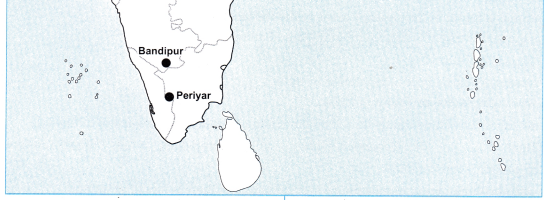
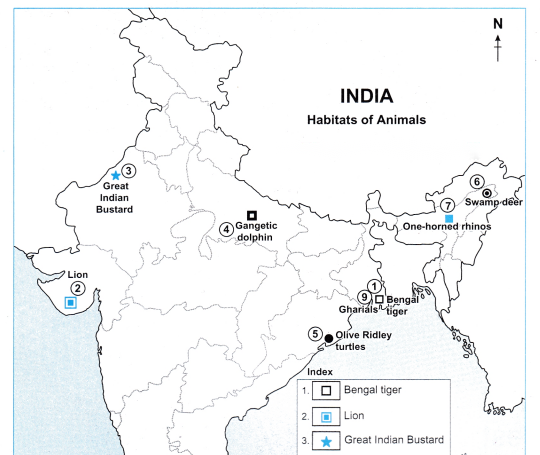
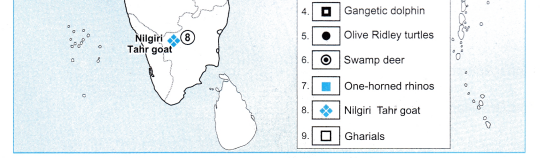
Mark the following on the map of India with the given information: Answer:
Mark the following on the map of Brazil with the given information: Answer:
Question 1
Maharashtra Board Solution
Show the habitats of tigers in India with their names on a map.
Solution & Step-by-Step Answer:
Question 2
Maharashtra Board Solution
Why is their habitat found in these regions?
Solution & Step-by-Step Answer:
Tiger’s habitats are found in these regions because here there are various types of forest areas with different types of herbivorous animals.
Answer the Questions Briefly:
Question 1
Maharashtra Board Solution
Thorny and shrub-like vegetation is found in regions where there is less or no rainfall.
Solution & Step-by-Step Answer:
Question 2
Maharashtra Board Solution
The evergreen rainforests in Brazil are rightly called the ‘Lungs of the world’.
Solution & Step-by-Step Answer:
Question 3
Maharashtra Board Solution
The largest variety of flora is found in Brazil.
Solution & Step-by-Step Answer:
Question 4
Maharashtra Board Solution
Suggest measures for the conservation of wildlife and forest in India?
Solution & Step-by-Step Answer:
Measures for the conservation of wildlife and forest in India are as follows:
Write short notes on:
Question 1
Maharashtra Board Solution
Brazilian Vegetation:
Solution & Step-by-Step Answer:
(i) In Brazil, rainfall varies due to physiography. In most parts of the Equatorial region, it rains throughout the year. (ii) As one moves away from the equator, the number of rainy days as well as amount of rainfall reduces. (iii) This affects the life cycle of the vegetation too. (iv) Evergreen forests are found in the areas where it rains throughout the year. (v) In regions which receive rainfall only during certain seasons, the density of the vegetation reduces. (vi) Instead of forests, various types of grass, short shrubs,,thorny vegetation, etc. are found. (vii) Brazil has the largest number of vegetation species in the world. (viii) This includes evergreen vegetation, semi-evergreen, arid, etc. (ix) One finds trees like Pau Brasil, rubber, mahogany, rosewood and a variety of orchids.
Question 2
Maharashtra Board Solution
wildlife of Brazil:
Solution & Step-by-Step Answer:
(i) A greater diversity in wildlife is found in Brazil compared to any other country in the world. (ii) In the swampy areas of the Pantanal, huge anacondas are found. Animals, such as guinea pigs, crocodiles, alligators, monkeys, pumas, leopards, etc. are found. (iv) Among the fish varieties, mainly swordfish are found in the seas, while pink dolphins and piranhas are found in the rivers. (v) Condors which are huge in size and fly high in the sky, various types of parrots, macaws, and flamingoes are the major birds found here. (vi) Millions of insect varieties are also found here.
Question 3
Maharashtra Board Solution
The wildlife of India:
Solution & Step-by-Step Answer:
(i) India is also a mega-diverse country in terms of wildlife. There are many species of wildlife in Irdia. (ii) Elephants are found in hot and humid forests. One-horned rhinoceroses are found in swampy and marshy lands of Assam. (iii) Wild ass and camels are found in arid lands. Snow leopards and yaks are found in the snow-capped regions of the Himalayas. (iv) Indian Bisons, deer, antelopes, and monkeys are found in the Peninsular region. (v) India is the only country in the world where both tigers and lions are found. (vi) Rivers, estuaries and coastal areas are homes to many turtles, crocodiles, and gavials (gharials). (vii) The forests and wetlands are the shelters of variety of birds like peacocks, Indian bustard, kingfishers, pheasants, ducks, parakeets, cranes, and pigeons.
|