Maharashtra State Board Class 10 Geography Solutions Chapter 7 Human Settlements
Class 10 Geography Chapter 7 Human Settlements Textbook Questions and Answers
1. Tick (✓) the correct options:
Question a.
The concentration of settlements is related to following major factors
(a) Proximity to the Sea
(b) Plain region
(c) Availability of water
(d) Climate
Answer:
(c) Availability of water
Question b.
In North-eastern part of Brazil, which types of settlements are found
(a) Nucleated
(b) Linear
(c) Dispersed
(d) Star-shaped
Answer:
(c) Dispersed
Question c.
Where do you find dispersed settlements in India?
(i) Near the rivers
(ii) Near the transport routes
(iii) Hilly areas
(iv) Industrial regions
Answer:
(iii) Hilly areas
Question d.
Concentrated settlements are found in Narmada Valley
(i) Forested land
(ii) Cultivable land
(iii) Undulating topography
(iv) Industries
Answer:
(ii) Cultivable land
Question e.
Which state has the least urbanisation in Brazil?
(i) Para
(ii) Amapa
(iii) Espirito Santo
(iv) Parana
Answer:
(i) Para
2. Give geographical reasons:
Question a.
Availability of water is a major factor affecting settlements.
Answer:
(i) Water is a major factor affecting settlements because water is required for survival of living beings, for purposes like drinking, cooking, agriculture, industries, etc.
(ii) Due to availability of water, agriculture and industries flourish, generating employment opportunities and leading to development of settlements.
(iii) Shortage of water will hamper the growth of agriculture and industries which lead to less development of settlements.
Question b.
In Brazil, majority of population is found in the eastern coastal areas.
Answer:
(i) Although the coastal climate is hot and humid, and flat land is limited due to rugged topography, the eastern coast of Brazil has a good water supply and a large range of natural resources.
(ii) The region has rich fertile soil which is most suitable for coffee cultivation..
(iii) The region is rich in minerals like iron ore and has a steady power supply.
(iv) An excellent transportation facility is also available here.
(v) Due to these factors, agriculture, industries and trade flourish and settlements increase.
So, majority of Brazil’s population is found in the eastern coastal areas.
Question c.
Urbanisation is increasing rapidly in India.
Answer:
(i) In India, there has been growing industrialisation, leading to availability of jobs in urban areas.
(ii) Urban areas have better facilities and amenities like water supply, electricity, health, education, etc.
(iii) There is increasing migration of people from rural areas to urban areas.
(iv) The urban population is increasing due to the expansion of urban centres and emergence of new towns.
So, urbanisation is increasing rapidly in India.
Question d.
Settlements are sparse in north-eastern Brazil.
Answer:
(i) The north east of Brazil is a Highland.
(ii) As this region lies in a rain shadow region it suffers from droughts.
(iii) Due to scanty rainfall and unavailability of resources, agriculture and industries are not well developed.
(iv) Transport facilities are also very poor here. Therefore, settlements are sparse in north – eastern Brazil.
Question e.
Except Delhi and Chandigarh, urbanisation is low in other parts of India.
Answer:
(i) Delhi and Chandigarh are union territories lying in the flat Northern Plains of India.
(ii) Delhi is the capital of India and has an ancient history of urbanisation while Chandigarh is one of the most well-planned cities.
(iii) Both Delhi and Chandigarh have good water supply due to river Yamuna and the Bhakra Canal.
(iv) As compared to the other cities in North India, both the cities have well-developed infrastructure, good transport links and other amenities.
(v) Fast developing industries and commercial centres in these places, offer high employment opportunities leading to urbanisation.
Hence, except Delhi and Chandigarh, urbanisation is low in other parts of India.
3. Answer in short:
Question a.
Write a comparative note on urbanisation in Brazil and India.
Answer:
(i) Rate of urbanisation in higher in Brazil than in India.
(ii) Growth of urbanisation in India has been slow.
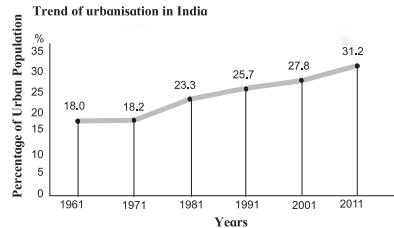
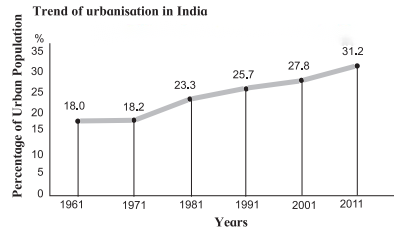
E.g. From 18% in 1961 to 31.2% in 2011.
(iii) Growth of urbanisation in Brazil has been rapid.
E.g. From 47.1% in 1960 to 84.6% in 2010.
(iv) Urbanisation has been more in the southern part than in the Northern part of India.
(v) Urbanisation in Brazil has been more in the coastal states of south and southeast than the states in the interior of the west and north.
(vi) India’s rate of urbanisation has increased continously in a fluctuating rate.
(vii) Brazil’s is rate of urbanisation has increased but in a diminishing rate.
Question b.
Differentiate between the human settlements in the Ganga river basin and the Amazon river basin.
Answer:
S.No | Human settlements in the Ganga river basin | Human settlements in the Amazon river basin |
(i) | Nucleated settlements are found in Ganga river basin. | (i) Dispersed settlements are found in Amazon river basin. |
(ii) | Flat land, availibality of water, fertile soil,favourable climate is suitable for human settlement. | (ii) Unfavourable climate, heavy rainfall, inaccessibility makes the Amazon river basin unsuitable for human settlement. |
(iii) | The above conditions along with a good transport network has helped to flourish agriculture and other industries. | (iii) Due to dense evergreen forests and poor transport facility there are restrictions on the use of natural resources, which have affected economic development. |
Question c.
Why do human settlements grow in specific locations only?
Answer:
Human settlements depend on various factors like climate, availability of water, slope of the land, level of development.
In India, nucleated human settlements are found in the Ganga River Basin because of flat fertile plains, abundance of water, favourable climate and growth of agriculture and industries. Dispersed settlements are found in Himalayan slopes, eastern and southern Rajasthan because of uneven topography, unfavourable climate and lack of development.
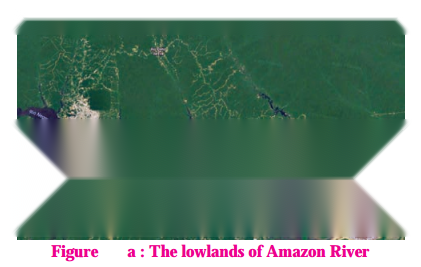
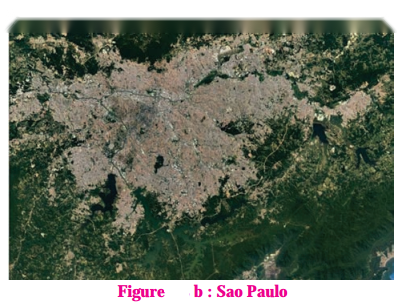
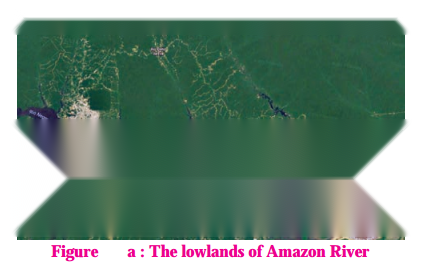
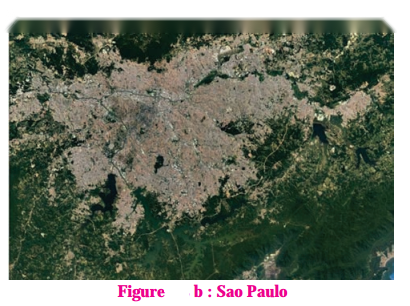
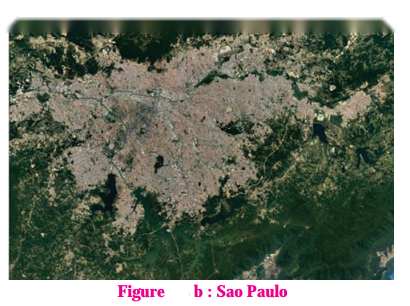
In Brazil, nucleated settlements are found in Sao Paulo and southern coast of Brazil, due to nearness to the ocean, fertile soil, availability of natural minerals like iron ore, steady power supply and good transportation system. Dispersed settlements are found in Northern Brazil due to the inaccessible forests in Amazon river basin, unhealthy climate, limitations on use of natural resources drought region and poor transport connectivity.
Class 10 Geography Chapter 7 Human Settlements Intext Questions and Answers
Geographical Explanation
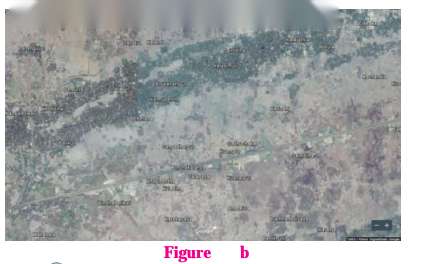
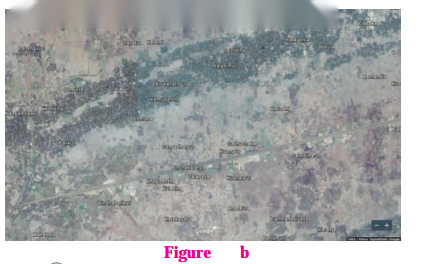
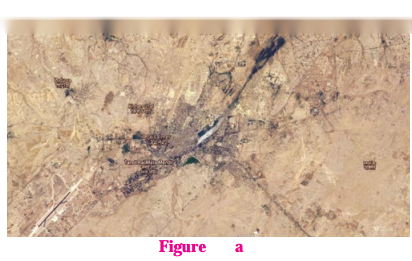
Study the two types of settlement patterns in India given in figure (a) and (b) Answer the following questions :


Think About It

Lets Recall
S.No | Amentity | Available in Villages | Available in Cities |
(1) | Petrol Pump | ✓ | ✓ |
(2) | Theatre | ✓ | |
(3) | Weekly Market | ✓ | |
(4) | Primary Health Centre | ✓ | |
(5) | Police Outpost | ✓ | ✓ |
(6) | Art Gallery | ✓ | |
(7) | Gram Panchayat | ✓ | |
(8) | Agricultural Produce Market Committee (APMC) | ✓ | |
(9) | Primary School | ✓ | ✓ |
(10) | Senior School | ✓ | |
(11) | College | ✓ | |
(12) | Shop | ✓ | ✓ |
(13) | Multi-speciality Hospital | ✓ | |
(14) | Metro station | ✓ | |
(15) | Bus station | ✓ | ✓ |
(16) | University | ✓ |
Try This.
Can You Tell
Read the graph below and answer the following questions:
Question 1.
What was the percentage of urbanisation in 1961?
Answer:
The percentage of urbanisation in 1961 was 18%.
Try This
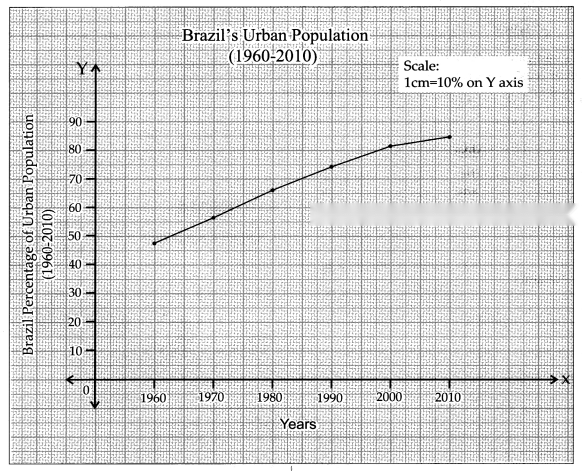
Look at the table. It shows the growth and share of urban population in total population of Brazil. Draw a line graph from this table. Examine the graph carefully and answer the following questions:
Brazil Percentage of urban population (1960 to 2010)
Answer:

Give It a Try
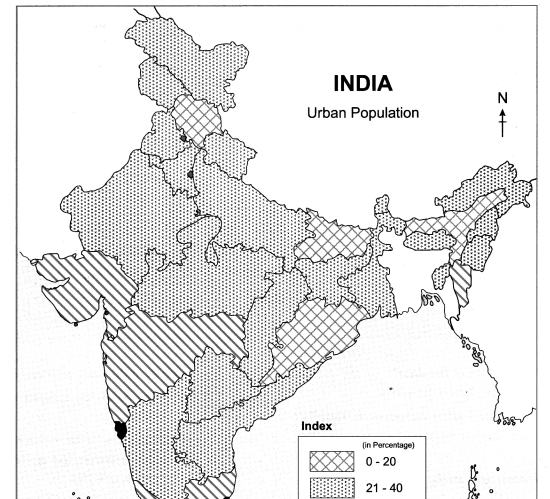
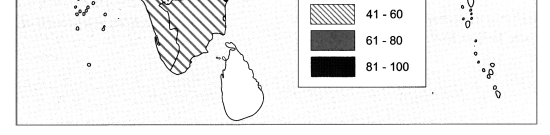
S.No. | Urban population percentage category | States /UTs falling in the category |
(1) | 0-20 | Himachal Pradesh, Bihar, Assam and Odisha |
(2) | 21-40 | Meghalaya, Uttar Pradesh, Arunachal Pradesh, Chhattisgarh, Jharkhand, Rajasthan, Sikkim, Tripura, Jammu and Kashmir, Nagaland, Manipur, Uttarakhand, West Bengal, Andhra Pradesh, Haryana, A and N Islands, Punjab, Karnataka and M. P. |
(3) | 41-60 | Gujarat, Maharashtra, Dadra and Nagar Haveli, Kerala, Tamil Nadu, Mizoram |
(4) | 61-80 | Goa, Puducherry, Daman and Diu, Lakshadweep |
(5) | 81 -100 | Chandigarh, NCT of Delhi |
Colours Of Both
Question 1
Maharashtra Board Solution
Compare the line graph shown in figure and the one drawn by you for Brazil. Write five lines on the changes that have occurred in urbanisation in both the countries, with time.
Solution & Step-by-Step Answer:
(i) After comparing the graphs of India and Brazil, it is clear that urbanisation in Brazil has been much more rapid as compared to India.
(ii) Urbanisation in Brazil grew from 47.1% in 1960¬70 to 84.6% in 2000-2010. Whereas urbanisation in India grew from 18% in 1961-70 to 31.2% in 2001-2011. (iii) But Brazil’s rate of urbanisation is showing signs of decline, whereas India’s rate of urbanisation is showing a slow and consistent growth. (iv) For e.g. the rate of urbanisation in Brazil has decreased from 9.7% in 1960-1970 to 3.1% in 2000¬2010. Whereas the rate of urbanisation in India has increased from 0.2% in 1961-1971 to 3.4% in 2001-2011. (v) Both Brazil and India are developing countries, but Brazil shows very high urbanisation as compared to India.
Question 2
Maharashtra Board Solution
Make a short note on the comparison between the settlement patterns in India and Brazil on the basis of the following points: (i) Location (ii) Pattern (iii) Types (iv) Density
Solution & Step-by-Step Answer:
India settlement pattern
Brazilian settlement pattern
Give It a Try
Question 1
Maharashtra Board Solution
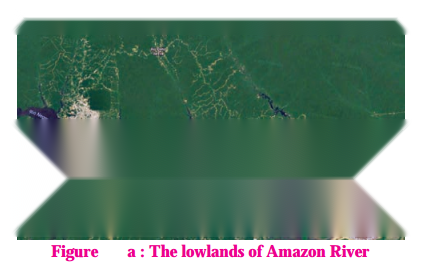
“Observe the two satellite images given below. Describe the settlements with respect to physiography, Considering the physiography, where could these settllements be located? Find out their settlement pattern and limitations with respect to their future growth.
Solution & Step-by-Step Answer:
(i) Location : Both satellite images show human settlements in a mountainous region. One settlement is along mountain slope, while the other is on top of a mountain. (ii) Pattern : Dispersed settlements. (iii) Future growth : Further growth for human settlements seems difficult. This is mainly because of the hilly terrain and forested land along the mountain slope.
Study the choropleth map of Brazil showing the Statewise urban population of Brazil and answer the following questions :
Question 2
Maharashtra Board Solution
Which state (region) in the least urbanised?
Solution & Step-by-Step Answer:
The states of Para, Maranhao and Piaui in northern part of Brazil are the least urbanised states.
Use Your Brain Power
Question 1
Maharashtra Board Solution
Which factors have affected urbanisation in Brazil?
Solution & Step-by-Step Answer:
(i) In Brazil, rapid urbanisation has taken place in South and South East Coastal regions. (ii) Being in proximity to the Atlantic Ocean have benefitted these regions immensely in the form of mild climatic conditions. (iii) Availability of water, fertile soil, natural minerals such as iron ore, good transport system and steady electric supply have positively impacted urbanisation in these parts. (iv) To the north of the Brazilian Highlands is the rain shadow region of ‘Drought Quadrilateral’ with sparse settlements.
Colours Of Both
Question 1
Maharashtra Board Solution
Write a paragraph on the settlement pattern, urban and rural settlement and urbanisation in India and Brazil.
Solution & Step-by-Step Answer:
India settlement pattern
Brazilian settlement pattern
Class 10 Geography Chapter 7 Human Settlements Additional Important Questions and Answers Choose the correct option and rewrite the statements.
Question 1
Maharashtra Board Solution
_______ settlements are found in tribal parts covering central part of India. (a) Nucleated (b) Linear (c) Dispersed (d) Circular
Solution & Step-by-Step Answer:
(c) Dispersed
Question 2
Maharashtra Board Solution
The earlier settlements in Brazil were formed by settlers from _______ mainly in coastal areas. (a) Africa (b) Asia (c) Europe (d) Australia
Solution & Step-by-Step Answer:
(c) Europe
Question 3
Maharashtra Board Solution
Sao paulo has _________ settlements. (a) isolated (b) nucleated (c) scattered (d) dispersed
Solution & Step-by-Step Answer:
(b) nucleated
Question 4
Maharashtra Board Solution
Rural areas of Brazil such as the north east highlands suffer from _____ which make it difficult for practising agriculture. (a) high rainfall (b) extreme cold (c) extreme droughts (d) extreme heat
Solution & Step-by-Step Answer:
(c) extreme droughts
Question 5
Maharashtra Board Solution
Settlements become _____ as we go to the central part of Brazil. (a) sparse (b) dense (c) nucleated (d) triangular
Solution & Step-by-Step Answer:
(a) sparse
Question 6
Maharashtra Board Solution
The growth of urbanisation in India has been ________. (a) quick (b) moderate (c) slow (d) rapid
Solution & Step-by-Step Answer:
(c) slow
Question 7
Maharashtra Board Solution
In India, urbanisation has been more in the _______ part. (a) Western (b) Eastern (c) Northern (d) Southern
Solution & Step-by-Step Answer:
(d) Southern
Question 8
Maharashtra Board Solution
Goa is the most urbanised state in India with _______ urban population. (a) 92% (b) 52% (c) 62% (d) 82%
Solution & Step-by-Step Answer:
(c) 62%
Question 9
Maharashtra Board Solution
_____ is more than 80% urban. (a) Goa (b) Gujarat (c) Delhi (d) Puducherry
Solution & Step-by-Step Answer:
(c) Delhi
Question 10
Maharashtra Board Solution
Today, about ______ of Brazil’s population lives in urban area. (a) 96% (b) 66% (c) 86% (d) 76%
Solution & Step-by-Step Answer:
(c) 86%
Question 11
Maharashtra Board Solution
Looking at the growth in a few parts of the country, the government is promoting “Go _______ ” policy which reduces pressure on other densely populated areas. (a) East (b) North (c) South (d) West
Solution & Step-by-Step Answer:
(d) West
Question 12
Maharashtra Board Solution
Urbanisation has occurred more in the _______ states, in Brazil. (a) inland (b) coastal (c) central (d) north-western (b) coastal |



Question 13
Maharashtra Board Solution
_________ is a port on the confluence of the Negro and the Amazon rivers, where urbanisation has occurred. (a) Alagoas (b) Parana (c) Manaus (d) Ceara (c) Manaus |
Find out the correct group :
Question 1. States of Brazil in having 91% to 100% urban population. (a) Sao Paulo, Goias, Espirito Santo and Tocantins. (b) Espirito Santo, Rio De Janeiro, Para and Goias. (c) Espirito Santo, Goias, Sao Paulo, Rio De Janeiro. (d) Sao Paulo, Amapa, Santa Catarina, and Rondonia.
Solution & Step-by-Step Answer:
block bg-white dark:bg-slate-900/80 border-l-4 border-emerald-500 rounded-r-xl p-5 my-3 shadow-xs border border-slate-200/60 dark:border-slate-800">
Solution & Step-by-Step Answer:
(c) Espirito Santo, Goias, Sao Paulo and Rio De Janeiro.
Question 2
Maharashtra Board Solution
States of India having less than 20% of Urbanization. (a) Meghalaya, Uttar Pradesh, Arunachal Pradesh and Rajasthan.. (b) Lakshadweep, Daman and Diu, Puducherry and Nagaland. (c) Tamil Nadu, Mizoram, Gujarat and Maharashtra. (d) Odisha, Assam, Bihar and Himachal Pradesh.
Solution & Step-by-Step Answer:
(d) Odisha, Assam, Bihar, Himachal Pradesh.
Question 3
Maharashtra Board Solution
Nucleated settlements in India. (a) Vindhyan plateau, Plateau region of Narmada valley, Paddy lands in Bihar and Uttar Pradesh. (b) Rajasthan, Sikkim, Arunachal Pradesh, and Punjab. (c) Himalayan slopes, East Rajasthan, Tribal part of Madhya Pradesh and Nagaland. (d) Vindhyan plateau, Paddy lands in Uttar Pradesh, Land with dissected topography and Bihar.
Solution & Step-by-Step Answer:
(a) Vindhyan plateau, Plateau region of Narmada valley, Paddy lands in Bihar and Uttar Pradesh.
Question 4
Maharashtra Board Solution
Dispersed settlements in India. (a) West coast, West Rajasthan, Paddy lands of Punjab and Mizoram. (b) Land with dissected topography, South Rajasthan, Vindhya plateau and Uttar Pradesh. (c) Tribal part of Madhya Pradesh, Himalayan slopes, West and South Rajasthan and Land with the uneven topography. (d) Himalayan slopes, Narmada Valley, West Rajasthan and South India.
Solution & Step-by-Step Answer:
(c) Tribal part of Madhya Pradesh, Himalayan slopes, West and South Rajasthan and Land with the uneven topography.
Question 5
Maharashtra Board Solution
States of India having urbanization between 41% to 60%. (a) Chandigarh, Daman and Diu, Gujarat and Uttar Pradesh. (b) Maharashtra, Kerala, Gujarat and Mizoram. (c) Jharkhand, Karnataka, Maharashtra and Goa. (d) Andhra Pradesh, West Bengal and Uttarakhand, Assam.
Solution & Step-by-Step Answer:
(b) Maharashtra, Kerala, Gujarat, Mizoram.
Question 1
Maharashtra Board Solution
Match the columns:
|
Column ‘A’ | Column ‘B’ | ||
(1) | Most urbanised state in India | (a) | Sao Paulo |
(2) | Most urbanised state in Brazil | (b) | Goa |
(3) | Least urbanised state in India | (c) | Mato Grosso |
(4) | Least urbanised | (d) | Himachal Pradesh |
state in Brazil | (e) | Delhi | |
(f) | Para |
1 – b
2 – a
3 – d
4 – f
Are the sentences right or wrong?
Question 1
Maharashtra Board Solution
India does not have a great tradition of urbanisation.
Solution & Step-by-Step Answer:
Wrong.
Question 2
Maharashtra Board Solution
The earlier settlements in Brazil were formed by the settlers from America.
Solution & Step-by-Step Answer:
Wrong.
Question 3
Maharashtra Board Solution
North-East Highlands of Brazil suffer from extreme drought.
Solution & Step-by-Step Answer:
Right.
Question 4
Maharashtra Board Solution
The growth of urbanisation in India has been very fast, reaching 86% in 2011.
Solution & Step-by-Step Answer:
Wrong.
Question 5
Maharashtra Board Solution
In underdeveloped countries, the rate of urbanisation is low.
Solution & Step-by-Step Answer:
Right.
Give geographical reasons:
Question 1
Maharashtra Board Solution
Sao Paulo area has nucleated settlements.
Solution & Step-by-Step Answer:
(i) Sao Paulo is situated in South East coast of Brazil. (ii) The region has a good water supply. (iii) It an extensive area under rich fertile soil which is ideal for growing coffee. (iv) It has a large supply of natural minerals, such as iron ore. (v) It also has a steady energy supply. (vi) This region has a good transport system too. So, Sao Paulo area has nucleated settlements.
Question 2
Maharashtra Board Solution
The Brazilian government is promoting ‘Go West’ policy.
Solution & Step-by-Step Answer:
(i) Brazil is one of the few developing countries which is highly urbanised. (ii) But urbanisation in Brazil is confined to South and South East. (iii) For e.g. States like Sao Paulo, Goias, Minas Gerais, Rio De Janeiro have very high urban population. (iv) Western Brazil continues to remain least urbanised, which is creating regional imbalance. (v) In order to reduce regional imbalance, the Brazil Government is promoting ‘Go-West Policy’.
|