Problem Set 3 Algebra 10th Std Maths Part 1 Answers Chapter 3 Arithmetic Progression
i. The sequence – 10,- 6,- 2, 2, …
(A) is an A.P. Reason d = – 16
(B) is an A.P. Reason d = 4
(C) is an A.P. Reason d = – 4
(D) is not an A.P.
(B)
ii. First four terms of an A.P. are …, whose first term is -2 and common difference is -2.
(A) -2, 0, 2, 4
(B) -2, 4,- 8, 16
(C) -2, -4, -6, -8
(D) -2,-4, -8, -16
Answer:
(C)
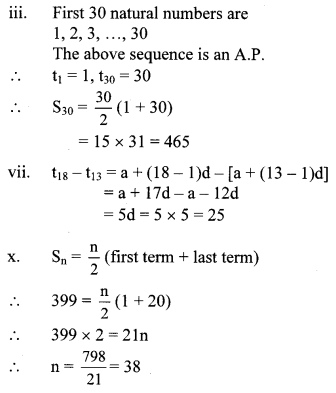
iii. What is the sum of the first 30 natural numbers?
(A) 464
(B) 465
(C) 462
(D) 461
Answer:
(B)
iv. For an given A.P. t7= 4, d = – 4, then a = ………
(A) 6
(B) 7
(C) 20
(D) 28
Answer:
(D)
v. For an given A.P. a = 3.5, d = 0, n = 101, then tn= ….
(A) 0
(B) 3.5
(c) 103.5
(D) 104.5
Answer:
(B)
vi. In an A.P. first two terms are – 3, 4, then 21st term is ….
(A) -143
(B) 143
(C) 137
(D) 17
Answer:
(C)
vii. If for any A.P. d = 5, then t18– t13= ….
(A) 5
(B) 20
(C) 25
(D) 30
Answer:
(C)
viii. Sum of first five multiples of 3 is …
(A) 45
(B) 55
(C) 15
(D) 75
Answer:
(A)
ix. 15, 10, 5, … In this A.P. sum of first 10 terms is…
(A) -75
(B) -125
(C) 75
(D) 125
Answer:
(A)
x. In an A.P. 1stterm is 1 and the last term is 20. The sum of all terms is 399, then n = ….
(A) 42
(B) 38
(C) 21
(D) 19
Answer:
(B)
Hints:
Question 2
Maharashtra Board Solution
Find the fourth term from the end in an A.P.: -11, -8, -5, …, 49.
Solution & Step-by-Step Answer:
The given A.P. is -11,-8,-5, ……. 49 Reversing the A.P., we get 49, …, -5, -8, -11 Here, a = 49, d = -11 -(-8) = -11 + 8 = -3 Since, tn = a + (n – 1)d ∴ t4 = 49 + (4 – 1)(-3) = 49 + (3) (-3) = 49 – 9 = 40 ∴ Fourth term from the end in the given A.P. is 40. [Note: If an AY. is reversed, then the resulting sequence is also an A.P.]
Question 3
Maharashtra Board Solution
In an A.P. the 10th term is 46, sum of the 5th and 7th term is 52. Find the A.P.
Solution & Step-by-Step Answer:
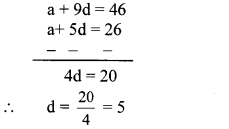
For an A.P., let a be the first term and d be the common difference. t10 = 46, t5 + t7 = 52 …[Given] Since, tn = a + (n – 1)d ∴ t10 = a + (10 – 1)d ∴ 46 = a + 9d i. e. a + 9d = 46 …(i) Also, t5 + t7 = 52 ∴ a + (5 – 1)d + a + (7 – 1)d = 52 ∴ a + 4d + a + 6d = 52 ∴ 2a + 10d = 52 ∴ 2 (a + 5d) = 52 ∴ a + 5d = ∴ a + 5d = 26 …(ii) Subtracting equation (ii) from (i), we get Substituting d = 5 in equation (ii), we get a + 5(5) = 26 ∴ a + 25 = 26 ∴ a = 26 – 25 = 1 t1 = a = 1 t2 = t1 + d = 1 + 5 = 6 t3 = t2 + d = 6 + 5 = 11 t4 = t3 + d = 11 + 5 = 16 The required A.P. is 1,6,11,16,….
Question 4
Maharashtra Board Solution
The A.P. in which 4th term is -15 and 9th term is -30. Find the sum of the first 10 numbers.
Solution & Step-by-Step Answer:
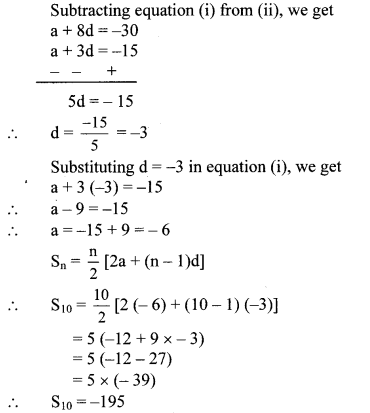
t4 = -15, t9 = – 30 …[Given] Since, tn = a + (n – 1)d ∴ t4 = a + (4 – 1)d ∴ – 15 = a + 3d i. e. a + 3d = -15 …(i) Also, t9 = a + (9 – 1)d ∴ -30 = a + 8d i.e. a + 8d = -30 …(ii) ∴ The sum of the first 10 numbers is -195.
Question 5
Maharashtra Board Solution
Two given A.P.’s are 9, 7, 5, … and 24, 21, 18, … If nth term of both the.progressions are equal then find the value of n and n,h term.
Solution & Step-by-Step Answer:
The first A.P. is 9, 7, 5,… Here, a = 9, d = 7- 9 = -2 ∴nth term = a + (n – 1)d = 9 + (n – 1) (-2) = 9 – 2n + 2 = 11 – 2n The second A.P. is 24, 21, 18, … Here, a = 24, d = 21 – 24 = – 3 ∴ nth term = a + (n – 1)d = 24 + (n – 1) (-3) = 24 – 3n + 3 = 27 – 3n Since, the nth terms of the two A.P.’s are equal. ∴ 11 – 2n = 27 – 3n ∴ 3n – 2n = 27 – 11 ∴ n = 16 ∴ t16 = 9 + (16 – 1) (-2) = 9 + 15 × (-2) = 9 – 30 ∴ t16 = -21 ∴ The values of n and nth term are 16 and -21 respectively.
Question 6
Maharashtra Board Solution
If sum of 3rd and 8th terms of an A.P. is 7 and sum of 7th and 14th terms is -3, then find the 10th term.
Solution & Step-by-Step Answer:
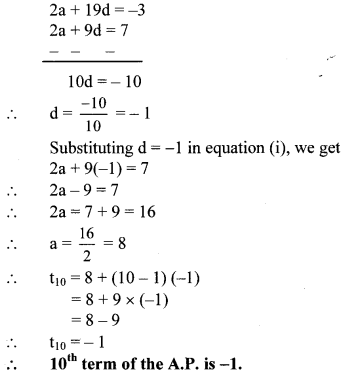
for an A.P., let a be the first term and d be the common difference. According to the first condition, t3 + tg = 7 ∴ a + (3 – 1) d + a + (8 – 1)d = 7 …[∵ tn = a + (n – 1)d] ∴ a + 2d + a + 7d = 7 ∴ 2a + 9d = 7 …(i) According to the second condition, t7 + t14 = -3 ∴ a + (7 – 1)d + a + (14 – 1 )d = -3 ∴ a + 6d + a + 13d = -3 ∴ 2a + 19 d = – 3 …(ii) Subtracting equation (i) from (ii), we get
Question 7
Maharashtra Board Solution
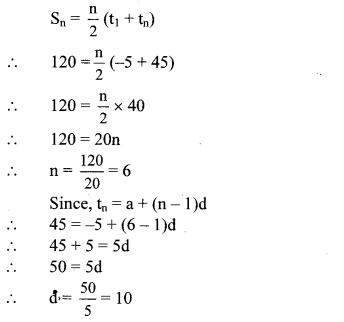
In an A.P. the first term is -5 and last term is 45. If sum of all numbers in the A.P. is 120, then how many terms are there? What is the common difference?
Solution & Step-by-Step Answer:
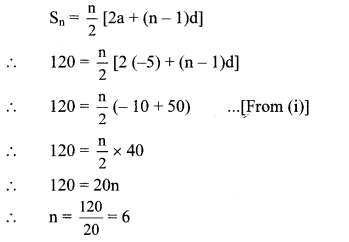
Let the number of terms in the A.P. be n and the common difference be d. Then, a = -5, tn = 45, Sn = 120 Since, tn = a + (n – 1)d ∴ 45 = -5 + (n – 1)d ∴ 45 + 5 = (n – 1)d ∴ (n – 1)d = 50 …(i) Substituting n = 6 in equation (i), we get (6 – 1)d = 50 ∴ 5d = 50 ∴ d = = 10 ∴ There are 6 terms in the A.P. and the common difference is 10.
Alternate Method:
Question 8
Maharashtra Board Solution
Sum of 1 to n natural numbers is 36, then find the value of n.
Solution & Step-by-Step Answer:
The natural numbers from 1 to n are 1,2, 3, ……, n. The above sequence is an A.P. ∴ a = 1, d = 2 – 1 = 1 Sn = 36 …[Given] Now, Sn = [2a + (n – 1)d] ∴ 36 = [2(1) + (n – 1)(1)] ∴ 36 = (2 + n – 1) ∴ 36 × 2 = n (n + 1) ∴ 72 = n (n + 1) ∴ 72 = n2 + n ∴ n2 + n – 72 = 0 ∴ n2 + 9n – 8n – 72 = 0 ∴ n(n + 9) – 8 (n + 9) = 0 ∴ (n + 9) (n – 8) = 0 ∴ n + 9 = 0 or n – 8 = 0 ∴ n = -9 or n = 8 But, n cannot be negative. ∴ n = 8 ∴ The value of n is 8.
Question 9
Maharashtra Board Solution
Divide 207 in three parts, such that all parts are in A.P. and product of two smaller parts will be 4623.
Solution & Step-by-Step Answer:
Let the three parts of 207 that are in A.P. be a – d, a, a + d According to the first condition, (a – d) + a + (a + d) = 207 ∴ 3a = 207 ∴ a = ∴ a = 69 …(i) According to the second condition, (a – d) × a = 4623 ∴ (69 – d) × 69 = 4623 …[From (i)] ∴ 69 – d = ∴ d = 69 – 67 ∴ d = 2 ∴ a – d = 69 – 2 = 67 a = 69 a + d = 69 + 2 = 71 ∴ The three parts of 207 that are in A.P. are 67, 69 and 71.
Question 10
Maharashtra Board Solution
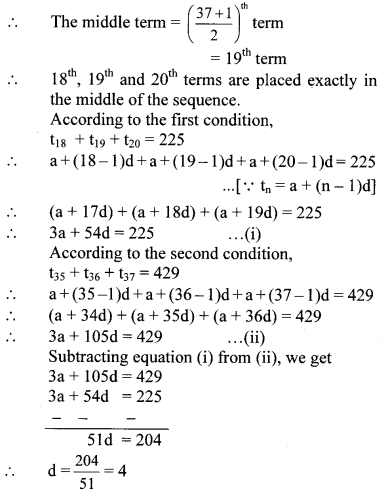
There are 37 terms in an A.P., the sum of three terms placed exactly at the middle is 225 and the sum of last three terms is 429. Write the A.P.
Solution & Step-by-Step Answer:
Since, there are 37 terms in the A.P. Substituting d = 4 in equation (i), we get 3a + 54(4) = 225 ∴ 3a + 216 = 225 ∴ 3a = 225 – 216 ∴ 3a = 9 ∴ a = = 3 ∴The required A. P. is a, a + d, a + 2d, a + 3d, …., a + (n – 1)d i.e. 3, 3 + 4,3 + 2 × 4, 3 + 3 × 4,…, 3 + (37 – 1)4 i.e. 3, 7,11,15, …,147
Question 11
Maharashtra Board Solution
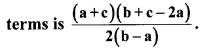
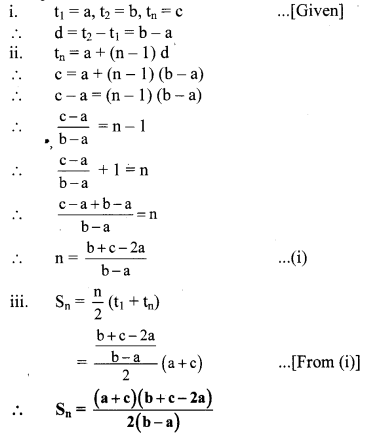
If first term of an A.P. is a, second term is b and last term is c, then show that sum of all
Solution & Step-by-Step Answer:
Question 12
Maharashtra Board Solution
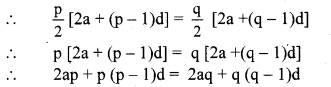
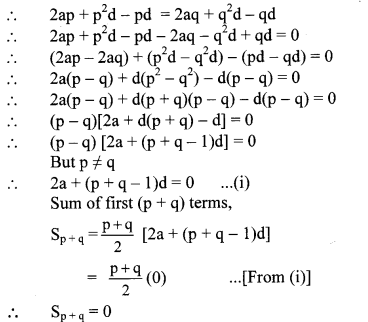
If the sum of first p terms of an A.P. is equal to the sum of first q terms then show that the sum of its first (p + q) terms is zero, (p ≠ q)
Solution & Step-by-Step Answer:
For an A.P., let a be the first term and d be the common difference. The sum of first n terms of an A.P. is given by Sn = [2a + (n – 1)d] According to the given condition, Sp = Sq ∴ The sum of the first (p + q) terms is zero
Question 13
Maharashtra Board Solution
If m times the mth term of an A.P. is equal to n times nth term, then show that the (m + n)th term of the A.P. is zero.
Solution & Step-by-Step Answer:
According to the given condition, mtm = ntn ∴ m[a + (m – 1)d] = n[a + (n – 1)d] ∴ ma + md(m – 1) = na + nd(n- 1) ∴ ma + m2d – md = na + n2d – nd ∴ ma + m2d – md – na – n2d + nd = 0 ∴ (ma – na) + (m2d – n2d) – (md – nd) = 0 ∴ a(m – n) + d(m2 – n2) – d(m – n) = 0 ∴ a(m – n) + d(m + n) (m – n) – d(m – n) = 0 ∴ (m – n)[a + (m + n – 1) d] = 0 ∴ [a+ (m + n – 1)d] = 0 …[Dividing both sides by (m – n)] ∴ t(m+n) = 0 ∴ The (m + n)th term of the A.P. is zero.
Question 14
Maharashtra Board Solution
₹ 1000 is invested at 10 percent simple interest. Check at the end of every year if the total interest amount is in A.P. If this is an A.P. then find interest amount after 20 years. For this complete the following activity.
Solution & Step-by-Step Answer:
|