Maharashtra State Board Class 10 Science Solutions Part 1 Chapter 3 Chemical Reactions and Equations
a. To prevent rusting, a laver of ……… metal is applied on iron sheets.
To prevent rusting, a layer of zinc metal is applied on iron sheets.
The rusting of iron is an oxidation process. Due to corrosion of an iron a deposit of reddish substance (Fe2O3.H2O) is formed on it. This substance is called rust. To prevent corrosion, a layer of zinc metal (galvanisation) is applied on iron sheets.
b. The conversion or ferrous sulphate to ferric sulphate is …….. reaction.
Answer:
The conversion of ferrous sulphate to ferric sulphate is an oxidation reaction.
When ferric ion is formed. from ferrous ion, the positive charge is increased by one unit. while this happens the rerrous ion loses one electron. A process in which a metal or its ion loses one or more electrons is called an oxidation.
2FeSO4→ Fe2(SO4)3
Fe2+ SO42-→ 2Fe3++ SO42-

c. When electric current is passed through acidulated water …….. of water takes place.
Answer:
when electric current is passed through acidulated water decomposition of water takes place. In this reaction. hydrogen and oxygen gas are formed.
This decomposition takes place with the help of an electric current, it is also called electrolytic decomposition.

d. Addition of an aqueous solution of ZnSO4to an aqueous solution of BaCl2is an example of ……… reaction.
Answer:
Addition of an aqueous solution of ZnSO4to an aqueous solution or BaCl2is an example or double displacement reaction.
Barium chloride reacts with zinc sulphate to form a white precipitate of barium sulphate. white precipitate is formed by exchange of ions Ba++and SO4—between the reactants.

Question 2
Maharashtra Board Solution
a. What is the reaction called when oxidation and reduction take place simultaneously? Explain with one example.
Solution & Step-by-Step Answer:
The reaction which involves simultaneous oxidation and reduction is called an oxidation-reduction or redox reaction. In a redox reaction, one reactant gets oxidised while the other gets reduced during a reaction. Redox reaction = Reduction + Oxidation
In redox reaction, the reductant is oxidized by the oxidant and the oxidant is reduced by the Other examples of redox reactions:
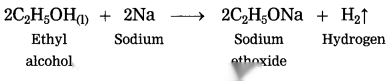
b. How can the rate of the chemical reaction, namely, decomposition of hydrogen peroxide be increased? c. Explain the term reactant product giving examples. d. Explain the types of reactions with reference to oxygen and hydrogen. Illustrate with examples. 1. Oxidation reaction: (2) When sodium reacts with ethyl alcohol, sodium ethoxide and hydrogen gas is formed. In this reaction, hydrogen is removed from ethyl alcohol, therefore this is an oxidation reaction.
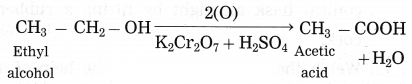
(3) Acidified potassium dichromate (K2Cr2O7/ H2SO4) oxidises ethly alcohol to acetic acid.
2. Reduction reaction:
(2) when hydrogen gas is passed over red hot coke, methane is obtained.
e. Explain the similarity and difference in two events, namely adding NaOH to water and adding CaO to water.
Question 3
Maharashtra Board Solution
Explain the following terms with examples. a. Endothermic reaction
Solution & Step-by-Step Answer:
Endothermic reaction: The reaction in which heat is absorbed is called an endothermic reaction. when KNO3(s) dissolves in water, there is absorption of heat during the reaction and the temperature of the solution falls. KNO2(s) + H2O(l) + Heat → KNO3(aq)
b. Combination reaction
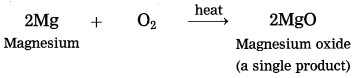
2. Magnesium burns in air to form white powder of magnesium oxide as a single product.
3. Iron reacts with sulphur to form iron sulphide.
c. Balanced equation d. Displacement reaction When zinc granules are added to the blue coloured copper sulphate solution, the zinc ions formed from zinc atoms take the place of Cu2+ions in CuSO4, and copper atoms, formed from Cu2+ions comes out i.e. the more reactive zinc displaces the less reactive Cu from copper sulphate.
4. Give scientific reason:
b. It takes time for pieces of Shahabud tile to disappear in HCl, but its powder disappears rapidly. In the reaction of dil. HCl with pieces of Shahabad tile, CO2effervescence is formed amid the tile disappears slowly. On the other hand. CO2effervescence forms at faster rate with Shahabad tile powder and it disappears rapidly. c. While preparing dilute sulphuric acid from concentrated sulphuric acid in the laboratory, the concentrated sulphuric acid is added slowly to water with constant stirring. (2) During the preparation of dilute sulphuric acid. large amount of water is taken in a glass container which is surrounded by ice. Cool it for twenty minutes, Now small quantity of conc. H2SO4is added slowly with stirring. Therefore, only a small amount of heat is liberated at a time. In this way dilute sulphuric acid is prepared. (3) On the other hand, in the process of dilution or conc. sulphuric acid with water, very large amount of heat is liberated. As a result, water gets evaported instantaneously, if it is poured in to conc. H2SO4which may cause an accident. d. It is recommended to use air tight container for storing oil for long time.
Question 5
Maharashtra Board Solution
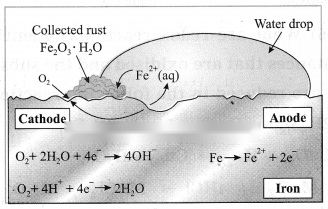
Observe the following picture a write down the chemical reaction with explanation.
Solution & Step-by-Step Answer:
The rusting of iron is an oxidation process. The rust on iron does not form by a simple reaction between oxygen and iron surface. The rust is formed by an electrochemical reaction. Fe oxidises to Fe2O3. H2O on one part of iron surface while oxygen gets reduced to H2O on another part or surface, Different regions on the surface of iron become anode and cathode. (1) Fe is oxidised to Fe2+ in the anode region. Fe(s) → Fe2+ (aq) + 2e– (2) O2 is reduced to form water in the cathode region. O2(g) + 4H+ (aq) + 4e— → 2H2O(l)
When Fe2+ions migrate from the anode region they react with water and futher get oxidised to form Fe3+ions.
Question 6
Maharashtra Board Solution
Identify from the following reactions the reactants that undergo oxidation and reduction. a. Fe + S → FeS
Solution & Step-by-Step Answer:
Fe + S → FeS In this reaction, Iron (Fe) undergoes oxidation and sulphur. (S) undergoes reduction.
b. 2Ag2O → 4Ag + O2↑ c. 2Mg + O2→ 2MgO d. NiO + H2→ Ni + H2O
Question 7
Maharashtra Board Solution
Balance the following equation stepwise. a. H2S2O7(l) + H2O(l) → H2SO4(l)
Solution & Step-by-Step Answer:
Step 1: Rewrite the given equation as it is H2S2O7(l) + H2O(l) → H2SO4(l) Step 2: write the number or atoms of each element in the unbalanced equation on both sides of equations.
Step 3: To equalise the number of hydrogen atoms, sulphur atoms and oxygen atoms we use 2 as the coemficient or factor in the product.
Now the equation becomes H2S2O7+ H2O → 2H2SO4 b. SO2(g)+ H2S(aq)→ S(s)+ H2O(l) Step 2:
The number of hydrogen atoms on both sides of the equation is same, therefore, equalise the number of sulphur atoms and oxygen atoms. Step 3: To balance the number of sulphur atoms:
To equalise the number of sulphur atoms, we use 2 as the factor in the product, now the equation becomes Step 4:
To equalise the number of sulphur atoms, we use 2 as the factor in the product i.e. H2O, now the unbalanced equation becomes Step 5:
To equalise the number of hydrogen atoms we use 2 as the factor in the reactant i.e, H2S, now the unbalanced equation become c. Ag(s)+ HCl(l)→ AgCl ↓ + H2↑ Step 2:
The number of silver and chlorine atoms on both sides of the equation are same, therefore, equalise the number of hydrogen atoms. Step 3:
To equalise the number of hydrogen atoms, we use 2 as the factor in the product HCl, now the unbalanced equation become Step 4:
To equalise the number of chlorine atoms, we use 2 as the factor in the product AgCl. now the unbalanced equation becomes d. H2SO4(aq)+ NaOH(aq)→ Na2SO4(aq)+ H2O(l) Step 2:
The number of oxygen atoms involved in different compounds on both sides (reactants and products) are equal. Therefore, balance the number of atoms of the second element, sodium. Step 3:
To equalise the number of sodium atoms, we use 2 as the factor of NaOH in the reactants. Now, the partly balanced equation becomes as follows Step 4:
To equalise the number of hydrogen atoms, we use 2 as the factor or H2O in the products. The equation then becomes
Question 8
Maharashtra Board Solution
Identify the endothermic and exothermic reaction. a. HCl + NaOH → NaCl + H2O + heat
Solution & Step-by-Step Answer:
Exothermic reaction.
b. c. CaO + H2O → Ca(OH)2+ heat d.
Question 9
Maharashtra Board Solution
Match the column in the following table: |







Reactants | products | Type of chemical reaction |
BaCl2(aq)+ ZnSO4(aq) | H2CO3(aq) | Displacement |
2 AgCl(s) | FeSO4(aq)+ Cu(s) | Combination |
CuSO4(aq)+ Fe(s) | BaSO4↓ + ZnCl2(aq) | Decomposition |
H2O(l)+ CO2(g) | 2Ag(s)+ Cl2(g) | Double displacement |
Reactants | products | Type of chemical reaction | |||||||||||||||||||||||||||||||||||||||||||||
BaCl2(aq)+ ZnSO4(aq) | BaSO4↓ + ZnCl2(aq) | Double displacement | |||||||||||||||||||||||||||||||||||||||||||||
2 AgCl(s) | 2Ag(s)+ Cl2(g) | Decomposition | |||||||||||||||||||||||||||||||||||||||||||||
CuSO4(aq)+ Fe(s) | FeSO4(aq)+ Cu(s) | Displacement | |||||||||||||||||||||||||||||||||||||||||||||
H2O(l)+ CO2(g) | H2CO3(aq) | Combination Project: 2. Observe and note the physical and chemical changes experienced in various incidents in your day to day 1ife. Can you recall? (Text Book Page No.16)
Question 1
Maharashtra Board Solution
what are the types of molecules of elements and compounds?
Solution & Step-by-Step Answer:
Elements are divided into three classes i.e. metals, nonmetals and metalloids. When two or more elements combine chemically in a fixed proportion by weight, a compound is formed. The properties of a compound are altogether different from those of the constitutional elements.
Question 2
Maharashtra Board Solution
what is meant by valency of element?
Solution & Step-by-Step Answer:
The number of electrons that an atom of an element gives away or takes up while forming an ionic bond, is called the valency or that element.
Question 3
Maharashtra Board Solution
What is the requirement for writing molecular formulae of different compounds? How are the molecular formulae of the compounds written?
Solution & Step-by-Step Answer:
while writing the molecular formulae of different compounds, the symbol of the radicals and their valence should be known. The number of the ions is written as subscript on the right of the symbol or the ion. By cross multiplication of valenceies chemical formula is obtained.
Find out (Text Book Page No. 44) Use your brain power! (Text Book Page No. 35)
Question 1
Maharashtra Board Solution
write down the physical states of reactants and products in the reaction SO2 + 2H2S → 3S + 2H2O
Solution & Step-by-Step Answer:
Reactants : SO2(g), 2H2S(g) Products : 3S(s), 2H2O(l).
Question 2
Maharashtra Board Solution
write down the physical states of reactants and products in the reaction 2Ag + 2HCl → 2AgCl + H2
Solution & Step-by-Step Answer:
Reactants: 2Ag(s), 2HCl(l) Products: 2AgCl ↓, H2 ↑
Question 3
Maharashtra Board Solution
Identify the reactants and products of the following equation.
Solution & Step-by-Step Answer:
Reactants: vegetable oil, H2(g) Product: Vanaspathi ghee
Use your brain power! (Text Book Page No. 42)
Question 1
Maharashtra Board Solution
Which is the oxidant used for purification of drinking water?
Solution & Step-by-Step Answer:
The chlorine based oxidants are used in the purification of drinking water.
Question 2
Maharashtra Board Solution
Why is potassium permanganate used during cleaning water tanks?
Solution & Step-by-Step Answer:
Potassium permanganate is an oxidising agent. It oxidises dissolved iron, manganese and hydrogen sulphide into solid particles that are filtered out of the water tank. It is used to control iron bacteria growth in tank.
Can you tell? (Text Book Page No. 43)
Question 1
Maharashtra Board Solution
what is the type of this reaction, in which Vanaspathi ghee is formed from vegetable oil?
Solution & Step-by-Step Answer:
In the preparation of vanaspathi ghee from vegetable oil hydrogen gas is used. This process is known as hydrogenation. This is reduction reaction.
Find out (Text Book page No. 33) What are the other uses of silver nitrate in every day life? Use your brain power! (Text Book Page No. 35)
Question 1
Maharashtra Board Solution
N2(g) + H2(g) ⇌ NH3(g)
Solution & Step-by-Step Answer:
Step 1: Rewrite the given equation as it is N2(g) + H2(g) ⇌ NH3(g)
Step 2:
Step 3:
To equalise the number of hydrogen atoms, we use 3 as the factor in the reactant and 2 as the factor in the products. Now the equation becomes
Question 2
Maharashtra Board Solution
Calcium chloride + Sulphuric acid → Calcium sulphate + Hydrogen chloride.
Solution & Step-by-Step Answer:
Step 1: Write the chemical equation from the given word equation. CaCl2 + H2SO4 → CaSO4 + HCl
Step 2:
Step 3:
To equalise the number of hydrogen atoms we use 2 as the factor in the product so that the number of H atoms on both sides are equal. Therefore, the equation becomes Can you tell? (Text Book Page No. 39) Take into account the time required for following processes. Classify them into two groups and give titles to the groups. Use your brain power! (Text Book Page No. 43)
Question 1
Maharashtra Board Solution
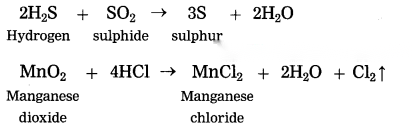
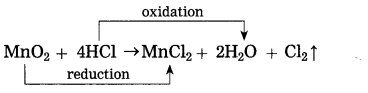
Some more examples of redox reaction are as follows. Identify the reductants and oxidants from them. (1) 2H2S + SO2 → 3S↓ + 2H2O (2) MnO2 + 4HCl → MnCl2 + 2H2O + Cl2↑
Solution & Step-by-Step Answer:
Oxidants: SO2, MnO2 Reductants: H2S, HCl
Question 2
Maharashtra Board Solution
If oxidation means losing electrons, what is meant by reduction.
Solution & Step-by-Step Answer:
Reduction means gaining one or more electrons.
Question 3
Maharashtra Board Solution
Write the reaction of formation of Fe2+ by reduction Fe3+ by making use of the symbol (e–).
Solution & Step-by-Step Answer:
Fe3+ + e– → Fe2+ (reduction)
Think about it (Text Book Page No. 43)
Question 1
Maharashtra Board Solution
The luster of the surface of the aluminium utensils in the house is lost after a few days. Why does this happen?
Solution & Step-by-Step Answer:
The aluminium utensils when kept in the house for a few days, oxidation of aluminium takes place, a thin laver aluminium oxide (Al2O3) is deposited on the surface. Hence, aluminium utensils lose their lustre in a few days.
Question 3
Maharashtra Board Solution
How many products are formed in each of the above reactions?
Solution & Step-by-Step Answer:
A single product is formed in each of the above reaction.
Use your brain power! (Text Book Page No. 39)
Question 1
Maharashtra Board Solution
What is the difference in the process of dissolution and a chemical reaction.
Solution & Step-by-Step Answer:
In the process of dissolution, new substance is not necessarily formed. Whereas in a chemical reaction a new substance is definitely formed.
Question 2
Maharashtra Board Solution
Does a new substance form when a solute dissolves in a solvent?
Solution & Step-by-Step Answer:
It is not necessary that a new substance is always formed.
Fill in the blanks:
Question 1
Maharashtra Board Solution
Organic waste is decomposed by micro-organism and as a result manure and……..are formed.
Solution & Step-by-Step Answer:
Organic waste is decomposed by micro-organism and as a result manure and bio gas are formed.
Question 2
Maharashtra Board Solution
……….is formed on mixing yeast in glucose solution under proper condition.
Solution & Step-by-Step Answer:
Alcohol is formed on mixing yeast in glucose solution under proper condition.
Question 3
Maharashtra Board Solution
The chemical reaction during which H2(g) is lost is termed as………
Solution & Step-by-Step Answer:
The chemical reaction during which H2(g) s lost is termed as oxidation.
Question 4
Maharashtra Board Solution
Corrosion can be prevented by using………
Solution & Step-by-Step Answer:
Corrosion can be prevented by using antirust solution.
Question 5
Maharashtra Board Solution
The chemical reactions in which heat is liberated are called………..reactions.
Solution & Step-by-Step Answer:
The chemical reactions in which heat is liberated are called exothermic reactions.
Question 6
Maharashtra Board Solution
The chemical formula of rust is………
Solution & Step-by-Step Answer:
The chemical formula of rust is Fe2O3.H2O.
Question 7
Maharashtra Board Solution
A reaction in which heat is absorbed is called………reaction.
Solution & Step-by-Step Answer:
A reaction in which heat is absorbed is called endothermic reaction.
Question 8
Maharashtra Board Solution
The process of rusting or iron is………process.
Solution & Step-by-Step Answer:
The process of rusting of iron is oxidation process.
Question 9
Maharashtra Board Solution
when oil and fats are oxidised or even allowed to stand in air for a long time, they become ……….
Solution & Step-by-Step Answer:
when oil and fats are oxidised or even allowed to stand in air for a long time, they become rancid.
Question 10
Maharashtra Board Solution
……… are used to prevent oxidation of food.
Solution & Step-by-Step Answer:
Antioxidants are used to prevent oxidation of food.
Question 11
Maharashtra Board Solution
Carbon dioxide is passed through water. The reaction is a………reaction.
Solution & Step-by-Step Answer:
Carbon dioxide is passed through water. The reaction is a combination reaction.
Question 12
Maharashtra Board Solution
Calcium carbonate is heated. The reaction is a………..reaction.
Solution & Step-by-Step Answer:
Calcium carbonate is heated. The reaction is a decomposition reaction.
Question 13
Maharashtra Board Solution
Zinc strip is dipped in a CuSO4
Solution & Step-by-Step Answer:
The reaction is a……….reaction. Answer: Zinc strip is dipped in a CuSO4 solution. The reaction is a displacement reaction.
Question 14
Maharashtra Board Solution
Silver nitrate solution is added to NaCl
Solution & Step-by-Step Answer:
The reaction is a……….reaction. Answer: Silver nitrate solution is added to NaCl solution. The reaction is a double displacement reaction.
Question 15
Maharashtra Board Solution
The slow process of decay or destruction of a metal due to effect of air, moisture and acids on it is known as……….
Solution & Step-by-Step Answer:
The slow process of decay or destruction of a metal due to effect of air, moisture and acids on it is known as corrosion.
Rewrite the following statements by selecting the correct options:
Question 1
Maharashtra Board Solution
The reaction of iron nail with copper sulphate solution is………reaction. (March 2019) (a) double displacement (b) displacement (c) combination (d) decomposition
Solution & Step-by-Step Answer:
(b) displacement
Question 2
Maharashtra Board Solution
Reddish brown deposit formed on iron nails kept in a solution of copper sulphate is (a) Cu2O (b) Cu (c) CuO (d) CuS
Solution & Step-by-Step Answer:
(b) Cu
Question 3
Maharashtra Board Solution
The reaction CuSO4(aq) + Zn(s) → ZnSO4(aq) + Cu(s) is a……..reaction. (a) displacement (b) double displacement (c) decomposition (d) combination
Solution & Step-by-Step Answer:
(a) displacement
Question 4
Maharashtra Board Solution
………is a combination reaction. (a) Cu + H2SO4 → CuSO4 + H2 (b) H2 + Cl2 → 2HCl (c) (d)
Solution & Step-by-Step Answer:
(b) H2 + Cl2 → 2HCl
Question 5
Maharashtra Board Solution
………..a decomposition reaction. (a) (b) H2O + CO2 → H2CO3 (c) CaS + 2HCl → CaCl2 + H2S (d) 2H2 + O2 → 2H2O
Solution & Step-by-Step Answer:
(a)
Question 6
Maharashtra Board Solution
In a chemical equation the……….are written on the left hand side. (a) products (b) reactants (c) catalysts (d) elements
Solution & Step-by-Step Answer:
(b) reactants
Question 7
Maharashtra Board Solution
The Δ sign written above the arrow indicates………..of the reaction. (a) reactant (b) product (c) heat (d) direction of the reaction
Solution & Step-by-Step Answer:
(c) heat
Question 8
Maharashtra Board Solution
The reaction KNO3(S) + H2O(l) + Heat → KNO3(aq) is a/an……….reaction. (a) exothermic (b) endothermic (c) oxidation (d) reduction
Solution & Step-by-Step Answer:
(b) endothermic
Question 9
Maharashtra Board Solution
The reaction NaOH(S) + H2O(l) → NaOH(aq) is a/an……..reaction. (a) exothermic (b) endothermic (c) oxidation (d) reduction
Solution & Step-by-Step Answer:
(a) exothermic
Question 10
Maharashtra Board Solution
A solution of Al2(SO4)3 in water is………. (a) blue (b) pink (c) green (d) colourless
Solution & Step-by-Step Answer:
(d) colourless
Question 11
Maharashtra Board Solution
Carbon dioxide……….. (a) turns lime water milky (b) is odourless (c) is colourless (d) All the three (a), (b) and (c) are correct
Solution & Step-by-Step Answer:
(d) All the three (a), (b) and (c) are correct
Question 12
Maharashtra Board Solution
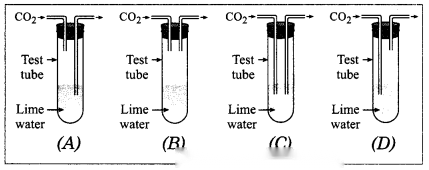
……….is the correct set up to pass CO2 through lime water.
Solution & Step-by-Step Answer:
Correct set up D.
Question 13
Maharashtra Board Solution
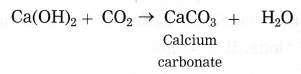
when……..is passed through fresh lime water, it turns milky. (a) H2 (b) CO (c) CO2 (d) SO2
Solution & Step-by-Step Answer:
(c) CO2
Question 14
Maharashtra Board Solution
Magnesium reacts with con. HCl to form………..salt. (a) copper chloride (b) ferrous chloride (c) calcium chloride (d) magnesium chloride
Solution & Step-by-Step Answer:
(d) magnesium chloride
Question 15
Maharashtra Board Solution
Zinc reacts with hydrochloric acid. The reaction is a reaction. (a) combination (b) decomposition (c) displacement (d) double decomposition
Solution & Step-by-Step Answer:
(c) displacement
Question 16
Maharashtra Board Solution
In a double displacement reaction,………… (Practice Activity Sheet – 1) (a) ions remain at rest (b) ions get liberated (c) ions are exchanged (d) ions are not created
Solution & Step-by-Step Answer:
(c) ions are exchanged
State whether the following statements are True or False:
Question 1
Maharashtra Board Solution
Rusting of iron is a fast reaction.
Solution & Step-by-Step Answer:
False. (Rusting of iron is a slow reaction.)
Question 2
Maharashtra Board Solution
Milk is set into curd is a chemical change.
Solution & Step-by-Step Answer:
True.
Question 3
Maharashtra Board Solution
The reaction between salt and water is an example of exothermic reaction.
Solution & Step-by-Step Answer:
False. (The reaction between salt and water is an example of endothermic reaction.)
Question 4
Maharashtra Board Solution
The speed of a chemical reaction depends on the catalyst used in the chemical reaction.
Solution & Step-by-Step Answer:
True.
Question 5
Maharashtra Board Solution
The simple form of representation of a chemical reaction in words is known as word reaction.
Solution & Step-by-Step Answer:
True.
Question 6
Maharashtra Board Solution
Nascent oxygen is always denoted by showing the symbol of oxygen.
Solution & Step-by-Step Answer:
False. (Nascent oxygen is always denoted by showing symbol of oxygen [0] in square brackets.)
Question 7
Maharashtra Board Solution
Antioxidants are used to prevent oxidation or food containing fats and oils.
Solution & Step-by-Step Answer:
True.
Question 8
Maharashtra Board Solution
When oils and fats are allowed to stand for a long time, they become rancid.
Solution & Step-by-Step Answer:
True.
Question 9
Maharashtra Board Solution
The chemical formula of rust is Fe3O4.xH2O.
Solution & Step-by-Step Answer:
False. (The chemical formula or rust is Fe2O3.xH2O.)
Question 10
Maharashtra Board Solution
Glucose combines with oxygen in our body and provides energy. The reaction is an endothermic reaction.
Solution & Step-by-Step Answer:
False. (Glucose combines with oxygen in our body and provides energy. The reaction is an exothermic reaction.)
Question 11
Maharashtra Board Solution
Chemical reactions in which reactants gain oxygen are reduction reactions.
Solution & Step-by-Step Answer:
False. (Chemical reactions in which reactants gain oxygen are oxidation reactions.)
Question 12
Maharashtra Board Solution
CuSO4(aq) + Znl(s) → ZnlSO4(aq) + Cu(s) is an example of decomposition reaction.
Solution & Step-by-Step Answer:
False. (It is an example of displacement reaction.)
Question 13
Maharashtra Board Solution
The chemical reactions in which heat is liberated are called endothermic reactions.
Solution & Step-by-Step Answer:
False. (The chemical reactions in which heat is liberated are called exothermic reactions.)
Question 14
Maharashtra Board Solution
The product or insoluble solid in chemical reaction is indicated by an arrow pointing upwards.
Solution & Step-by-Step Answer:
False. (The product or insoluble solid in chemical reaction is indicated by an arrow ↑ pointing downwards.)
Question 15
Maharashtra Board Solution
The rate of a reaction increases on increasing the temperature.
Solution & Step-by-Step Answer:
True.
Question 16
Maharashtra Board Solution
The digestion of food is a chemical decomposition process.
Solution & Step-by-Step Answer:
True.
Question 17
Maharashtra Board Solution
The reaction between sodium hydroxide and hydrochloric acid is a slow reaction.
Solution & Step-by-Step Answer:
False (The reaction between sodium hydroxide and hydrochloric acid is a fast reaction.)
Question 18
Maharashtra Board Solution
When calcium carbonate is heated, it decomposes into calcium oxide and oxygen gas.
Solution & Step-by-Step Answer:
False (when calcium carbonate is heated. it decomposes into calcium oxide and carbon dioxide gas.
Question 19
Maharashtra Board Solution
The rate of a chemical reaction changes in presence of catalyst.
Solution & Step-by-Step Answer:
True.
Question 20
Maharashtra Board Solution
Chlorines is an oxidant.
Solution & Step-by-Step Answer:
True.
Taking into consideration the relationship in the first pair, complete the second pair. (OR)Complete the following:
Question 1
Maharashtra Board Solution
2H2 + O2 → 2H2O Combination reaction :: 2HgO → 2Hg + O2 :……….
Solution & Step-by-Step Answer:
Decomposition reaction
Question 2
Maharashtra Board Solution
NH3 + HCl → NH4Cl : Combination reaction :: Fe + CuSO4 → FeSO4 + Cu :……..
Solution & Step-by-Step Answer:
Displacement reaction
Question 3
Maharashtra Board Solution
2C2H5OH + 2Na → 2C2H5ONa + H2 : Oxidation :: CuO + H2 → Cu + H2O :……….
Solution & Step-by-Step Answer:
Reduction
Question 4
Maharashtra Board Solution
CuCl2 + 2KI → CuI2 + 2KCl : Double displacement :: Zn + 2HCl → ZnCl2 + H2 :……….
Solution & Step-by-Step Answer:
Displacement reaction
Question 5
Maharashtra Board Solution
Solution & Step-by-Step Answer:
Combination reaction
Question 6
Maharashtra Board Solution
CuI2 : Brown :: AgCl :……….
Solution & Step-by-Step Answer:
White.
Match the column in the following table:
Question 1
Maharashtra Board Solution
|



Reactants | products | Type of chemical reaction |
Fe + S | NaCl + H2O | Oxidation |
CuSO4+ Zn | 2CuO | Neutralization |
2Cu + O2 | ZnSO4+ Cu | Displacement |
HCl + NaOH | FeS | Combination |
Reactants | products | Type of chemical reaction |
Fe + S | FeS | Combination |
CuSO4+ Zn | ZnSO4+ Cu | Displacement |
2Cu + O2 | 2CuO | Oxidation |
HCl + NaOH | NaCl + H2O | Neutralization Rewrite the second column so as to match the item from first column or Match the following:
Question 1
Maharashtra Board Solution
|
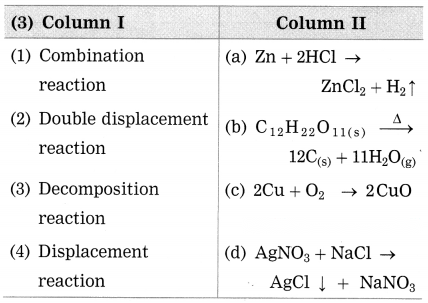
Column I | Column II |
1. Reduction | (a) Type of a chemical reaction |
2. Oxidation | (b) Combination with hydrogen |
3. Double displacement | (c) Losing hydrogen |
4. Displacement | (d) Exchange of ions |
(1) Reduction – Combination with hydrogen
(2) Oxidation – Losing hydrogen
(3) Double displacement – Exchange of ions
(4) Displacement – Type of chemical reaction.
Question 2
Maharashtra Board Solution
Answer:
Question 3
Maharashtra Board Solution
Solution & Step-by-Step Answer:
(1) Combination reaction – 2Cu +O4 → 2CuO (2) Double displacement reaction – AgNO3 + NaCl → AgCl ↓ + NaNO3 (3) Decomposition reaction – (4) Displacement reaction – Zn+ 2HCl → ZnCl2 + H2 ↑
Classify each of the following reactions as combination, decomposition, displacement or double displacement reactions:
Name the following:
Question 1
Maharashtra Board Solution
The product formed in the thermal decomposition of sugar.
Solution & Step-by-Step Answer:
Carbon is formed in the thermal decomposition of sugar.
Question 2
Maharashtra Board Solution
The gas evolved when sorghum metal reacts with ethanol.
Solution & Step-by-Step Answer:
Hydrogen (H2) gas is evolved when sodium metal reacts with ethanol.
Question 3
Maharashtra Board Solution
The precipitate formed when barium sulphide reacts with zinc sulphate.
Solution & Step-by-Step Answer:
When barium sulphide reacts with zinc sulphide, a precipitate of barium sulphate is formed.
Question 4
Maharashtra Board Solution
The reducing agent used for the reduction of copper oxide.
Solution & Step-by-Step Answer:
Hydrogen is used for the reduction of copper oxide.
Question 5
Maharashtra Board Solution
The catalyst used to accelerate the rate of decomposition of hydrogen peroxide.
Solution & Step-by-Step Answer:
Manganese dioxide (MnO2) is used as a catalyst to accelerate the rate of decomposition of hydrogen peroxide.
Question 6
Maharashtra Board Solution
which oxidising agent is used to oxidise ferrous sulphate.
Solution & Step-by-Step Answer:
Potassium permanganate (KMnO4) is used as an oxidising agent to oxidise ferrous sulphate.
Question 7
Maharashtra Board Solution
The product formed in the oxidation of ethyl alcohol.
Solution & Step-by-Step Answer:
Acetic acid is formed in the oxidation of ethyl alcohol.
Answer the following questions in one sentence each:
Question 1
Maharashtra Board Solution
what is meant by a chemical equation?
Solution & Step-by-Step Answer:
The simple representation or a chemical reaction in a condensed form with the help of chemical formulae is called a chemical equation.
Question 2
Maharashtra Board Solution
what is meant by a word equation?
Solution & Step-by-Step Answer:
The simple form or representation or a chemical reaction in words is known as word equation.
Question 3
Maharashtra Board Solution
what happens in a combination reaction?
Solution & Step-by-Step Answer:
A single compound (product) is formed from two or more substances during a combination reaction.
Question 4
Maharashtra Board Solution
what happens in a displacement reaction?
Solution & Step-by-Step Answer:
In a displacement reaction. a more reactive element displaces another element, having less reactivity, from its compound.
Question 5
Maharashtra Board Solution
what happens in a decomposition reaction?
Solution & Step-by-Step Answer:
A single substance is broken down and two or more substances are formed during a decomposition reaction.
Question 6
Maharashtra Board Solution
what happens in a double displacement reaction?
Solution & Step-by-Step Answer:
A precipitate is formed by exchange of ions between the reactants during a double displacement reaction.
Question 7
Maharashtra Board Solution
IdentIry the type of following reaction: (Practice Activity Sheet – 2)
Solution & Step-by-Step Answer:
The above reaction is a decomposition reaction.
Question 8
Maharashtra Board Solution
what happens in an endothermic reaction?
Solution & Step-by-Step Answer:
In an endothermic reaction, the reactants absorb heat to form products.
Question 9
Maharashtra Board Solution
State the use of antioxidants in food containing fats and oils.
Solution & Step-by-Step Answer:
Antioxidants are used to prevent oxidation of food containing fats and oils.
Question 10
Maharashtra Board Solution
What are edible oils?
Solution & Step-by-Step Answer:
Edible oils are compounds of alcohols and organic acids (carboxylic acids). The compounds formed are known as esters of carboxylic acids.
Question 11
Maharashtra Board Solution
Is rancidity a phenomenon of oxidation or reduction?
Solution & Step-by-Step Answer:
Rancidity is a phenomenon of oxidation.
Answer the following questions:
Question 1
Maharashtra Board Solution
What do you understand by a physical change? OR Define physical change.
Solution & Step-by-Step Answer:
The change in which only the physical state of a substance is changed; no new substance is formed. This change is temporary. During this change the composition of the substance does not change.
Question 2
Maharashtra Board Solution
Explain giving two examples or physical change.
Solution & Step-by-Step Answer:
(1) Conversion of ice into water is a physical change. On heating, ice melts into water. when the water is cooled, it freezes into ice. Thus, we get ice from water by a simple method and no new substance is formed. Hence, conversion of ice into water is a physical change.
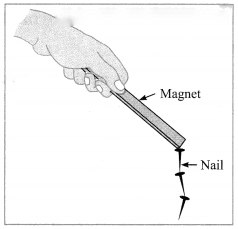
(2) Magnetization of iron nail is a physical change. An iron nail magnetized by induction loses its magnetism as soon as it is detached from the magnet which induces magnetism in it. An iron nail magnetized by some other methods can also be demagnetized by simple means such as hammering or heating it. Thus, the magnetization of an iron nail can be easily reversed to get original nail. Hence, it is a physical change.
Question 3
Maharashtra Board Solution
what do you understand by a chemical change? OR Define Chemical change.
Solution & Step-by-Step Answer:
The change in which a substance or substances are converted into a new substance or substances, possessing properties altogether different from the original ones, is called a chemcial change. During this change, the original substance cannot be recovered by any simple means. This change is permanent.
Question 4
Maharashtra Board Solution
Explain giving two examples of chemical change.
Solution & Step-by-Step Answer:
(1) When carbon is burnt, carbon dioxide is formed. In this process carbon combines with oxygen, therefore carbon and oxygen are reactants, while curbon dioxide is a product. This change is permanent.
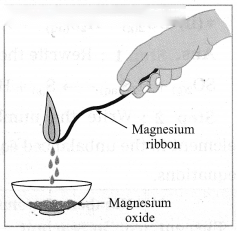
(2) When a magnesium wire is burnt in air, a white powder of magnesium oxide is formed. We cannot obtain magnesium from magnesium oxide by simple methods. Properties of magnesium oxide are altogether different from those of magnesium. A new substance MgO is formed in the reaction. Hence, this change is a chemical change.
Question 5
Maharashtra Board Solution
What is meant by a chemical reaction?
Solution & Step-by-Step Answer:
A process in which some substances undergo bond breaking and are transformed into new substances by formation of new bonds is called a chemical reaction.
Question 6
Maharashtra Board Solution
What is the importance of a chemical equation?
Solution & Step-by-Step Answer:
Question 7
Maharashtra Board Solution
What are the conventions used in writing a chemical equation?
Solution & Step-by-Step Answer:
Conventions used in writing a chemical equation: (1) The reactants are written on the left hand side (LHS), while the products are written on the right hand side (RHS).
(2) Whenever there are two or more reactants, a plus sign (+) is written between each two of them. Similarly, if there are two or more products, a plus sign is written between each two of them. (3) Reactant side and product side are connected with an arrow (→) pointing from reactants to products. The arrow represents the direction of the reaction. Heat is to be given from outside to the reaction, it is indicated by the sign Δ written above the arrow. (4) The conditions like temperature, pressure, catalyst, etc., are mentioned above the arrow (→) pointing towards the product side. (5) The physical states of the reactants and products are also mentioned in a chemical equation. The notations g, l, s, and aq are written in brackets as a subscript along with the symbols / formulae of reactants and products. The symbols g, l, s, and aq stand for gaseous, 1iquid. solid and aqueous respectively. If the product is gaseous, instead of (g) it can be indicated by an arrow ↑ pointing upwards. If the product formed is insoluble solid, then instead of (s) it can be indicated by an arrow ↓ pointing downwards. (6) Special information or names of reactants/products are written below their formulae. Write the balanced equations for the following reactions:
Question 1
Maharashtra Board Solution
Ba(OH)2 + HBr → BaBr2 + H2O
Solution & Step-by-Step Answer:
Step 1: Rewrite the given equation as it is Ba(OH)2 + HBr → BaBr2 + H2O
Step 2:
Step 3:
To equalise the number of oxygen atoms, we use 2 as the coefficient of H2O in the product. Step 4:
To equalise the number of hydrogen atoms, we use 2 as the coefficient of HBr in the reactants. Now, the equation becomes
Question 2
Maharashtra Board Solution
KCN + H2SO4 → K2SO4 + HCN
Solution & Step-by-Step Answer:
Step 1: Rewrite the given equation as it is KCN + H2SO4 → K2SO4 + HCN
Step 2:
The number of oxygen atoms involved in different compounds on both sides (reactants and products) are equal. Therefore, balance the number of atoms of the second element, potassium. Step 3:
To equalise the number of potassium atoms, we use 2 as the coefficient of KCN in the reactants.
Question 3
Maharashtra Board Solution
CH4 + O2 → 4CO2 + H2O
Solution & Step-by-Step Answer:
Step 1: Rewrite the given equation as it is CH4 + O2 → 4CO2 + H2O
Step 2:
Step 3:
To equalise the number of oxygen atoms, we use 2 as the coefficient of O2in the reactants and 2 as the coefficient of H2O in the product. Answer the following questions:
Question 1
Maharashtra Board Solution
what are the different types of chemical reaction?
Solution & Step-by-Step Answer:
Types of chemical reaction
Question 2
Maharashtra Board Solution
What is meant by a combination reaction? OR Define: combination reaction.
Solution & Step-by-Step Answer:
When two or more reactants combine in a reaction to form a single product, it is called a combination reaction.
Question 3
Maharashtra Board Solution
Give two examples of combination reaction.
Solution & Step-by-Step Answer:
Examples of combination reaction : (1) The ammonia gas reacts with hydrogen chloride gas to form the salt in gaseous state, immediately it condenses at room temperature and gets transformed into the solid state.
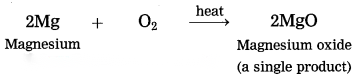
(2) Magnesium burns in air to form white powder of magnesium oxide as a single product.
(3) Iron reacts with sulphur to form iron sulphide.
Question 4
Maharashtra Board Solution
What Is meant by a decomposition reaction?
Solution & Step-by-Step Answer:
The chemical reaction in which two or more products are formed from a single reactant is called decomposition reaction.
Question 5
Maharashtra Board Solution
what is meant by a thermal decomposition?
Solution & Step-by-Step Answer:
The reaction in which a compound is decomposed by heating it to a high temperature is called thermal decomposition.
Question 6
Maharashtra Board Solution
What is meant by a electrolytic decomposition?
Solution & Step-by-Step Answer:
The reaction in which a compound is decomposed by passing an electric current through its solution or molten mass is called an electrolytic decomposition.
Question 7
Maharashtra Board Solution
Give two examples of thermal decomposition.
Solution & Step-by-Step Answer:
(1) At high temperature, calcium carbonate decomposes into calcium oxide and carbon dioxide.
(2) At high temperature sugar decomposes into black mass of carbon and water vapour.
Question 8
Maharashtra Board Solution
Give an example of electrolytic decomposition.
Solution & Step-by-Step Answer:
When an electric current is passed through acidified water, it is electrolysed giving hydrogen and oxygen.
Question 9
Maharashtra Board Solution
Study the following reaction and answer the questions asked. (a) State the type of reaction. (b) Define this reaction. (Practice Activity Sheet – 1)
Solution & Step-by-Step Answer:
(a) The type of reaction is electrolytic decomposition reaction. (b) The reaction in which a compound is decomposed by passing an electric current through its solution or molten mass is called an electrolytic decomposition.
Question 10
Maharashtra Board Solution
what is meant by a displacement reaction?
Solution & Step-by-Step Answer:
The reaction in which the place of the ion of a less reactive element in a compound is taken by another more reactive element by formation of its own ions, is called displacement reaction.
Question 11
Maharashtra Board Solution
Give an example of displacement reaction.
Solution & Step-by-Step Answer:
when zinc granules are added to the blue coloured copper sulphate solution, the zinc ions formed from zinc atoms take the place or Cu2+ ions in CuSO4, and copper atoms, formed from Cu2+ ions comes out i.e. the more reactive zinc displaces the less reactive Cu from copper sulphate.
Question 12
Maharashtra Board Solution
Observe the reaction and answer the following questions. CuSO4(aq) + Fe(s) → FeSO4(aq) + Cu(s) (a) Identify and write the type of chemical reaction. (b) write the definition of above reaction. (Practice Activity Sheet – 3)
Solution & Step-by-Step Answer:
(a) When iron powder is added to the blue coloured copper sulphate solution, the iron ions formed from iron atoms take the place or Cu2+ ions in CuSO4, and copper atoms, formed from Cu2+ ions comes out i.e. the more reactive iron displaces the less reactive Cu from copper sulphate. Therefore this reaction is a displacement reaction.
(b) The reaction in which the place of the ion of a less reactive element in a compound is taken by another more reactive element by formation of its own ions, is called displacement reaction.
Question 13
Maharashtra Board Solution
what is meant by a double displacement reaction?
Solution & Step-by-Step Answer:
The reaction in which the ions in the reactants are exchanged to form a precipitate is called double displacement reaction.
Question 14
Maharashtra Board Solution
Give two examples of double displacement reaction.
Solution & Step-by-Step Answer:
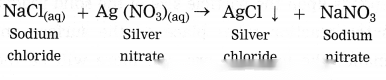
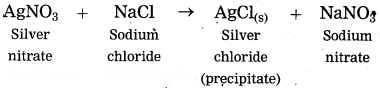
(1) Solutions of sodium chloride and silver nitrate react with each other forming a precipitate of silver chloride and a solution of sodium nitrate. White precipitate of AgCl is formed by exchange of ions Ag+ and Cl– between the reactants.
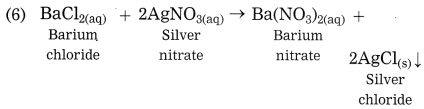
(2) Barium suiphide reacts with zinc sulphate to form zinc sulphide and a white precipitate of barium sulphate.
Question 15
Maharashtra Board Solution
Write down what you understand from the following chemical reaction: AgNO3(aq) + NaCl(aq) → AgCl ↓ + NaNO3(aq)
Solution & Step-by-Step Answer:
(i) The above reaction is a double displacement reaction. (ii) AgNO3 and NaCl are the reactants while AgCl and NaNO3 are the products. (iii) The reactants and the product NaNO3 are in aqueous state. The product AgCl is formed in the form of precipitate.
Question 16
Maharashtra Board Solution
Study the following chemical reaction and answer the questions given below: AgNO3(aq) + NaCl(aq) → AgCl(s)↓ + NaNO3(aq) (i) Identiry and write the type of chemical reaction. (ii) write the definition of above type of chemical reaction. (iii) Write the names of reactants and products of above reaction. (March 2019)
Solution & Step-by-Step Answer:
(i) The type of chemical reaction: Double displacement reaction. (ii) The reaction in which the ions in the reactants are exchanged to form a precipitate is called double displacement reaction. (iii)
Question 17
Maharashtra Board Solution
When sodium chromate solution is mixed with barium sulphate solution, a precipitate is formed. (i) What is the colour of the precipitate formed? (ii) Name the precipitate. (iii) What is the type of chemical reaction?
Solution & Step-by-Step Answer:
(i) The colour of the precipitate is yellow. (ii) The yellow precipitate formed is barium chromate. (iii) The type of chemical reaction is double displacement.
Question 18
Maharashtra Board Solution
Explain the term Exothermic reaction.
Solution & Step-by-Step Answer:
Exothermic reaction : The process in which heat is given out is called an exothermic reaction. When NaOH(s) dissolves in water, there is evolution of heat leading to a rise in temperature. NOH(s) + H3O(l) → NaOH(aq) + Heat
Question 19
Maharashtra Board Solution
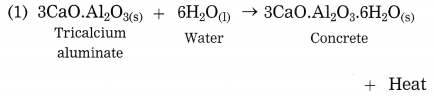
State whether the following reactions are exothermic or endothermic: (i) 3CaO. Al2O3(s) + 6H2O(l) → 3CaO. Al2O3. 6H2O(s) + Heat
Solution & Step-by-Step Answer:
Exothermic reaction
(ii) 2CaSO4. H2O + 3H2O → 2CaSO4. 2H2O + Heat (iii) KNO3(aq)+ H2O(l)+ Heat → KNO3(aq) (iv) NaOH(s)+ H2O(l)→ NaOH(aq)+ Heat (v) Transformation of ice into water. (vi) Water turns into ice. (vii) Cooking of food. (viii) Burning candle.
Question 20
Maharashtra Board Solution
What do you mean by slow speed reaction? OR Define: Slow speed reaction.
Solution & Step-by-Step Answer:
The reaction which requires long time for completion i.e. occurs slowly is called slow speed reaction.
Question 21
Maharashtra Board Solution
What do you mean by fast speed reaction? OR Define: Fast speed reaction.
Solution & Step-by-Step Answer:
The reaction which is completed in short time i.e. occurs rapidly is called fast speed reaction.
Question 22
Maharashtra Board Solution
Give two examples of slow speed reactions.
Solution & Step-by-Step Answer:
(1) On heating potassium chlorate (KClO3) it decomposes slowly into potassium chloride and oxygen gas. This reaction requires long time for completion, therefore it is slow speed reaction.
(2) Rusting of iron is a slow speed reaction. In this reaction iron reacts with oxygen from air to form iron oxide.
Question 23
Maharashtra Board Solution
Give two examples of fast speed reactions.
Solution & Step-by-Step Answer:
(1) The reaction between sodium hydroxide (NaOH) and hydrochloric acid (HCl) is a neutralization reaction and it is fast speed reaction. NaOH2(aq) + HCl(aq) → NaCl(aq) + H2O(l) This neutralizaton reaction is completed in short time, therefore it is fast speed reaction.
(2) Aqueous solution of sodium chloride reacts with silver nitrate solution to form white precipitate of silver chloride (NaCl) and sodium nitrate.
Question 24
Maharashtra Board Solution
Write a short note on slow speed and fast speed reactions.
Solution & Step-by-Step Answer:
Slow speed reaction: The reaction which requires long time for completion i.e. occurs slowly is called slow speed reaction. Examples: (1) On heating potassium chlorate (KClO3) it decomposes slowly into potassium chloride and oxygen gas. This reaction requires long time for completion, therefore it is slow speed reaction.
(2) Rusting of iron is a slow speed reaction. In this reaction iron reacts with oxygen from air to form iron oxide.
Fast speed reaction: (2) Aqueous solution of sodium chloride reacts with silver nitrate solution to form white precipitate of silver chloride (NaCl) and sodium nitrate.
Question 25
Maharashtra Board Solution
State the factors which affect the speed (or rate) of a reaction.
Solution & Step-by-Step Answer:
The factors which affect the rate of a reaction are
Question 26
Maharashtra Board Solution
How does the rate of reaction depend on the nature of the reactants? Illustrate with suitable example.
Solution & Step-by-Step Answer:
(1) when the reactant combines with two or more other reactants then the rate of a chemical reaction depends on the nature of the reactants.
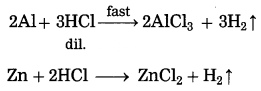
(2) Both Al and Zn reacts with dilute hydrochloric acid, H2gas is liberated and water soluble salts of these metals are formed. However, aluminium metal reacts faster with dil. HCl as compared to zinc metal. (3) Al is more reactive than Zn. Therefore, the rate of reaction of Al with hydrochloric acid is higher than that of Zn. Hence, the nature of the reactant affect the rate of a reaction.
Question 27
Maharashtra Board Solution
How does the rate of a reaction depend on the size of the particles of reactants?
Solution & Step-by-Step Answer:
(1) In the reaction of dil. HCl and Shahabad tile, CO2 effervescence is formed slowly. On the other hand, C2 effervescence forms at faster speed with the powder of Shahabad tile.
(2) The above observation indicates that the rate of a reaction depends upon the size of the particles of the reactants taking part in the reaction. Smaller the size of the reactant particles taking part in a reaction faster will be the rate of reaètion.
Question 28
Maharashtra Board Solution
How does the rate of a reaction depend upon the concentration of the reactants? Give suitable example.
Solution & Step-by-Step Answer:
(1) A chemical reaction takes place due to collisions of the reactant molecules. Higher the concentrations of the reactants more will be the frequency of collisions and faster wifi be the rate of the reaction.
(2) In the reaction of dil. HCl and CaCO3, CaCO3disappears slowly and CO2also liberates slowly. On the other hand the reaction with concentrated HCl takes place rapidly and CaCO3disappears fast. (3) Concentrated acid reacts faster than dilute acid, that means the rate of a reaction is proportional to the concentration of reactants. Slow reaction:
Question 29
Maharashtra Board Solution
How does the rate of a reaction depend upon the temperature of reactants? Give suitable example.
Solution & Step-by-Step Answer:
(i) (1) When the temperature of the reactants is increased, the reactant molecules start moving with more velocity and their kinetic energy increases. As a result, the number collisions increases. Hence, the rate of chemical reaction increases.
(2) Lime stone on heating decomposes to give CO2, which turns 1ime water milky. On the other hand, the lime water does not turn milky before heating the lime stone: because of the zero rate of reaction. The above observation indicates that the rate of a reaction increases on increasing the temperature. (ii) Solid CaCO3does not decompose at room temperature when heated, it decomposes to give CaO and CO2that means the rise in temperature increases the rate of reaction. CaCO3room temperature No chemical reaction.
Question 30
Maharashtra Board Solution
How does the rate if a reaction depend upon the catalyst? Give suitable example.
Solution & Step-by-Step Answer:
(1) The substance in whose presence the rate of a chemical reaction changes, without causing any chemical change to it is called a catalyst.
(2) On heating potassium chlorate (KClO3) decomposes into potassium chloride and oxygen slowly.
Question 31
Maharashtra Board Solution
State the Importance of rate in a chemical reaction.
Solution & Step-by-Step Answer:
Question 32
Maharashtra Board Solution
Define Oxidation reaction.
Solution & Step-by-Step Answer:
Oxidation: The chemical reaction in which a reactant combines with oxygen or loses hydrogen to form the product is called oxidation reaction.
Question 33
Maharashtra Board Solution
Give examples of oxidation.
Solution & Step-by-Step Answer:
(1) when carbon burns in air, it forms carbon dioxide. In this reaction carbon accepts oxygen, therefore, this is an oxidation reaction. C(s) + O2(g) → CO2(g)
(2) when sodium reacts with ethyl alcohol, sodium ethoxide and hydrogen gas is formed. In this reaction, hydrogen is removed from ethyl alcohol, therefore this is an oxidation reaction.
Question 34
Maharashtra Board Solution
What do you mean by oxidant? Explain with suitable example.
Solution & Step-by-Step Answer:
The chemical substances which bring about an oxidation reaction by making oxygen available are called oxidants or oxidizing agents.
Question 35
Maharashtra Board Solution
Name the various oxidants. How nascent oxygen is liberated from these oxidants?
Solution & Step-by-Step Answer:
K2Cr2O7/H2SO4, KMnO4/H2SO4 are the commonly used chemical oxidants. Hydrogen peroxide (H2O2) is used as a mild oxidant. Ozone (O3) is also a chemical oxidant. Nascent oxygen is generated by chemical oxidants and it is used for the oxidation reaction. O3 → O2 + [O]. H2O2 → H2O + [O] K2Cr2O7 + 4H2SO4 → K2SO4 + Cr2(SO4)3 + 4H2O + 3[O] 2KMnO4 + 3H2SO4 → K2SO4 + 2MnSO4 + 3H2O + 5[O] Nascent oxygen is a state prior to the formation of the O2 molecule. It is the reactive form of oxygen and is represented by the symbol as [O]
Question 36
Maharashtra Board Solution
Acidified potassium permanganate (KMnO4) is a chemical oxidant and explain, how acidified potassium permanganate oxidise ferrous sulphate (FeSO4). Accordingly write a new definition of oxidation and reduction.
Solution & Step-by-Step Answer:
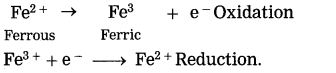
Acidified KMnO4 oxidises ferrous sulphate (FeSO4) to ferric sulphate Fe2(SO4)3 and in addition to above K2SO4 and MnSO4 by-products are formed. 2KMnO4 + 10 FeSO4 → 8H2SO4 → K2SO4 + 2MnSO4 + 5Fe2(SO4)3 + 8H2O 2FeSO4 → Fe2(SO4)3 Ionic reaction : 2Fe2 + 2SO42+ → 2Fe3+ + 3SO22- Net Ionic equation Fe2+ → Fe3+ + e– When ferric ion is formed from ferrous ion the positive change is increased by one unit. While this happens the rerrous ion loses one electron.
When metal or its ion loses electron, it is called an oxidation and gain of electron is called reduction.
Question 37
Maharashtra Board Solution
Define reduction reaction.
Solution & Step-by-Step Answer:
The chemical reaction in which a reactant gains hydrogen and loses oxygen to form the product is called the reduction reaction.
Question 38
Maharashtra Board Solution
Give two examples of reduction.
Solution & Step-by-Step Answer:
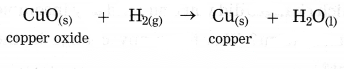
(1) When hydrogen gas is passed over black copper oxide a reddish coloured layer of copper is formed. In this reaction an oxygen atom removed from CuO to form copper, hence, this is reduction.
(2) When hydrogen gas is passed over red hot coke, methane is obtained.
Question 39
Maharashtra Board Solution
What do you mean by reductant? Explain with suitable example.
Solution & Step-by-Step Answer:
The chemical substances which bring about reduction by making hydrogen available are called reductant. In the preparation of methane from carbon, hydrogen is a reductant.
Question 40
Maharashtra Board Solution
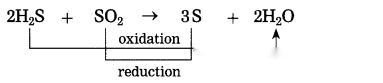
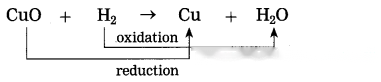
What are redox reactions? Identify the substances that are oxidised and the substances that are reduced in the following reactions: (1) 2H2S2(g) + SO2(g) → 3S(s) + 2H2O(l) (2) CuO(s) + H2(g) → CU(s) + H2O(l)
Solution & Step-by-Step Answer:
When oxidation and reduction take place simultaneously in a given chemical reaction, it is known as a redox reaction. (1) H2S is oxidised and SO2 is reduced.
(2)
(3)
Question 41
Maharashtra Board Solution
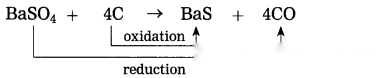
Observe the following reaction and answer the questions given below: BaSO4 + 4C → BaS + 4CO (1) what type of reaction is it? Justify. (2) Give one more example.
Solution & Step-by-Step Answer:
(1) This is a redox reaction. In this reaction the reduction of BaSO4 and oxidation of carbon take place simultaneously.
(2) Example
Question 42
Maharashtra Board Solution
What is corrosion?
Solution & Step-by-Step Answer:
The slow process of decay or oxidation of metals due to various components of atmosphere is known as corrosion. Iron rusts and a reddish coloured layer is collected on it. This is corrosion of iron.
Question 43
Maharashtra Board Solution
How does rusting of iron occur?
Solution & Step-by-Step Answer:
Iron when exposed to moist air forms a reddish layer of hydrated ferric oxide.
Question 44
Maharashtra Board Solution
How can corrosion be prevented?
Solution & Step-by-Step Answer:
Question 45
Maharashtra Board Solution
What is corrosion? Do gold ornaments corrode? Justify.
Solution & Step-by-Step Answer:
The slow process of decay or oxidation or metal due to the effect of air, moisture and acids on it is known as corrosion. (1) Gold is a noble metal. There is no effect or moist air or action of acid on it at any temperature. (2) Pure gold is a very soft metal. it breaks and gets bent easily. Hence, in gold ornaments, gold is alloyed with other metals 1ike copper or silver in appropriate proportion to make it hard and resistant to corrosion. Hence gold ornaments do not get corroded.
Question 46
Maharashtra Board Solution
Complete the process of iron rusting by filling the blanks. Suggest a way to prohibit the process. The iron rust is formed due to reaction. Different regions on iron surface become anode and cathode. Reaction on anode region: Fe(s) → Fe2+ (aq) + 2e– Reaction on cathode region: O2(g) + 4H+ (aq) +………→ 2H2O(l) when Fe2+ ions migrate from anode region they react with……..to fomm Fe3+ ions. A reddish coloured hytirated oxide is formed from……….ions. It is called rust. 2Fe3+ (aq) + 4H2O(l) → +………+ 6H+ (aq) A way to prevent rusting……….. (Practice Activity Sheer – 2)
Solution & Step-by-Step Answer:
The iron rust is formed due to electrochemical reaction. Different regions on iron surface become unode and cathode. Reaction on anode region: Fe(s) → Fe2+ (aq) + 2e– Reaction on cathode region: O2(g) + 4H+ (aq) + 4e– → 2H2O(l) when Fe2+ ions migrate from anode region they react with water to form Fe3+ ions. A reddish coloured hydrated oxide is formed from Fe3+ ions. It is called rust. 2Fe3+ (aq) + 4H2O(l) → + Fe2O3. H2O(s) + 6H+(aq) A way to prevent rusting by colouring with acrylic paints, Zn plating, galvanizing, anodizing, alloying, etc.
Question 17
Maharashtra Board Solution
Deifne: Rancidity.
Solution & Step-by-Step Answer:
When oil or fat or left over cooking oil for making food stuff undergoes oxidation ir stored for a long time and it is found to have foul odour called rancidity.
Distinguish between the following:
Question 1
Maharashtra Board Solution
Combination reaction and Decomposition reaction. |























Combination reaction | Decomposition reaction |
1. In a combination reaction, two or more reactants take part in the chemical reaction. | 1. In a decomposition reaction there is only one reactant in the chemical reaction. |
1. In the combination reaction, only one product is formed. | 2. In a decomposition reaction, two or more products are formed. |
Question 2
Maharashtra Board Solution
Oxidation and reduction
Solution & Step-by-Step Answer:
block bg-white dark:bg-slate-900/80 border-l-4 border-emerald-500 rounded-r-xl p-5 my-3 shadow-xs border border-slate-200/60 dark:border-slate-800">
Solution & Step-by-Step Answer:
Question 3
Maharashtra Board Solution
Exothermic and Endothermic reaction.
Solution & Step-by-Step Answer:
Give scientific reasons:
Question 1
Maharashtra Board Solution
Grills of doors and windows are always painted before they are used.
Solution & Step-by-Step Answer:
Question 2
Maharashtra Board Solution
Physical states of reactants and products are mentioned while writing a chemical equation.
Solution & Step-by-Step Answer:
(1) while writing a chemical equation, gaseous, 1iquid and solid states are symbolised as (g), (l) and (s) respectively.
(2) This is done to make it more informative and to emphasise that those reactions occur in that manner only under those conditions. Hence, physical states of reactants and products are mentioned while writing a chemical equation.
Question 3
Maharashtra Board Solution
Iron articles rust readily whereas steel which is also mainly made of iron does not undergo corrosion.
Solution & Step-by-Step Answer:
(1) Iron articles rust readily as iron reacts with oxygen and moisture of air to convert into its hydroxide and oxide (Fe2O3. x H2O), while steel is an alloy of iron, carbon and chromium.
(2) The properties of an alloy are different from the properties of its constituents. The added metals increase its resistance to corrosion. It is more durable and clean.
Question 4
Maharashtra Board Solution
Concentrated hydrochloric acid reacts more vigorously with calcium carbonate than dilute hydrochloric acid.
Solution & Step-by-Step Answer:
Question 5
Maharashtra Board Solution
Zinc powder reacts much faster with dil. H2SO4 than does granulated zinc of the Same mass.
Solution & Step-by-Step Answer:
(1) In a reaction. the rate of the reaction depends upon the particle size of the solid reactant as the reaction takes place on the surface only. Smaller the particles are, the more will be their total surface area and faster will be the rate of the reaction. (2) Hence, zinc powder reacts much faster with dil. H2SO4 than does granulated zinc.
Question 6
Maharashtra Board Solution
When copper articles exposed to air for a long time, gets corroded.
Solution & Step-by-Step Answer:
Copper oxidises to form black coloured laver of copper oxide. when copper oxide combines with carbon dioxide from air, copper loses its lustre due to formation of greenish layer of copper carbonate on its surface. Thus, copper articles exposed to air for a long time get corroded.
Question 7
Maharashtra Board Solution
When silver vessels exposed to air turns blackish after sometime.
Solution & Step-by-Step Answer:
On exposure to air, silver vessels turns blackish after sometime. This is because of the layer of silver sulphide (Ag2S) formed by the reaction or silver with hydrogen suphide in air.
Explain the following reactions giving their balanced chemical equations:
Question 1
Maharashtra Board Solution
Calcium carbonate (Lime stone) is heated.
Solution & Step-by-Step Answer:
When calcium carbonate (Lime stone) is heated at high temperature it decomposes to form quicklime and carbon dioxide gas.
Question 2
Maharashtra Board Solution
Copper reacts with dil. nitric acid.
Solution & Step-by-Step Answer:
When copper reacts with dil. nitric acid, nitric oxide gas is formed.
Question 3
Maharashtra Board Solution
Copper reacts with conc. nitric acid.
Solution & Step-by-Step Answer:
When copper reacts with conc. nitric acid, reddish coloured poisonous nitrogen dioxide gas is formed.
Question 4
Maharashtra Board Solution
Ammonia gas reacts with hydrogen chloride gas.
Solution & Step-by-Step Answer:
When ammonia gas reacts with hydrogen chloride gas, it forms the salt ammonium chloride in gaseous state, but immediately it got transformed into the solid state.
Question 5
Maharashtra Board Solution
Magnesium strip is burnt in air.
Solution & Step-by-Step Answer:
When magnesium strip is burnt in air, a white powder of magnesium oxide is formed.
Question 6
Maharashtra Board Solution
Calcium oxide is mixed with water.
Solution & Step-by-Step Answer:
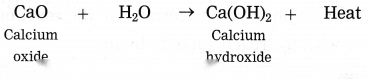
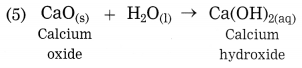
When calcium oxide (slaked lime) is mixed with water, calcium hydroxide is formed with evolution of large amount of heat.
Question 7
Maharashtra Board Solution
Sugar is heated.
Solution & Step-by-Step Answer:
When sugar is heated, it decomposes to form carbon (black substance).
Question 8
Maharashtra Board Solution
Electric current is passed through acidulated water.
Solution & Step-by-Step Answer:
When an electric current is passed through acidulated water, it decomposes into hydrogen and oxygen gas.
Question 9
Maharashtra Board Solution
Zinc powder is added to copper sulphate
Solution & Step-by-Step Answer:
Answer: When zinc powder is added to copper sulphate solution, more reactive zinc displaces less reactive copper from copper sulphate solution. The colourless zinc sulphate is formed with evolution of heat.
Question 10
Maharashtra Board Solution
Iron powder is added to copper sulphate
Solution & Step-by-Step Answer:
Answer: When iron powder is added to copper sulphate solution, more reactive iron displaces less reactive copper from copper sulphate. The colourless ferrous sulphate solution is formed with evolution of heat.
Question 11
Maharashtra Board Solution
Lead is added to copper sulphate
Solution & Step-by-Step Answer:
Answer: When lead is added to copper sulphate solution, more reactive lead displaces less reactive copper from copper sulphate. The colourless lead sulphate solution is formed with evolution of heat.
Question 12
Maharashtra Board Solution
Potassium chromate solution is added to barium sulphate
Solution & Step-by-Step Answer:
Answer: When potassium chromate solution is added to barium sulphate solution, yellow precipitate of barium chromate is formed.
Question 13
Maharashtra Board Solution
Calcium chloride solution is added to sodium carbonate
Solution & Step-by-Step Answer:
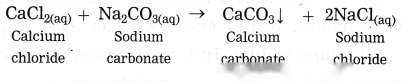
Answer: When calcium chloride solution is added to sodium carbonate solution, white precipitate of calcium carbonate is formed.
Question 14
Maharashtra Board Solution
Sodium chloride solution is mixed with silver nitrate
Solution & Step-by-Step Answer:
Answer: When sodium chloride solution is mixed with silver nitrate solution, white precipitate or silver chloride is formed.
Question 15
Maharashtra Board Solution
Dilute sulphuric acid is added to barium chloride
Solution & Step-by-Step Answer:
Answer: When dilute sulphuric acid is added to barium chloride solution, white precipitate of barium sulphate is rormed.
Question 16
Maharashtra Board Solution
Calcium carbonate (Lime stone) is treated with dil. hydrochloric acid.
Solution & Step-by-Step Answer:
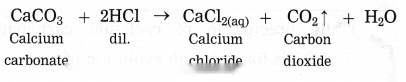
When calcium carbonate (lime stone) is treated with dil. hydrochloric acid, carbon dioxide gas is formed.
Question 17
Maharashtra Board Solution
Aluminium is treated with dil. hydrochloric acid.
Solution & Step-by-Step Answer:
When aluminium is treated with dilute hydrochloric acid, hydrogen gas is liberated.
Question 18
Maharashtra Board Solution
Magnesium is treated with hydrochloric acid.
Solution & Step-by-Step Answer:
When magnesium is treated with hydrochloric acid, hydrogen gas is liberated.
Question 19
Maharashtra Board Solution
Hydrogen peroxide is decomposed in the presence of manganese dioxide (MnO2).
Solution & Step-by-Step Answer:
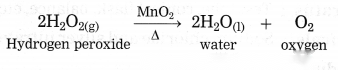
When hvdrogen peroxide is decomposed in the presence of manganese dioxide (MnO2), water and oxygen are formed.
Question 20
Maharashtra Board Solution
Ethyl alcohol is treated with acidified potassium dlchromate.
Solution & Step-by-Step Answer:
When ethly alcohol is treated with acidified potassium dichromate, acetic acid is formed. This is oxidation reaction.
Question 21
Maharashtra Board Solution
Hydrogen gas is passed over black copper oxide.
Solution & Step-by-Step Answer:
When hydrogen gas is passed over black copper oxide, a reddish coloured layer of copper is formed.
|