Maharashtra State Board Class 10 Science Solutions Part 2 Chapter 3 Life Processes in Living Organisms Part – 2
Asexual reproduction | Sexual reproduction |
1. Reproduction that occurs with the help of somatic cells is called asexual reproduction. | 1. __________________________________________ |
2. __________________________________________ | 2. Male and female parent are necessary for sexual reproduction. |
3. This reproduction occurs with the help of mitosis only. | 3. __________________________________________ |
4. __________________________________________ | 4. New individual formed by this method is genetically different from parents. |
5. Asexual reproduction occurs in different individuals by various methods like binary fission, multiple fission, budding, fragmentation, regeneration, vegetative propagation, spore production, etc. | 5. __________________________________________ |
Asexual reproduction | Sexual reproduction |
1. Reproduction that occurs with the help of somatic cells is called asexual reproduction. | 1. Reproduction that occurs due to fertilization of gametes is called sexual reproduction. |
2. For asexual reproduction only one parent is necessary. | 2. Male and female parents are necessary for sexual reproduction. |
3. This reproduction occurs with the help of mitosis only. | 3. This reproduction occurs with the help of both mitosis and meiosis. |
4. New individual formed by this method is genetically identical with parents. | 4. New individual formed by this method is genetically different from parents. |
5. Asexual reproduction occurs in different individuals by various methods like binary fission, multiple fission, budding, fragmentation, regeneration, vegetative propagation, spore production, etc. | 5. Sexual reproduction occurs in two steps: First formation of haploid gametes by meiosis and then fertilization of these haploid gametes to form diploid zygote. There are no subtypes in the sexual reproduction.
Question 2
Maharashtra Board Solution
Fill in the blanks. a. In humans, sperm production occurs in the organ ………… (a) prostate gland (b) testis (c) ovaries (d) Cowper’s gland
Solution & Step-by-Step Answer:
(b) testis
b. In humans, …………. chromosome is responsible for maleness. c. In male and female reproductive system of human, …………. gland is same. d. Implantation of embryo occurs in ………… e. …………type of reproduction occurs without fusion of gametes. f. Body breaks up into several fragments and each fragment begins to live as a new individual. g. Pollen grains are formed by division in locules of anthers.
Question 3
Maharashtra Board Solution
Complete the paragraph with the help of words given in the bracket: (Luteinizing hormone, endometrium of uterus, follicle stimulating hormone, estrogen, progesterone, corpus luteum) Growth of follicles present in the ovary occurs under the effect of ………….. This follicle secretes estrogen. Ovarian follicle along with oocyte grows/regenerates under the effect of estrogen. Under the effect of ………….., fully grown up follicle bursts, ovulation occurs and …………….. is formed from remaining part of follicle. It secretes ……………. and ………. Under the effect of these hormones, glands of ……….. are activated and it becomes ready for implantation.
Solution & Step-by-Step Answer:
Growth of follicles present in the ovary occurs under the effect of follicle stimulating hormone. This follicle secretes estrogen. Ovarian follicle along with oocyte grows/regenerates under the effect of estrogen. Under the effect of Luteinizing hormone, fully grown up follicle bursts, ovulation occurs and corpus luteum is formed from remaining part of follicle. It secretes estrogen and progesterone. Under the effect of these hormones, glands of endometrium of uterus are activated and it becomes ready for implantation.
Question 4
Maharashtra Board Solution
Answer the following questions short. a. Explain with examples types of asexual reproduction in unicellular organism.
Solution & Step-by-Step Answer:
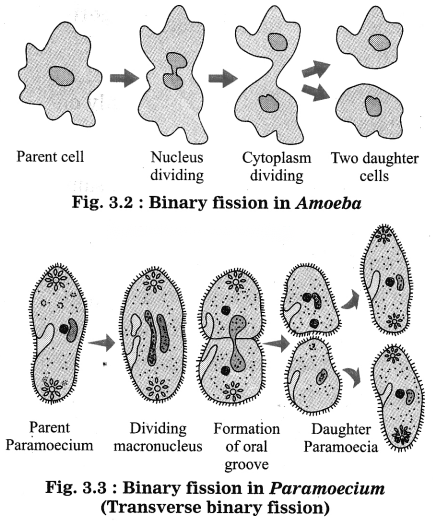
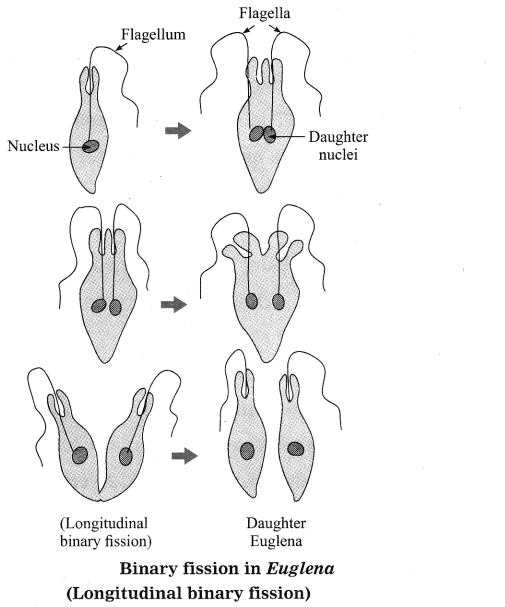
There are different methods of asexual reproduction in different unicellular animals. (1) Binary fission: The process in which the parent cell divides to form two similar daughter cells is binary fission. It takes place either by mitosis or amitosis. When there are favourable conditions and abundant food supply then the organisms undergo binary fission. Prokaryotes, Protists and eukaryotic 5 cell-organelle like mitochondria and chloroplasts perform binary fission.
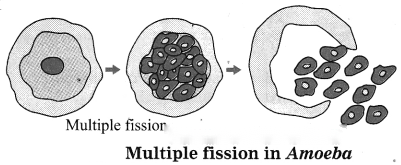
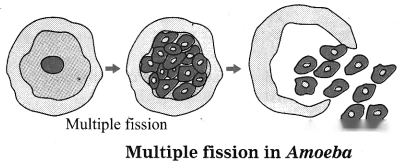
Based on axis of fission there are three subtypes of binary fission. (2) Multiple fission:
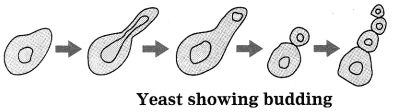
(3) Budding in yeast:
b. Explain the concept of IVF. c. Which precautions will you follow to maintain the reproductive health? d. What is menstrual cycle? Describe it in brief.
Question 5
Maharashtra Board Solution
In case of sexual reproduction, newborn show similarities about characters. Explain this statement with suitable examples.
Solution & Step-by-Step Answer:
(1) Sexual reproduction occurs due to two different gametes. One male gamete is from father while the other female gamete is from mother. (2) Both the gametes are produced by meiosis. (3) When the gametes unite it is called process of fertilization which produces diploid zygote. (4) Due to the chromosomes of parents, their DNA pass to the next generation through such fertilization. Therefore, the characters of newborn show similarities with parents.
Question 6
Maharashtra Board Solution
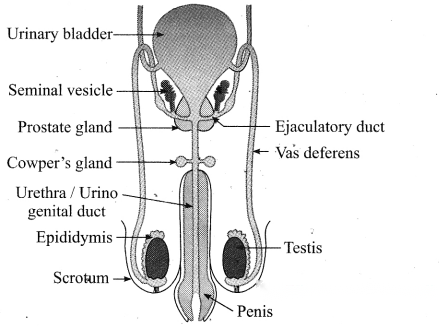
Sketch the labelled diagrams. a. Human male reproductive system.
Solution & Step-by-Step Answer:
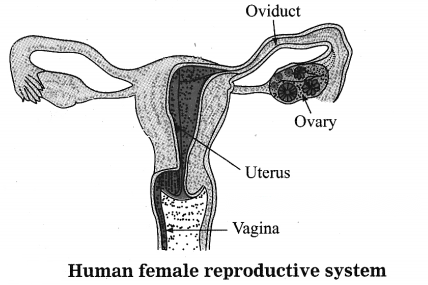
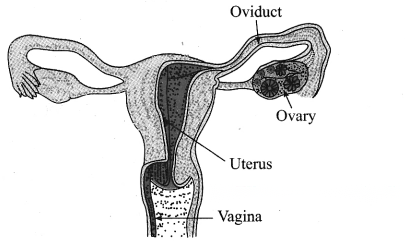
b. Human female reproductive system.
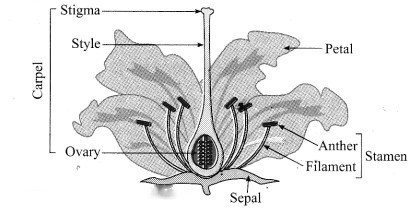
c. Flower with its reproductive organs.
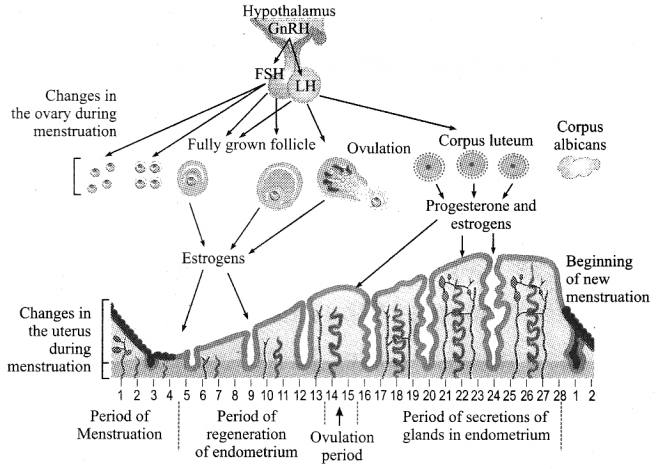
d. Menstrual cycle.
Question 7
Maharashtra Board Solution
Give the names. a. Hormones related with male reproductive system.
Solution & Step-by-Step Answer:
Follicle stimulating hormone and ICSH or Luteinizing hormone secreted by pituitary gland, testosterone secreted by testis.
b. Hormones secreted by ovary of female reproductive system. c. Types of twins. d. Any two sexual diseases. e. Methods of family planning.
Question 8
Maharashtra Board Solution
Gender of child is determined by the male? partner of couple. Explain with reasons whether this statement is true or false. (OR) “A couple shall have a male child or female child totally depends upon husband”. Prove truthfulness of this statement with scientific reason.
Solution & Step-by-Step Answer:
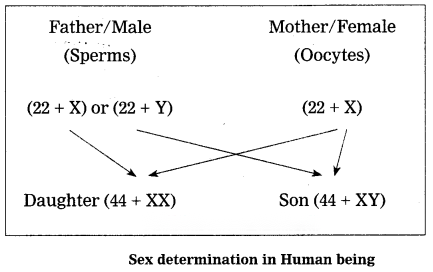
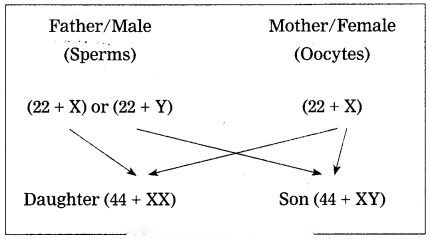
Sex determination in Human being (1) The statement Gender of child is determined by the male partner of couple is true. (2) It is clearly seen from the diagram that there are two types of sperms produced by males. One sperm has a X chromosome while the other has a Y chromosome, apart from autosomes. The mother on the other hand has all X bearing oocytes. Thus the sperm that fertilizes the oocyte decides the sex of the child. (3) If X bearing sperm fertilizes the oocyte, daughter is born and when Y bearing sperm fertilizes the oocyte, son is born. (4) Thus father or male partner is responsible for the determination of the sex.
Question 9
Maharashtra Board Solution
Explain asexual reproduction in plants.
Solution & Step-by-Step Answer:
Question 10
Maharashtra Board Solution
Modern techniques like surrogate mother, sperm bank and IVF technique will help the human beings. Justify this statement. OR Despite various diagnostic tests, a couple could not have a child. In this situation, which remedies will you suggest? (July 2019)
Solution & Step-by-Step Answer:
(1) Some couples want a child but they are not able to bear one due to various problems either in mother or in father. In such cases modern techniques such as IVF, surrogacy and sperm bank are useful in conceiving a child.
(2) These methods are as follows: Oocyte from real mother is taken out and fertilized with sperms collected from her husband. These gametes are fertilized outside in a test-tube and then the fertilized zygote is implanted in the surrogate mother. (ii) In Vitro Fertilization (IVF) is done when there are problems like less sperm count or obstacles in oviduct. In IVF, fertilization is done in the test-tube. The embryo formed is implanted in uterus of woman for further growth. (iii) Sperm bank: If man has problems with the sperm production, then the sperms are collected from the sperm bank. Sperm bank is the place where the donor’s donate the sperms and such sperms are kept stored. The donor’s identity is kept secret and he should also be physically and medically fit person.
Question 11
Maharashtra Board Solution
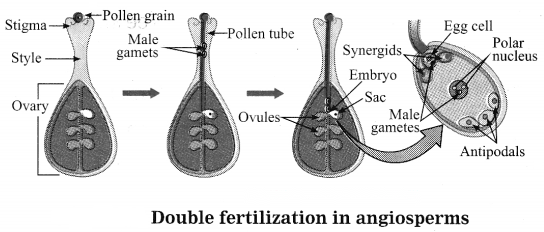
Explain sexual reproduction in plants. (OR) Explain double fertilization in plants.
Solution & Step-by-Step Answer:
Activities: (Do it your self)
Question 1
Maharashtra Board Solution
Collect the official data about present and a decade old population of various Asian countries and plot a graph of that data. With the help of it, draw your conclusions about demographic changes. |
Question 2
Maharashtra Board Solution
With the help of your teacher, compose and present a road show to increase the awareness about prenatal gender detection and gender bias. |
Can you recall? (Text Book Page No. 22)
Question 1. Which are the important life processes in living organisms?
Solution & Step-by-Step Answer:
block bg-white dark:bg-slate-900/80 border-l-4 border-emerald-500 rounded-r-xl p-5 my-3 shadow-xs border border-slate-200/60 dark:border-slate-800">
Solution & Step-by-Step Answer:
The important life processes in living organisms are respiration, circulation, nutrition, excretion, sensation and response through nervous system.
Question 2
Maharashtra Board Solution
Which life processes are essential for production of energy required by body?
Solution & Step-by-Step Answer:
The oxidation of nutrients that are absorbed in body is done because of oxygen supplied to cells by respiratory and circulatory system. This helps in liberation of energy. Thus respiration, circulation and nutrition are the life processes that are essential for production of energy required by body.
Question 3
Maharashtra Board Solution
Which are main types of cell division? What are the differences?
Solution & Step-by-Step Answer:
The main types of cell division are mitosis and meiosis. In mitosis, the chromosome number remains the same. 2 daughter cells are obtained from one cell. In meiosis, the chromosome number is reduced to half. From one cell, four daughter cells are obtained.
Question 4
Maharashtra Board Solution
What is the role of chromosomes in cell division?
Solution & Step-by-Step Answer:
Due to chromosomes, the DNA from parental cells enter into daughter cells. The hereditary, characters are transmitted to next generation by cell division.
Can you recall? (Text Book Page No. 22)
Question 1
Maharashtra Board Solution
What do we mean by maintenance of species?
Solution & Step-by-Step Answer:
Maintenance of species means a species undertakes successful reproduction and produces individuals of its own kind. This keeps the species existing on the earth.
Question 2
Maharashtra Board Solution
Whether the new organism is genetically exactly similar to earlier one that has produced it?
Solution & Step-by-Step Answer:
No. The new organism produced from the old one is not genetically exactly similar to the parents. In meiotic cell division there is crossing over in the homologous chromosomes. This produces genetic recombination. Thus the new organism is different from the earlier one. However, if the reproduction is of asexual type, then the young one is exactly similar to the parents.
Question 3
Maharashtra Board Solution
Who determines whether the two organisms of a species will be exactly similar or not?
Solution & Step-by-Step Answer:
The type of reproduction, whether it is asexual or sexual, the type of crossing over, the extent of genetic recombination, etc. determine the similarity among the parent organisms and their, offspring. Based on this genetic recombination the two organisms of a species do not show exact similarity. However, in case of monozygotic twins there is exact similarity. In asexual reproduction to there is similarity.
Question 4
Maharashtra Board Solution
What is the relationship between the cell division and formation of new organism of same species by earlier existing organism?
Solution & Step-by-Step Answer:
In the process of reproduction, there is division of chromosomes. Due to cell division, the gametes are formed. The union of gametes produce new offspring. In sexual reproduction, all these processes take place due to cell division. In asexual reproduction too there is cell division. Growth of new organism also occurs due to cell division.
Let’s Think: (Text Book Page No. 26)
Question 1
Maharashtra Board Solution
What would have been happened if the male and female gametes had been diploid?
Solution & Step-by-Step Answer:
Diploid (2n) gametes if united, they will form 4n, i.e. tetraploid variety. Such zygote will show severe abnormality. The chromosome number will not be maintained.
Question 2
Maharashtra Board Solution
What would have been happened if any of the cells in nature had not been divided by meiosis?
Solution & Step-by-Step Answer:
If meiosis does not happen the gametes produced will be diploid. This will create abnormality.
Can you recall? (Text Book Page No. 28)
Question 1
Maharashtra Board Solution
Which different hormones control the functions of human reproductive system through chemical coordination?
Solution & Step-by-Step Answer:
Pituitary gland secretes FSH and LH. LH is known as ICSH in males, as its function in the male body is different. From the gonads of male and female, hormones are secreted which are essential for male and female reproductive functions respectively. These hormones are testosterone secreted from testis in males and estrogen and progesterone secreted from the ovaries in females. Testosterone is essential for masculinity as well as for sperm production while female hormones are essential for changes in the female body leading to motherhood.
Question 2
Maharashtra Board Solution
Which hormones are responsible for changes in human body occurring during onset of sexual maturity?
Solution & Step-by-Step Answer:
Testosterone in male body and estrogen in female body are responsible for maturity onset changes in human body.
Question 3
Maharashtra Board Solution
Why has the Government of India enacted the law to fix the minimum age of marriage as 18 in girls and 21 in boys?
Solution & Step-by-Step Answer:
The full growth of female body is not completed till the age of 18. Till 18 years of age the physical and emotional maturity is not attained. Therefore, she is not suitable for marriage, sexual relationship and pregnancy. Similarly, boy attains complete growth only the age of 21. Therefore, to keep individuals and their progeny safe and healthy the Government of India enacted the law to fix the minimum age of marriage as 18 in girls and 21 in boys.
Can you recall? (Text Book Page No. 31)
Question 1
Maharashtra Board Solution
Which hormone is released from pituitary of mother once the foetal development is completed?
Solution & Step-by-Step Answer:
The hormone oxytocin is released from the posterior pituitary of mother once the foetal development is completed.
Question 2
Maharashtra Board Solution
Under the effect of that hormone, which organ of the female reproductive system starts to contract and thereby birth process (parturition) is facilitated?
Solution & Step-by-Step Answer:
Due to oxytocin, uterus contracts involuntarily and the baby is expelled out. Thus initiation of birth process is possible due to contractions of uterus.
Use your brain power. (Text Book Page No. 24)
Question 1
Maharashtra Board Solution
Does the parent cell exist after asexual reproduction-fission?
Solution & Step-by-Step Answer:
In fission, the parent cell divides into two. This nucleus and cytoplasm, both are divided. Thus, parent cell does not exist any longer, it is converted into new cells.
Choose the correct alternative and write that alphabet against the sub-question number:
Question 1
Maharashtra Board Solution
Pranav and Pritee are twins in your class. They belong to ……….. twins type. (a) monozygotic (b) dizyotic (c) siamese (d) none of the above
Solution & Step-by-Step Answer:
(b) dizyotic
Question 2
Maharashtra Board Solution
Longitudinal binary fission is seen in ………….. (a) Paramoecium (b) Euglena (c) Amoeba (d) Spirogyra
Solution & Step-by-Step Answer:
(b) Euglena
Question 3
Maharashtra Board Solution
Yeast cell performs asexual reproduction by …………….. (a) fragmentation (b) budding (c) binary fission (d) regeneration
Solution & Step-by-Step Answer:
(b) budding
Question 4
Maharashtra Board Solution
Carrot and raddish undergoes …………. with the help of their roots. (a) vegetative propagation (b) fragmentation (c) budding (d) regeneration
Solution & Step-by-Step Answer:
(a) vegetative propagation
Question 5
Maharashtra Board Solution
Androecium and gynoecium are ……….. whorl of the flower. (a) accessory (b) essential (c) external (d) internal
Solution & Step-by-Step Answer:
(b) essential
Question 6
Maharashtra Board Solution
Flowers without stalk are called ……….. flowers. (a) stalkless (b) sessile (c) incomplete (d) complete
Solution & Step-by-Step Answer:
(b) sessile
Question 7
Maharashtra Board Solution
………….. on the inner surface of fallopian ducts (oviducts) push the egg towards uterus. (a) Cilia (b) Tentacles (c) Flagella (d) Fibres
Solution & Step-by-Step Answer:
(a) Cilia
Question 8
Maharashtra Board Solution
Pregnant mother supplies nourishment to her foetus through ………….. (a) breasts (b) uterus (c) placenta (d) ovaries
Solution & Step-by-Step Answer:
(c) placenta
Question 9
Maharashtra Board Solution
The length of a sperm is about …………. micrometers. (a) 400 (b) 5 (c) 60 (d) 600 (July ’19)
Solution & Step-by-Step Answer:
(c) 60
Question 10
Maharashtra Board Solution
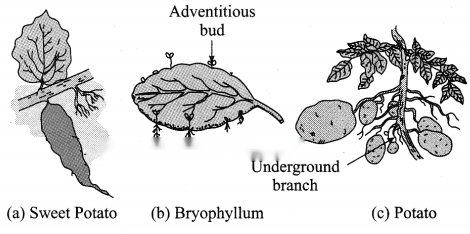
Vegetative propagation is performed with the help of ……….. in sweet potato. (a) root (b) stem (c) leaf (d) flower
Solution & Step-by-Step Answer:
(a) root
Question 11
Maharashtra Board Solution
Which of the following is not a unisexual flower? (a) Coconut (b) Papaya (c) Gulmohar (d) Maize
Solution & Step-by-Step Answer:
(c) Gulmohar
Write whether the following statements are true or false, with the suitable reason:
Question 1
Maharashtra Board Solution
Absence of genetic recombination is an advantage whereas fast process is drawback of asexual reproductive method.
Solution & Step-by-Step Answer:
False. (Absence of genetic recombination is a drawback whereas fast process is advantage of asexual reproductive method.)
Question 2
Maharashtra Board Solution
Prokaryotes show fission which occurs either by mitosis or amitosis.
Solution & Step-by-Step Answer:
True. (Prokaryotes show fission by both the methods, i.e. mitosis and amitosis.)
Question 3
Maharashtra Board Solution
During favourable conditions multiple fission is performed by amoeba.
Solution & Step-by-Step Answer:
False. (During unfavourable conditions multiple fission is performed by amoeba.)
Question 4
Maharashtra Board Solution
Any encysted Amoeba or any other protist is called ‘Cyst’.
Solution & Step-by-Step Answer:
True. (Cyst is the tough capsule like structure which keeps the protists dormant inside it. This helps the organisms to tide over unfavourable conditions.)
Question 5
Maharashtra Board Solution
If the body of Sycon breaks up accidentally into only large and few fragments, then only each fragment develops into new Sycon.
Solution & Step-by-Step Answer:
False. (If the body of Sycon breaks up accidentally into many fragments, each fragment develops into new Sycon. Because the capacity to regenerate is very strong in poriferan Sycon, even a small piece of parent Sycon can give rise to entire new individual.)
Question 6
Maharashtra Board Solution
Pollen tube reaches the zygote via style.
Solution & Step-by-Step Answer:
False. (Pollen tube reaches the embryo sac via style. Later, double fertilization takes place and the zygote and endosperm are formed.)
Question 7
Maharashtra Board Solution
There is glucose sugar in the semen.
Solution & Step-by-Step Answer:
False. (There is fructose sugar in the semen. Glucose is not present in semen.)
Question 8
Maharashtra Board Solution
Out of 2 – 4 million ova, approximately only 400 oocytes are released up to the age of menopause.
Solution & Step-by-Step Answer:
True. (During the reproductive span of the woman, from menarche to menopause only one oocyte per one month is released in the span of 30 to 35 years.)
Question 9
Maharashtra Board Solution
If the oocyte is fertilized, secretion of estrogen and progesterone stops completely.
Solution & Step-by-Step Answer:
False. (If the oocyte is not fertilized, there is no need of corpus luteum which secretes progesterone. In absence of conception, the progesterone is not needed, thus corpus luteum degenerates and forms corpus albicans.)
Question 10
Maharashtra Board Solution
During menstruation there is need of rest along with special personal hygiene.
Solution & Step-by-Step Answer:
True. (During phase of menstruation there is pain and bleeding in woman. Her body is also susceptible for infections. There is weakness and hence she needs rest along with special personal hygiene.)
Find the odd one out:
Question 1
Maharashtra Board Solution
Circulation, Excretion, Sensation, Reproduction.
Solution & Step-by-Step Answer:
Reproduction. (All others are processes necessary for survival of the individual.)
Question 2
Maharashtra Board Solution
Budding in hydra, Regeneration, Binary fission, Fragmentation
Solution & Step-by-Step Answer:
Binary fission. (All others are processes of asexual reproduction in multicellular organisms.)
Question 3
Maharashtra Board Solution
Carrot, Radish, Potato, Sweet potato.
Solution & Step-by-Step Answer:
Potato. (All others are edible roots.)
Question 4
Maharashtra Board Solution
Vas eferens, vas deferens, prostate gland, epididymis.
Solution & Step-by-Step Answer:
Prostate gland. (All others are duct systems in male reproductive system.)
Question 5
Maharashtra Board Solution
Prostate gland, Bartholin’s gland, Cowper’s gland, Epididymis.
Solution & Step-by-Step Answer:
Bartholin’s glands. (All others are parts of male reproductive system.)
Question 6
Maharashtra Board Solution
Stigma, style, pollen, ovary.
Solution & Step-by-Step Answer:
Pollen. (All others are parts of gynoecium.)
Identify the correlation between the first two words and suggest the suitable words in the fourth place:
Question 1
Maharashtra Board Solution
Amoeba : Fission : : Hydra : ………….
Solution & Step-by-Step Answer:
Amoeba : Fission : : Hydra : Budding
Question 2
Maharashtra Board Solution
Transverse binary fission : Paramoecium : : Longitudinal binary fission : ………… (July ‘19)
Solution & Step-by-Step Answer:
Transverse binary fission : Paramoecium : : Longitudinal binary fission : Euglena
Question 3
Maharashtra Board Solution
Calyx : Sepals : : Corolla : ………….
Solution & Step-by-Step Answer:
Calyx : Sepals : : Corolla : Petals
Question 4
Maharashtra Board Solution
Accessory whorls : Calyx and corolla : : Essential whorls : ………..
Solution & Step-by-Step Answer:
Accessory whorls : Calyx and corolla : : Essential whorls : Androecium and gynoeciuin
Question 5
Maharashtra Board Solution
Bisexual flower : Hibiscus : : Unisexual flower : ………….
Solution & Step-by-Step Answer:
Bisexual flower : Hibiscus : : Unisexual flower : Papaya
Question 6
Maharashtra Board Solution
FSH : Development of qocyte : : LH : ………….
Solution & Step-by-Step Answer:
FSH : Development of qocyte : : LH : Ovulation
Define the following/Give meanings of the following:
Question 1
Maharashtra Board Solution
Budding in yeast.
Solution & Step-by-Step Answer:
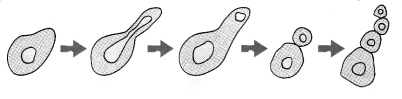
Budding in yeast: Budding is the asexual reproductive process in which a! small bulge or bud appears on the surface of parent cell as seen in unicellular yeast.
Question 2
Maharashtra Board Solution
Budding in hydra.
Solution & Step-by-Step Answer:
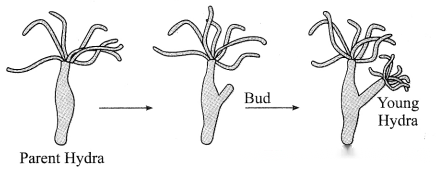
Budding in hydra: Budding in hydra is asexual reproductive process in which an outgrowth is formed by repeated divisions of regenerative cells of body wall called bud.
Question 3
Maharashtra Board Solution
Regeneration.
Solution & Step-by-Step Answer:
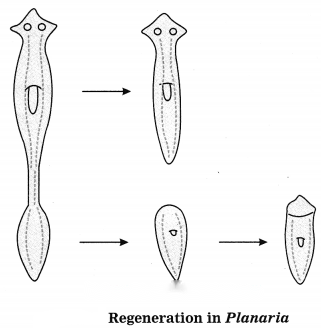
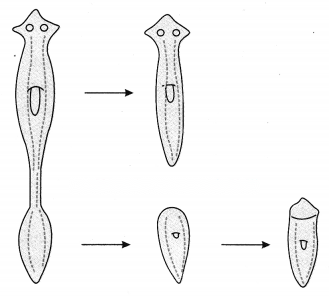
Regeneration: Regeneration is the asexual reproduction in Planaria in which the body is broken up into two parts and resulting each part regenerates remaining part of the body.
Question 4
Maharashtra Board Solution
Fragmentation.
Solution & Step-by-Step Answer:
Fragmentation: Fragmentation is the asexual type of reproduction in which the body of parent organism breaks up into many fragments. Each fragment can start living independently.
Question 5
Maharashtra Board Solution
Vegetative propagation.
Solution & Step-by-Step Answer:
Vegetative propagation: Vegetative propagation is a type of asexual reproduction in plants that takes place with the help of vegetative parts like root, stem, leaf and bud.
Question 6
Maharashtra Board Solution
Fertilization.
Solution & Step-by-Step Answer:
Fertilization: The process by which two haploid gametes unite to form a diploid zygote is called fertilization.
Question 7
Maharashtra Board Solution
Pedicel.
Solution & Step-by-Step Answer:
Pedicel: The stalk of the flower which is for the support is called pedicel.
Question 8
Maharashtra Board Solution
Pollination.
Solution & Step-by-Step Answer:
Pollination: Transfer of pollen grains from anther to the stigma is called pollination.
Question 9
Maharashtra Board Solution
Self-Pollination.
Solution & Step-by-Step Answer:
Self-Pollination: Pollination involving only one flower or two flowers borne on same plant is called self-pollination.
Question 10
Maharashtra Board Solution
Cross-Pollination.
Solution & Step-by-Step Answer:
Cross-Pollination: Pollination involving two flowers borne on two plants of same species is cross-pollination.
Question 11
Maharashtra Board Solution
Endosperm.
Solution & Step-by-Step Answer:
Endosperm: Endosperm is the nourishing substance formed by the union of second male gamete with two polar nuclei at the time of fertilization in plants.
Question 12
Maharashtra Board Solution
Embryo sac.
Solution & Step-by-Step Answer:
Embryo sac: There are many ovules in the ovary, the structure formed in each of the ovule by meiosis is called embryo sac.
Question 13
Maharashtra Board Solution
Menopause.
Solution & Step-by-Step Answer:
Menopause: Stoppage of functioning of female reproductive system due to lack of synthesis of hormones due to advancing age is called menopause.
Question 14
Maharashtra Board Solution
Placenta.
Solution & Step-by-Step Answer:
Placenta: An organ developed in the uterus of the pregnant mother, through which the embryo is given nourishment is called placenta.
Question 15
Maharashtra Board Solution
Menstrual cycle.
Solution & Step-by-Step Answer:
Menstrual cycle: The repetitive changes at the interval of every 28-30 days in female reproductive system that take place after puberty, form menstrual cycle.
Question 16
Maharashtra Board Solution
Corpus luteum.
Solution & Step-by-Step Answer:
Corpus luteum: Corpus luteum is the secondary structure that is formed from empty ovarian follicle after ovulation. This corpus luteum produces progesterone and thereby maintains pregnancy.
Question 17
Maharashtra Board Solution
Corpus albicans.
Solution & Step-by-Step Answer:
Corpus albicans: Corpus albicans is the degenerate body which is formed from corpus luteum, if the ovum is not fertilized.
Question 18
Maharashtra Board Solution
Ovulation.
Solution & Step-by-Step Answer:
Ovulation: Bursting of mature ovarian follicle under the influence of hormones to release the oocyte is called ovulation.
Question 19
Maharashtra Board Solution
IVF.
Solution & Step-by-Step Answer:
IVF: In Vitro Fertilization is the technique in which fertilization is brought about outside the female body but in the test-tube and the embryo is implanted in uterus of woman.
Question 20
Maharashtra Board Solution
Sperm bank.
Solution & Step-by-Step Answer:
Sperm bank: Sperm bank is the place where semen donated by the desired men is collected after their thorough physical and medical check-up and stored at sub-zero temperatures in sterile conditions.
Name the following/Give the names:
Question 1
Maharashtra Board Solution
Different glands associated with male reproductive system.
Solution & Step-by-Step Answer:
Seminal vesicles, Prostate gland, Cowper’s or bulbourethral glands.
Question 2
Maharashtra Board Solution
Agents of pollination.
Solution & Step-by-Step Answer:
Biotic: Insects, birds, few animals. Abiotic: Water and wind.
Question 3
Maharashtra Board Solution
Components of semen.
Solution & Step-by-Step Answer:
Secretion of prostate gland seminal vesicles and Cowper’s glands along with sperms.
Question 4
Maharashtra Board Solution
Two accessory whorls in flower.
Solution & Step-by-Step Answer:
Calyx and corolla.
Question 5
Maharashtra Board Solution
Two essential whorls in flower.
Solution & Step-by-Step Answer:
Androecium and gynoecium.
Question 6
Maharashtra Board Solution
The modern techniques in reproduction.
Solution & Step-by-Step Answer:
In Vitro Fertilization, Surrogate mother, Sperm bank.
Question 7
Maharashtra Board Solution
Symptoms of gonorrhea.
Solution & Step-by-Step Answer:
Painful and burning sensation during urination, oozing of pus through penis and vagina, inflammation of urinary tract, anus, throat, eyes, etc.
Question 8
Maharashtra Board Solution
Symptoms of syphilis.
Solution & Step-by-Step Answer:
Occurrence of chancre (patches) on various parts of body including genitals, rash, fever, inflammation of joints, alopecia, etc.
Write the functions of the following organs:
Question 1
Maharashtra Board Solution
Sporangium.
Solution & Step-by-Step Answer:
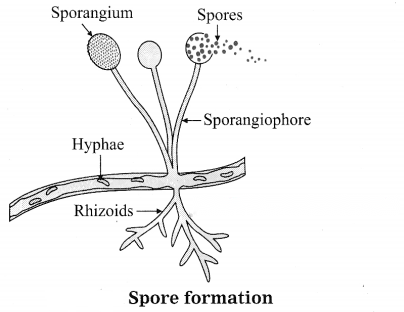
Storing the spores and releasing them by bursting.
Question 2
Maharashtra Board Solution
Calyx.
Solution & Step-by-Step Answer:
Protection of inner whorls of the flower.
Question 3
Maharashtra Board Solution
Corolla.
Solution & Step-by-Step Answer:
Attracting insects for pollination. Protecting inner whorls.
Question 4
Maharashtra Board Solution
Androecium.
Solution & Step-by-Step Answer:
Production of pollen grains, the male gametes of flower.
Question 5
Maharashtra Board Solution
Gynoecium.
Solution & Step-by-Step Answer:
Production of female gametes of flower. Participating in production of fruits.
Question 6
Maharashtra Board Solution
Endosperm.
Solution & Step-by-Step Answer:
Nourishment of the growing embryo.
Question 7
Maharashtra Board Solution
Testis.
Solution & Step-by-Step Answer:
Production of sperms and male hormone-testosterone.
Question 8
Maharashtra Board Solution
Scrotum.
Solution & Step-by-Step Answer:
Protection and temperature control of testis.
Question 9
Maharashtra Board Solution
Seminal vesicles.
Solution & Step-by-Step Answer:
Secretion of seminal fluid which forms major portion of semen. Nourishment of sperms.
Question 10
Maharashtra Board Solution
Penis.
Solution & Step-by-Step Answer:
Transferring of sperms to vagina at the time of intercourse. Release of urine at the time of urination.
Question 11
Maharashtra Board Solution
Ovary.
Solution & Step-by-Step Answer:
Production of oocytes and female hormones – estrogen and progesterone.
Question 12
Maharashtra Board Solution
Uterus.
Solution & Step-by-Step Answer:
Growth and development of foetus during pregnancy. Helping in parturition (childbirth) by contractions.
Question 13
Maharashtra Board Solution
Fallopian tubes/ducts.
Solution & Step-by-Step Answer:
Transporting the released oocyte after ovulation to the uterus. Providing space for fertilization of oocyte by sperm. Conception is possible only when sperm and oocyte meet in the fallopian tube.
Question 14
Maharashtra Board Solution
Vagina.
Solution & Step-by-Step Answer:
Passage for copulation/intercourse. Birth canal. Passage for menstrual flow.
Question 15
Maharashtra Board Solution
Placenta.
Solution & Step-by-Step Answer:
Supplying nourishment to the growing foetus.
Distinguish between:
Question 1
Maharashtra Board Solution
Binary fission and Multiple fission.
Solution & Step-by-Step Answer:
Binary fission:
Multiple fission:
Question 2
Maharashtra Board Solution
Human male and Human female reproduction system.
Solution & Step-by-Step Answer:
Human male reproductive system:
Human female reproductive system:
Question 3
Maharashtra Board Solution
Monozygotic twins and Dizygotic twins.
Solution & Step-by-Step Answer:
Monozygotic twins:
Dizygotic twins: Give scientific reasons:
Question 1
Maharashtra Board Solution
Individual developed by sexual reproduction always carry recombined genes of both the parents.
Solution & Step-by-Step Answer:
Question 2
Maharashtra Board Solution
Flower is the structural unit of sexual reproduction in plant.
Solution & Step-by-Step Answer:
Question 3
Maharashtra Board Solution
Fertilization in plants is called double fertilization.
Solution & Step-by-Step Answer:
Question 4
Maharashtra Board Solution
By the age of 45 – 50 women gets menopause.
Solution & Step-by-Step Answer:
Question 5
Maharashtra Board Solution
Older mothers have greater chance of conceiving abnormal children.
Solution & Step-by-Step Answer:
Question 6
Maharashtra Board Solution
Indians should follow family planning for controlling the population.
Solution & Step-by-Step Answer:
Answer the following questions in short:
Question 1
Maharashtra Board Solution
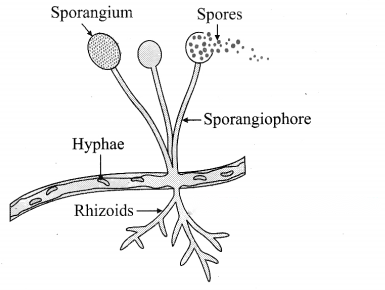
How does reproduction take place in fungus Mucor?
Solution & Step-by-Step Answer:
Question 2
Maharashtra Board Solution
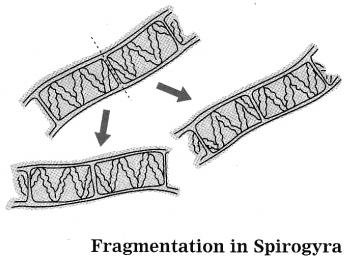
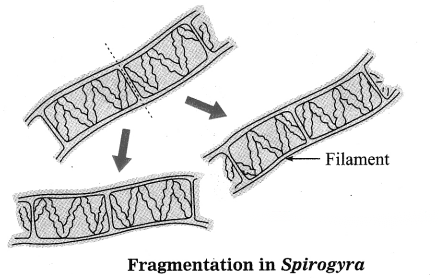
What is the type of asexual reproduction shown in the diagram below? (Board’s Model Activity Sheet)
Solution & Step-by-Step Answer:
Type of asexual reproduction shown in the diagram above is fragmentation in Spirogyra.
Question 3
Maharashtra Board Solution
Describe the structure of a flower.
Solution & Step-by-Step Answer:
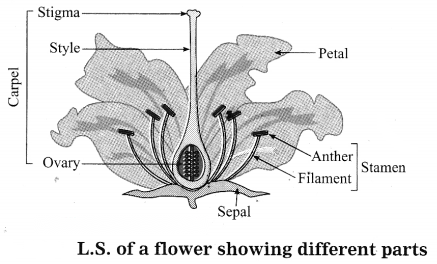
(1) The structural unit of sexual reproduction in plants is flower. There are total four floral whorls. Of these, two are accessory floral whorls while two are essential floral whorls. (2) Calyx and corolla are accessory whorls. They are protective in nature. (3) Members of calyx are known as sepals. They are usually green in colour. They protect the inner whorls. (4) The members of corolla are called petals. They can be of different colours. (5) Androecium and gynoecium are essential whorls as they participate in sexual reproduction. (6) The male whorl androecium is made up of stamens. Each stamen has a filament with anther located at the upper end. In the anther there are four locules. Inside the locules the meiosis takes place forming pollen grains. During suitable time, the pollen grains are released from anther lobes. (7) Gynoecium is made up of carpels, either in separate form or are united. Each carpel is formed of ovary at the basal end hollow ‘style’ and the stigma at the tip of style. There are one or many ovules inside the ovary. (8) In bisexual flowers both androecium and gynoecium are located in the same flower, e.g. Hibiscus. (9) In unisexual flowers, androecium is present in male flowers and gynoecium is present in the female flowers, e.g. Papaya.
Question 4
Maharashtra Board Solution
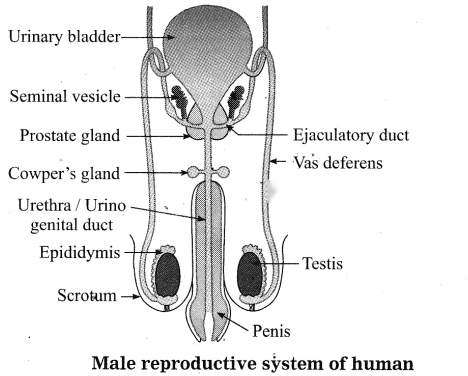
Describe the human male reproductive system.
Solution & Step-by-Step Answer:
In human male reproductive system, the reproductive organs are as follows:
Question 5
Maharashtra Board Solution
Describe the human female reproductive system.
Solution & Step-by-Step Answer:
Question 6
Maharashtra Board Solution
What problems cause infertility in couple?
Solution & Step-by-Step Answer:
Question 7
Maharashtra Board Solution
Answer the following questions: (July 2019) (a) In our country, there seems to be lack of awareness regarding reproductive health. Why? (b) Write the symptoms of disease gonorrhea. (c) What precautions will you take to maintain reproductive health?
Solution & Step-by-Step Answer:
(a) There is lack of awareness about reproductive health among majority of people of our country. This is due to social customs, traditions, illiteracy, social taboo and shyness.
(b) Symptoms of gonorrhea are as follows: (c) Precautions to maintain reproductive health are cleanliness and personal hygiene. Guarding against any sexual infections.
Question 8
Maharashtra Board Solution
If a piece of bread is kept in a container in moist place for 2-3 days, (1) What will you see? (2) Write scientific name and a character of the organism you may observe.
Solution & Step-by-Step Answer:
(1) If a piece of bread is kept in moist container we can see growth of fungus on it. (2) Fungi belonging to species Mucor is seen. It has filamentous body and sporangia. Sporangia burst open to spread spores. It has saprophytic mode of nutrition as it devoid of chlorophyll.
Write short notes on:
Question 1
Maharashtra Board Solution
Multiple fission.
Solution & Step-by-Step Answer:
During unfavourable conditions when there is lack of food. multiple fission is shown by amoeba. Amoeba forms protective covering and becomes encysted. Inside the cyst, amoeba undergoes repeated nuclear division. This is followed by cytoplasmic divisions. Many amoebulae are formed which remain dormant inside the cyst. When favourable conditions reappear, they come out by breaking the cyst.
Question 2
Maharashtra Board Solution
Regeneration.
Solution & Step-by-Step Answer:
In developed animals like wall lizard the process of regeneration is used to restore the lost parts like tail or limbs. As the reproductive system is one of the fullfledged system in the body, the process of regeneration cannot be called type of reproduction.
But some primitive organisms such as Plarfaria use this method for procreation. Planaria breaks up its body into two parts. Each part has the ability to develop the lost part by process of regeneration. This forms two new Planaria.
Question 3
Maharashtra Board Solution
Seed germination.
Solution & Step-by-Step Answer:
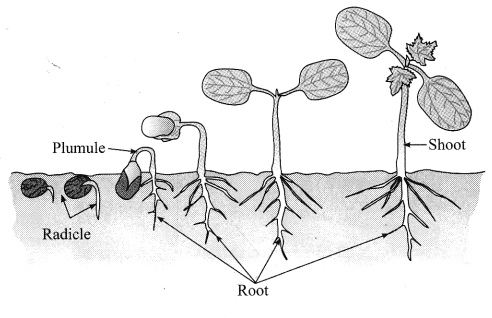
Seed germination is the process in which the seed develops into a new plantlet. In the plants, after fertilization the ovule develops into seed and ovary turns into fruit. Seeds fallen on the ground due to bursting of the fruits start germinating. Only under favourable conditions in the soil, this germination takes place. The zygote present inside the seed uses food stored in endosperm of seed and hence develops further to produce a new plantlet.
Question 4
Maharashtra Board Solution
Budding in hydra.
Solution & Step-by-Step Answer:
In multicellular organisms asexual reproduction by budding is shown by hydra. In fully grown Hydra, at specific part of its body there is development of bud.
This development is only during favourable period. The bud is an outgrowth developed due to repeated divisions of regenerative cells of body wall. It grows up gradually to form a small hydra. Parent hydra’s dermal layers and digestive cavity are in continuity with those of the budding hydra. It receives all the nutrition from parent hydra.When the budding hydra grows sufficiently, it detaches from parent hydra. Then it leads an independent life.
Question 5
Maharashtra Board Solution
Fragmantation.
Solution & Step-by-Step Answer:
Fragmentation is one of the type of asexual reproduction in multicellular organisms. During fragmentation, the body of parent organism breaks up into many fragments. All the resulting fragments start to develop as an independent new organism. In alga Spirogyra, and sponge like Sycon asexual reproduction takes place by fragmentation. Spirogyra grow up very fast and break up into many small fragments when there are favourable conditions. Each newly formed fragment lives independently as a new Spirogyra. Similarly the body of Sycon if accidentally broken into many fragments, develops into new Sycon from each old fragment.
Question 6
Maharashtra Board Solution
Monozygotic twins.
Solution & Step-by-Step Answer:
The twins developed from a single embryo are called monozygotic twins. If within 8 days of zygote formation i.e. in early embryonic development cells of that embryo divide into two groups. Each one develop as two separate embryos forming two monozygotic twins. Monozygotic twins are genetically exactly similar to each other. The gender of the twins is also same.
The Siamese twins develop from monozygotic twins, if the embryonic cells are divided into two groups 8 days after the zygote formation. These are conjoined twins where some parts of body are joined to each other. Also some organs are common in Siamese twins. Read the paragraph and answer the questions given below: Reproduction is the process by which the living species continues its existence. Lower organisms carry out asexual reproduction while higher plants and animals always show sexual reproduction. Plants reproduce asexually by methods such as fragmentation, vegetative propagation, budding, spore formation. For sexual reproduction they form gametes. In animal kingdom, budding, fission of different types and parthenogenesis are some of the methods that do not require both the sexes. Though regeneration also forms new individual, it is not considered to be a reproductive process because, basically it is a repair process. The ability to regenerate is lost in higher phyla. In human beings | it is restricted only to wound healing. Sexual reproduction is also undergoing lots of experimentation such as cloning which may make females capable of producing their own baby without intervention of any male. Questions and Answers:
Question 1
Maharashtra Board Solution
How do living species continue their existence?
Solution & Step-by-Step Answer:
Through the process of reproduction, living species continue their existence.
Question 2
Maharashtra Board Solution
Which are asexual methods of reproduction in kingdom Animalia?
Solution & Step-by-Step Answer:
Fission, budding and parthenogenesis are the asexual methods of reproduction in Kingdom Animalia.
Question 3
Maharashtra Board Solution
Why is regeneration not true method of reproduction?
Solution & Step-by-Step Answer:
Regeneration is the repair process than a reproductive process. It is not done with the intention of producing offspring, but is for healing or repairing the lost part.
Question 4
Maharashtra Board Solution
What are methods of reproduction in plants?
Solution & Step-by-Step Answer:
Plants reproduce by asexual as well as sexual methods. Asexual reproduction is by fragmentation, vegetative propagation, budding, spore formation, while by formation of gametes, sexual reproduction is done.
Question 5
Maharashtra Board Solution
What is the modern method of reproduction aimed at in higher organisms?
Solution & Step-by-Step Answer:
Cloning is the modern method of reproduction by which production of young one can be aimed at.
Diagram-based Questions:
Question 1
Maharashtra Board Solution
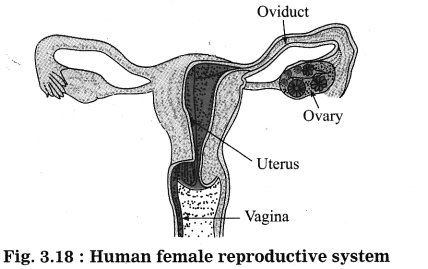
Observe the figure 3.18 and answer the questions below: (Board’s Model Activity Sheet) (a) What does the figure 3.18 indicate?
Solution & Step-by-Step Answer:
The figure indicates the menstrual cycle in human female.
(b) Which human organs are involved in this process? (c) Which hormones take part in this process? (d) What is the periodicity for these changes? (e) The body of woman undergoing this process is impure, she should remain away from other people. What is your opinion about this statement? Give justification for your opinion. She should get enough rest and nutrition during this period. It is painful period in which there is a possibility of infections. Therefore, she should take ! hygienic care and rest till the bleeding persists. But blind faith and superstition to keep her away from others should not be followed.
Question 2
Maharashtra Board Solution
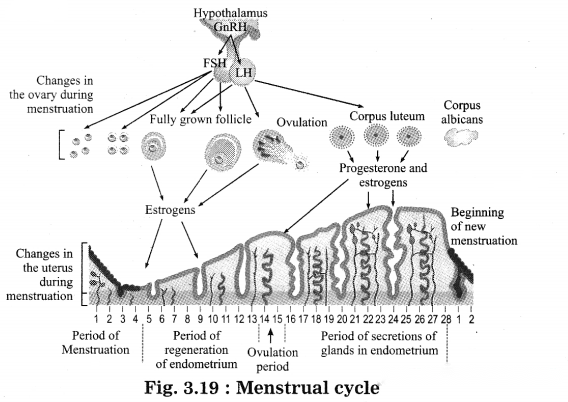
Observe the diagram (Fig. 3.19) of menstrual cycle and answer the following questions: (1) What is the period of menstruation?
Solution & Step-by-Step Answer:
1 to 5 days is the period of menstruation.
(2) On which day does ovulation occur during menstrual cycle? (3) During which period is corpus luteum active during menstrual cycle? Which hormones are secreted by corpus luteum ? (4) In menstrual cycle which reproductive organs undergo changes? (5) Which period is said to be period of regeneration of endometrium? (6) Which period is said to be period of secretions of glands in endometrium?
Question 3
Maharashtra Board Solution
Observe the following picture and describe the type of reproduction shown in.
Solution & Step-by-Step Answer:
In developed animals like wall lizard the process of regeneration is used to restore the lost parts like tail or limbs. As the reproductive system is one of the fullfledged system in the body. the process of regeneration cannot be called type of reproduction.
But some primitive organisms such as Planaria use this method for procreation. Planaria breaks up its body into two parts. Each part has the ability to develop the lost part by process of regeneration. This forms two new Planaria.
Question 4
Maharashtra Board Solution
Answer the following questions: (March 2019) (a) “Gender of child is determined by the male partner of couple.” Draw a diagram explaining the above statement.
Solution & Step-by-Step Answer:
(b) Prepare a slogan for campaign against female foeticide. (c) In the following figure, explain how new fungal colonies of mucor are formed:
(d) Identify and state the type of reproduction represented in the above figure.
Question 5
Maharashtra Board Solution
Write the type of asexual reproduction shown in the figure.
Solution & Step-by-Step Answer:
The figure shows budding in yeast. Budding is the type of asexual reproduction.
Experiments: (1) Observation of Paramoecia. Projects: Project 1. Project 2. Project 3. |