Maharashtra State Board Class 10 Science Solutions Part 2 Chapter 7 Introduction to Microbiology
a. Process of ……. of milk proteins occurs due to lactic acid.
Process of Coagulation of milk proteins occurs due to lactic acid.
Explanation: The lactobacilli are the bacteria carrying out fermentation of the milk. In this process, the lactose sugar in the milk is converted into lactic acid. This lactic acid causes coagulation of the proteins present in the milk.
b. Harmful bacteria like ………. in the intestine are destroyed due to probiotics.
Answer:
Harmful bacteria like Clostridium in the intestine are destroyed due to probiotics.
Explanation: In probiotics, there are lactobacilli which are useful. They control other bacteria present in the alimentary canal and also their metabolism. These bacteria thus stop the action of Clostridium which is a harmful bacteria.
c. Chemically, vinegar is …………
Answer:
Chemically, vinegar is 4% Acetic acid.
Explanation: Chemically vinegar is 4% acetic acid. It is a good preservative of the food and thus while using it as additive to the food, it is called vinegar.
d. Salts which can be used as supplement of calcium and iron are obtained from ……………. acid.
Answer:
Salts which can be used as supplement of calcium and iron are obtained from Gluconic acid.
Explanation: The microbe Aspergillus niger is used on the source material of glucose and corn steep liquor to produce amino acid called Gluconic acid. Gluconic acid is used for the production of minerals used as supplement for calcium and iron.
Question 2
Maharashtra Board Solution
Match the pairs.
[Note: In examination match the column question will ham 2 components in Column ‘A’ with 4 alternatives in Column ‘B’.]
Solution & Step-by-Step Answer:
(1) Xylitol – To impart sweetness
(2) Citric acid – To impart acidity (3) Lycopene – Pigment (4) Nycin – Microbial restrictor.
Question 3
Maharashtra Board Solution
Answer the following: a. Which fuels can be obtained by microbial processes? Why is it necessary to increase the use of such fuels?
Solution & Step-by-Step Answer:
b. How can the oil spills of rivers and oceans be cleaned? c. How can the soil polluted by acid rain be made fertile again? d. Explain the importance of bio pesticides in organic farming. e. What are the reasons for increasing the popularity of probiotic products? All these facts have made probiotics a popular choice for people. f. How the bread and other products produced using baker’s yeast are nutritious? g. Which precautions are necessary for proper decomposition of domestic waste? The decomposition process can be done at house-hold level too in a pot or a tank. This decomposition will yield a rich manure. The pot should be covered by a thin layer of soil and it should be kept in a dark but airy place. The non-biodegradable things such as plastic articles, glass pieces, metal objects, unused 5 medicines, e-waste should never be thrown in wet wastes. The toxic substances and the insecticides if added to wet waste, will never allow the natural decomposition process. Therefore, only after taking proper precautions we can aim at proper decomposition of domestic wastes. h. Why is it necessary to ban the use of plastic bags? If thrown in water bodies, it causes harm to aquatic life. Cattle graze on plastic unknowingly and are killed by it as it clogs inside their alimentary canal. The gutters and rain water drains get clogged due to plastic bags and this causes cities to submerge in water during heavy rains. Nowadays, the fishermen get more than half of plastic if they cast their net in the sea. People use the plastic bags indiscriminately without any thought towards their environmental impact. There are better alternatives for plastic bags such as cloth bags which can be reused again and again. Therefore, it is absolutely necessary to ban the use of plastic bag.
Question 4
Maharashtra Board Solution
Complete the following conceptual picture.
Solution & Step-by-Step Answer:
Question 5
Maharashtra Board Solution
Give scientific reasons. a. Use of mutant strains has been increased in industrial microbiology.
Solution & Step-by-Step Answer:
b. Enzymes obtained by microbial process are mixed with detergents. c. Microbial enzymes are used instead of chemical catalysts in chemical industry. (March 2019)
Question 6
Maharashtra Board Solution
Complete the following conceptual picture with respect to its uses. (Board’s Model Activity Sheet)
Solution & Step-by-Step Answer:
Question 7
Maharashtra Board Solution
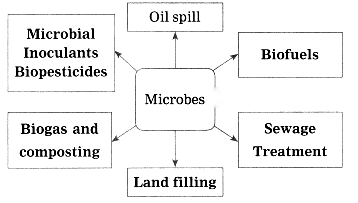
Complete the following conceptual picture related to environmental management.
Solution & Step-by-Step Answer:
Question 8
Maharashtra Board Solution
Answer the following questions. a. What is the role of microbes in compost production?
Solution & Step-by-Step Answer:
b. What are the benefits of mixing ethanol with petrol and diesel? The particulate pollutants which otherwise are emitted through combustion of petrol and diesel are not formed when fuels are mixed with ethanol. By adding ethanol to the fuels, the cost of expensive petrol or diesel also becomes less. The ethanol burns more efficiently hence ethanol is mixed with petrol and diesel. c. Which plants are cultivated to obtain the fuel? d. Which fuels are obtained from biomass? e. How does the bread become spongy? Project: (Do it your self) Project 1. Project 2. Project 3. Can you recall? (Text Book Page No. 77)
Question 1
Maharashtra Board Solution
Which different microbes are useful to us?
Solution & Step-by-Step Answer:
Many microbes are useful to us, such as bacteria which are used for making curds from milk, yeast used to ferment the batter of bread, bacteria used for making other milk products, bacteria and fungi used for making antibiotics. The bacteria are even used for pollution control.
Question 2
Maharashtra Board Solution
Which different products can he produced with the help of Microbes?
Solution & Step-by-Step Answer:
Milk products, cheese, cocoa, pickles made from vegetables, wine and other beverages, bread, probiotic substances and cattle feed are produced with the help of microbes.
Use your brain power. (Text Book Page No. 79)
Question 1
Maharashtra Board Solution
In the earlier class, you had prepared the solution of dry yeast for observation of yeast. Which substance is prepared by its use on commercial basis?
Solution & Step-by-Step Answer:
The commercial production of bread and other bakery products need yeast. In wine and beer making also solution of yeast is required.
(Use your brain power. (Text Book Page No. 81)
Question 1
Maharashtra Board Solution
Food materials like cold drinks, ice creams, cakes, juices are available in various colours and flavours. Whether these colours and flavours are really derived from fruits?
Solution & Step-by-Step Answer:
The eatables can be made directly from fruits or essence of fruits. But most of the food products purchased from markets use these colours and flavours which are derived from synthetic chemicals.
Let’s Think: (Text Book Page No. 83) Question.1 On the contrary if everything is dumped indiscriminately, it adds to the total volume of the solid wastes. This becomes unmanageable. Therefore, to reduce the problems of solid waste management, the dry and wet waste segregation must be done at every point source. This also could fetch wealth from waste.
Question 2
Maharashtra Board Solution
What is done with the segregated waste?
Solution & Step-by-Step Answer:
In big cities, there is a mechanism to pick up the solid waste every day or even twice a day at some places. The segregated garbage is taken by the municipal garbage trucks at the land filling sites. Here it is buried deep in the ground. The dry waste that can be reused or recycled, is sold to the recycling units.
Question 3
Maharashtra Board Solution
Which is most appropriate method of disposal of dry waste?
Solution & Step-by-Step Answer:
Reuse and recycle is the most appropriate method of disposal of dry waste.
Choose the correct alternative and write its alphabet against the sub-question number:
Question 1
Maharashtra Board Solution
Enzyme ……….. obtained from fungi is used to produce vegetarian cheese. (a) lipase (b) protease (c) amylase (d) trypsin
Solution & Step-by-Step Answer:
(b) protease
Question 2
Maharashtra Board Solution
Milk is subjected to ………… at the beginning to destroy unwanted microbes. (a) pasteurization (b) fermentation (c) coagulation (d) decomposition
Solution & Step-by-Step Answer:
(a) pasteurization
Question 3
Maharashtra Board Solution
………….. like compounds are formed due to lactobacilli that gives characteristic taste to the yoghurt. (a) Lactose (b) Caesin (c) Acetyldehyde (d) All the above
Solution & Step-by-Step Answer:
(c) Acetyldehyde
Question 4
Maharashtra Board Solution
Methane can be obtained by …………. decomposition of urban agricultural and industrial waste. (a) aerobic (b) anaerobic (c) microbial anaerobic (d) chemical
Solution & Step-by-Step Answer:
(c) microbial anaerobic
Question 5
Maharashtra Board Solution
……….. gas is considered to be the fuel of future. (a) Hydrogen (b) Nitrogen (c) Methane (d) Butane
Solution & Step-by-Step Answer:
(a) Hydrogen
Question 6
Maharashtra Board Solution
………. are mixed with waste materials at land-filling sites for quicker decomposition. (a) Microbes (b) Bioreactors (c) Fungi (d) Worms
Solution & Step-by-Step Answer:
(b) Bioreactors
Question 7
Maharashtra Board Solution
…………. bacteria decompose the xenobiotic chemicals present in sewage. (a) Hydrocarbonoclastic (b) Decomposing (c) E.coli (d) Phenol oxidizing
Solution & Step-by-Step Answer:
(d) Phenol oxidizing
Question 8
Maharashtra Board Solution
Microbes are used for ………… of environment polluted due to sewage. (a) protection (b) conservation. (c) bioremediaiion (d) decomposition
Solution & Step-by-Step Answer:
(c) bioremediaiion
Question 9
Maharashtra Board Solution
……….. is a powerful antibiotic against tuberculosis. (a) Streptomycin (b) Tetracycline (c) Rifamycin (d) Bacitracin
Solution & Step-by-Step Answer:
(c) Rifamycin
Question 10
Maharashtra Board Solution
Bacteria are used to clear the oil spills are called ………….. bacteria. (a) phenol oxidizing (b) electrolytic (c) hydrocarbonoclastic (d) decomposing
Solution & Step-by-Step Answer:
(c) hydrocarbonoclastic
Question 11
Maharashtra Board Solution
………… convert these salts of uranium into insoluble salts. (a) Saccharomyces (b) Thiobacillus (c) Acidobacillus (d) Geobacter
Solution & Step-by-Step Answer:
(d) Geobacter
Question 12
Maharashtra Board Solution
………….., a byproduct of fermentation is a biopesticide. (a) Fluoroacetamide (b) Vanillin (c) Aspertame (d) Spinosad
Solution & Step-by-Step Answer:
(d) Spinosad
Question 13
Maharashtra Board Solution
…………. beverage is obtained by fermentation of apple juice. (July ’19) (a) Cider (b) Wine (c) Coffee (d) Cocoa
Solution & Step-by-Step Answer:
(a) Cider
Question 14
Maharashtra Board Solution
Vinegar is the chemically ………… acid. (Board’s Model Activity Sheet) (a) Citric (b) Gluconic (c) Glutamic (d) Acetic
Solution & Step-by-Step Answer:
(d) Acetic
Question 15
Maharashtra Board Solution
In which of the following industries microbial enzymes are not used? (a) Glass industry (b) Cheese industry (c) Tanning industry (d) Paper industry
Solution & Step-by-Step Answer:
(a) Glass industry
Question 16
Maharashtra Board Solution
Citric acid used in production of beverages, toffees, chocolates is obtained by fermentation of …….. by Aspergillus niger. (a) grapes (b) sugar molasses (c) apple (d) coffee nuts
Solution & Step-by-Step Answer:
(b) sugar molasses
Match the pairs:
Question 1
Maharashtra Board Solution
|
Column ‘A’ | Column ‘B’ |
(1) Vinegar | (a) Polylactic acid |
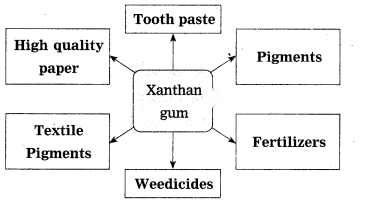
(2) Xanthan gum | (b) Molasses |
(c) Icecreams and puddings | |
(d) Acetic acid |
(1) Vinegar – Acetic acid
(2) Xanthan gum – Icecreams and puddings
Find the odd one out:
Question 1
Maharashtra Board Solution
Lactobacillus acidophilus, Lactobacillus casei, Bifidobacterium bifidum, Streptococcus thermophilus
Solution & Step-by-Step Answer:
Streptococcus thermophilus. (All others are bacteria producing probiotics.)
Question 2
Maharashtra Board Solution
Lactobacillus lactis, Bifidobacterium bifidtim, Lactobacillus cremoris, Streptococcus thermophilus
Solution & Step-by-Step Answer:
Bifidobacterium bifidum. (All others are bacteria used in cheese production.)
Question 3
Maharashtra Board Solution
Dark chocolate, Miso soup, Wafers, Corn syrup
Solution & Step-by-Step Answer:
Wafers. (All others are probiotic products.)
Question 4
Maharashtra Board Solution
Vinegar, Soya sauce, Ketchup, Monosodium glutamate
Solution & Step-by-Step Answer:
Ketchup. (All others are products prepared by microbial fermentation.)
Question 5
Maharashtra Board Solution
Actinomycetes, Streptomyces, Nocardia, yeast
Solution & Step-by-Step Answer:
Yeast. (All others have ability of decomposing rubber from garbage.)
Find the correlation:
Question 1
Maharashtra Board Solution
Bread Baker’s yeast : : Soya sauce : ……….
Solution & Step-by-Step Answer:
Bread Baker’s yeast : : Soya sauce : Aspergillus oryzae
Question 2
Maharashtra Board Solution
Coffee : Caffea arabica : : Cocoa : …………
Solution & Step-by-Step Answer:
Coffee : Coffea arabica : : Cocoa : Theobroma cacao
Question 3
Maharashtra Board Solution
Oil slick : Alcanovorax : Rubber from garbage : …………
Solution & Step-by-Step Answer:
Oil slick : Alcanovorax : Rubber from garbage : Actinomycetes
Question 4
Maharashtra Board Solution
Conversion of metals into comounds : Thiobacilli : : Conversion of uranium salts …………
Solution & Step-by-Step Answer:
Conversion of metals into comounds : Thiobacilli : : Conversion of uranium salts Geobacter.
Name the following:
Question 1
Maharashtra Board Solution
Microbial enzymes.
Solution & Step-by-Step Answer:
Oxidoreductases, transferases, hydrolases, lyases, isomerases, ligases.
Question 2
Maharashtra Board Solution
Emulsifiers.
Solution & Step-by-Step Answer:
Polysaccharides and glycolipids.
Question 3
Maharashtra Board Solution
Microbe used in preparation of wine and cider.
Solution & Step-by-Step Answer:
Saccharomyces cerevisiae.
Question 4
Maharashtra Board Solution
Effective antibiotic against tuberculosis.
Solution & Step-by-Step Answer:
Rifamycin.
Question 5
Maharashtra Board Solution
Antibiotics.
Solution & Step-by-Step Answer:
Penicillin, cephalosporins, monobactam, erythromycin, gentamycin, neomycin, streptomycin, tetracyclins, vancomycin.
Question 6
Maharashtra Board Solution
Bacteria that use sulphuric acid as source of energy.
Solution & Step-by-Step Answer:
Acidobacillus ferroxidens, Acidophillium spp.
Question 7
Maharashtra Board Solution
Substance that makes biodegradable plastic.
Solution & Step-by-Step Answer:
Polylactic acid.
Question 8
Maharashtra Board Solution
Curd like food product made from sheep milk.
Solution & Step-by-Step Answer:
Kefir.
Question 9
Maharashtra Board Solution
Enzyme used to make vegetarian cheese.
Solution & Step-by-Step Answer:
Protease.
Question 10
Maharashtra Board Solution
Fungus used for making soya sauce.
Solution & Step-by-Step Answer:
Aspergillus oryzae.
Complete the charts:
Question 1
Maharashtra Board Solution
|
Fruit | Microbe used | Name of beverage |
___________________________ | ___________________________ | Coffee |
Theobroma cacao | Candida, Hansenula, Pichia, Saccharomyces | ___________________________ |
Grapes | ___________________________ | ___________________________ |
Apple | Saccharomyces cerevisiae | ___________________________ |
Fruit | Microbe used | Name of beverage |
Caffea arabica | Lactobacillus brevis | Coffee |
Theobroma cacao | Candida, Hansenula, Pichia, Saccharomyces | Cocoa |
Grapes | Saccharomyces cerevisiae | Wine |
Apple | Saccharomyces cerevisiae | Cider
Question 2
Maharashtra Board Solution
|
Source | Microbe | Amino acid | Use |
Sugar and beet molasses, ammonia salt | ___________________ | ___________________ | Production of monosodium glutamate (Ajinomoto). |
___________________ | Aspergillus niger | ___________________ | Drinks, toffees, chocolate production. |
Glucose, corn steep liquor | ___________________ | Gluconic acid | ___________________ |
Molasses, corn steep liquor | Lactobacillus delbrueckii | ___________________ | ___________________ |
___________________ | Aspergillus itaconius | Itaconic acid | ___________________ |
Source | Microbe | Amino acid | Use |
Sugar and beet molasses, ammonia salt | Brevibacterium, Corynobacterium | L-glutamic acid | Production of monosodium glutamate (Ajinomoto). |
Sugar molasses, salt | Aspergillus niger | Citric acid | Drinks, toffees, chocolate production. |
Glucose, corn steep liquor | Aspergillus niger | Gluconic acid | Production of minerals used as supplement for calcium and iron. |
Molasses, corn steep liquor | Lactobacillus delbrueckii | Lactic acid | Source of nitrogen, production of vitamins. |
Molasses, corn steep liquor | Aspergillus itaconius | Itaconic acid | Paper, textile, plastic industry, gum production
Question 3
Maharashtra Board Solution
|
Source | Microbe | Amino acid |
(1) Sugar molasses and salt | ___________________ | Citric acid |
(2) ___________________ | Lactobacillus delbrueckii | ___________________ |
(3) Corn steep liquor | Aspergillus itaconius | ___________________ |
Source | Microbe | Amino acid |
(1) Sugar molasses and salt | Aspergillus niger | Citric acid |
(2) Molasses, corn steep liquor | Lactobacillus delbrueckii | Lactic acid |
(3) Corn steep liquor | Aspergillus itaconius | Itaconic acid Answer the following questions:
Question 1
Maharashtra Board Solution
Which microbes are used in the baking industries? (Board’s Model Activity Sheet)
Solution & Step-by-Step Answer:
Yeast i.e. Saccharomyces cerevisiae is used in the baking industries.
Question 2
Maharashtra Board Solution
There is an oil layer on the water surface of river in your area. What will you do? (March 2019)
Solution & Step-by-Step Answer:
If there is an oil layer on the water surface, we shall use hydrocarbonoclastic bacteria like Pseudomonas to clean up the oil spill.
Question 3
Maharashtra Board Solution
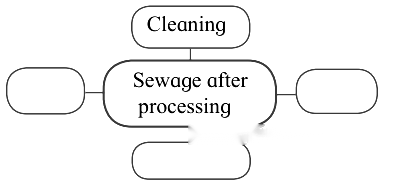
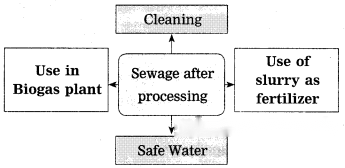
(a) How are microbes used in sewage management? (b) How is the sludge produced in this process utilized? (Board’s Model Activity Sheet)
Solution & Step-by-Step Answer:
(a)
(b) The sludge formed in this process, is used as fertilizer.
Question 4
Maharashtra Board Solution
Answer the following questions: (a) What is clean technology?
Solution & Step-by-Step Answer:
Clean technology is the method to use microbes for controlling air, soil and water pollution. These microbes can degrade the manmade chemicals.
(b) Why is it essential to ban plastic bags? If thrown in water bodies, it causes harm to aquatic life. Cattle graze on plastic unknowingly and are killed by it as it clogs inside their alimentary canal. The gutters and rain water drains get clogged due to plastic bags and this causes cities to submerge in water during heavy rains. Nowadays, the fishermen get more than half of plastic if they cast their net in the sea. People use the plastic bags indiscriminately without any thought towards their environmental impact. There are better alternatives for plastic bags such as cloth bags which can be reused again and again. Therefore, it is absolutely necessary to ban the use of plastic bag. Write short notes on the following:
Question 1
Maharashtra Board Solution
Production of Yoghurt.
Solution & Step-by-Step Answer:
Question 2
Maharashtra Board Solution
Production of cheese.
Solution & Step-by-Step Answer:
Cheese is made from cow’s milk throughout the world. The steps in the process of cheese manufacture are as follows:
Question 3
Maharashtra Board Solution
Land-filling sites.
Solution & Step-by-Step Answer:
Complete the paragraph by choosing the appropriate words given in the brackets:
Question 1
Maharashtra Board Solution
(Nocardia, Geobacter, Ideonella sakaiensis, Pseudomonas, Alcanovorax borkumensis, hydrocarbonoclastic, Acidophillium, streptomyces) Bacteria like ………… spp. and ………. have the ability to destroy the pyridines and other chemicals. Hence, these bacteria are used to clear the oil spills. These are called ………. bacteria. It has been observed that species like Vibrio, …………… can decompose the PET. Similarly, species of fungi like ………… have ability of decomposing rubber from garbage. Sulphuric acid is source of energy for some species of bacteria like ………… Hence, these bacteria can control the soil pollution occurring due to acid rain. …………..convert the salts of uranium into insoluble salts.
Solution & Step-by-Step Answer:
Bacteria like Pseudomonas spp. and Alcanovorax borkumensis have the ability to destroy the pyridines and other chemicals. Hence, these bacteria are used to clear the oil spills. These are called hydrocarbonoclastic bacteria. It has been observed that species like Vibrio, Ideonella sakaiensis can decompose the PET. Similarly, species of fungi like Nocardia have ability of decomposing rubber from garbage. Sulphuric acid is source of energy for some species of bacteria like Acidophillium. Hence, these bacteria can control the soil pollution occurring due to acid rain. Geobacter convert the salts of uranium into insoluble salts.
Read the paragraph and answer the questions given below: Remediation is the process of removing dangerous or poisonous substances from the environment, or limiting the effect that they have on it. When any biological organism is used for remediation, it is called bioremediation. When plant species are used for the purpose of remediation, it is called phytoremediation. When any microbes are used then it is named as microbial remediation. The methods of such remediation have helped to clean the environment from toxic effluents, especially sewage and crude oil. Dr. Anand Chakraborty, a scientist of Indian origin, has worked on Pseudomonas aeruginosa which have reduced the crude oil films into carbon dioxide and water. Questions and Answers:
Question 1
Maharashtra Board Solution
What is the meaning of remediation?
Solution & Step-by-Step Answer:
Remediation is the process by which dangerous or toxic substances are removed from the environment.
Question 2
Maharashtra Board Solution
What is the difference between phytoremediation and microbial remediation?
Solution & Step-by-Step Answer:
When any plant species are used for remediation process, then it is called phytoremediation, whereas when any microbe species used for remediation then it is called microbial remediation.
Question 3
Maharashtra Board Solution
Which environmental pollutant is mainly removed through bioremediation processes?
Solution & Step-by-Step Answer:
Toxicants released through sewage and crude oil are removed by bioremediation processes.
Question 4
Maharashtra Board Solution
What is the role of Pseudomonas aeruginosa?
Solution & Step-by-Step Answer:
Pseudomonas aeruginosa helps in bioremediation by acting on film of crude oil and reduces it to carbon dioxide and water.
Question 5
Maharashtra Board Solution
Why Dr. Anand Chakraborty’s work phenomenal?
Solution & Step-by-Step Answer:
Dr. Anand Chakraborty discovered that Pseudomonas aeruginosa bacteria can act on oil film which is toxic and reduce it to nontoxic products. This helps in controlling the oil pollution of marine waters which otherwise is very difficult to control.
Diagram based questions:
Question 1
Maharashtra Board Solution
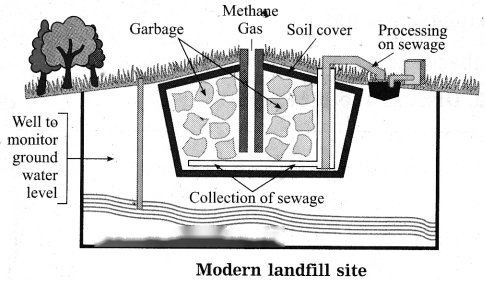
Observe the diagram and answer the following questions: (a) Name the following method of solid waste management.
Solution & Step-by-Step Answer:
The above diagram shows modern landfill site. This method is used for solid waste management.
(b) What type of waste is used in this method? (c) What kind of useful substances can be obtained from such methods?
Question 2
Maharashtra Board Solution
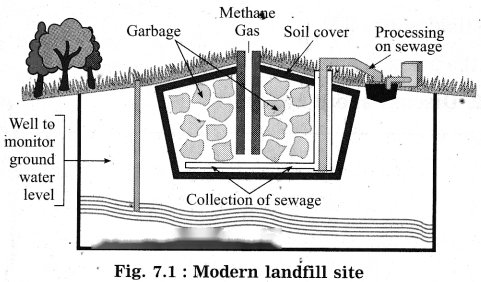
Observe the Figure 7.1 and answer the following questions: (March 2019) (a) Identify the process shown in the figure.
Solution & Step-by-Step Answer:
The figure shows modern land fill site where microbial biodegradation process is carried out.
(b) Explain the process in short. Activity based questions:
Question 1
Maharashtra Board Solution
Collect Information Search : (Textbook page no. 84) (i) Which materials should not be present in garbage for its proper microbial decomposition?
Solution & Step-by-Step Answer:
If there are non-biodegradable materials in the garbage, they will not decompose. The plastic, glass, metals etc. will not undergo microbial decomposition, therefore, such items should not be- there in the garbage. The toxic matter, hazardous chemicals and e-waste should also be removed. If such materials are present in the garbage, the microbes will be killed and the entire process of decomposition will be suffered.
(ii) How the sewage generated in your house or apartment is disposed off ?
Question 2
Maharashtra Board Solution
Observe: (Textbook page no. 83) Observe the garbage vans of gram panchayat and municipality. Nowadays, there is facility of decreasing the volume of garbage by compaction in those vans. Explain the advantages of this activity.
Solution & Step-by-Step Answer:
When the garbage is compressed, its volume is reduced. The trips of the vans that pick up the garbage can be reduced due to such measures. The land filling sites can also accommodate more garbage if it is compacted.
Question 3
Maharashtra Board Solution
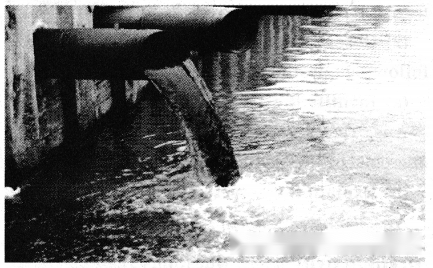
Observe the figure and answer the following: (i) Lack of management of which factor is shown in the picture?
Solution & Step-by-Step Answer:
The above picture shows the lack of management of sewage resulting in waste water being dumped carelessly.
(ii) How can that factor be managed with the help of microbes? (iii) How are the oil spills in oceans cleared? Projects: (Do it your self) Project 1. Project 2. Project 3. |