Balbharati Maharashtra State Board11th Commerce Maths Solution Book PdfChapter 3 Complex Numbers Ex 3.2 Questions and Answers.
Maharashtra State Board 11th Commerce Maths Solutions Chapter 3 Complex Numbers Ex 3.2
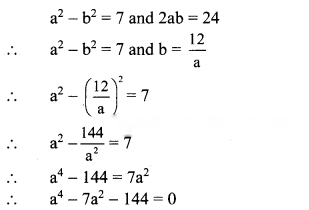
(ii) 7 + 24i
Solution:
Let = a + bi, where a, b ∈ R
Squaring on both sides, we get
7 + 24i = (a + bi)2
7 + 24i = a2+ b2i2+ 2abi
7 + 24i = (a2– b2) + 2abi …..[∵ i2= -1]
Equating real and imaginary parts, we get

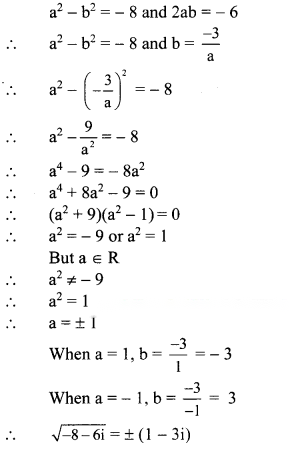
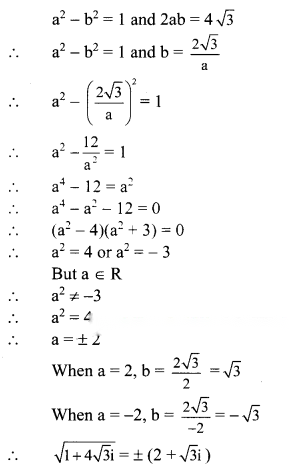
(iii) 1 + 4√3i
Solution:
Let = a + bi, where a, b ∈ R
Squaring on both sides, we get
1 + 4√3i = (a + bi)2
1 + 4√3i = a2+ b2i2+ 2abi
1 +4√3i = (a2– b2) + 2abi ……[∵ i2= -1]
Equating real and imaginary parts, we get
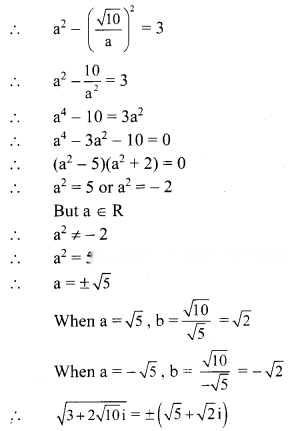
(iv) 3 + 2√10i
Solution:
Let = a + bi, where a, b ∈ R
Squaring on both sides, we get
3 + 2√10i = (a + bi)2
3 + 2√10i = a2+ b2i2+ 2abi
3 + 2√10i = (a2– b2) + 2abi …..[∵ i2= -1]
Equating real and imaginary parts, we get
a2– b2= 3 and 2ab = 2√10
a2– b2= 3 and b =
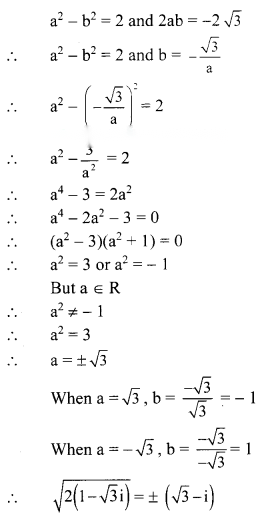
(v) 2(1 – √3i)
Solution:
Let = a + bi, where a, b ∈ R
Squaring on both sides, we get
2(1 – √3i) = (a + bi)2
2(1 – √3i) = a2+ b2i2+ 2abi
2 – 2√3i = (a2– b2) + 2abi …..[∵ i2= -1]
Equating real and imaginary parts, we get
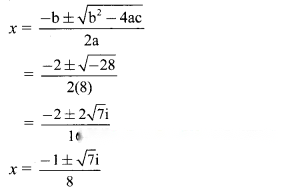
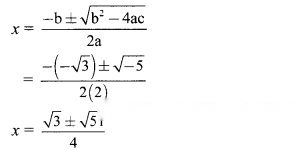
(ii) 2x2– √3x + 1 = 0
Solution:
Given equation is 2x2– √3x + 1 = 0
Comparing with ax2+ bx + c = 0, we get
a = 2, b = -√3, c = 1
Discriminant = b2– 4ac
= (-√3)2– 4 × 2 × 1
= 3 – 8
= -5 < 0
So, the given equation has complex roots.
These roots are given by
∴ the roots of the given equation are and
(iii) 3x2– 7x + 5 = 0
Solution:
Given equation is 3x2– 7x + 5 = 0
Comparing with ax2+ bx + c = 0, we get
a = 3, b = -7, c = 5
Discriminant = b2– 4ac
= (-7)2– 4 × 3 × 5
= 49 – 60
= -11 < 0
So, the given equation has complex roots.
These roots are given by
∴ the roots of the given equation are and

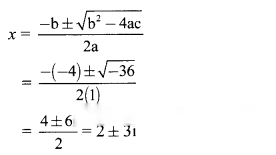
(iv) x2– 4x + 13 = 0
Solution:
Given equation is x2– 4x + 13 = 0
Comparing with ax2+ bx + c = 0, we get
a = 1, b = -4, c = 13
Discriminant = b2– 4ac
= (-4)2– 4 × 1 × 13
= 16 – 52
= -36 < 0
So, the given equation has complex roots.
These roots are given by
∴ the roots of the given equation are 2 + 3i and 2 – 3i.
(ii) 2x2+ 3ix + 2 = 0
Solution:
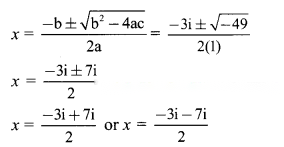
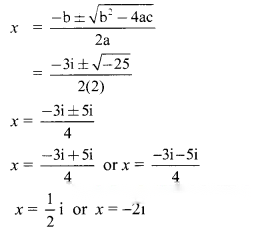
Given equation is 2x2+ 3ix + 2 = 0
Comparing with ax2+ bx + c = 0, we get
a = 2, b = 3i, c = 2
Discriminant = b2– 4ac
= (3i)2– 4 × 2 × 2
= 9i2– 16
= -9 – 16
= -25 < 0
So, the given equation has complex roots.
These roots are given by
∴ the roots of the given equation are i and -2i.
(iii) x2+ 4ix – 4 = 0
Solution:
Given equation is x2+ 4ix – 4 = 0
Comparing with ax2+ bx + c = 0, we get
a = 1, b = 4i, c = -4
Discriminant = b2– 4ac
= (4i)2– 4 × 1 × -4
= 16i2+ 16
= -16 + 16 …..[∵ i2= -1]
= 0
So, the given equation has equal roots.
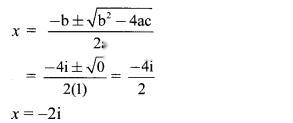
These roots are given by
∴ the roots of the given equation are -2i and -2i.
(iv) ix2– 4x – 4i = 0
Solution:
ix2– 4x – 4i = 0
Multiplying throughout by i, we get
i2x2– 4ix – 4i2= 0
∴ -x2– 4ix + 4 = 0 ……[∵ i2= -1]
∴ x2+ 4ix – 4 = 0
Comparing with ax2+ bx + c = 0, we get
a = 1, b = 4i, c = -4
Discriminant = b2– 4ac
= (4i)2– 4 × 1 × -4
= 16i2+ 16
= -16 + 16 …..[∵ i2= -1]
= 0
So, the given equation has equal roots.
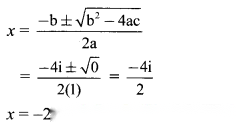
These roots are given by
∴ the roots of the given equation are -2i and -2i.
(ii) x2– (3√2 + 2i) x + 6√2i = 0
Solution:
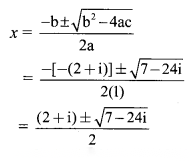
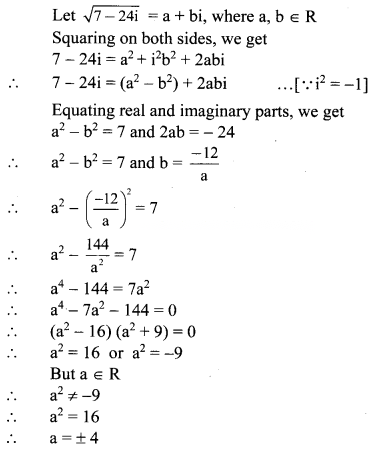
Given equation is x2– (3√2 + 2i) x + 6√2i = 0
Comparing with ax2+ bx + c = 0, we get
a = 1, b = -(3√2 + 2i), c = 6√2i
Discriminant = b2– 4ac
= [-(3√2 + 2i)]2– 4 × 1 × 6√2i
= 18 + 12√2i + 4i2– 24√2i
= 18 – 12√2i – 4 …..[∵ i2= -1]
= 14 – 12√2i
So, the given equation has complex roots.
These roots are given by
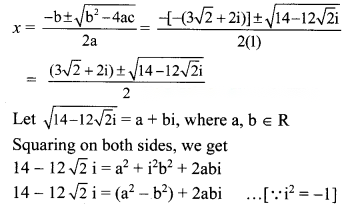
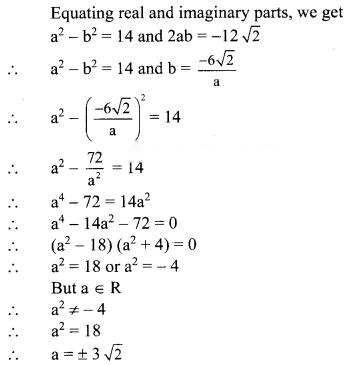

(iii) x2– (5 – i) x + (18 + i) = 0
Solution:
Given equation is x2– (5 – i)x + (18 + i) = 0
Comparing with ax2+ bx + c = 0, we get
a = 1, b = -(5 – i), c = 18 + i
Discriminant = b2– 4ac
= [-(5 – i)]2– 4 × 1 × (18 + i)
= 25 – 10i + i2– 72 – 4i
= 25 – 10i – 1 – 72 – 4i …..[∵ i2= -1]
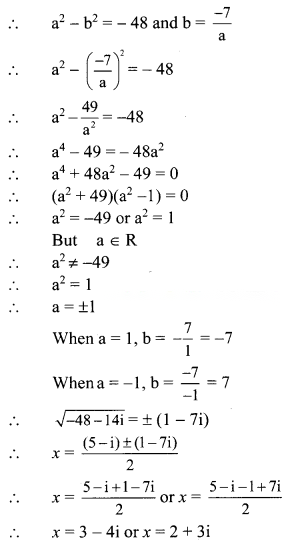
= -48 – 14i
So, the given equation has complex roots.
These roots are given by
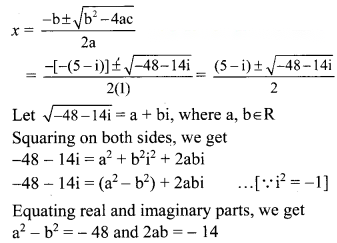
(iv) (2 + i) x2– (5 – i) x + 2(1 – i) = 0
Solution:
Given equation is
(2 + i) x2– (5 – i) x + 2(1 – i) = 0
Comparing with ax2+ bx + c = 0, we get
a = 2 + i, b = -(5 – i), c = 2(1 – i)
Discriminant = b2– 4ac
= [-(5 – i)]2– 4 × (2 + i) × 2(1 – i)
= 25 – 10i + i2– 8(2 + i)(1 – i)
= 25 – 10i + i2– 8(2 – 2i + i – i2)
= 25 – 10i – 1 – 8(2 – i + 1) …..[∵ i2= -1]
= 25 – 10i – 1 – 16 + 8i – 8
= -2i
So, the given equation has complex roots.
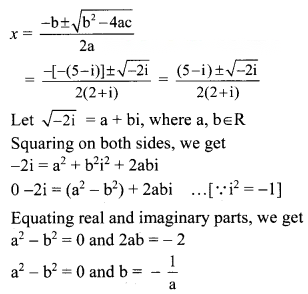
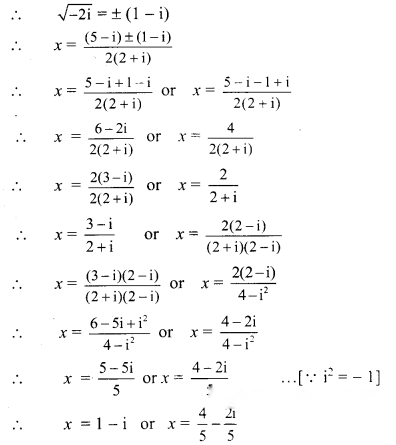
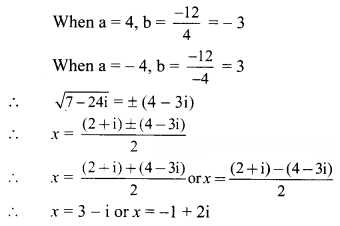
These roots are given by