Balbharati Maharashtra State Board11th Commerce Maths Solution Book PdfChapter 5 Locus and Straight Line Ex 5.3 Questions and Answers.
Maharashtra State Board 11th Commerce Maths Solutions Chapter 5 Locus and Straight Line Ex 5.3
Solution & Step-by-Step Answer:
(a) Equation of a line parallel to the X-axis is y = k. Since the line is at a distance of 5 units above the X-axis. ∴ k = 5 ∴ the equation of the required line is y = 5.
(b) Equation of a line parallel to the Y-axis is x = h.
Since the line is at a distance of 5 units to the left of the Y-axis.
∴ h = -5
∴ the equation of the required line is x = -5.
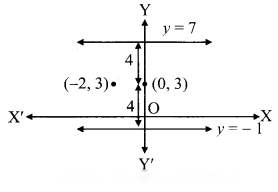
(c) Equation of a line parallel to the X-axis is of the form y = k (k > 0 or k < 0).
Since, the line is at a distance of 4 units from the point (-2, 3).
∴ k = 3 + 4 = 7 or k = 3 – 4 = -1
∴ the equation of the required line is y = 7 or y = -1.
Solution & Step-by-Step Answer:
(a) Equation of a line parallel to X-axis with y-intercept ‘k’ is y = k. Here, y-intercept = 3 ∴ the equation of the required line is y = 3.
(b) Equation of a line parallel to Y-axis with x-intercept ‘h’ is x = h.
Here, x-intercept = 4
∴ the equation of the required line is x = 4.
Solution & Step-by-Step Answer:
(a) Equation of a line parallel to the Y-axis is of the form x = h. Since, the line passes through A(2, -3). ∴ h = 2 ∴ the equation of the required line is x = 2.
(b) Equation of a line parallel to the X-axis is of the form y = k.
Since, the line passes through B(4, -3)
∴ k = -3
∴ the equation of the required line is y = -3.
Solution & Step-by-Step Answer:
The required line passes through the points A(2, 0) = (x1, y1) and B(3, 4) = (x2, y2) say. Equation of the line in two-point form is ∴ the equation of the required line is ∴ ∴ ∴ y = 4(x – 2) ∴ y = 4x – 8 ∴ 4x – y – 8 = 0
Check:
If the points A(2, 0) and B(3, 4) satisfy 4x – y – 8 = 0, then our answer is correct.
For point A(2, 0),
L.H.S. = 4x – y – 8
= 4(2) – 0 – 8
= 8 – 8
= 0
= R.H.S.
For point B(3, 4),
L.H.S. = 4x – y – 8
= 4(3) – 4 – 8
= 12 – 12
= 0
= R.H.S.
Thus, our answer is correct.
Solution & Step-by-Step Answer:
Given, A(2, 1) and B(3, 2). Equation of a line in two-point form is ∴ the equation of the passing through A and B line is ∴ ∴ ∴ y – 1 = x – 2 ∴ y = x – 1 Comparing this equation with y = mx + c, we get m = 1 and c = -1
Alternate method:
Points A(2, 1) and B(3, 2) lie on the line y = mx + c.
∴ They must satisfy the equation.
∴ 2m + c = 1 ……..(i)
and 3m + c = 2 ……(ii)
equation (ii) – equation (i) gives m = 1
Substituting m = 1 in (i), we get
2(1) – c = 1
∴ c = 1 – 2 = -1
Solution & Step-by-Step Answer:
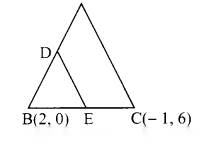
Vertices of ∆ABC are A(3, 4), B(2, 0) and C(-1, 6). (a) Equation of a line in two-point form is ∴ the equation of the side BC is ……[B = (x1, y1) = (2, 0), C = (x2, y2) = (-1, 6)] ∴ ∴ y = -2(x – 2) ∴ 2x + y – 4 = 0
(b) Let D be the midpoint of side BC.
Then, AD is the median through A.
∴ D =
The median AD passes through the points A(3, 4) and D(, 3)
∴ the equation of the median AD is
∴
∴ (y – 4) = x – 3
∴ 5y – 20 = 2x – 6
∴ 2x – 5y + 14 = 0

(c) Let D and E be the midpoints of side AB and side BC respectively.
∴ D = and
E =
the equation of the line DE is
∴
∴ -4(y – 2) = 2x – 5
∴ -4y + 8 = 2x – 5
∴ 2x + 4y – 13 = 0
Solution & Step-by-Step Answer:
(a) Given equation of the line is This is of the form , where x-intercept = a, y-intercept = b ∴ x-intercept = 3, y-intercept = 2
(b) Given equation of the line is
∴
This is of the form ,
where x-intercept = a, y-intercept = b
∴ x-intercept = and y-intercept =
(c) Given equation of the line is 2x – 3y + 12 = 0
∴ 2x – 3y = -12
∴
∴
This is of the form ,
where x-intercept = a, y-intercept = b
∴ x-intercept = -6 and y-intercept = 4
Solution & Step-by-Step Answer:
Let the equation of the line be …..(i) Since, the required line make equal intercepts on the co-ordinate axes. ∴ a = b ∴ (i) reduces to x + y = a …..(ii) Since the line passes through A(3, 4). ∴ 3 + 4 = a i.e. a = 7 Substituting a = 7 in (ii) to get x + y = 7
Solution & Step-by-Step Answer:
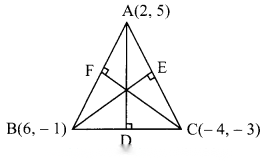
A(2, 5), B(6, -1), C(-4, -3) are the vertices of ∆ABC. Let AD, BE and CF be the altitudes through the vertices A, B and C respectively of ∆ABC. Slope of BC = ∴ slope of AD = -5 ……..[∵ AD ⊥ BC] Since, altitude AD passes through (2, 5) and has slope -5. ∴ the equation of the altitude AD is y – 5 = -5(x – 2) ∴ y – 5 = – 5x + 10 ∴ 5x + y – 15 = 0 Now, slope of AC = ∴ slope of BE = …..[∵ BE ⊥ AC] Since, altitude BE passes through (6, -1) and has slope . ∴ the equation of the altitude BE is y – (-1) = (x – 6) ∴ 4(y + 1) = -3(x – 6) ∴ 3x + 4y – 14 = 0 Also, slope of AB = ∴ slope of CF = ………[∵ CF ⊥ AB] Since, altitude CF passes through (-4, -3) and has slope . ∴ the equation of the altitude CF is y – (-3) = [x – (-4)] ∴ 3(y + 3) = 2(x + 4) ∴ 2x – 3y – 1 = 0