Balbharati Maharashtra State Board11th Commerce Maths Solution Book PdfChapter 7 Probability Ex 7.2 Questions and Answers.
Maharashtra State Board 11th Commerce Maths Solutions Chapter 7 Probability Ex 7.2
(ii) Let B be the event that sum of the numbers on uppermost face is 10.
∴ B = {(4, 6), (5, 5), (6, 4)}
∴ n(B) = 3
∴ P(B) =
(iii) Let C be the event that sum of the numbers on uppermost face is at least 10 (i.e., 10 or more than 10 which are 10 or 11 or 12)
∴ C = {(4, 6), (5, 5), (5, 6), (6, 4), (6, 5), ( 6, 6)}
∴ n(C) = 6
∴ P(C) =
(iv) Let D be the event that sum of the numbers on uppermost face is 4.
∴ D = {(1, 3), (2, 2), (3, 1)}
∴ n(D) = 3
∴ P(D) =
(v) Let E be the event that 1st throw gives an odd number and 2nd throw gives multiple of 3.
∴ E = {(1, 3), (1, 6), (3, 3), (3, 6), (5, 3), (5, 6)}
∴ n(E) = 6
∴ P(E) =
(vi) Let F be the event that both times die shows same number.
∴ F = {(1, 1), (2, 2), (3, 3), (4, 4), (5, 5), (6, 6)}
∴ n(F) = 6
∴ P(F) =
(ii) Let B be the event that both the cards drawn are diamond.
There are 13 diamond cards in a pack of 52 cards.
∴ 2 diamond cards can be drawn from 13 diamond cards in13C2ways
∴ n(B) =13C2
∴ P(B) =
(iii) Let C be the event that both the cards drawn are aces.
In a pack of 52 cards, there are 4 ace cards.
∴ 2 ace cards can be drawn from 4 ace cards in4C2ways
∴ n(C) =4C2
∴ P(C) =
(iv) Let D be the event that both the cards drawn are face cards.
There are 12 face cards in a pack of 52 cards.
∴ 2 face cards can be drawn from 12 face cards in12C2ways.
∴ n(D) =12C2
∴ P(D) =
(v) Let E be the event that out of the two cards drawn one is a spade and other is non-spade.
There are 13 spade cards and 39 cards are non-spade cards in a pack of 52 cards.
∴ One spade card can be drawn from 13 spade cards in13C1ways and one non-spade card can be drawn from 39 non-spade cards in 39C1 ways.
∴ n(E) =13C1.39C1
∴ P(E) =
(vi) Let F be the event that both the cards drawn are of the same suit.
A pack of 52 cards consists of 4 suits each containing 13 cards.
2 cards can be drawn from a suit in13C2ways.
A suit can be selected in 4 ways.
∴ n(F) =13C2× 4
∴ P(F) =
(vii) Let G be the event that both the cards drawn are of same denominations.
A pack of cards has 13 denominations and 4 different cards for each denomination
∴ n(G) = 13 ×4C2
∴ P(G) =
(ii) Let B be the event that all the cards drawn are of different suits.
A pack of 52 cards consists of 4 suits each containing 13 cards.
∴ A card can be drawn from each suit in13C1ways.
∴ 4 cards can be drawn from 4 different suits in13C1×13C1×13C1×13C1ways.
∴ n(B) =13C1×13C1×13C1×13C1
∴ P(B) =
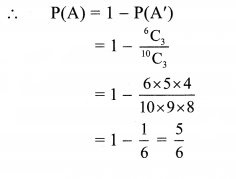
(iii) Let C be the event that out of the four cards drawn at least one is a heart.
∴ C’ is the event that all 4 cards drawn are non-heart cards.
In a pack of 52 cards, there are 39 non-heart cards.
∴ 4 non-heart cards can be drawn in39C4ways.
∴ n(C’) =39C4
∴ P(C’) =
∴ P(C) = 1 – P(C’) = 1 –
(iv) Let D be the event that all the 4 cards drawn are clubs and one of them is a jack.
In a pack of 52 cards, there are 13 club cards having 1 jack card.
∴ 1 jack can be drawn in1C1way and the other 3 cards can be drawn from remaining 12 club cards in12C3ways.
∴ n(D) =12C3×1C1
∴ P(D) =
(ii) Total number of balls = 15 and
P(G) = , P(B) = , P(Y) =
∴ number of green balls = × 15 = 5
number of black balls = × 15 = 7
and number of yellow balls = × 15 = 3.
(ii) Let B be the event that number on ticket is a perfect square.
∴ B = {1, 4, 9, 16, 25, 36, 49, 64}
∴ n(B) = 8
∴ P(B) =
(iii) Let C be the event that the number on the ticket is a prime number.
∴ C = {2, 3, 5, 7, 11, 13, 17, 19, 23, 29, 31, 37, 41, 43, 47, 53, 59, 61, 67, 71, 73}
∴ n(C) = 21
∴ P(C) =
(iv) Let D be the event that number on ticket is divisible by 3 and 5 i.e., divisible by L.C.M. of 3 and 5 i.e., 15
∴ D = {15, 30, 45, 60, 75}
∴ n(D) = 5
∴ P(D) =
(ii) Let B be the event that the committee contains at least 3 boys (i.e., 3 boys and 2 girls or 4 boys and 1 girl or 5 boys and no girl)
∴ n(B) =8C3.5C2+8C4.5C1+8C5.5C0
∴ P(B) =
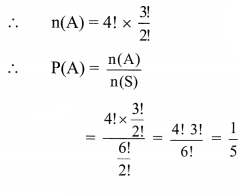
(ii) Let B be the event that vowels are never together.
Consider the following arrangement
_C_C_C_C_C_C_
6 consonants create 7 gaps.
∴ 3 vowels can be arranged in 7 gaps in7P3ways.
Also 6 consonants can be arranged among themselves in6P6= 6! ways.
∴ n(B) = 6! ×7P3
∴ P(B) =
(iii) Let C be the event that exactly 4 letters are arranged between G and H.
Consider the following arrangement
1 2 3 4 5 6 7 8 9
∴ Out of 9 places, G and H can occupy any one of following 4 positions in 4 ways.
1st and 6th, 2nd and 7th, 3rd and 8th, 4th and 9th
Now, G and H can be arranged among themselves in2P2= 2! =2 ways.
Also, the remaining 7 letters can be arranged in remaining 7 places in7P7= 7! ways.
∴ n(C) = 4 × 2 × 7! = 8 × 7! = 8!
∴ P(C) =
(iv) Let D be the event that word begins with O and ends with T.
Thus first and last letter can be arranged in one way each and the remaining 7 letters can be arranged in remaining 7 places in7P7= 7! ways
∴ n(D) = 7! × 1 × 1 = 7!
∴ P(D) =
(v) Let E be the event that word starts with vowel and ends with consonant.
There are 3 vowels and 6 consonants in the word LOGARITHM.
∴ The first place can be filled in 3 different ways and the last place can be filled in 6 ways.
Now, remaining 7 letters can be arranged in 7 places in7P7= 7! ways
∴ n(E) = 3 × 6 × 7!
∴ P(E) =