Maharashtra State Board Class 11 Geography Solutions Chapter 9 Disaster Management
1. Identify the correct Alternative.
a | b | c | d |
Tectonic | Flood | Tectonic | Tectonic |
Geological | Geological | Geological | Human |
Human | Human | Volcanic | Biological |
Climate | Climate | Climate | Volcanic |
Answer:
a
a | b | c | d |
Recovery | Rehabilitation | Preparedness | Response |
Rehabilitation | Preparedness | Mitigation | Recovery |
Preparedness | Mitigation | Response | Rehabilitation |
Mitigation | Response | Recovery | Preparedness |
Response | Recovery | Rehabilitation | Mitigation |
c
Question 3
Maharashtra Board Solution
Statement A – The cyclonic depression originating in the Bay of Bengal is marching towards Tamil Nadu at a velocity of 350 km/hr. Statement B – The loss of life was not much but property loss occurred on a large scale. (a) A indicates a disaster and B indicates a hazard. (b) A indicates a hazard while B indicates a disaster. (c) A indicates a disaster but B does not indicate a hazard. (d) A does not indicate a disaster but B indicates a hazard.
Solution & Step-by-Step Answer:
(b) A indicates a hazard while B indicates a disaster.
Question 4
Maharashtra Board Solution
India has been successful in mitigation the effects of the following disaster. (a) Earthquake (b) Volcanic eruptions (c) Floods (d) Cyclones
Solution & Step-by-Step Answer:
(c) Floods
2. Write short notes on.
Question 1
Maharashtra Board Solution
Vulnerability
Solution & Step-by-Step Answer:
Question 2
Maharashtra Board Solution
Disaster
Solution & Step-by-Step Answer:
Generally man-made disasters can be prevented as they happen due to mistakes or carelessness by humans.
Question 3
Maharashtra Board Solution
Hazard
Solution & Step-by-Step Answer:
Question 4
Maharashtra Board Solution
Man-made Disasters
Solution & Step-by-Step Answer:
3. Write in short.
Question 1
Maharashtra Board Solution
Mitigation for Cyclone
Solution & Step-by-Step Answer:
For example, Effective mitigation measures were taken before the arrival of cyclone Fani in India, Due to proper mitigation measures, there was less financial impact of disaster on government agencies.
Question 2
Maharashtra Board Solution
Preparedness for Floods
Solution & Step-by-Step Answer:
Preparedness involves measures taken to prepare and reduce the effect of disaster. You can prepare for flooding in a number of ways:
Question 3
Maharashtra Board Solution
Rehabilitation after Earthquakes
Solution & Step-by-Step Answer:
4. Answer in detail.
Question 1
Maharashtra Board Solution
Explain the types of disaster according to origin.
Solution & Step-by-Step Answer:
Disasters can be classified into various types depending on their origin: They can be of the following types: 1. Tectonic Disasters : Earthquakes, Volcanic eruptions, Tsunamis, etc. Example, in 2004, there was one of the deadliest tsunamis in the Indian Ocean. It affected many surrounding countries like India, Sri Lanka, Thailand, Maldives, Indonesia. Nearly 2,30,210 people were killed.
2. Geological Disasters : Landslides, mudslides, avalanches. Example, Malin landslide of 2014 in Maharashtra, on 7th May 2018, landslides occurred due to heavy rainfall along NH-6 connecting Shillong with Assam, Tripura And Mizoram. 3. Meteorological Disasters : Flood, cyclone, storm, heatwave, etc. Example, in 2008, due to heavy rain, Kosi river was flooded and abruptly changed her course, 4. Biological Disasters : Locust attacks, pest attacks, epidemics, such as flu, dengue, cholera, etc. Example, the 2009 swine flu pandemic. 5. Anthropogenic or Man-made: Industrial accidents, transportation accidents, nuclear accidents, etc. There have been 30 industrial accidents in India, killing 75 workers and injuring over hundred others within two months from May 2020 to July 2020.
Question 2
Maharashtra Board Solution
Explain the effects of disasters with the help of examples.
Solution & Step-by-Step Answer:
The disasters can bring a lot of immediate and long-term effects on various sectors of a society:
Question 3
Maharashtra Board Solution
Write about the preparedness in Disaster Management in India.
Solution & Step-by-Step Answer:
1. India’s geo-climatic conditions and its high degree of socio-economic vulnerability, makes it one of the most disaster-prone country in the world.
2. After the Tsunami in 2004, approach towards disaster management has drastically changed. Various State Governments were requested to set up a disaster management office. 3. At the Government of India level two institutes were set up in New Delhi – the National Institute of Disaster Management (NIDM) and the National Disaster Management Authority (NDMA). The aim was to mitigate the damage potential of natural disasters in future. 4. The disaster management authorities have been established at different levels. At the centre level, the National Disaster Management Authority (NDMA) has been established. At state level, State Disaster Management Authority (SDMA) has been established, at district level, District Disaster Management Authority (DDMA) has been established. 5. The National Crisis Management Committee, also functions at the centre. 6. The nodal ministers are identified for different disaster types of function under the overall guidance of the ministry of Home Affairs (Nodal Ministry for Disaster Management). These ministers interact at different levels within the disaster management framework. Example, for disasters, such as drought, the Ministry for Agriculture is the Nodal Agency. 7. Military forces and para-military forces such as Home Guard, etc., play an important role. 8. Various agencies such as ISRO, NRSC (National Remote Sensing Centre) etc., also play an important role in disaster management.
Question 4
Maharashtra Board Solution
Explain with example, how will you carry out disaster management in your region or premises?
Solution & Step-by-Step Answer:
In Mumbai region there is always flooding either due to continuous heavy downpour or due to cyclone. Disaster management can be done in following ways: Preparedness and mitigation
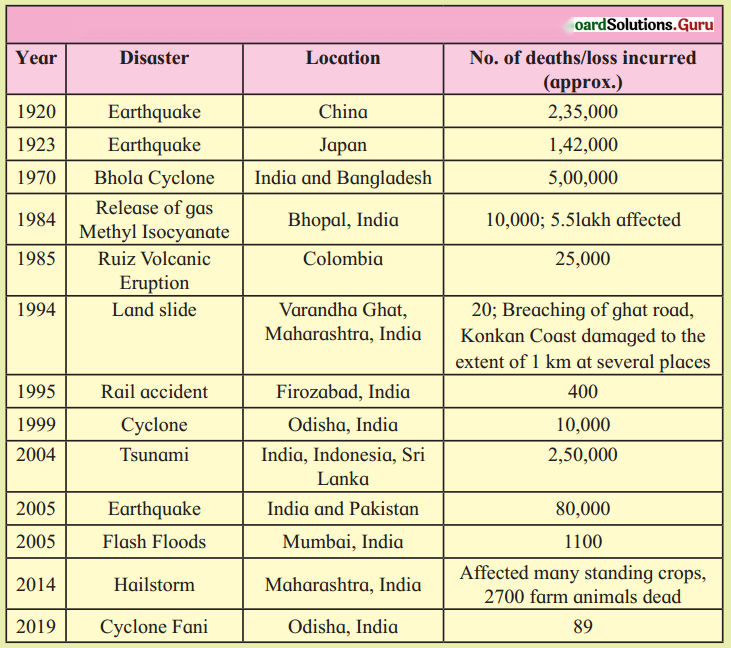
Disaster response Recovery Rehabilitation 11th Geography Digest Chapter 9 Disaster Management Intext Questions and Answers Try this. Read about the following disasters which have occurred across the world and answer the following questions. (Textbook Page No. 97)
Question 1
Maharashtra Board Solution
Classify these disasters into natural and man-made disasters.
Solution & Step-by-Step Answer:
Question 2
Maharashtra Board Solution
Which of these disasters occurred due to climatic conditions?
Solution & Step-by-Step Answer:
Bhola Cyclone (India and Bangladesh), Cyclone of Odisha, India; Hailstorm in Maharashtra, India; Cyclone Fani in Odisha, India are disasters that occurred due to climatic conditions.
Question 3
Maharashtra Board Solution
Which of these disasters occurred due to geological causes?
Solution & Step-by-Step Answer:
Earthquakes (in China, India, Japan, Pakistan) Ruiz Volcanic Eruption (Colombia), Landslide (Varandha Ghats, Maharashtra, India), Tsunami (India, Indonesia, Sri Lanka) occurred due to geological causes.
Question 4
Maharashtra Board Solution
Can you relate the location of a disaster with its cause?
Solution & Step-by-Step Answer:
Question 5
Maharashtra Board Solution
Besides the number of deaths, what other losses might be occurring after the disasters?
Solution & Step-by-Step Answer:
Breaching of ghat road, damage to coastal road in the Konkan, many standing crops were destroyed.
Question 6
Maharashtra Board Solution
Comparing the cyclones of 1999 and 2019, can you think of the reasons behind the reduction in the number of deaths?
Solution & Step-by-Step Answer:
In the two decades between 1999 and 2019, the capacity to cope with disasters, manage them, the ability of the people and organisations has undergone a huge improvement.
Question 7
Maharashtra Board Solution
Which of these disasters can be predicted in advance?
Solution & Step-by-Step Answer:
Cyclones and Tsunamis can be predicted in advance.
Question 8
Maharashtra Board Solution
Of those disasters for which prediction can be made, can the people be evacuated from the area?
Solution & Step-by-Step Answer:
Cyclones can be predicted in advance and the people can be evacuated in advance.
Question 9
Maharashtra Board Solution
Why do some people get affected by the disaster in specific regions?
Solution & Step-by-Step Answer:
Some people get affected by disasters in specific areas.
Can you tell? (Textbook Page No. 99) If an earthquake occurs with a magnitude of more than 6 in Sahara Desert area which is totally uninhabited by humans and a similar one occurs in Assam, which one would you call a disaster? Can you do it? (Textbook Page No. 99) Classify the above components of disaster management into pre-disaster and post-disaster.
Use your brain power! (Textbook Page No. 100)
Question 1
Maharashtra Board Solution
In 1988, an earthquake of magnitude 6.9 struck Armenia and took 25,000 lives. On the other hand, an earthquake in 1989 in Californ ia of magnitude 7 took only 63 lives. Can you think of the reason behind this difference?
Solution & Step-by-Step Answer:
Armenia is densely populated whereas California has a lesser population. Hence, the damage and death caused in Armenia is much higher than that in California.
Question 2
Maharashtra Board Solution
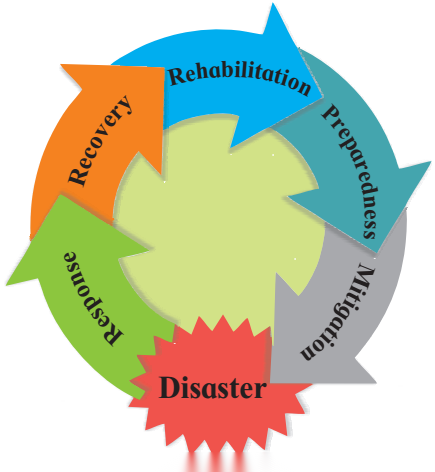
Why is disaster management called a cycle? See the figure given below. (extbook Page No. 101)
Solution & Step-by-Step Answer:
The disaster preparedness, mitigation, disaster response, recovery and rehabilitation are the five stages of disaster management which are followed by one after another so it is called disaster management cycle.
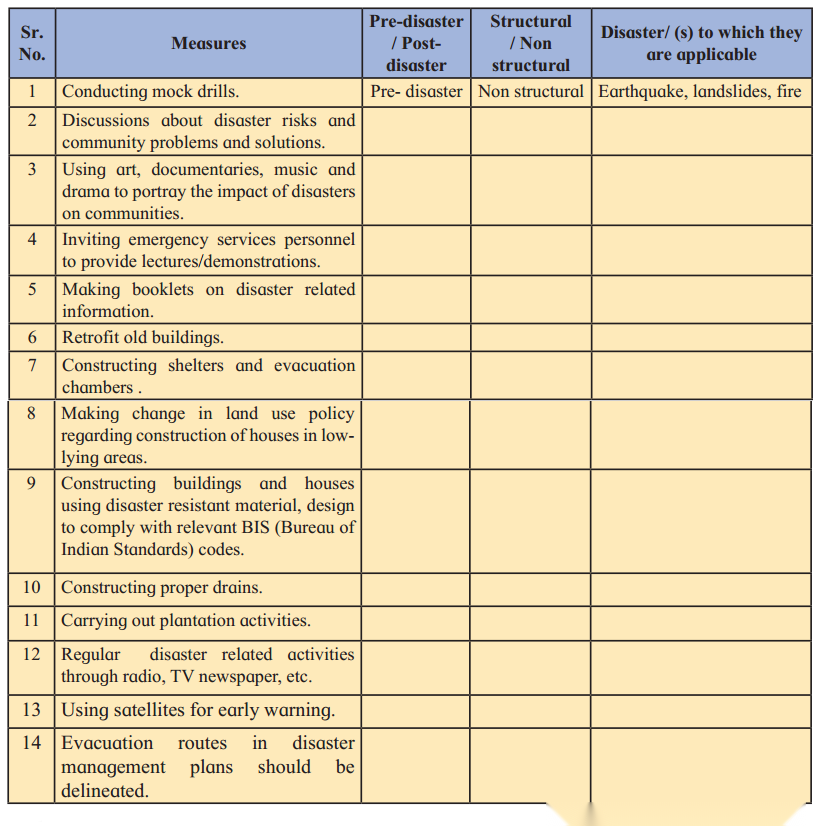
Give it a try. (Textbook Page No. 101) Given below are a list of measures taken for disaster. Write whether they are pre-disaster or post-disaster and structural or non-structural. Also write the name of the disaster for which they are used. Complete the table.
Find out! (Textbook Page No. 102)
Question 1
Maharashtra Board Solution
Who is responsible for looking after disaster management in our country?
Solution & Step-by-Step Answer:
Question 2
Maharashtra Board Solution
Find out about the role of the military and paramilitary forces in disaster management of India. (Textbook Page No. 103)
Solution & Step-by-Step Answer:
Military and paramilitary forces evacuate people from the flood-affected areas. They distribute food packets and clothing in the flood-affected areas. They also help in cleaning debris.
|