Maharashtra State Board 11th Maths Solutions Chapter 1 Angle and its Measurement Ex 1.1
Solution & Step-by-Step Answer:
210°,- 150° 210°-(- 150°) = 210°+ 150° = 360° = 1 (360°), which is a multiple of 360°. ∴ The given pair of angles is co-terminal.
ii. 360°, – 30°
360° – (- 30°) = 360° + 30°
= 390°,
which is not a multiple of 360°.
∴ The given pair of angles is not co-terminal.
iii. -180°, 540°
540° -(-180°) = 540°+ 180°
= 720°
= 2(360°),
which is a multiple of 360°.
.’. The given pair of angles is co-terminal.
iv. – 405°, 675°
675° – (- 405°) = 675° + 405°
= 1080°
= 3(360°),
which is a multiple of 360°.
.’. The given pair of angles is co-terminal.
v. 860°, 580°
860° – 580° = 280°
which is not a multiple of 360, °.
∴ The given pair of angles is not co-terminal.
vi. 900°, 900°
900° – (-900°) = 900° + 900°
= 1800°
= 5(360°)
which is a multiple of 360°
∴ The given pair of angles is co-terminal.
Solution & Step-by-Step Answer:
From the figure, the given angle terminates in quadrant III.
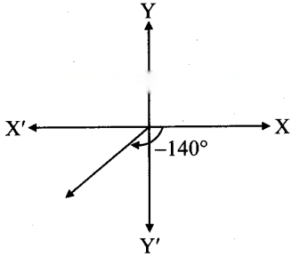
ii.
From the figure, the given angle terminates in quadrant III.

iii.
From the figure, the given angle terminates in quadrant I.
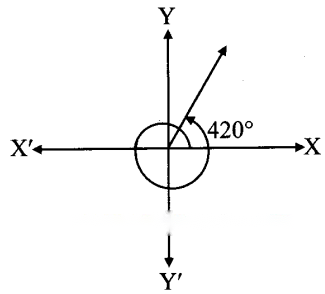
iv.
From the figure, the given angle terminates in quadrant I.
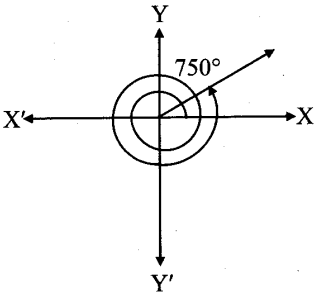
v.
From the figure, the given angle terminates in quadrant III.
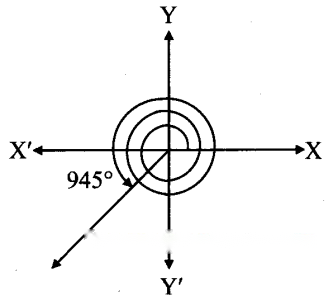
vi.
From the figure, the given angle terminates in quadrant I.
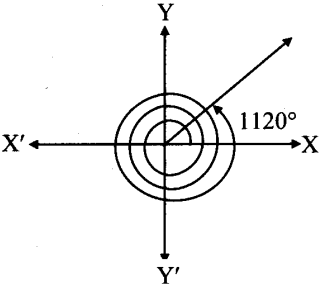
vii.
From the figure, the given angle terminates in quadrant IV.
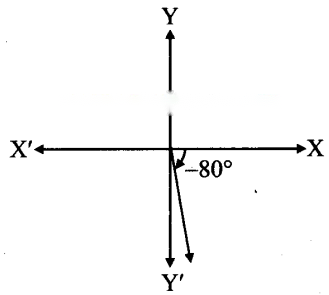
viii.
From the figure, the given angle terminates in quadrant I.
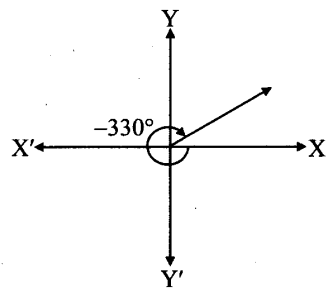
ix.
From the figure, the given angle terminates in quadrant III.
[Note: Answer given in the textbook is ‘Angle lies in quadrant II’. However, we found that it lies in quadrant III.]
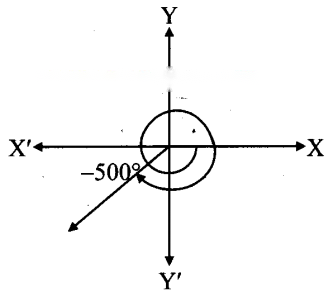
x.
From the figure, the given angle terminates in quadrant III.

Solution & Step-by-Step Answer:
we know that = i. 85° = ii. 250° = iii. 132° = [Note : Answer given in the textbook is However, as per our calculation it is ]
iv. 65° 30′ = 65° + 30′
= 65° + … [1′ = (1/60)°]
= 65° + (1/2)°

v. 75° 30′ = 75° + 30′

vi. 40°48′ = 40° + 48′

Solution & Step-by-Step Answer:


Solution & Step-by-Step Answer:
We know that 1° = 60′ and 1′ = 60″ i. (183.7)° = 183° +(0.7)° = 183° + (0.7 x 60)’ = 183°+ 42′ = 183° 42′
ii. (245.33)° = 245° + (0.33)°
= 245° + (0.33 x 60)’
= 245° + (19.8)’
= 245° + 19’+ (0.8)’
= 245° 19’+ (0.8 x 60)”
= 245° 19’+ 48″
= 245° 19′ 48″
iii. We know that θc= (θ x )°
= (11.46)°
= 11° +(0.46)°
= 11° + (0.46×60)’
= 11°+ (27.6)’
= 11°+ 27’+ (0.6)’
= 11° + 27′ + (0.6×60)”
= 11°27′ + 36″
= 11°27’36” (approx.)

Solution & Step-by-Step Answer:
We know that θ c = (θ x ) ° In △ABC, m∠A = = 35° m∠B = 120° ∴ m∠A + m∠B + m∠C = 180° … [Sum of the angles of a triangle is 180°] ∴ 35° + 120° + m∠C = 180° m∠C = 180° – 35° – 120° ∴ m∠C = 25°


Solution & Step-by-Step Answer:
We know that θc = [θ x i.e., i.e., 100°, 50° Let the measure of third angle of the triangle be x°. ∴ 100°+50°+x° = 180° …[Sum of the angles of a triangle is 180°] ∴ x° = 180°- 100° – 50° ∴ x° = 30° ∴ The degree and radian measures of the third angle are 30° and respectively.

Solution & Step-by-Step Answer:
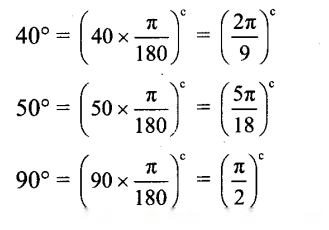
Since the triangle is aright angled triangle, one of the angles is 90°. In the right angled triangle, the acute angles are in the ratio 4:5. Let the measures of the acute angles of the triangle in degrees be 4k and 5k, where k is a constant. ∴ 4k + 5k+ 90°= 180° … [Sum of the angles of a triangle is 180°] ∴ 9k = 180° – 90° ∴ 9k = 90° ∴ k = 10° ∴ The measures of the angles in degrees are 4k = 4 x 10° = 40°, 5k = 5 x 10° = 50° and 90°. we known that θ° = ( θ x ) c ∴ The measure of the angles in radius are
Solution & Step-by-Step Answer:
Let the measures of the two angles in degrees be x and y. Sum of two angles is 5πc x + y = 5πc x + y = (5π x ) …[ θc = ] ∴ x + y = 900° ………..(i) ∴ Difference of two angles is 60°. x – y = 60° ….(ii) Adding (i) and (ii), we get 2x = 960° ∴ x = 480° Substituting the value of x in (i), we get 480° + y = 900° ∴ y = 900° — 480° = 420° ∴ The measures of the two angles in degrees are 480° and 420°.
Solution & Step-by-Step Answer:
The measures of the angles of the triangle are in the ratio 3:7:8. Let the measures of the angles of the triangle in degrees be 3k, 7k and 8k, where k is a constant. ∴ 3k + 7k + 8k = 180° … [Sum of the angles of a triangle is 180°] ∴ 18k =180° ∴ k = 10° ∴ The measures of the angles in degrees are 3k = 3 x 10° = 30°, 7k = 7 x 10° = 70° and 8k = 8 x 10° = 80°.

Solution & Step-by-Step Answer:
Let the measures of the angles of the triangle in degrees be a – d, a, a + d, where a > d> 0. ∴ a – d + a + a + d = 180° …[Sum of the angles of a triangle is 180°] ∴ 3a = 180° ∴ a = 60° …(i) According to the given condition, greatest angle is 5 times the smallest angle. ∴ a + d = 5 (a – d) ∴ a + d = 5a – 5d ∴ 6d = 4a ∴ 3d = 2a ∴ 3d = 2(60°) …[From (i)] ∴ d = = 40° ∴ The measures of the angles in degrees are a – d = 60° – 40° = 20° a = 60° and a + d = 60° + 40° = 100°

Solution & Step-by-Step Answer:
Let ABCD be the cyclic quadrilateral such that ∠A = 40° and ∴ ∠A + ∠C = 180° ∴ 40° + ∠C = 180° ∴ ∠C= 180°- 40°= 140° Also, ∠B + ∠D = 180° … [Opposite angles of a cyclic quadrilateral are supplementary] ∴ 60° + ∠D =180° ∴ ∠D = 180°- 60° = 120° ∴ The angles of the quadrilateral in degrees are 40°, 60°, 140° and 120°.

Solution & Step-by-Step Answer:
We know that θc = ) One angle of the quadrilateral has measure Measures of other three angles are in the ratio 2:3:4. Let the measures of the other three angles of the quadrilateral in degrees be 2k, 3k, 4k, where k is a constant. ∴ 72° + 2k + 3k + 4k = 360° …[Sum of the angles of a quadrilateral is 360°] ∴ 9k = 288° k = 32° ∴ The measures of the angles in degrees are 2k = 2 x 32° = 64° 3k = 3 x 32° = 96° 4k = 4 x 32°= 128° We know that θ° = (θ x )c ∴ The measures of the angles in radians are

Solution & Step-by-Step Answer:
i. Pentagon: Number of sides = 5 Number of exterior angles = 5 Sum of exterior angles = 360° Interior angle + Exterior angle = 180° ∴ Each interior angle = 180° — 72° = 108° =

ii. Hexagon:
Number of sides = 6
Number of exterior angles = 6
Sum of exterior angles = 360°
Interior angle + Exterior angle = 180°
∴ Each interior angle = 180° – 60° = 120°
= (120 x )c= ( )c

iii. Septagon:
Number of sides = 7
Number of exterior angles = 7
Sum of exterior angles = 360°
∴ Each exterior angle = {360°}{no. of sides }={360°}{7}
= (51.43)°
=
Interior angle + Exterior angle = 180°
∴ Each interior angle = 180° – ( )°

iv. Octagon:
Number of sides = 8
Number of exterior angles = 8
Sum of exterior angles = 360°
∴ Each exterior angle =
= 45°
=
Interior angle + Exterior angle = 180°
Each interior angle = 180° – 45° = 135°
=
Solution & Step-by-Step Answer:
i. At 11:10, the minute-hand is at mark 2 and hour-hand has crossed of the angle between 11 and 12. Angle between two consecutive marks = = 30° Angle traced by hour-hand in 10 minutes = (30°) = 5° Angle between marks 11 and 2 = 3 x 30° = 90° ∴ Angle between two hands of the clock at ten past eleven = 90° – 5° = 85°
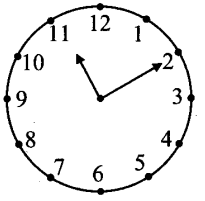
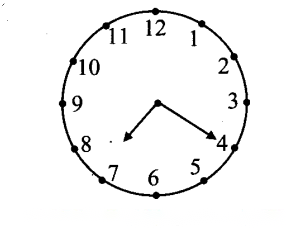
ii. At 7 : 20 the minute -hand is at mark 4 and hour -hand has crossed rd of angle between 7 and 8.
Angle between two consecutive marks
= 360°/12 = 30°
Angle traced by hour-hand in 20 minutes
= (30°)= 10°
Angle between marks 4 and 7 = 3 x 30° = 90°
Angle between two hands of the clock at twenty past seven = 90° – 10° = 100°
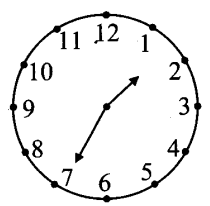
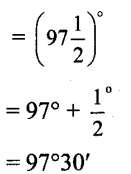
iii. At 1 : 35 the minute -hand is at mark 7 and hour -hand has crossed th of angle between 1 and 2.
Angle between two consecutive marks
= 360°/12 = 30°
Angle traced by hour-hand in 35 minutes
=
Angle between marks 1 and 7 = 6 x 30° = 180°
Angle between two hands of the clock at thirty five past one = 180° –
= 162° + = 162°30′
iv. At 5:45, the minute-hand is at mark 9 and hour- hand has crossed ( )th of the angle between 5 and 6.
Angle between two consecutive marks
= 360°/12 = 30°
Angle traced by hour-hand in 45 minutes
Angle between marks 5 and 9
= 4 x 30° = 120°
∴ Angle between two hands of the clock at quarter to six =

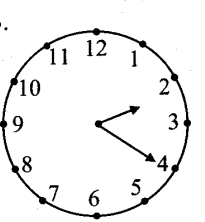
v. At 2 : 20, the minute-hand is at mark 4 hour hand has crossed rd of the angle between 2 and 3.
Angle between two consecutive marks = 360°/12 = 30°
Angle traced by hour-hand in 20 minutes
= (30°)= 10°
Angle between marks 2 and 4 = 2 x 30° = 60°
∴ Angle between two hands of the clock at 2 :20 = 60° – 10° = 50°
vi. At 10:10, the minute-hand is at mark 2 and hour-hand has crossed[/latex] th between 10 and 11.
Angle between two consecutive marks
360°/12 = 30°
Angle traced by hour-hand in 10 minutes
= (30°) = 5°
Angle between marks 10 and 2= 4 x 30° = 120°
… Angle between two hands of the clock at 10:10
= 120° – 5°= 115°
