Latest Maharashtra State Board (SSC & HSC) 2026-27 Syllabus Digest & Solutions Updated!
Class 11 (FYJC / HSC)Mathematics & Statistics2026-27 Syllabus

Chapter 1 Complex Numbers Ex 1.1 Solutions

Complete Maharashtra State Board Balbharati & Yuvakbharati textbook solutions for Chapter 1 Complex Numbers Ex 1.1. Step-by-step solved exercises, numerical problems, and digest answers.

24 Solved Questions32 Diagrams2337 words

Maharashtra State Board 11th Maths Solutions Chapter 1 Complex Numbers Ex 1.1
Question 1 Maharashtra Board Solution
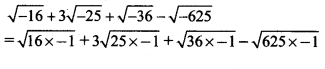
Simplify: (i) √-16 + 3√-25 + √-36 – √-625
Solution & Step-by-Step Answer:
= 4i + 3(5i) + 6i – 25i = 25i – 25i = 0

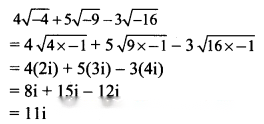
(ii) 4√-4 + 5√-9 – 3√-16
Solution:

Question 2 Maharashtra Board Solution
Write the conjugates of the following complex numbers (i) 3 + i
Solution & Step-by-Step Answer:
Conjugate of (3 + i) is (3 – i).

(ii) 3 – i
Solution:
Conjugate of (3 – i) is (3 + i).

(iii) √-5 – √7 i
Solution:
Conjugate of (√-5 – √7 i) is (√-5 + √7 i).

(iv) -√-5
Solution:
-√-5 = -√5 × √-1 = -√5 i
Conjugate of (-√-5) is √5 i

(v) 5i
Solution:
Conjugate of (5i) is (-5i).

(vi) √5 – i
Solution:
Conjugate of (√5 – i) is (√5 + i).

(vii) √2 + √3 i
Solution:
Conjugate of (√2 + √3 i) is (√2 – √3 i)

(viii) cos θ + i sin θ
Solution:
Conjugate of (cos θ + i sin θ) is (cos θ – i sin θ)

Question 3 Maharashtra Board Solution
Find a and b if (i) a + 2b + 2ai = 4 + 6i
Solution & Step-by-Step Answer:
a + 2b + 2ai = 4 + 6i Equating real and imaginary parts, we get a + 2b = 4 …..(i) 2a = 6 ……(ii) ∴ a = 3 Substituting, a = 3 in (i), we get 3 + 2b = 4 ∴ b = ∴ a = 3 and b =

Check:
For a = 3 and b =
Consider, L.H.S. = a + 2b + 2ai
= 3 + 2() + 2(3)i
= 4 + 6i
= R.H.S.

(ii) (a – b) + (a + b)i = a + 5i
Solution:
(a – b) + (a + b)i = a + 5i
Equating real and imaginary parts, we get
a – b = a ……(i)
a + b = 5 ……(ii)
From (i), b = 0
Substituting b = 0 in (ii), we get
a + 0 = 5
∴ a = 5
∴ a = 5 and b = 0

(iii) (a + b) (2 + i) = b + 1 + (10 + 2a)i
Solution:
(a + b) (2 + i) = b + 1 + (10 + 2a)i
2(a + b) + (a + b)i = (b + 1) + (10 + 2a)i
Equating real and imaginary parts, we get
2(a + b) = b + 1
∴ 2a + b = 1 ……(i)
and a + b = 10 + 2a
-a + b = 10 …….(ii)
Subtracting equation (ii) from (i), we get
3a = -9
∴ a = -3
Substituting a = – 3 in (ii), we get
-(-3) + b = 10
∴ b = 7
∴ a = -3 and b = 7

(iv) abi = 3a – b + 12i
Solution:
abi = 3a – b + 12i
∴ 0 + abi = (3a – b) + 12i
Equating real and imaginary parts, we get
3a – b = 0
∴ 3a = b …..(i)
and ab = 12
∴ b = ……..(ii)
Substituting b = in (i), we get
3a =
3a2= 12
a2= 4
a = ±2
When a = 2, b = = = 6
When a = -2, b = = = -6
∴ a = 2 and b = 6 or a = -2 and b = -6

(v) = 3 – 2i
Solution:
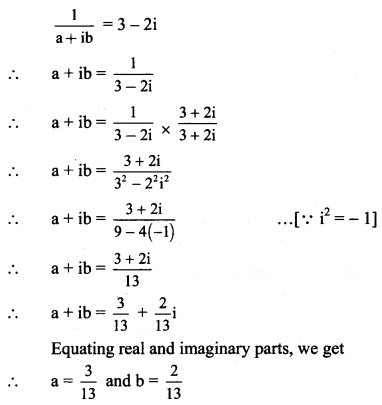
(vi) (a + ib) (1 + i) = 2 + i
Solution:
(a + ib)(1 + i) = 2 + i
a + ai + bi + bi2= 2 + i
a + (a + b)i + b(-1) = 2 + i ……(∵ i2= -1)
(a – b) + (a + b)i = 2 + i
Equating real and imaginary parts, we get
a – b = 2 ……(i)
a + b = 1 …….(ii)
Adding equations (i) and (ii), we get
2a = 3
∴ a =
Substituting a = in (ii), we get
+ b = 1
∴ b = 1 – =
∴ a = and b =

Question 4 Maharashtra Board Solution
Express the following in the form of a + ib, a, b ∈ R, i = √-1. State the values of a and b: (i) (1 + 2i)(-2 + i)
Solution & Step-by-Step Answer:
(1 + 2i)(-2 + i) = -2 + i – 4i + 2i2 = -2 – 3i + 2(-1) ……[∵ i2 = -1] ∴ (1 + 2i)(-2 + i) = -4 – 3i ∴ a = -4 and b = -3

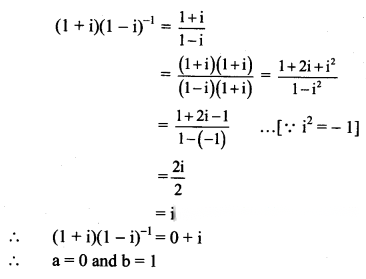
(ii) (1 + i)(1 – i)-1
Solution:

(iii)
Solution:
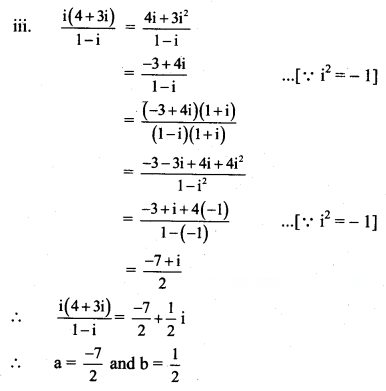
(iv)
Solution:
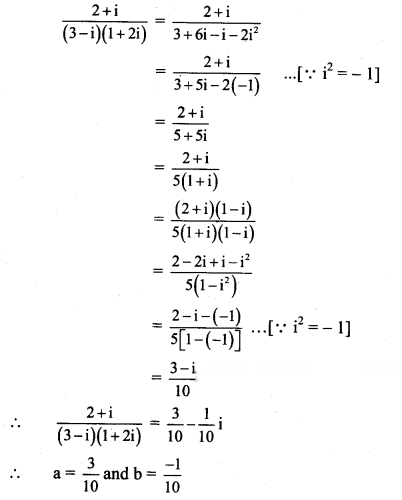
(v)
Solution:
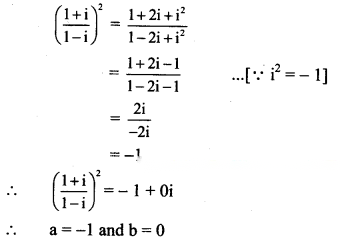
(vi)
Solution:

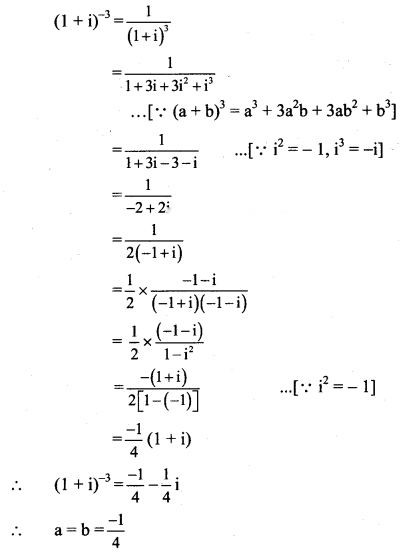
(vii) (1 + i)-3
Solution:
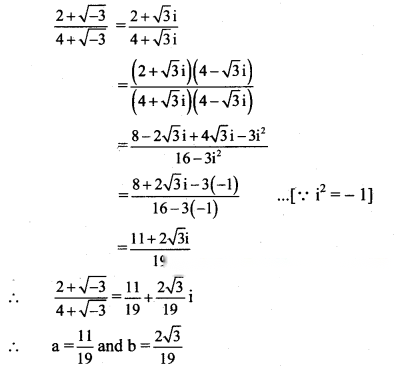
(viii)
Solution:
(ix) (-√5 + 2√-4 ) + (1 – √-9 ) + (2 + 3i)(2 – 3i)
Solution:
(-√5 + 2√-4) + (1 – √-9) + (2 + 3i)(2 – 3i)
= (-√5 + 2√4.√-1) + (1 – √9.√-1) + 4 – 9i2
= [-√5 + 2(2)i] + (1 – 3i) + 4 – 9i2
= -√5 + 4i + 1 – 3i + 4 – 9(-1) ……[∵ i2= -1]
= (14 – √5) + i
∴ a = 14 – √5 and b = 1

(x) (2 + 3i)(2 – 3i)
Solution:
(2 + 3i)(2 – 3i)
= 4 – 9i2
= 4 – 9(-1) …[∵ i2= -1]
= 4 + 9
= 13
∴ (2 + 3i)(2 – 3i) = 13 + 0i
∴ a = 13 and b = 0

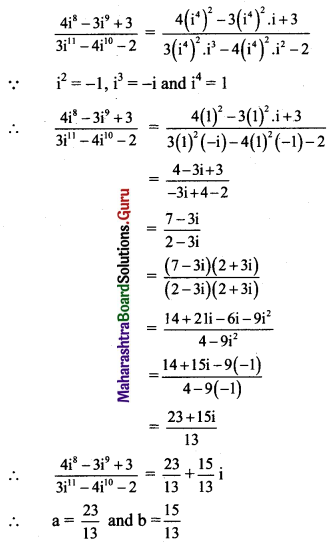
(xi)
Solution:
Question 5 Maharashtra Board Solution
Show that (-1 + √3i)3 is a real number.
Solution & Step-by-Step Answer:

Question 6 Maharashtra Board Solution
Find the value of (3 + ) (i6 – i7) (1 + i11).
Solution & Step-by-Step Answer:

Question 7 Maharashtra Board Solution
Evaluate the following: (i) i35 (ii) i888 (iii) i93 (iv) i116 (v) i403 (vi) (vii) i-888 (viii) i30 + i40 + i50 + i60
Solution & Step-by-Step Answer:

Question 8 Maharashtra Board Solution
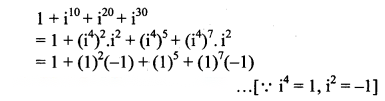
Show that 1 + i10 + i20 + i30 is a real number.
Solution & Step-by-Step Answer:
= 1 – 1 + 1 – 1 = 0, which is a real number.

Question 9 Maharashtra Board Solution
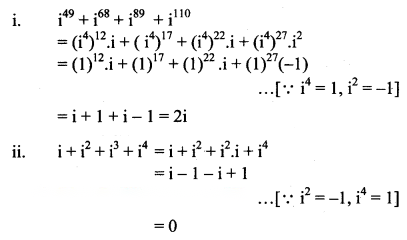
Find the value of (i) i49 + i68 + i89 + i110 (ii) i + i2 + i3 + i4
Solution & Step-by-Step Answer:

Question 10 Maharashtra Board Solution
Simplify:
Solution & Step-by-Step Answer:

Question 11 Maharashtra Board Solution
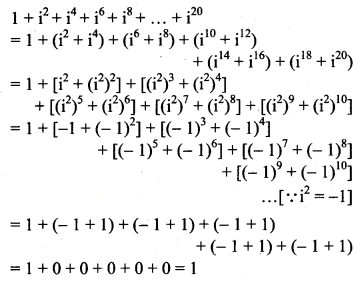
Find the value of 1 + i2 + i4 + i6 + i8 + …… + i20.
Solution & Step-by-Step Answer:

Question 12 Maharashtra Board Solution
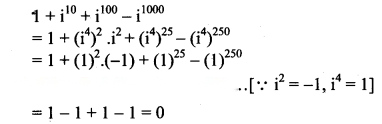
Show that 1 + i10 + i100 – i1000 = 0.
Solution & Step-by-Step Answer:

Question 13 Maharashtra Board Solution
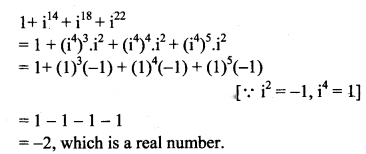
Is (1 + i14 + i18 + i22) a real number? Justify your
Solution & Step-by-Step Answer:
Solution:

Question 14 Maharashtra Board Solution
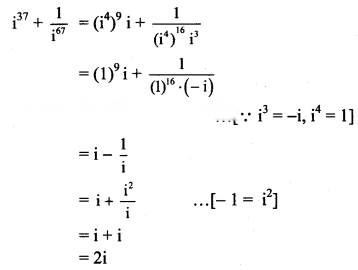
Evaluate:
Solution & Step-by-Step Answer:

Question 15 Maharashtra Board Solution
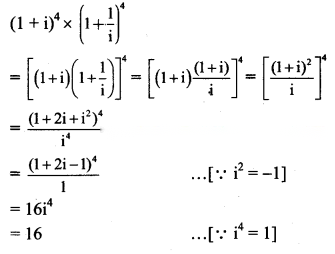
Prove that: (1 + i)4 × = 16
Solution & Step-by-Step Answer:

Question 16 Maharashtra Board Solution
Find the value of
Solution & Step-by-Step Answer:

Question 17 Maharashtra Board Solution
If a = , b = , then show that a2 = b and b2 = a.
Solution & Step-by-Step Answer:

Question 18 Maharashtra Board Solution
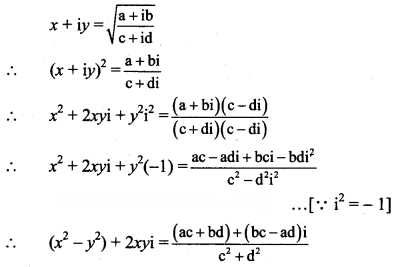
If x + iy = (a + ib)3, show that = 4(a2 – b2)
Solution & Step-by-Step Answer:
x + iy = (a + ib)3 x + iy = a3 + 3a2bi + 3ab2i2 + b3i3 x + iy = a3 + 3a2bi – 3ab2 – b3i ……[∵ i2 = -1, i3 = -i] x + iy = (a3 – 3ab2) + (3a2b – b3)i Equating real and imaginary parts, we get x = a3 – 3ab2 and y = 3a2b – b3 = a2 – 3b2 and = 3a2 – b2 = a2 – 3b + 3a2 – b2 = 4a2 – 4b2 = 4(a2 – b2)

Alternate Method:
x + iy = (a + ib)3
x + iy = a3+ 3a2bi + 3ab2i2+ b3i3
x + iy = a3+ 3a2bi – 3ab2– b3i …..[∵ i2= -1, i3= -i]
x + iy = (a3– 3ab2) + (3a2b – b3)i
Equating real and imaginary parts, we get
x = a3– 3ab2and y = 3a2b – b3
Consider

Question 19 Maharashtra Board Solution
If = 1 – i, show that (5a – 7b) = 0.
Solution & Step-by-Step Answer:
= 1 – i a + 3i = (1 – i)(2 + ib) = 2 + bi – 2i – bi2 = 2 + (b – 2)i – b(-1) ……[∵ i2 = -1] a + 3i = (2 + b) + (b – 2)i Equating real and imaginary parts, we get a = 2 + b and 3 = b – 2 a = 2 + b and b = 5 a = 2 + 5 = 7 5a – 7b = 5(7) – 7(5) = 35 – 35 = 0
Question 20 Maharashtra Board Solution
If x + iy = , prove that
Solution & Step-by-Step Answer:

Question 21 Maharashtra Board Solution
If (a + ib) = , then prove that a2 + b2 = 1.
Solution & Step-by-Step Answer:
∴ a + bi = 0 + i Equating real and imaginary parts, we get a = 0 and b = 1 a2 + b2 = 02 + 12 = 1

Question 22 Maharashtra Board Solution
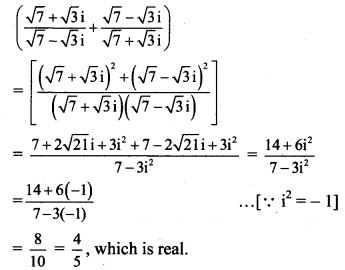
Show that is real.
Solution & Step-by-Step Answer:

Question 23 Maharashtra Board Solution
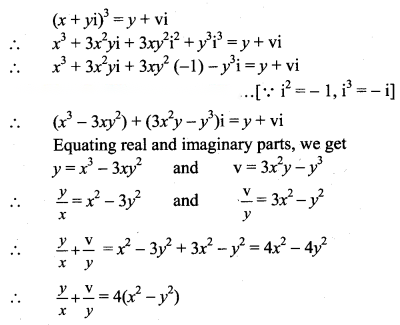
If (x + iy)3 = y + vi, then show that = 4(x2 – y2).
Solution & Step-by-Step Answer:

Question 24 Maharashtra Board Solution
Find the values of x and y which satisfy the following equations (x, y ∈ R) (i) (x + 2y) + (2x – 3y)i + 4i = 5
Solution & Step-by-Step Answer:
(x + 2y) + (2x – 3y)i + 4i = 5 (x + 2y) + (2x – 3y)i = 5 – 4i Equating real and imaginary parts, we get x + 2y = 5 ……(i) and 2x – 3y = -4 …..(ii) Equation (i) x 2 – equation (ii) gives 7y = 14 ∴ y = 2 Substituting y = 2 in (i), we get x + 2(2) = 5 x + 4 = 5 ∴ x = 1 ∴ x = 1 and y = 2

Check:
For x = 1 and y = 2
Consider, L.H.S. = (x + 2y) + (2x – 3y)i + 4i
= (1 + 4) + (2 – 6)i + 4i
= 5 – 4i + 4i
= 5
= R.H.S.

(ii)
Solution:

(x + y) + (y – x – 2)i = 2i
(x + y) + (y – x – 2)i = 0 + 2i
Equating real and imaginary parts, we get
x + y = 0 and y – x – 2 = 2
∴ x + y = 0 …….(i)
and -x + y = 4 …….(ii)
Adding (i) and (ii), we get
2y = 4
∴ y = 2
Substituting y = 2 in (i), we get
x + 2 = 0
∴ x = -2
∴ x = -2 and y = 2

(iii)
Solution:

(2x + 3y + 1) + (8 – 3x + 2y)i = 9 + 9i
Equating real and imaginary parts, we get
2x + 3y + 1 = 9 and 8 – 3x + 2y = 9
2x + 3y = 8 ……(i)
and 3x – 2y = – 1 ……(ii)
Equation (i) × 2 + equation (ii) × 3 gives
13x = 13
∴ x = 1
Substituting x = 1 in (i), we get
2(1) + 3y = 8
3y = 6
∴ y = 2
∴ x = 1 and y = 2

(iv) If x(1 + 3i) + y(2 – i) – 5 + i3= 0, find x + y
Solution:
x(1 + 3i) + y(2 – i) – 5 + i3= 0
x + 3xi + 2y – yi – 5 – i = 0 ……[∵ i3= -i]
(x + 2y – 5) + (3x – y – 1)i = 0 + 0i
Equating real and imaginary parts, we get
x + 2y – 5 = 0 …..(i)
and 3x – y – 1 = 0 ……(ii)
Equation (i) + equation (ii) × 2 gives
7x – 7 = 0
7x = 1
∴ x = 1
Substituting x = 1 in (i), we get
1 + 2y – 5 = 0
2y = 4
y = 2
∴ x = 1 and y = 2
∴ x + y = 1 + 2 = 3

(v) If x + 2i + 15i6y = 7x + i3(y + 4), find x + y
Solution:
x + 2i + 15i6y = 7x + i3(y + 4)
x + 2i + 15(i2)3y = 7x + i3(y + 4)
x + 2i + 15(-1)3y = 7x – i(y + 4) ……[∵ i2= -1, i3= -i]
x + 2i – 15y – 7x + iy + 4i = 0
(-6x – 15y) + i(y + 6) = 0 + 0i
Equating real and imaginary parts, we get
-6x – 15y = 0 and y + 6 = 0
-6x – 15y = 0 and y = -6
-6x – 15(-6) = 0
-6x + 90 = 0
∴ x = 15
∴ x + y = 15 – 6 = 9