Latest Maharashtra State Board (SSC & HSC) 2026-27 Syllabus Digest & Solutions Updated!
Class 11 (FYJC / HSC)Mathematics & Statistics2026-27 Syllabus

Chapter 1 Complex Numbers Miscellaneous Exercise 1 Solutions

Complete Maharashtra State Board Balbharati & Yuvakbharati textbook solutions for Chapter 1 Complex Numbers Miscellaneous Exercise 1. Step-by-step solved exercises, numerical problems, and digest answers.

30 Solved Questions50 Diagrams2292 words

Maharashtra State Board 11th Maths Solutions Chapter 1 Complex Numbers Miscellaneous Exercise 1

(I) Select the correct answer from the given alternatives.
Question 1 Maharashtra Board Solution
If n is an odd positive integer, then the value of 1 + (i)2n + (i)4n + (i)6n is: (A) -4i (B) 0 (C) 4i (D) 4
Solution & Step-by-Step Answer:
(B) 0 Hint: 1 + (i2)n + (i4)n + (i2)3n = 1 – 1 + 1 – 1 …..(n odd positive integer) = 0
Question 2 Maharashtra Board Solution
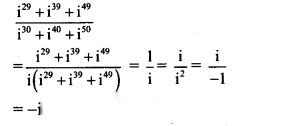
The value of is equal to: (A) -2 (B) 1 (C) 0 (D) -1
Solution & Step-by-Step Answer:
(D) -1 Hint:

Question 3 Maharashtra Board Solution
√-3 √-6 is equal to (A) -3√2 (B) 3√2 (C) 3√2 i (D) -3√2 i
Solution & Step-by-Step Answer:
(A) -3√2 Hint: √-3 √-6 = (√3 i) (√6 i) = 3√2 (-1) = -3√2
Question 4 Maharashtra Board Solution
If ω is a complex cube root of unity, then the value of ω99 + ω100 + ω101 is: (A) -1 (B) 1 (C) 0 (D) 3
Solution & Step-by-Step Answer:
(C) 0 Hint: ω99 + ω100 + ω101 = ω99 (1 + ω + ω2) = ω99 (0) = 0
Question 5 Maharashtra Board Solution
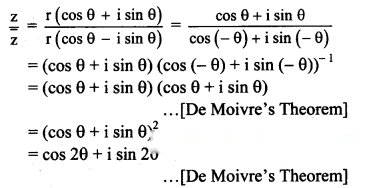
If z = r(cos θ + i sin θ), then the value of is (A) cos 2θ (B) 2cos 2θ (C) 2cos θ (D) 2sin θ
Solution & Step-by-Step Answer:
(B) 2cos 2θ Hint:

Question 6 Maharashtra Board Solution
If ω(≠1) is a cube root of unity and (1 + ω)7 = A + Bω, then A and B are respectively the numbers (A) 0, 1 (B) 1, 1 (C) 1, 0 (D) -1, 1
Solution & Step-by-Step Answer:
(B) 1, 1 Hint: (1 + ω)7 = (-ω2)7 = -ω14 = -ω2(ω3)4 = -ω2 = 1 + ω A = 1, B = 1
Question 7 Maharashtra Board Solution
The modulus and argument of (1 + i√3)8 are respectively (A) 2 and (B) 256 and (C) 256 and (D) 64 and
Solution & Step-by-Step Answer:
(C) 256 and Hint:

Question 8 Maharashtra Board Solution
If arg (z) = θ, then arg = (A) -θ (B) θ (C) π – θ (D) π + θ
Solution & Step-by-Step Answer:
(A) -θ Hint: Let z = , then ∴ arg = -θ.
Question 9 Maharashtra Board Solution
If -1 + √3 i = , then θ = (A) – (B) (C) – (D)
Solution & Step-by-Step Answer:
(D) Hint:

Question 10 Maharashtra Board Solution
If z = x + iy and |z – zi| = 1, then (A) z lies on X-axis (B) z lies on Y-axis (C) z lies on a rectangle (D) z lies on a circle
Solution & Step-by-Step Answer:
(D) z lies on a circle Hint: |z – zi | = |z| |1 – i| = 1 ∴ |z| = ∴ x2 + y2 =

(II) Answer the following:

Question 1 Maharashtra Board Solution
Simplify the following and express in the form a + ib. (i) 3 + √-64
Solution & Step-by-Step Answer:
3 + √-64 = 3 + √64 √-1 = 3 + 8i

(ii) (2i3)2
Solution:
(2i3)2
= 4i6
= 4(i2)3
= 4(-1)3
= -4 …..[∵ i2= -1]
= -4 + 0i

(iii) (2 + 3i) (1 – 4i)
Solution:
(2 + 3i)(1 – 4i)
= 2 – 8i + 3i – 12i2
= 2 – 5i – 12(-1) …..[∵ i2= -1]
= 14 – 5i

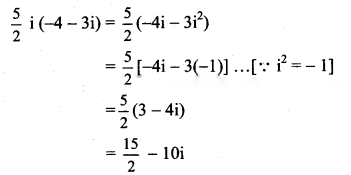
(iv) i(-4 – 3i)
Solution:
(v) (1 + 3i)2(3 + i)
Solution:
(1 + 3i)2(3 + i)
= (1 + 6i + 9i2)(3 + i)
= (1 + 6i – 9)(3 + i) ……[∵ i2= -1]
= (-8 + 6i)(3 + i)
= -24 – 8i + 18i + 6i2
= -24 + 10i + 6(-1)
= -24 + 10i – 6
= -30 + 10i

(vi)
Solution:
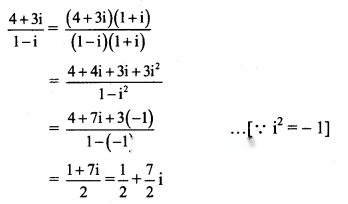
(vii)
Solution:

(viii)
Solution:

(ix)
Solution:

(x)
Solution:
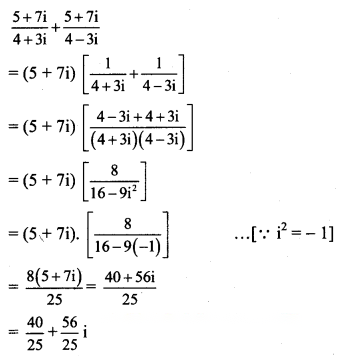
Question 2 Maharashtra Board Solution
Solve the following equations for x, y ∈ R (i) (4 – 5i)x + (2 + 3i)y = 10 – 7i
Solution & Step-by-Step Answer:
(4 – 5i)x + (2 + 3i)y = 10 – 7i (4x + 2y) + (3y – 5x) i = 10 – 7i Equating real and imaginary parts, we get 4x + 2y= 10 i.e., 2x + y = 5 ……(i) and 3y – 5x = -7 ……(ii) Equation (i) × 3 – equation (ii) gives 11x = 22 ∴ x = 2 Putting x = 2 in (i), we get 2(2) + y = 5 ∴ y = 1 ∴ x = 2 and y = 1

(ii) = 7 – i
Solution:
= 7 – i
x + iy = (7 – i)(2 + 3i)
x + iy = 14 + 21i – 2i – 3i2
x + iy = 14 + 19i – 3(-1)
x + iy = 17 + 19i
Equating real and imaginary parts, we get
∴ x = 17 and y = 19

(iii) (x + iy) (5 + 6i) = 2 + 3i
Solution:
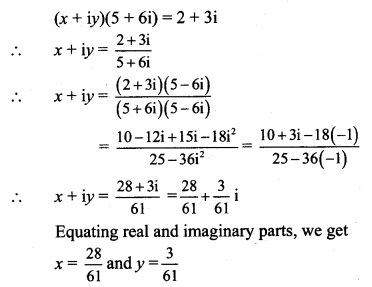
(iv) 2x + i9y(2 + i) = x i7+ 10 i16
Solution:
2x + i9y(2 + i) = x i7+ 10 i16
2x + (i4)2. i. y(2 + i) = x(i2)3. i + 10. (i4)4
2x + (1)2. iy(2 + i) = x(-1)3. i + 10(1)4……..[∵ i2= -1, i4= 1]
2x + 2yi + y i2= -xi + 10
2x + 2yi – y + xi = 10
(2x – y) + (x + 2y)i = 10 + 0. i
Equating real and imaginary parts, we get
2x – y = 10 ……(i)
and x + 2y = 0 ……..(ii)
Equation (i) × 2 + equation (ii) gives, we get
5x = 20
∴ x = 4
Putting x = 4 in (i), we get
2(4) – y = 10
y = 8 – 10
∴ y = -2
∴ x = 4 and y = -2
Question 3 Maharashtra Board Solution
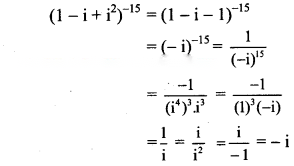
Evaluate (i) (1 – i + i2)-15
Solution & Step-by-Step Answer:

(ii) i131+ i49
Solution:
i131+ i49
= (i4)32. i3+ (i4)12. i
= (1)32(-i) + (1)12. i
= -i + i
= 0
Question 4 Maharashtra Board Solution
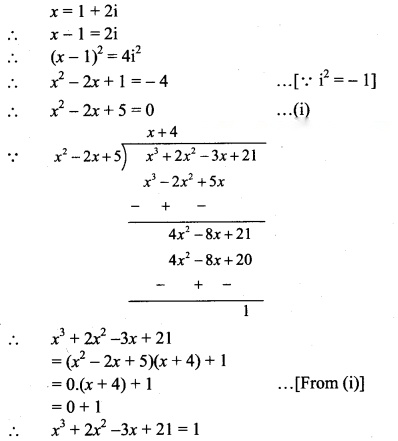
Find the value of (i) x3 + 2x2 – 3x + 21, if x = 1 + 2i
Solution & Step-by-Step Answer:

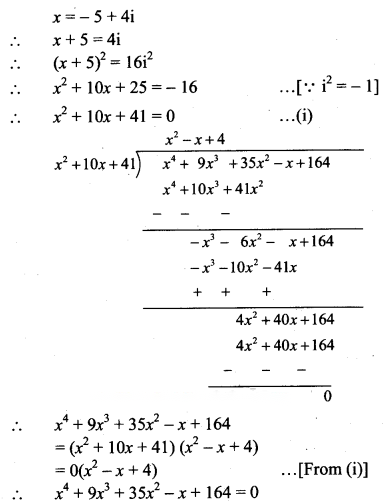
(ii) x4+ 9x3+ 35x2– x + 164, if x = -5 + 4i
Solution:
Question 5 Maharashtra Board Solution
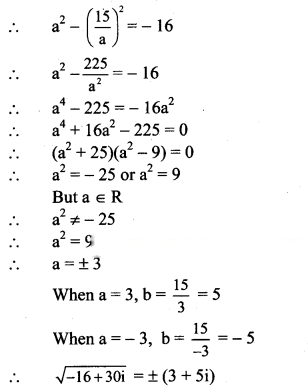
Find the square roots of (i) -16 + 30i
Solution & Step-by-Step Answer:
Let = a + bi, where a, b ∈ R. Squaring on both sides, we get -16 + 30i = a2 + b2 i2 + 2abi -16 + 30i = (a2 – b2) + 2abi …..[∵ i2 = -1] Equating real and imaginary parts, we get a2 – b2 = -16 and 2ab = 30 a2 – b2 = -16 and b =

(ii) 15 – 8i
Solution:
Let = a + bi, where a, b ∈ R.
Squaring on both sides, we get
15 – 8i = a2+ b2i2+ 2abi
15 – 8i = (a2– b2) + 2abi …..[∵ i2= -1]
Equating real and imaginary parts, we get
a2– b2= 15 and 2ab = -8
a2– b2= 15 and b =

When a = 4, b = = -1
When a = -4, b = = 1
∴ = ±(4 – i)

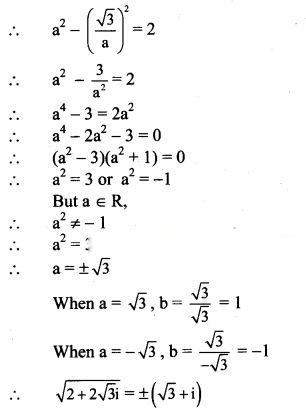
(iii) 2 + 2√3 i
Solution:
Let = a + bi, where a, b ∈ R.
Squaring on both sides, we get
2 + 2√3 i = a2+ b2i2+ 2abi
2 + 2√3 i = a2– b2+ 2abi …..[∵ i2= -1]
Equating real and imaginary parts, we get
a2– b2= 2 and 2ab = 2√3
a2– b2= 2 and b =
(iv) 18i
Solution:
Let √18i = a + bi, where a, b ∈ R.
Squaring on both sides, we get
18i = a2+ b2i2+ 2abi
0 + 18i = a2– b2+ 2abi …..[∵ i2= -1]
Equating real and imaginary parts, we get
a2– b2= 0 and 2ab = 18
a2– b2= 0 and b =


a4– 81 = 0
(a2– 9) (a2+ 9) = 0
a2= 9 or a2= -9
But a ∈ R
∴ a2≠ -9
∴ a2= 9
∴ a = ± 3
When a = 3, b = = 3
When a = -3, b = = -3
∴ √18i = ±(3 + 3i) = ±3(1 + i)

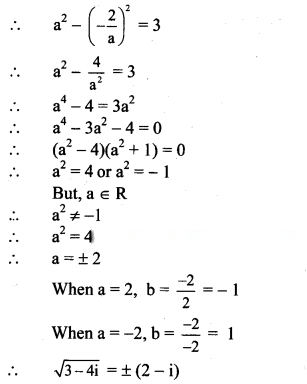
(v) 3 – 4i
Solution:
Let = a + bi, where a, b ∈ R.
Squaring on both sides, we get
3 – 4i = a2+ b2i2+ 2abi
3 – 4i = a2– b2+ 2abi ……[∵ i2= -1]
Equating real and imaginary parts, we get
a2– b2= 3 and 2ab = -4
a2– b2= 3 and b =
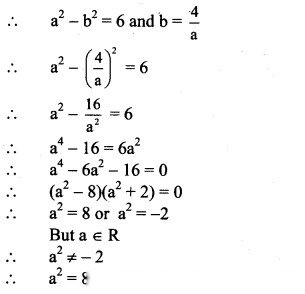
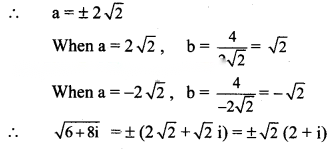
(vi) 6 + 8i
Solution:
Let = a + bi, where a, b ∈ R.
Squaring on both sides, we get
6 + 8i = a2+ b2i2+ 2abi
6 + 8i = a2– b2+ 2abi ……[∵ i2= -1]
Equating real and imaginary parts, we get
a2– b2= 6 and 2ab = 8
Question 6 Maharashtra Board Solution
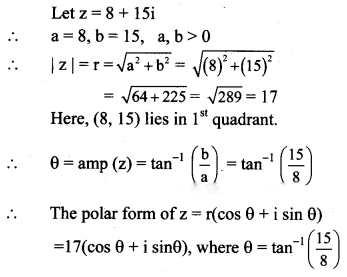
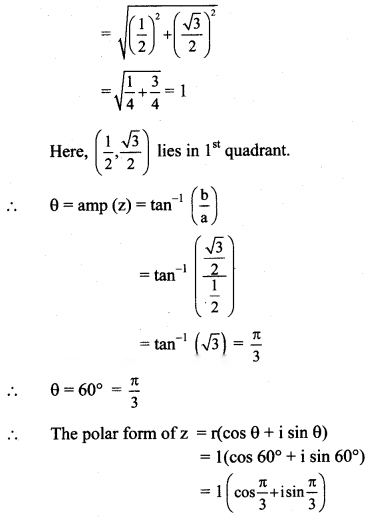
Find the modulus and argument of each complex number and express it in the polar form. (i) 8 + 15i
Solution & Step-by-Step Answer:

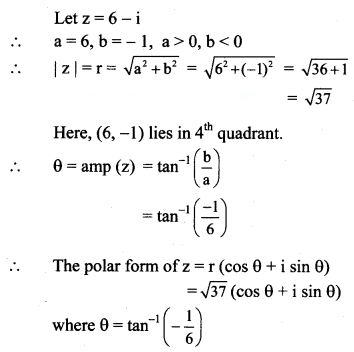
(ii) 6 – i
Solution:

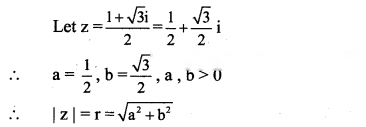
(iii)
Solution:
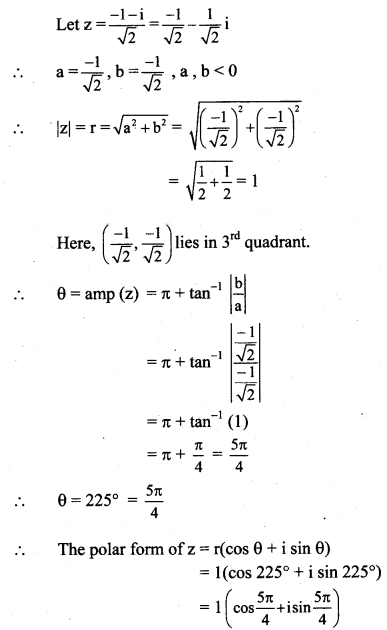
(iv)
Solution:
(v) 2i
Solution:
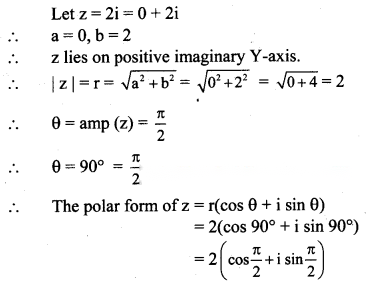
(vi) -3i
Solution:
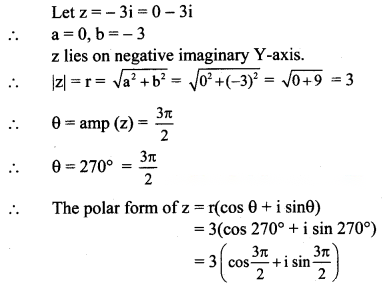
(vii)
Solution:
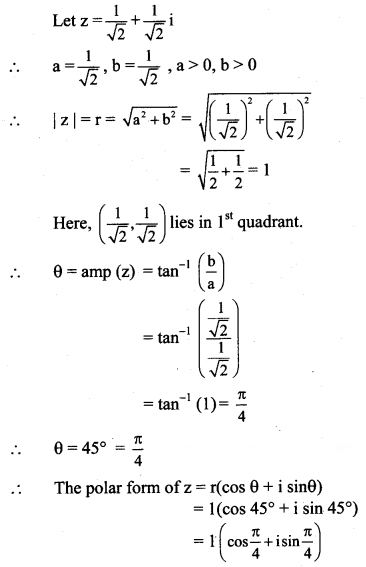
Question 7 Maharashtra Board Solution
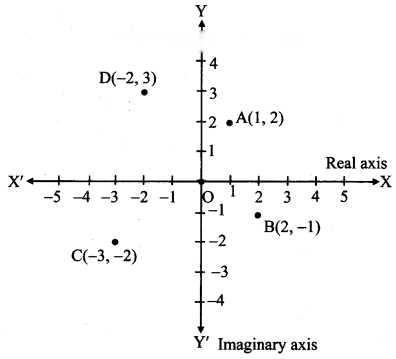
Represent 1 + 21, 2 – i, -3 – 2i, -2 + 3i by points in Argand’s diagram.
Solution & Step-by-Step Answer:
The complex numbers 1 + 2i, 2 – i, -3 – 2i, -2 + 3i will be represented by the points A(1, 2), B(2, -1), C(-3, -2), D(-2, 3) respectively as shown below:

Question 8 Maharashtra Board Solution
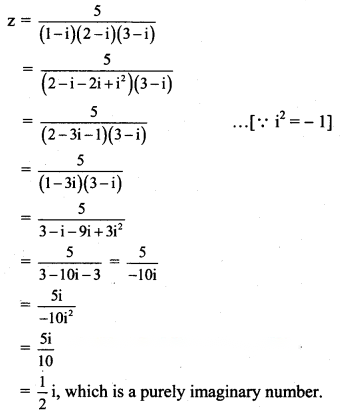
Show that z = is purely imaginary number.
Solution & Step-by-Step Answer:

Question 9 Maharashtra Board Solution
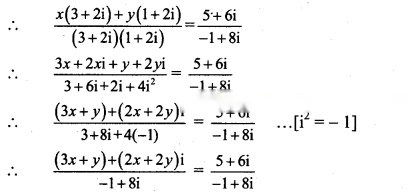
Find the real numbers x and y such that
Solution & Step-by-Step Answer:
(3x + y) + 2(x + y)i = 5 + 6i Equating real and imaginary parts, we get 3x + y = 5 ……(i) and 2(x + y) = 6 i.e., x + y = 3 …….(ii) Subtracting (ii) from (i), we get 2x = 2 ∴ x = 1 Putting x = 1 in (ii), we get 1 + y = 3 ∴ y = 2 ∴ x = 1, y = 2

Question 10 Maharashtra Board Solution
Show that
Solution & Step-by-Step Answer:

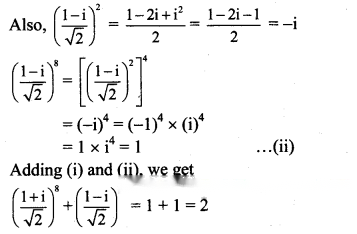
Question 11 Maharashtra Board Solution
Show that
Solution & Step-by-Step Answer:

Question 12 Maharashtra Board Solution
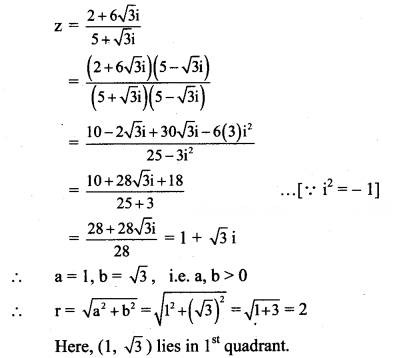
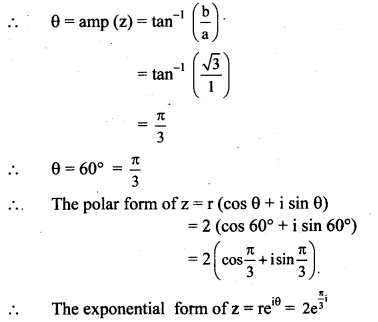
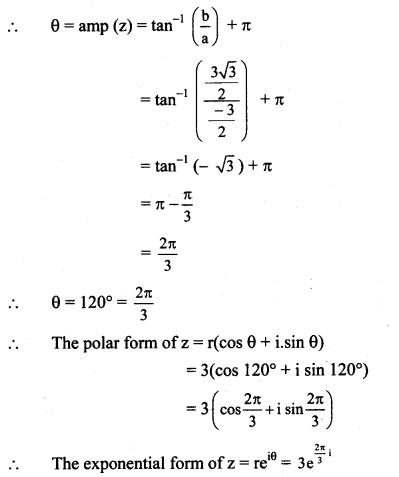
Convert the complex numbers in polar form and also in exponential form. (i) z =
Solution & Step-by-Step Answer:

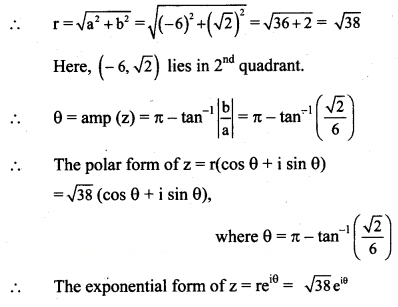
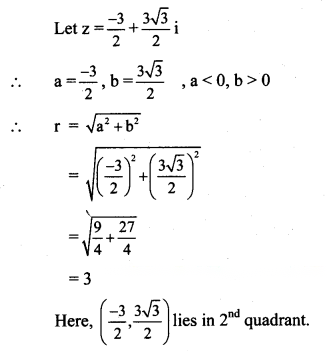
(ii) z = -6 + √2 i
Solution:
z = -6 + √2 i
∴ a = -6, b = √2
i.e. a < 0, b > 0
(iii)
Solution:
Question 13 Maharashtra Board Solution
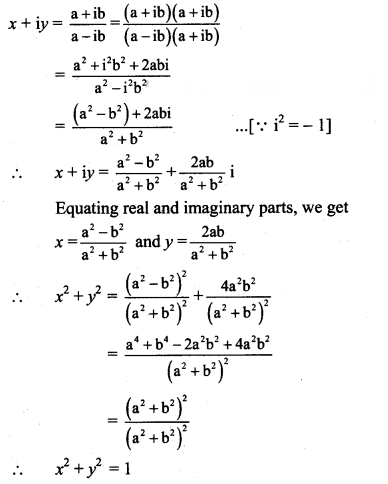
If x + iy = , prove that x2 + y2 = 1.
Solution & Step-by-Step Answer:

Question 14 Maharashtra Board Solution
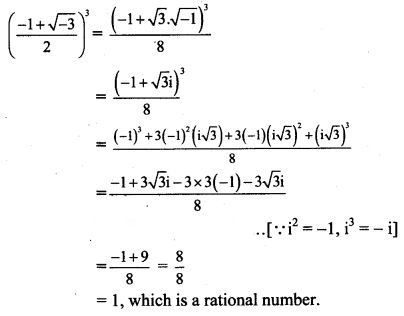
Show that z = is a rational number.
Solution & Step-by-Step Answer:

Question 15 Maharashtra Board Solution
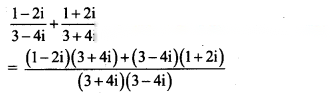
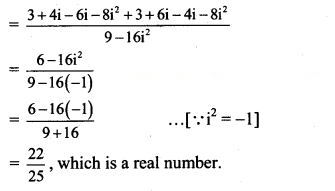
Show that is real.
Solution & Step-by-Step Answer:

Question 16 Maharashtra Board Solution
Simplify (i)
Solution & Step-by-Step Answer:

(ii)
Solution:

(iii)
Solution:

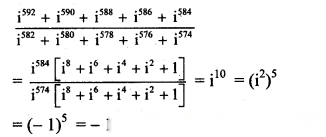
Question 17 Maharashtra Board Solution
Simplify
Solution & Step-by-Step Answer:

Question 18 Maharashtra Board Solution
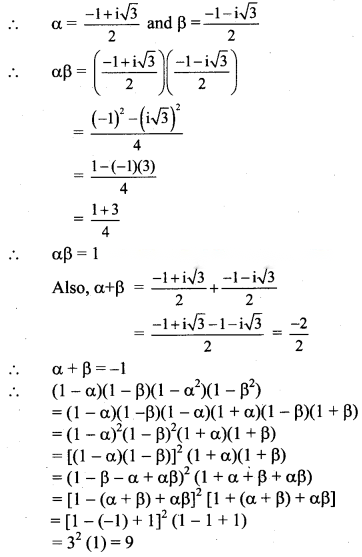
If α and β are complex cube roots of unity, prove that (1 – α) (1 – β) (1 – α2) (1 – β2) = 9.
Solution & Step-by-Step Answer:
α and β are the complex cube roots of unity.

Question 19 Maharashtra Board Solution
If ω is a complex cube root of unity, prove that (1 – ω + ω2)6 + (1 + ω – ω2)6 = 128.
Solution & Step-by-Step Answer:
ω is the complex cube root of unity. ∴ ω3 = 1 and 1 + ω + ω2 = 0 Also, 1 + ω2 = -ω, 1 + ω = -ω2 ∴ L.H.S. = (1 – ω + ω2)6 + (1 + ω – ω2)6 = [(1 + ω2) – ω]6 + [(1 + ω) – ω2]6 = (-ω – ω))6 + (-ω2 – ω2)6 = (-2ω)6 + (-2ω2)6 = 64ω6 + 64ω12 = 64(ω3)2 + 64(ω3)4 = 64(1)2 + 64(1)4 = 128 = R.H.S.
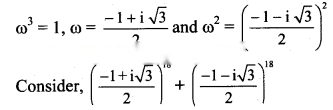
Question 20 Maharashtra Board Solution
If ω is the cube root of unity, then find the value of
Solution & Step-by-Step Answer:
If ω is the complex cube root of unity, then Given Expression = ω18 + (ω2)18 = ω18 + ω36 = (ω3)6 + (ω3)12 = (1)6 + (1)12 = 2