Latest Maharashtra State Board (SSC & HSC) 2026-27 Syllabus Digest & Solutions Updated!
Class 11 (FYJC / HSC)Mathematics & Statistics2026-27 Syllabus

Chapter 2 Trigonometry – I Miscellaneous Exercise 2 Solutions

Complete Maharashtra State Board Balbharati & Yuvakbharati textbook solutions for Chapter 2 Trigonometry – I Miscellaneous Exercise 2. Step-by-step solved exercises, numerical problems, and digest answers.

20 Solved Questions39 Diagrams3483 words

Maharashtra State Board 11th Maths Solutions Chapter 2 Trigonometry – I Miscellaneous Exercise 2

I. Select the correct option from the given alternatives.

Question 1 Maharashtra Board Solution
The value of the expression cos1°. cos2°. cos3° … cos 179° = (A) -1 (B) 0 (C) (D) 1
Solution & Step-by-Step Answer:
(B) 0

Explanation:
cos 1° cos 2° cos 3° … cos 179°
= cos 1° cos 2° cos 3° … cos 90°… cos 179°
= 0 …[∵ cos 90° = 0]

Question 2 Maharashtra Board Solution
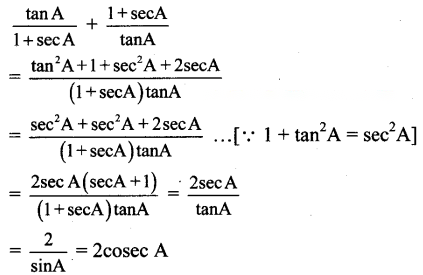
is equal to (A) 2cosec A (B) 2 sec A (C) 2 sin A (D) 2 cos A
Solution & Step-by-Step Answer:
(A) 2cosec A

Explanation:

Question 3 Maharashtra Board Solution
If α is a root of 25cos2 θ + 5cos θ – 12 = 0, < α < π, then sin 2α is equal to (A) (B) (C) (D)
Solution & Step-by-Step Answer:
(A)

Explanation:

25 cos2θ + 5 cos θ – 12 = 0
∴ (5cos θ + 4) (5 cos θ – 3) = 0
∴ cos θ = or cos θ =
Since < α < π,
cos α < 0
∴ cos α =
sin2α = 1 – cos2α = 1 –
∴ sin α =
Since < α < π sin α > 0
∴ sin α = 3/5
sin 2 α = 2 sin α cos α
=

Question 4 Maharashtra Board Solution
If θ = 60°, then is equal to (A) (B) (C) (D)
Solution & Step-by-Step Answer:
(B)

Explanation:

Question 5 Maharashtra Board Solution
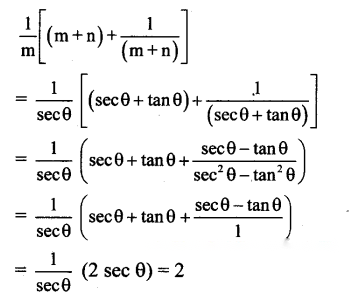
If sec θ = m and tan θ = n, then is equal to (A) 2 (B) mn (C) 2m (D) 2n
Solution & Step-by-Step Answer:
(A) 2 Explanation:

Question 6 Maharashtra Board Solution
If cosec θ + cot θ = , then the value of tan θ is (A) (B) (C) (D)
Solution & Step-by-Step Answer:
(B)

Explanation:
cosec θ + cot θ = …………….(i)
cosec2θ – cot2θ = 1
∴ (cosec θ + cot θ) (cosec θ – cot θ) = 1
∴ (cosec θ – cot θ) = 1
∴ cosec θ – cot θ = …(ii)
Subtracting (ii) from (i), we get
2 cot θ =
∴ cot θ =
∴ tan θ =

Question 7 Maharashtra Board Solution
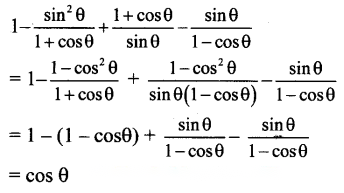
equals (A) 0 (B) 1 (C) sin θ (D) cos θ
Solution & Step-by-Step Answer:
(D) cos θ

Explanation:

Question 8 Maharashtra Board Solution
If cosec θ – cot θ = q, then the value of cot θ is (A) (B) (C) (D)
Solution & Step-by-Step Answer:
(C)

Explanation:

cosec θ – cot θ = q ……(i)
cosec2θ – cot2θ = 1
∴ (cosec θ + cot θ) (cosec θ – cot θ) = 1
∴ (cosec θ + cot θ)q = 1
∴ cosec θ + cot θ = 1/q …….(ii)
Subtracting (i) from (ii), we get
2cot θ =
∴ cot θ =

Question 9 Maharashtra Board Solution
The cotangent of the angles and are in (A) A.P. (B) G.P. (C) H.P. (D) Not in progression
Solution & Step-by-Step Answer:
(B) G.P.

Explanation:

Question 10 Maharashtra Board Solution
The value of tan 1°.tan 2° tan 3° equal to (A) -1 (B) 1 (C) (D) 2
Solution & Step-by-Step Answer:
(B) 1

Explanation:

tan1° tan2° tan3° … tan89°
= (tan 1° tan 89°) (tan 2° tan 88°)
…(tan 44° tan 46°) tan 45°
= (tan 1 ° cot 1 °) (tan 2° cot 2°)
…(tan 44° cot 44°). tan 45°
…tan(∵ 90° – θ) = cot θ]
= 1 x 1 x 1 x … x 1 x tan 45° =1

II. Answer the following:
Question 1 Maharashtra Board Solution
Find the trigonometric functions of: 90°, 120°, 225°, 240°, 270°, 315°, -120°, -150°, -180°, -210°, -300°, -330°
Solution & Step-by-Step Answer:
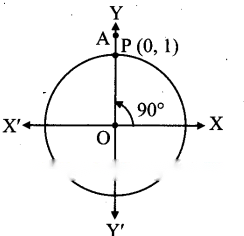
Angle of measure 90° : Let m∠XOA = 90° Its terminal arm (ray OA) intersects the standard, unit circle at P(0, 1). ∴ x = 0 and y = 1 sin 90° = y = 1 cos 90° = x = 0 tan 90° = , which is not defined cosec 90° = = 1 sec 90° = , which is not defined cot 90° = = 0

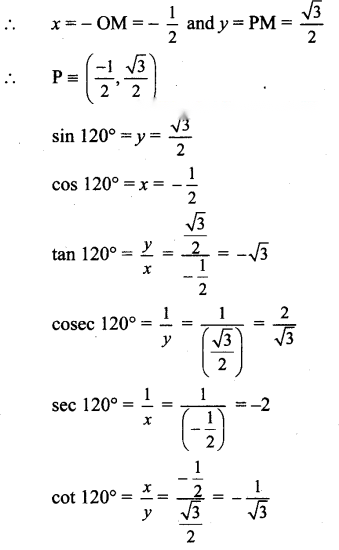
Angle of measure 120° :
Let m∠XOA =120°
Its terminal arm (ray OA) intersects the standard unit circle at P(x, y).
Draw seg PM perpendicular to the X-axis.
∴ ΔOMP is a 30° – 60° – 90° triangle.
OP = 1

Since point P lies in the 2nd quadrant, x < 0, y > 0

[Note: Answer given in the textbook of tan 120° is and cot 120° is . However, as per our calculation the answer of tan 120° is and cot 120° is

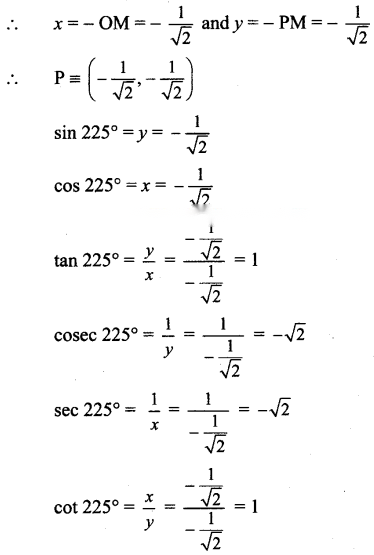
Angle of measure 225° :
Let m∠XOA = 225°
Its terminal arm (ray OA) intersects the standard unit circle at P(x, y).
Draw seg PM perpendicular to the X-axis.
ΔOMP is a 45° – 45° – 90° triangle.
OP = 1

Since point P lies in the 3rd quadrant, x < 0, y < 0

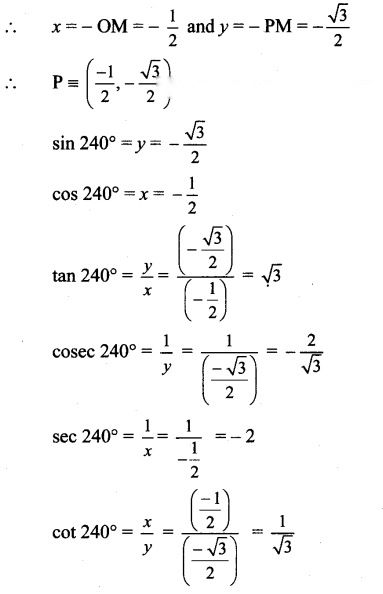
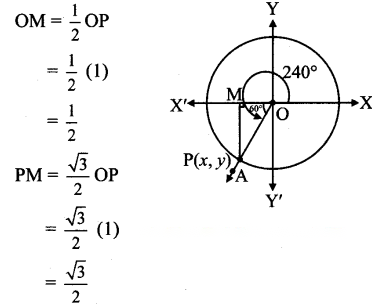
Angle of measure 240° :
Let m∠XOA = 240°
Its terminal arm (ray OA) intersects the standard unit circle at P(x, y).
Draw seg PM perpendicular to the X-axis.
ΔOMP is a 30° – 60° – 90° triangle.
OP = 1

Since point P lies in the 3rd quadrant, x < 0, y < 0
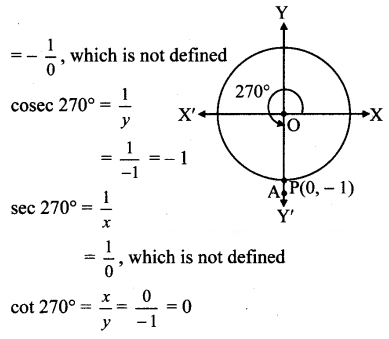
Angle of measure 270° :
Let m∠XOA = 270°
Its terminal arm (ray OA) intersects the standard unit circle at P(0, – 1).
x = 0 andy = – 1
sin 270° = y = -1
cos 270° = x = 0
tan 270° =

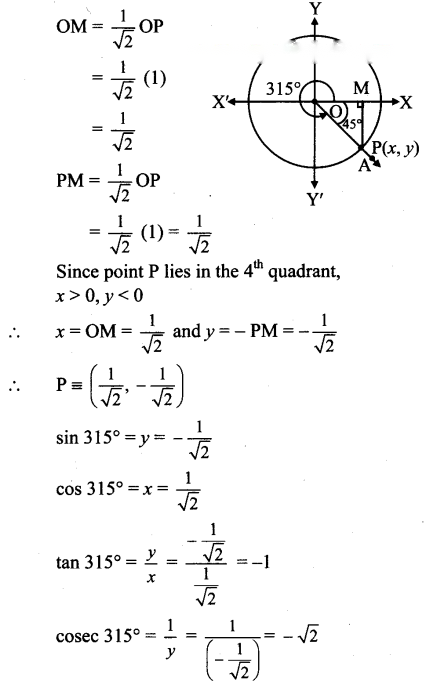
Angle of measure 315° :
Let m∠XOA = 315°
Its terminal arm (ray OA) intersects the standard unit circle at P(x, y).
Draw seg PM perpendicular to the X-axis.
∴ ΔOMP is a 45° – 45° – 90° triangle.
OP = 1


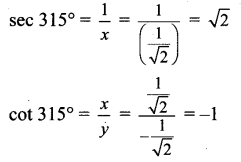
[Note: Answer given in the textbook of cot 315° is 1. However, as per our calculation it is -1.]

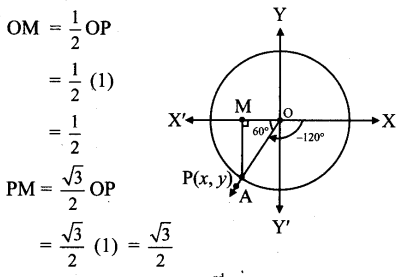
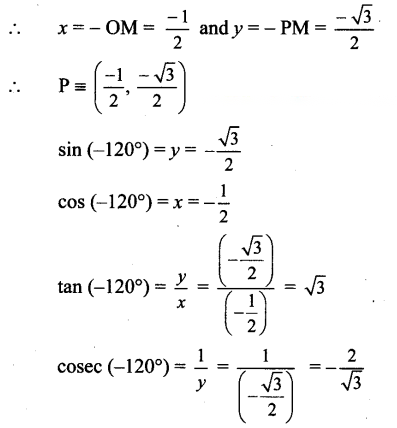
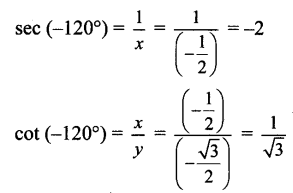
Angle of measure (-120°):
Let m∠XOA = – 120°
Its terminal arm (ray OA) intersects the standard unit circle at P(x, y).
Draw seg PM perpendicular to the X-axis.
∴ ΔOMP is a 30° – 60° – 90° triangle.
OP = 1,

Since point P lies in the 3rd quadrant, x < 0, y < 0
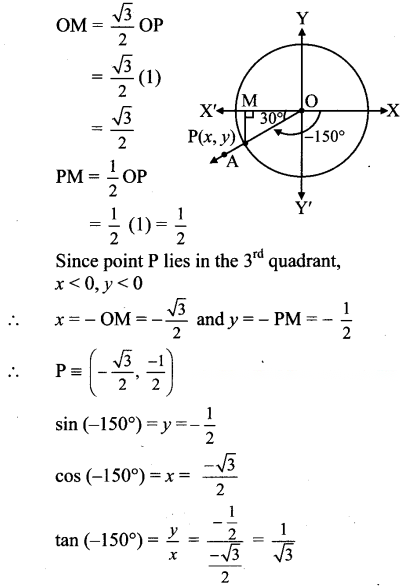
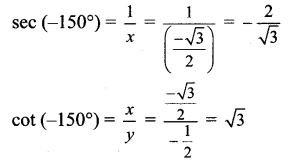
Angle of measure (-150°) :
Let m∠XOA = – 150°
Its terminal arm (ray OA) intersects the standard unit circle at P(x, y).
Draw seg PM perpendicular to the X-axis.
∴ ΔOMP is a 30° – 60° – 90° triangle.
OP = 1
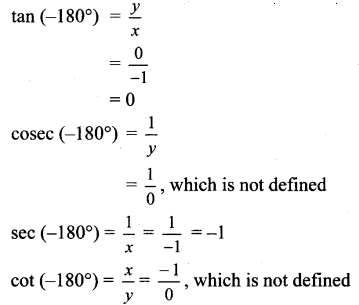
Angle of measure (-180°):
Let m∠XOA = – 180°
Its terminal arm (ray OA) intersects the standard unit circle at P(- 1, 0).
∴ x = – 1 andy = 0
sin (-180°) = y = 0
cos (-180°) = x
= -1

Angle of measure (- 210°):
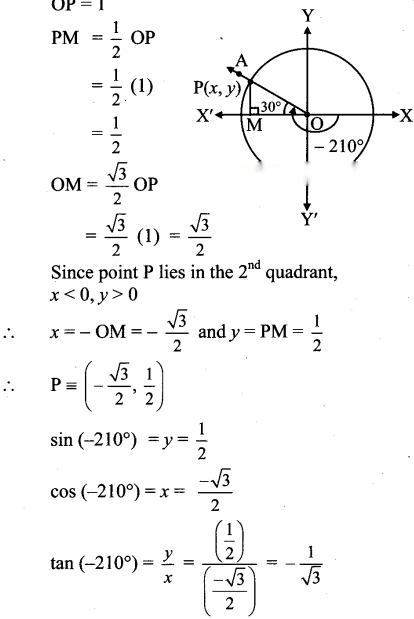
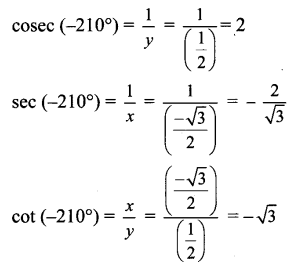
Let m∠XOA = -210°
Its terminal arm (ray OA) intersects the standard unit circle at P(x, y).
Draw seg PM perpendicular to the X-axis.
∴ ΔOMP is a 30° – 60° – 90° triangle.
OP = 1
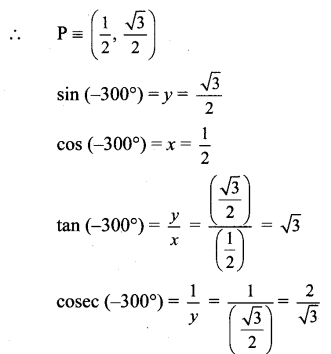
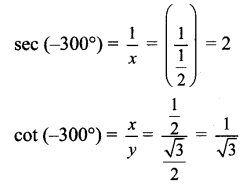
Angle of measure (- 300°):
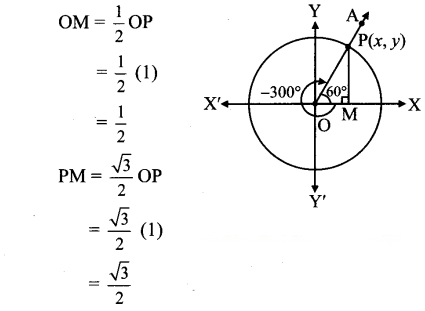
Let m∠XOA = – 300° Its terminal arm (ray OA) intersects the standard unit circle at P(x, y).
Draw seg PM perpendicular to the X-axis.
ΔOMP is a 30° – 60° – 90° triangle.
OP = 1

Since point P lies in the 1st quadrant, x>0,y>0
x = OM = and
y = PM =
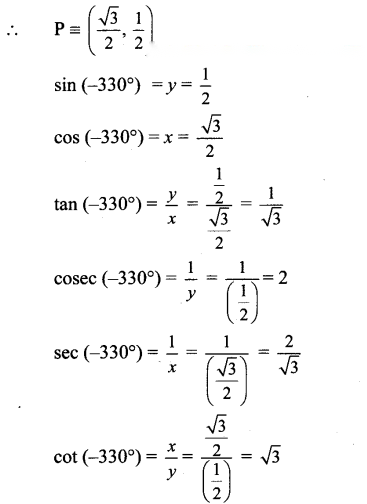
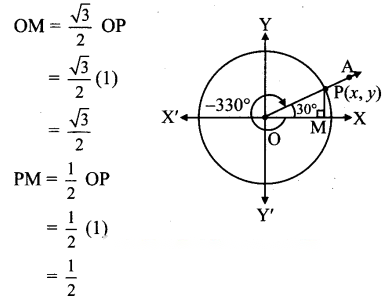
Angle of measure (- 330°):
Let m∠XOA = – 330°
Its terminal arm (ray OA) intersects the standard unit circle at P(x, y).
Draw seg PM perpendicular to the X-axis.
∴ ΔOMP is a 30° – 60° – 90° triangle.
OP= 1

Since point P lies in the 1st quadrant, x > 0, y > 0
∴ x = OM = and y = PM =
Question 2 Maharashtra Board Solution
State the signs of: i. cosec 520° ii. cot 1899° iii. sin 986°
Solution & Step-by-Step Answer:
i. 520° =360° + 160° ∴ 520° and 160° are co-terminal angles. Since 90° < 160° < 180°, 160° lies in the 2nd quadrant. ∴ 520° lies in the 2nd quadrant, ∴ cosec 520° is positive.

ii. 1899° = 5 x 360° + 99°
∴ 1899° and 99° are co-terminal angles.
Since 90° < 99° < 180°,
99° lies in the 2nd quadrant.
∴ 1899° lies in the 2nd quadrant.
∴ cot 1899° is negative.

iii. 986° = 2x 360° + 266°
∴ 986° and 266° are co-terminal angles.
Since 180° < 266° < 270°,
266° lies in the 3rd quadrant.
∴ 986° lies in the 3rd quadrant.
∴ sin 986° is negative.

Question 3 Maharashtra Board Solution
State the quadrant in which 6 lies if i. tan θ < 0 and sec θ > 0 ii. sin θ < 0 and cos θ < 0 iii. sin θ > 0 and tan θ < 0
Solution & Step-by-Step Answer:
i. tan θ < 0 tan θ is negative in 2nd and 4th quadrants, sec θ > 0 sec θ is positive in 1st and 4th quadrants. ∴ θ lies in the 4th quadrant.

ii. sin θ < 0
sin θ is negative in 3rd and 4th quadrants, cos θ < 0
cos θ is negative in 2nd and 3rd quadrants.
.’. θ lies in the 3rd quadrant.

iii. sin θ > 0
sin θ is positive in 1st and 2nd quadrants, tan θ < 0
tan θ is negative in 2nd and 4th quadrants.
∴ θ lies in the 2nd quadrant.
Question 4 Maharashtra Board Solution
Which is greater? sin (1856°) or sin (2006°)
Solution & Step-by-Step Answer:
1856° = 5 x 360° + 56° ∴ 1856° and 56° are co-terminal angles. Since 0° < 56° < 90°, 56° lies in the 1st quadrant. ∴ 1856° lies in the 1st quadrant, ∴ sin 1856° >0 …(i) 2006° = 5 x 360° + 206° ∴ 2006° and 206° are co-terminal angles. Since 180° < 206° < 270°, 206° lies in the 3rd quadrant. ∴ 2006° lies in the 3rd quadrant, ∴ sin 2006° <0 …(ii) From (i) and (ii), sin 1856° is greater.
Question 5 Maharashtra Board Solution
Which of the following is positive? sin(-310°) or sin(310°)
Solution & Step-by-Step Answer:
Since 270° <310° <360°, 310° lies in the 4th quadrant. ∴ sin (310°) < 0 -310° = -360°+ 50° ∴ 50° and – 310° are co-terminal angles. Since 0° < 50° < 90°, 50° lies in the 1st quadrant. ∴ – 310° lies in the 1st quadrant. ∴ sin (- 310°) > 0 ∴ sin (- 310°) is positive.
Question 6 Maharashtra Board Solution
Show that 1 – 2sin θ cos θ ≥ 0 for all θ ∈ R.
Solution & Step-by-Step Answer:
1 – 2 sin θ cos θ = sin2 θ + cos2 θ – 2sin θ cos θ = (sin θ – cos θ)2 ≥ 0 for all θ ∈ R
Question 7 Maharashtra Board Solution
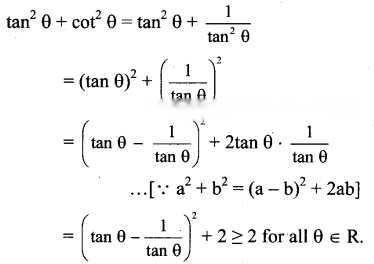
Show that tan2 θ + cot2 θ ≥ 2 for all θ ∈ R.
Solution & Step-by-Step Answer:

Question 8 Maharashtra Board Solution
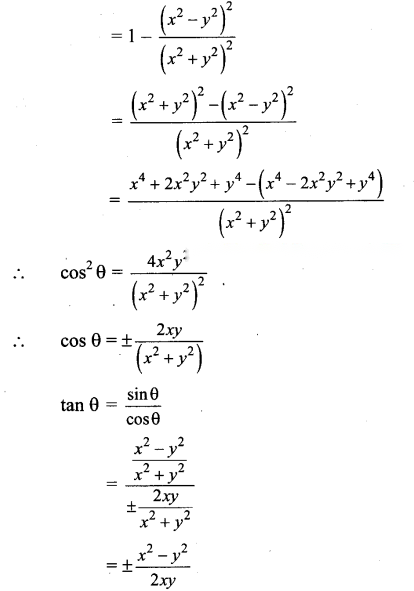
If sin θ = , then find the values of cos θ, tan θ in terms of x and y.
Solution & Step-by-Step Answer:
Given, sin θ = we know that cos2θ = 1 – sin2 θ

[Note: Answer given in the textbook of cos θ = and tan θ = and tan θ = ± . ]
Question 9 Maharashtra Board Solution
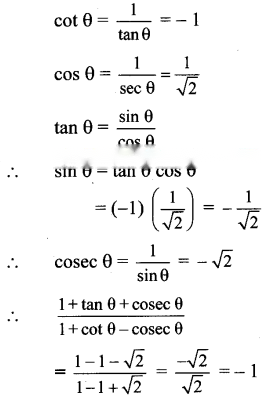
If sec θ = and < θ < 2π, then evaluate
Solution & Step-by-Step Answer:
Given sec θ = We know that, tan2 θ = sec2 θ – 1 = () – 1 = 2 – 1 = 1 ∴ tan θ = ±1 Since < θ < 2π θ lies in the 4th quadrant. ∴ tan θ < 0 ∴ tan θ = -1

Question 10 Maharashtra Board Solution
Prove the following:

i. sin2A cos2B + cos2A sin2B + cos2A cos2B + sin2A sin2B = 1
Solution & Step-by-Step Answer:
L.H.S. = sin2A cos2B + cos2A sin2B + cos2A cos2B + sin2A sin2B
= sin2A (cos2B + sin2B) + cos2A (sin2B + cos2B)
= sin2A(1) + cos2A(1)
= 1 = R.H.S.

ii.
Solution:

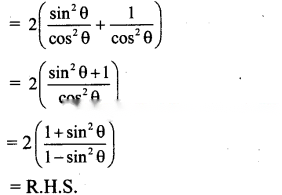
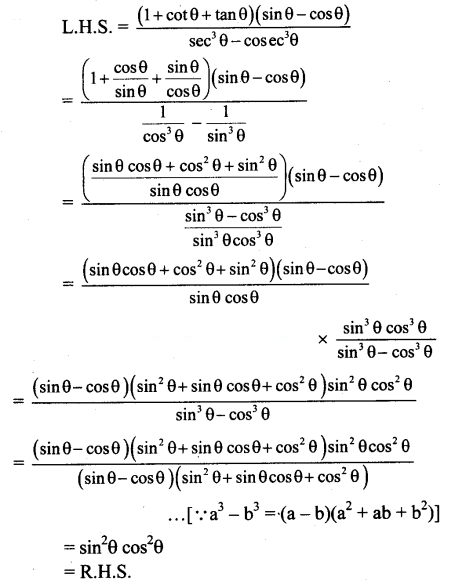
iii. L.H.S. =
Solution:
L.H.S. =
= (tanθ + secθ)2+ (tanθ – secθ)2
= tan2θ + 2 tan θ sec θ + sec2θ
+ tan2θ – 2 tan θ sec θ +.sec2θ
= 2(tan2θ + sec2θ)

iv. 2.sec2θ – sec4θ – 2.cosec2θ + cosec4θ = cot4θ – tan4θ
Solution:
LHS.
= 2.sec2θ – sec4θ – 2.cosec2θ + cosec4θ =  = 2 sec2θ – (sec2θ)2– 2cosec2θ + (cosec2θ)2
= 2(1+ tan2θ) – (1+ tan2θ)2– 2(1+ cot2θ)
+ (1+ cot2θ)2
= 2 + 2tan2θ – (1 + 2tan2θ + tan4θ)
– 2 – 2cot2θ + 1 + 2cot2θ + cot4θ
= 2 + 2.tan2θ – 1 – 2 tan2θ – tan4θ – 2
– 2 cot2θ + 1 + 2 cot2θ + cot4θ
= cot4θ – tan4θ = R.H.S.

v. sin4θ + cos4θ = sin4θ + cos4θ
Solution:
L.H.S. = sin4θ + cos4θ
= (sin2θ)2+ (cos2θ)2= (sin2θ + cos2θ)2– 2sin2θ cos2θ
… [ v a2+ b2= (a + b)2– 2ab]
= 1 – 2sin2θ cos2θ
= R.H.S.

vi. 2(sin6θ + cos6θ) – 3(sin4θ + cos4θ) + 1 = 0
L.H.S =
2(sin6θ + cos6θ) – 3(sin4θ + cos4θ) + 1=0
= sin6θ + cos6θ
= (sin2θ)3+ (cos2θ)3= (sin2θ + cos2θ)3
– 3 sin2θ cos2θ (sin2 0 + cos2 0)
…[••• a3+ b3= (a + b)3– 3ab(a + b)]
= (1)3– 3 sin2θ cos2θ(1)
= 1-3 sin2θ cos2θ sin4θ + cos4θ
= (sin2θ)2+ (cos2θ)2= (sin2θ + cos2θ)2– 2 sin2θ cos2θ
…[Y a2+ b2= (a + b)2– 2ab]
= 1-2 sin2θ cos2θ
L.H.S.= 2(sin6θ + cos6θ) – 3(sin4θ + cos4θ) + 1
= 2(1-3 sin2θ cos2θ) -3(1 – 2 sin2θ cos2θ) + 1
= 2-6 sin2θ cos2θ – 3 + 6 sin2θ cos2θ + 1 = c
= R.H.S.

vii. cos4θ – sin4θ + 1 = 2cos2θ
L.H.S. = cos4θ – sin4θ + 1
= (cos2θ)2– (sin2θ)2+ 1 = (cos2θ + sin2θ) c(os2θ – sin2θ) +1
= (1) (cos2θ – sin2θ) + 1 = cos2θ + (1 – sin2θ)
= cos2θ + cos2θ = 2cos2θ = R.H.S.

viii. sin4θ + 2sin2θ cos2θ = 1 – cos4θ
L.H.S. = sin4θ + 2sin2θ cos2θ = sin2θ(sin2θ + 2cos2θ)
= (sin2θ) (sin2θ + cos2θ + cos2θ) = (1 – cos2θ) (1 + cos2θ)
= 1 – cos4θ = R.H.S.

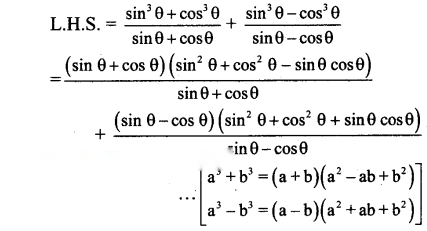
ix.
Solution:

= (sin2θ + cos2θ – sin θ cos θ) + (sin2θ + cos2θ + sinθ cosθ)
= 2 (sin2θ + cos2θ)
= 2(1)
= 2 = R.H.S.

x. tan2θ – sin2θ = sin4θ sec2θ
Solution:
L.H.S. = tan2θ – sin2θ
= – sin2θ
= sin2θ ()
=
= (sin2θ) (sin2θ)sec2θ
= sin4θ sec2θ
= R.H.S

xi. (sinθ + cosecθ)2+ (cos θ + see θ)2= tan2θ + cot2θ + 7
Solution:
L.H.S. = (sinθ + cosecθ)2+ (cos θ + see θ)2
= sin2θ + cosec2θ + 2sinθ cosec θ
+ cos2θ + sec2θ + 2sec0 cos0
= (sin2θ + cos2θ) + cosec2θ + 2 + sec2θ + 2
= 1 + (1 + cot2θ) + 2 + (1 + tan2θ) + 2 = tan2θ + cot2θ + 7
= R.H.S.

xii. sin8θ – cos8θ = (sin2θ – cos2θ) (1 – 2sin2θ cos2θ)
Solution:
L.H.S. = sin8θ – cos8θ
= (sin4θ)2– (cos4θ)2
= (sin4θ – cos4θ) (sin4θ + cos4θ)
= [(sin2θ)2– (cos2θ)2]
. [(sin2θ)2+ (cos2θ)2]
= (sin2θ + cos2θ) (sin2θ – cos2θ). [(sin2θ + cos2θ)2– 2sin2θ.cos2θ] …[Y a2+ b2= (a + b)2– 2ab]
= (1) (sin2θ – cos2θ) (12– 2sin2θ cos2θ)
= (sin2θ – cos2θ) (1 – 2sin2θ cos2θ)
= R.H.S.

xiii. sin6A + cos6A = 1 – 3 sin2A + 3sin4A
Soluiton:
L.H.S. = sin6A + cos6A
= (sin2A)3+ (cos2A)3
= (sin2A + cos2A)3
– 3sin2A cos2A(sin2A + cos2A)
…[ a3+ b3= (a + b)3– 3ab(a + b)]
= 13– 3sin2A cos2A (1)
= 1 – 3sin2A cos2A
= 1 – 3 sin2A (1 – sin2A)
= 1 – 3 sin2A + 3sin4A
= R.H.S.

xiv. (1 + tanA tanB)2+ (tanA – tanB)2= sec2A sec2B
Solution:
L.H.S. = (1 + tanA tanB)2+ (tanA – tanB)2
= 1 + 2tanA tanB + tan2A tan2+ tan2A- 2tanA tanB + tan2B
= 1 + tan2A + tan2B + tan2A tan2B
= 1(1+ tan2A) + tan2B(1 + tan2A)
= (1 + tan2A) (1 + tan2B)
= sec2A sec2B = R.H.S.

xv.
Solution:
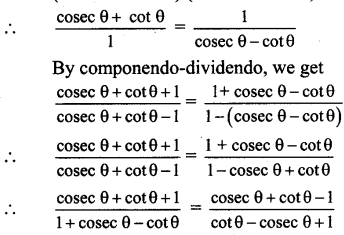
We know that cosec2θ – cot2θ = 1
∴ (cosec θ – cot θ) (cosec θ + cot θ) = 1

xvi.
Solution:
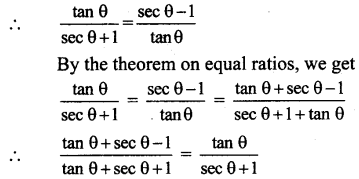
We know that
tan2θ = sec2θ – 1
∴ tan θ. tanθ = (sec θ + 1)(sec θ – 1)

xvii.
Solution:
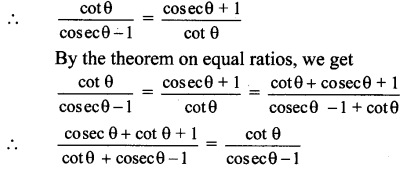
We know that,
cot2θ = cosec2θ – 1
∴ cot θ. cot θ = (cosec θ + 1)(cosec θ – 1)

Alternate Method:

xviii.
solution:
We know that,
cot2θ = cosec2θ – 1
∴ cot θ.cot θ = (cosec θ + 1) (cosec θ – 1)