Latest Maharashtra State Board (SSC & HSC) 2026-27 Syllabus Digest & Solutions Updated!
Class 11 (FYJC / HSC)Mathematics & Statistics2026-27 Syllabus

Chapter 4 Methods of Induction and Binomial Theorem Miscellaneous Exercise 4 Solutions

Complete Maharashtra State Board Balbharati & Yuvakbharati textbook solutions for Chapter 4 Methods of Induction and Binomial Theorem Miscellaneous Exercise 4. Step-by-step solved exercises, numerical problems, and digest answers.

36 Solved Questions50 Diagrams2130 words

Maharashtra State Board 11th Maths Solutions Chapter 4 Methods of Induction and Binomial Theorem Miscellaneous Exercise 4

(I) Select the correct answers from the given alternatives.

Question 1 Maharashtra Board Solution
The total number of terms in the expression of (x + y)100 + (x – y)100 after simplification is: (A) 50 (B) 51 (C) 100 (D) 202
Solution & Step-by-Step Answer:
(B) 51 Hint:

Question 2 Maharashtra Board Solution
The middle term in the expansion of (1 + x)2n will be: (A) (n – 1)th (B) nth (C) (n + 1)th (D) (n + 2)th
Solution & Step-by-Step Answer:
(C) (n + 1)th Hint: (1 + x)2n has (2n + 1) terms. ∴ (n + 1 )th term is the middle term.
Question 3 Maharashtra Board Solution
In the expansion of (x2 – 2x)10, the coefficient of x16 is (A) -1680 (B) 1680 (C) 3360 (D) 6720
Solution & Step-by-Step Answer:
(C) 3360 Hint: (x2 – 2x)10 = x10 (x – 2)10 To get the coefficient of x16 in (x2 – 2x)10, we need to check coefficient of x6 in (x – 2)10 ∴ Required coefficient = 10C6 (-2)4 = 210 × 16 = 3360
Question 4 Maharashtra Board Solution
The term not containing x in expansion of is (A) 11C5 (B) 10C5 (C) 10C4 (D) 10C7
Solution & Step-by-Step Answer:
(A) 11C5 Hint:

Question 5 Maharashtra Board Solution
The number of terms in expansion of (4y + x)8 – (4y – x)8 is (A) 4 (B) 5 (C) 8 (D) 9
Solution & Step-by-Step Answer:
(A) 4 Hint:

Question 6 Maharashtra Board Solution
The value of 14C1 + 14C3 + 14C5 + …. + 14C11 is (A) 214 – 1 (B) 214 – 14 (C) 212 (D) 213 – 14
Solution & Step-by-Step Answer:
(D) 213 – 14 Hint:

Question 7 Maharashtra Board Solution
The value of 11C2 + 11C4 + 11C6 + 11C8 is equal to (A) 210 – 1 (B) 210 – 11 (C) 210 + 12 (D) 210 – 12
Solution & Step-by-Step Answer:
(D) 210 – 12 Hint:

Question 8 Maharashtra Board Solution
In the expansion of (3x + 2)4, the coefficient of the middle term is (A) 36 (B) 54 (C) 81 (D) 216
Solution & Step-by-Step Answer:
(D) 216 Hint: (3x + 2)4 has 5 terms. ∴ (3x + 2)4 has 3rd term as the middle term. The coefficient of the middle term = 6 × 9 × 4 = 216

Question 9 Maharashtra Board Solution
The coefficient of the 8th term in the expansion of (1 + x)10 is: (A) 7 (B) 120 (C) 10C8 (D) 210
Solution & Step-by-Step Answer:
(B) 120 Hint: r = 7 t8 = 10C7 x7 = 10C3 x7 ∴ Coefficient of 8th term = 10C3 = 120
Question 10 Maharashtra Board Solution
If the coefficients of x2 and x3 in the expansion of (3 + ax)9 are the same, then the value of a is (A) (B) (C) (D)
Solution & Step-by-Step Answer:
(D) Hint:

(II) Answer the following.

Question 1 Maharashtra Board Solution
Prove by the method of induction, for all n ∈ N. (i) 8 + 17 + 26 + ….. + (9n – 1) = (9n + 7)
Solution & Step-by-Step Answer:
Let P(n) ≡ 8 + 17 + 26 +…..+(9n – 1) = (9n + 7), for all n ∈ N. Step I: Put n = 1 L.H.S. = 8 R.H.S. = [9(1) + 7] = 8 ∴ L.H.S. = R.H.S. ∴ P(n) is true for n = 1.

Step II:
Let us assume that P(n) is true for n = k.
∴ 8 + 17 + 26 +…..+ (9k – 1) = (9k + 7) ……(i)

Step III:
We have to prove that P(n) is true for n = k + 1,
i.e., 8 + 17 + 26 + …… + [9(k + 1) – 1]

∴ P(n) is true for n = k + 1.

Step IV:
From all the steps above, by the principle of mathematical induction, P(n) is true for all n ∈ N.
∴ 8 + 17 + 26 +…..+ (9n – 1) = (9n + 7) for all n ∈ N.

(ii) 12+ 42+ 72+ …… + (3n – 2)2= (6n2– 3n – 1)
Solution:
Let P(n) = 12+ 42+ 72+ ….. + (3n – 2)2= (6n2– 3n – 1), for all n ∈ N.
Step I:
Put n = 1
L.H.S.= 12= 1
R.H.S.= [6(1)2– 3(1) – 1] = 1
∴ L.H.S. = R.H.S.
∴ P(n) is true for n = 1.

Step II:
Let us assume that P(n) is true for n = k.
∴ 12+ 42+ 72+…..+ (3k – 2)2= (6k2– 3k – 1) ……(i)

Step III:
We have to prove that P(n) is true for n = k + 1,
i.e., to prove that

∴ P(n) is true for n = k + 1.

Step IV:
From all the steps above, by the principle of mathematical induction, P(n) is true for all n ∈ N.
∴ 12+ 42+ 72+ … + (3n – 2)2= (6n2– 3n – 1) for all n ∈ N.

(iii) 2 + 3.2 + 4.22+ …… + (n + 1) 2n-1= n. 2n
Solution:
Let P(n) ≡ 2 + 3.2 + 4.22+…..+ (n + 1) 2n-1= n.2n, for all n ∈ N.
Step I:
Put n = 1
L.H.S. = 2
R.H.S. = 1(21) = 2
∴ L.H.S. = R.H.S.
∴ P(n) is true for n = 1.

Step II:
Let us assume that P(n) is true for n = k.
∴ 2 + 3.2 + 4.22+ ….. + (k + 1) 2k-1= k.2k…..(i)

Step III:
We have to prove that P(n) is true for n = k + 1,
i.e., to prove that
2 + 3.2 + 4.22+….+ (k + 2) 2k= (k + 1) 2k+1

∴ P(n) is true for n = k + 1.

Step IV:
From all the steps above, by the principle of mathematical induction, P(n) is true for all n ∈ N.
∴ 2 + 3.2 + 4.22+……+ (n + 1) 2n-1= n.2nfor all n ∈ N.

(iv) =
Solution:


Question 2 Maharashtra Board Solution
Given that tn+1 = 5tn – 8, t1 = 3, prove by method of induction that tn = 5n-1 + 2.
Solution & Step-by-Step Answer:
Let the statement P(n) has L.H.S. a recurrence relation tn+1 = 5tn – 8, t1 = 3 and R.H.S. a general statement tn = 5n-1 + 2. Step I: Put n = 1 L.H.S. = 3 R.H.S. = 51-1 + 2 = 1 + 2 = 3 ∴ L.H.S. = R.H.S. ∴ P(n) is true for n = 1. Put n = 2 L.H.S = t2 = 5t1 – 8 = 5(3) – 8 = 7 R.H.S. = t2 = 52-1 + 2 = 5 + 2 = 7 ∴ L.H.S. = R.H.S. ∴ P(n) is tme for n = 2.

Step II:
Let us assume that P(n) is true for n = k.
∴ tk+1= 5tk– 8 and tk= 5k-1+ 2

Step III:
We have to prove that P(n) is true for n = k + 1,
i.e., to prove that
tk+1= 5k+1-1+ 2 = 5k+ 2
tk+1= 5tk– 8 and tk= 5k-1+ 2 ……[From Step II]
∴ tk+1= 5(5k-1+ 2) – 8 = 5k+ 2
∴ P(n) is true for n = k + 1.

Step IV:
From all the steps above, by the principle of mathematical induction, P(n) is true for all n ∈ N.
∴ tn= 5n-1+ 2, for all n ∈ N.
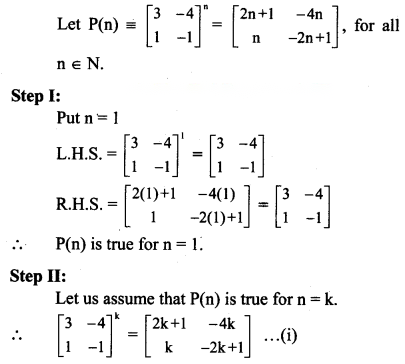
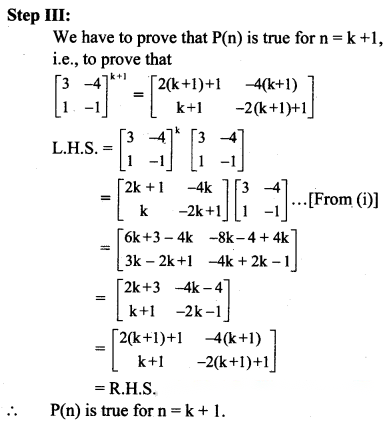
Question 3 Maharashtra Board Solution
Prove by method of induction , ∀ n ∈ N.
Solution & Step-by-Step Answer:
Step IV: From all the steps above, by the principle of mathematical induction, P(n) is true for all n ∈ N. ∴ , ∀ n ∈ N.

Question 4 Maharashtra Board Solution
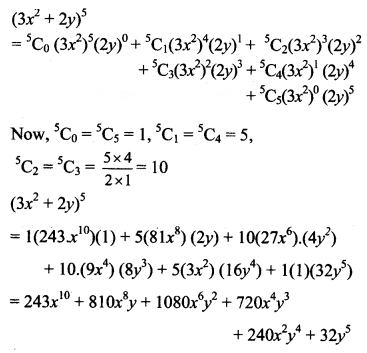
Expand (3x2 + 2y)5
Solution & Step-by-Step Answer:
Here, a = 3x2, b = 2y, n = 5. Using binomial theorem,

Question 5 Maharashtra Board Solution
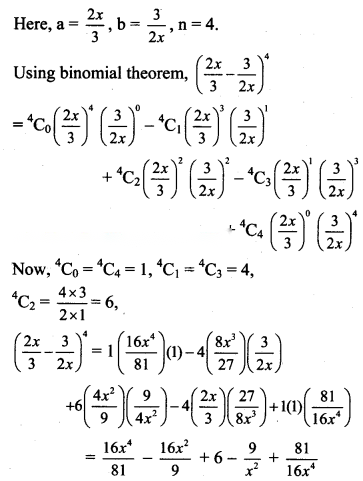
Expand
Solution & Step-by-Step Answer:

Question 6 Maharashtra Board Solution
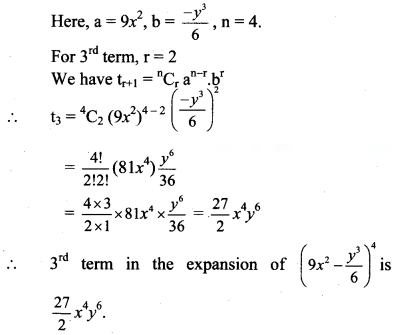
Find third term in the expansion of
Solution & Step-by-Step Answer:

Question 7 Maharashtra Board Solution
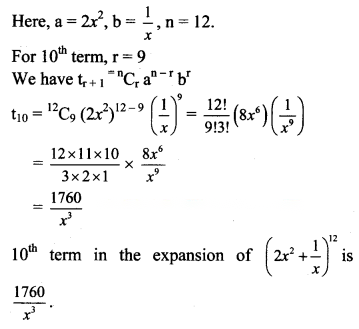
Find tenth term in the expansion of
Solution & Step-by-Step Answer:

Question 8 Maharashtra Board Solution
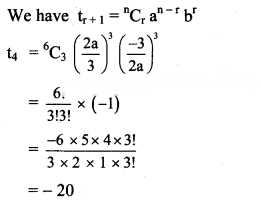
Find the middle term(s) in the expansion of (i)
Solution & Step-by-Step Answer:
Here, a = , b = , n = 6. Now, n is even. ∴ ∴ Middle term is t4, for which r = 3. ∴ The Middle term is -20.

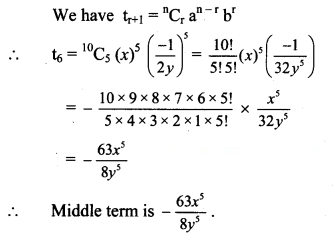
(ii)
Solution:
Here, a = x, b = , n = 10.
Now, n is even.

∴ Middle term is t6, for which r = 5

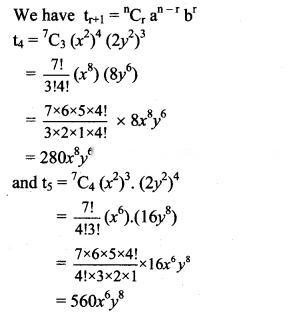
(iii) (x2+ 2y2)7
Solution:
Here, a = x2, b = 2y2, n = 7.
Now, n is odd.

∴ Middle terms are t4and t5, for which r = 3 and r = 4 respectively.

∴ Middle terms are 280x8y6and 560x6y8.
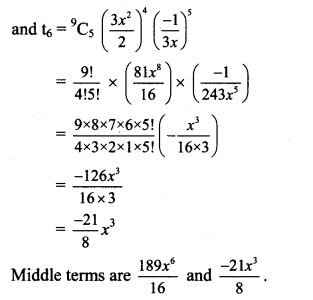
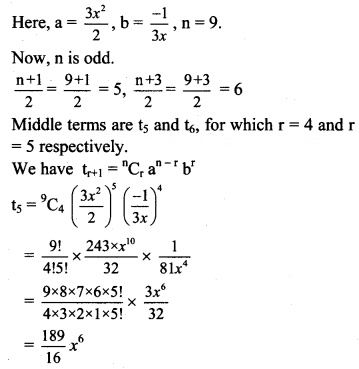
(iv)
Solution:
Question 9 Maharashtra Board Solution
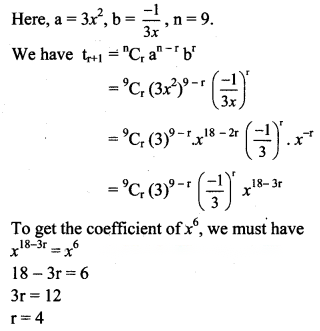
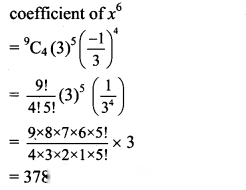
Find the coefficients of (i) x6 in the expantion of
Solution & Step-by-Step Answer:

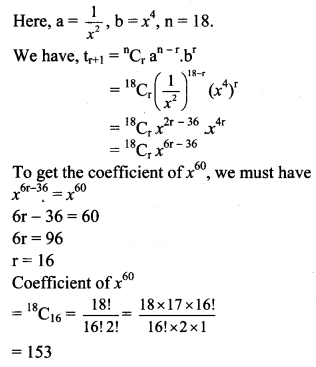
(ii) x60in the expansion of
Solution:
Question 10 Maharashtra Board Solution
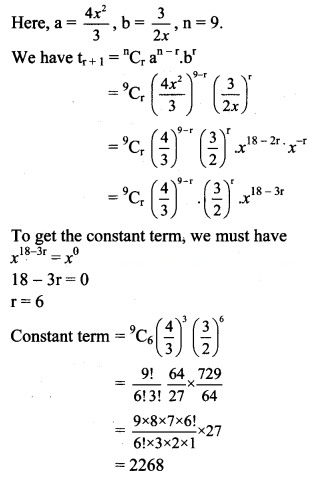
Find the constant term in the expansion of (i)
Solution & Step-by-Step Answer:

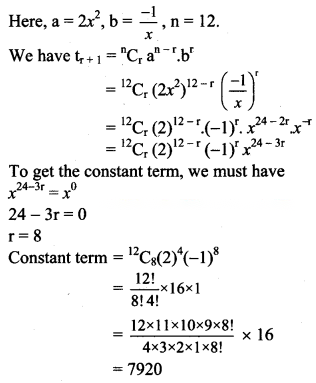
(ii)
Solution:

Question 11 Maharashtra Board Solution
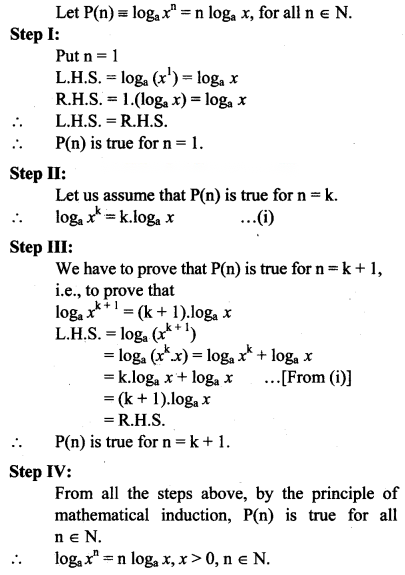
Prove by method of induction (i) loga xn = n loga x, x > 0, n ∈ N
Solution & Step-by-Step Answer:

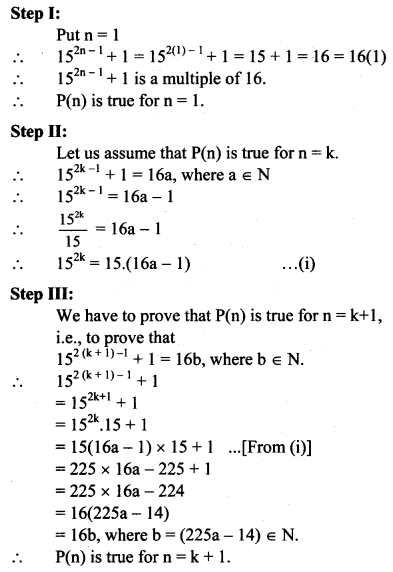
(ii) 152n-1+ 1 is divisible by 16, for all n ∈ N.
Solution:
152n-1+ 1 is divisible by 16, if and only if (152n-1+ 1) is is a multiple of 16.
Let P(n) ≡ 152n-1+ 1 = 16m, where m ∈ N.

Step IV:
From all the steps above, by the principle of mathematical induction, P(n) is true for all n ∈ N.
∴ 152n-1+ 1 is divisible by 16, for all n ∈ N.
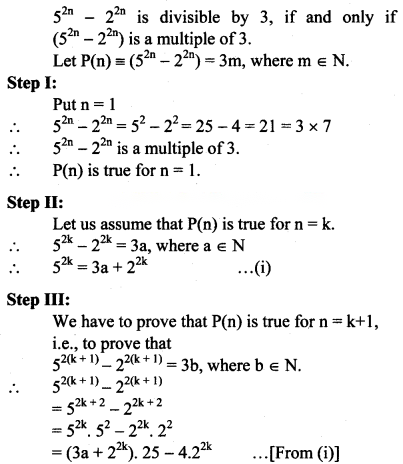
(iii) 52n– 22nis divisible by 3, for all n ∈ N.
Solution:
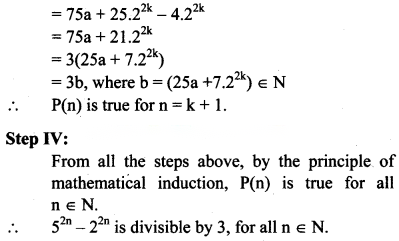
Question 12 Maharashtra Board Solution
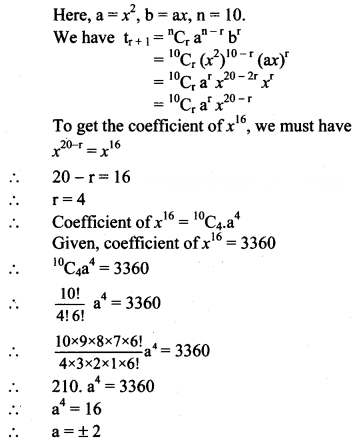
If the coefficient of x16 in the expansion of (x2 + ax)10 is 3360, find a.
Solution & Step-by-Step Answer:

Question 13 Maharashtra Board Solution
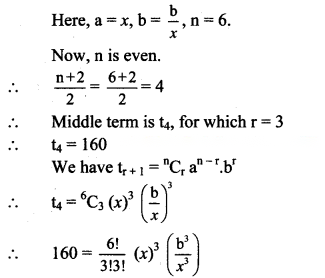
If the middle term in the expansion of is 160, find b.
Solution & Step-by-Step Answer:
∴ 160 = ∴ 160 = 20b3 ∴ 8 = b3 ∴ b = 2

Question 14 Maharashtra Board Solution
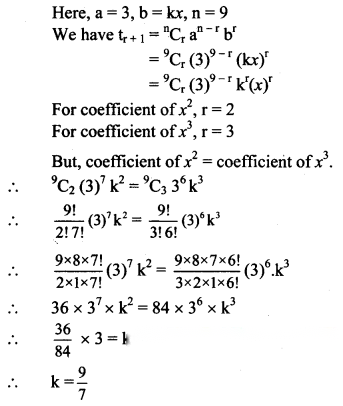
If the coefficients of x2 and x3 in theexpansion of (3 + kx)9 are equal, find k.
Solution & Step-by-Step Answer:

Question 15 Maharashtra Board Solution
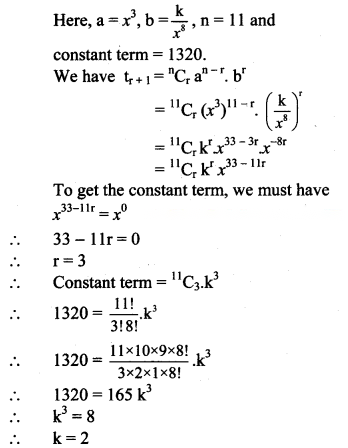
If the constant term in the expansion of is 1320, find k.
Solution & Step-by-Step Answer:

Question 16 Maharashtra Board Solution
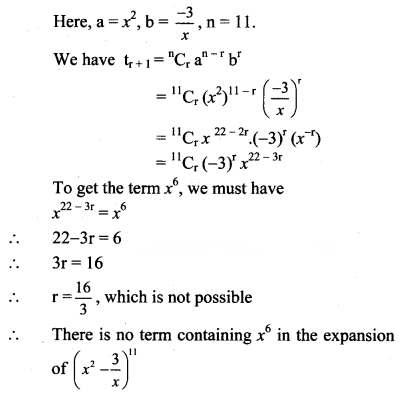
Show that there is no term containing x6 in the expansion of .
Solution & Step-by-Step Answer:

Question 17 Maharashtra Board Solution
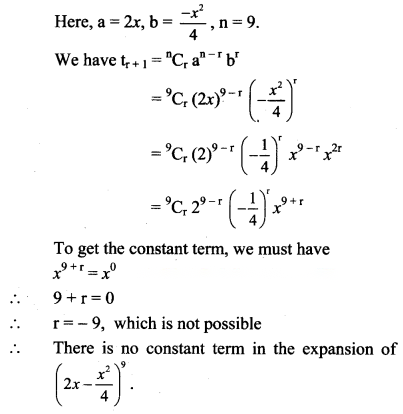
Show that there is no constant term in the expansion of
Solution & Step-by-Step Answer:

Question 18 Maharashtra Board Solution
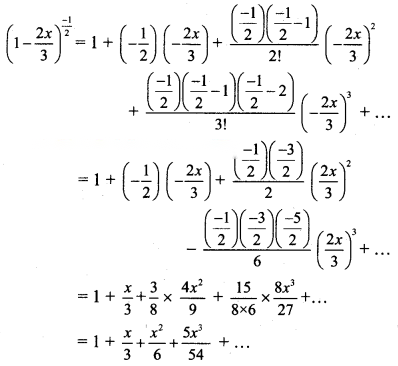
State, first four terms in the expansion of
Solution & Step-by-Step Answer:

Question 19 Maharashtra Board Solution
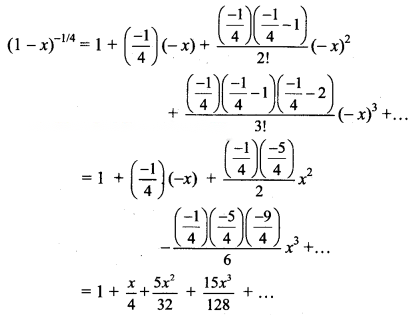
State, first four terms in the expansion of .
Solution & Step-by-Step Answer:

Question 20 Maharashtra Board Solution
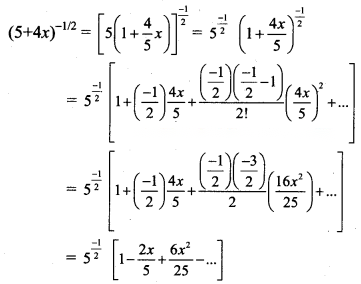
State, first three terms in the expansion of
Solution & Step-by-Step Answer:

Question 21 Maharashtra Board Solution
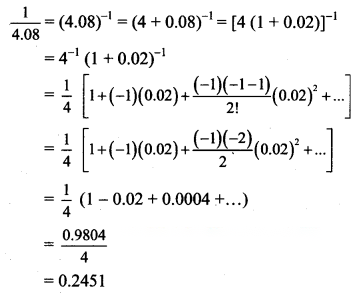
Using the binomial theorem, find the value of upto four places of decimals.
Solution & Step-by-Step Answer:

Question 22 Maharashtra Board Solution
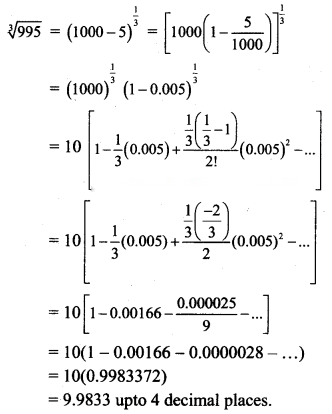
Find approximate value of upto four places of decimals.
Solution & Step-by-Step Answer:

Question 23 Maharashtra Board Solution
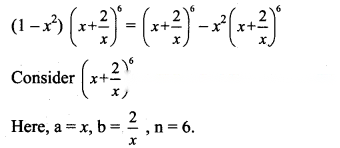
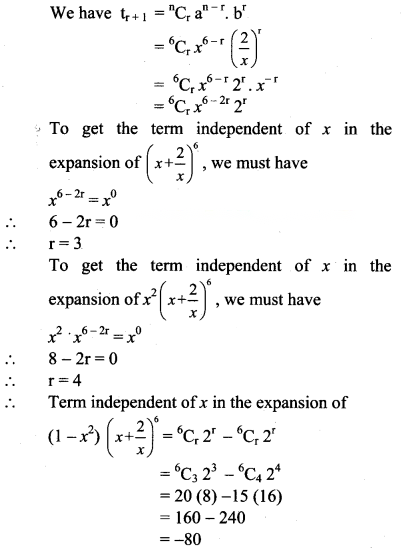
Find the term independent of x in the expansion of (1 – x2) .
Solution & Step-by-Step Answer:

Question 24 Maharashtra Board Solution
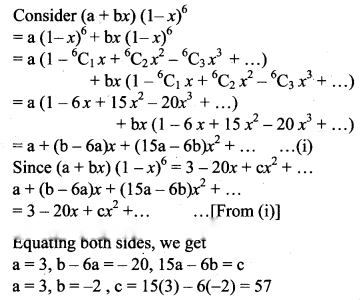
(a + bx) (1 – x)6 = 3 – 20x + cx2 + …, then find a, b, c.
Solution & Step-by-Step Answer:

Question 25 Maharashtra Board Solution
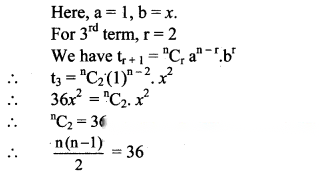
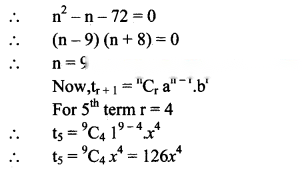
The 3rd term of (1 + x)n is 36x2. Find 5th term.
Solution & Step-by-Step Answer:

Question 26 Maharashtra Board Solution
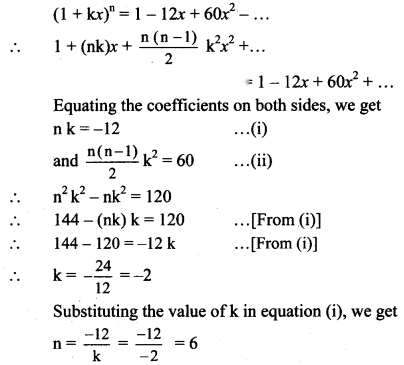
Suppose (1 + kx)n = 1 – 12x + 60x2 – …… find k and n.
Solution & Step-by-Step Answer: