Maharashtra State Board 11th Maths Solutions Chapter 5 Straight Line Ex 5.4
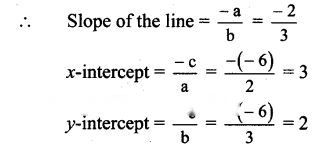
ii. Given equation of the line is 3x – y – 9 = 0.
Comparing this equation with ax + by + c = 0,
we get
a = 3, b = – 1, c = – 9
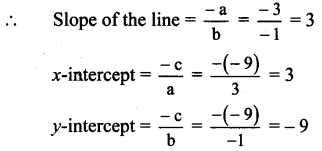
iii. Given equation of the line is x + 2y = 0.
Comparing this equation with ax + by + c = 0,
we get
a = 1, b = 2, c = 0
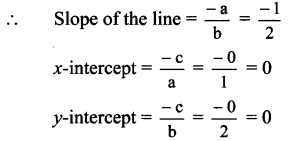
ii. y = 4
∴ 0x + 1y – 4 = 0 is the equation in ax + by + c = 0 form.
iii.
∴
∴ 2x + y – 4 = 0 is the equation in ax + by + c = 0 form.
iv.
∴ 2x – 3y = 0
∴ 2x – 3y + 0 = 0 is the equation in ax + by + c = 0 form.
[Note: Answer given in the textbook is ‘2x – 3y – 6 = 0’. However, as per our calculation it is ‘2x-3y + 0 = 0’.]
Question 3
Maharashtra Board Solution
Show that the lines x – 2y – 7 = 0 and 2x – 4y + 15 = 0 are parallel to each other.
Solution & Step-by-Step Answer:
block bg-white dark:bg-slate-900/80 border-l-4 border-emerald-500 rounded-r-xl p-5 my-3 shadow-xs border border-slate-200/60 dark:border-slate-800">
Solution & Step-by-Step Answer:
Let m1 be the slope of the line x – 2y – 7 = 0. ∴ m1 = Let m2 be the slope of the line 2x – 4y + 15 = 0. ∴ m2 = Since m1 = m2 the given lines are parallel to each other.
Question 4
Maharashtra Board Solution
Show that the lines x – 2y – 7 = 0 and 2x + y + 1 = 0 are perpendicular to each other. Find their point of intersection.
Solution & Step-by-Step Answer:
Let m1 be the slope of the line x – 2y – 7 = 0. ∴ m1 = Let m2 be the slope of the line 2x + y + 1 = 0. ∴ m2 = Since m1 x m1 = x (- 2) = -1, the given lines are perpendicular to each other. Consider, x – 2y – 7 = 0 …(i) 2x + y + 1 =0 …(ii) Multiplying equation (ii) by 2, we get 4x + 2y + 2 = 0 …(iii) Adding equations (i) and (iii), we get 5x – 5 = 0 ∴ x = 1 Substituting x = 1 in equation (ii), we get 2 + y + 1 = 0 ∴ y = – 3 ∴ The point of intersection of the given lines is (1,-3).
Question 5
Maharashtra Board Solution
If the line 3x + 4y = p makes a triangle of area 24 square units with the co-ordinate axes, then find the value of p.
Solution & Step-by-Step Answer:
Let the line 3x + 4y = p cuts the X and Y axes at points A and B respectively. 3x + 4y = p This equation is of the form , where a = and b = ∴ A (a, 0) ≡ (, 0) and B ≡ (0, b) = (0, ) ∴ OA = and OB = Given, A (∆OAB) = 24 sq. units ∴ ∴ ∴ p2 = 576 ∴ p = ± 24
Question 6
Maharashtra Board Solution
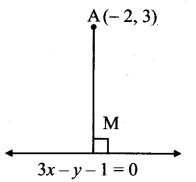
Find the co-ordinates of the foot of the perpendicular drawn from the point A(- 2,3) to the line 3x-y -1 = 0.
Solution & Step-by-Step Answer:
Let M be the foot of perpendicular drawn from point A(- 2,3) to the line 3x-y- 1 = 0 …(i) Slope of the line 3x-y – 1 = 0 is =3. Since AM ⊥ to line (i), slope of AM = ∴ Equation of AM is y – 3 = (x + 2) ∴ 3(y – 3) = – 1(x + 2) ∴ 3y – 9 = -x – 2 ∴ x + 3y – 7 = 0 …………(ii) The foot of perpendicular i.e., point M, is the point of intersection of equations (i) and (ii). By (i) x 3 + (ii), we get 10x -10 = 0 ∴ x = 1 Substituting x = 1 in (ii), we get 1 + 3y – 7 = 0 ∴ 3y = 6 ∴ y = 2 ∴ The co-ordinates of the foot of the perpendicular Mare (1,2).
Question 7
Maharashtra Board Solution
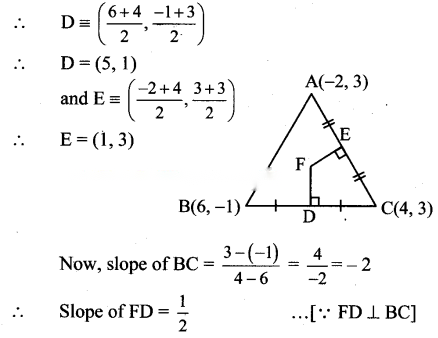
Find the co-ordinates of the circumcentre of the triangle whose vertices are A(- 2, 3), B(6, -1), C(4,3),e
Solution & Step-by-Step Answer:
Here, A(-2, 3), B(6, -1), C(4, 3) are the vertices of ∆ABC. Let F be the circumcentre of AABC. Let FD and FE be the perpendicular bisectors of the sides BC and AC respectively. ∴ D and E are the midpoints of side BC and AC respectively. Since FD passes through (5, 1) and has slope 1/2 equation of FD is y – 1 = (x-5) ∴ 2 (y – 1) = x – 5 ∴ 2y – 2 = x – 5 ∴ x – 2y – 3 = 0 …(i) Since both the points A and C have same y co-ordinates i.e. 3, the given points lie on the line y = 3. Since the equation FE passes through E(1, 3), the equation of FE is x = 1....(ii) To find co-ordinates of circumcentre, we have to solve equations (i) and (ii). Substituting the value of x in (i), we get 1 – 2y -3 = 0 ∴ y = -1 ∴ Co-ordinates of circumcentre F ≡ (1, – 1).
Question 8
Maharashtra Board Solution
Find the co-ordinates of the orthocentre of the triangle whose vertices are A(3, – 2), B(7,6), C (-1,2).
Solution & Step-by-Step Answer:
Let O be the orthocentre of ∆ABC. Let AD and BE be the altitudes on the sides BC and AC respectively. Slope of side BC = ∴ Slope of AD = – 2 [∵ AD ⊥ BC] ∴ Equation of line AD is y – (-2) = (- 2) (x – 3) ∴ y + 2 = -2x + 6 ∴ 2x + y -4 = 0 …(i) Slope of side AC = = -1 ∴ Slope of BE = 1 …[ ∵ BE ⊥ AC] ∴ Equation of line BE is y – 6 = 1(x – 7) ∴ y – 6 = x – 1 ∴ x = y + 1 …(ii) Substituting x = y + 1 in (i), we get 2(y + 1) + y – 4 = 0 ∴ 2y + 2 + y – 4 = 0 ∴ 3y – 2 = 0 ∴ y = in (ii), we get x = ∴ Co-ordinates of orthocentre, O =
Question 9
Maharashtra Board Solution
Show that the lines 3 – 4y + 5 = 0, lx – 8y + 5 = 0 and 4JC + 5y – 45 = 0 are concurrent. Find their point of concurrence.
Solution & Step-by-Step Answer:
The number of lines intersecting at a point are called concurrent lines and their point of intersection is called the point of concurrence. Equations of the given lines are 3x – 4y + 5 = 0 …(i) 7x-8y + 5 = 0 …(ii) 4x + 5y – 45 = 0 …(iii) By (i) x 2 – (ii), we get – x + 5 = 0 ∴ x = 5 Substituting x = 5 in (i), we get 3(5) – 4y + 5 = 0 ∴ -4y = – 20 ∴ y = 5 ∴ The point of intersection of lines (i) and (ii) is given by (5, 5). Substituting x = 5 and y = 5 in L.H.S. of (iii), we get L.H.S. = 4(5) + 5(5) – 45 = 20 + 25 – 45 = 0 = R.H.S. ∴ Line (iii) also passes through (5, 5). Hence, the given three lines are concurrent and the point of concurrence is (5, 5).
Question 10
Maharashtra Board Solution
Find the equation of the line whose x-intercept is 3 and which ¡s perpendicular to the line 3x – y + 23 = 0.
Solution & Step-by-Step Answer:
Slope of the line 3x – y + 23 = 0 is 3. ∴ Slope of the required line perpendicular to 3x – y + 23 = 0 is Since the x-intercept of the required line is 3, it passes through (3, 0). ∴ The equation of the required line is ‘ y – 0 = (x – 3) ∴ 3y = x + 3 ∴ x + 3y = 3
Question 11
Maharashtra Board Solution
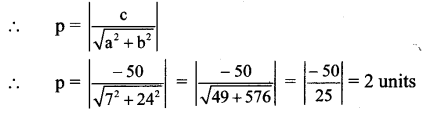
Find the distance of the origin from the line 7x + 24y – 50 = 0.
Solution & Step-by-Step Answer:
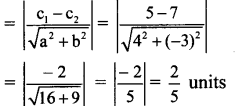
Let p be the perpendicular distance of origin fromtheline7x + 24y – 50 = 0 Here, a = 7, b = 24, c = -50
Question 12
Maharashtra Board Solution
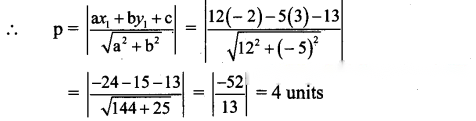
Find the distance of the point A(- 2, 3) from the line 12x – 5y – 13 = 0.
Solution & Step-by-Step Answer:
Let p be the perpendicular distance of the point A(- 2, 3) from the line 12x – 5y – 13 = 0 Here, a = 12, b = – 5, c = – 13, x1 = -2, y1 = 3
Question 13
Maharashtra Board Solution
Find the distance between parallel lines 4x – 3y + 5 = 0 and 4xr – 3y + 7 = 0.
Solution & Step-by-Step Answer:
Equations of the given parallel lines are 4x – 3y + 5 = 0 and 4x – 3y + 1 = 0 Here, a = 4, b = – 3, c1 = 5 and c2 = 7 ∴ Distance between the parallel lines
Question 14
Maharashtra Board Solution
Find the distance between the parallel lines 9x + 6y – 7 = 0 and 3x + 2y + 6 = 0.
Solution & Step-by-Step Answer:
Equations of the given parallel lines are 3x + 2y + 6 = 0 and 9x + 6y – 1 = 0 i.e., 3x + 2y – =0 Here, a = 3, b = 2, c1 = 6 and c2 = ∴ Distance between the parallel lines
Question 15
Maharashtra Board Solution
Find the points on the line x + y – 4 = 0 which are at a unit distance from the line 4JC + 3y = 10.
Solution & Step-by-Step Answer:
Let P(x1, y1) be a point on the line x + y – 4 = o. ∴ x1 + y1 – 4 = 0 ∴ y1 = 4 – x1 …(i) Also, distance of P from the line 4x + 3y- 10 = 0 is 1 ∴ 5 = | x1 + 2 | ∴ x1 + 2 = ± 5 ∴ x1 + 2 = 5 or x1 + 2 = – 5 ∴ x1 = 3 or x1 = – 7 From (i), when x1 = 3, y1 = 1 and when x1 = -7, y1 = 11 ∴ The required points are (3, 1) and (-7, 11). [Note: The question has been modified]
Question 16
Maharashtra Board Solution
Find the equation of the line parallel to the X-axis and passing through the point of intersection of lines x + y – 2 = 0 and 4x + 3y = 10.
Solution & Step-by-Step Answer:
Let u = x + y – 2 = 0 and v = 4x + 3y – 10 = 0 Equation of the line passing through the point of intersection of lines u = 0 and v = 0 is given by u + kv = 0. ∴ (x + y – 2) + k(4x + 3y – 10) = 0 …(i) ∴ x + y – 2 + 4kx + 3ky – 10k = 0 ∴ x + 4kx + y + 3ky – 2 – 10k = 0 ∴ (1+ 4k)x + (1 + 3k)y – 2 – 10k = 0 But, this line is parallel to X-axis. ∴ Its slope = 0 ∴ = 0 ∴ 1 + 4k = 0 ∴ k = Substituting the value of k in (i), we get (x + y – 2) + (4x + 3y – 10) = 0 ∴ 4(x +y – 2) – (4x + 3y -10 ) = 0 ∴ 4x + 4y – 8 – 4x – 3y + 10 = 0 ∴ y + 2 = 0, which is the equation of the required line. [Note: Answer given in the textbook is 5y – 8= 0. However, as per our calculation it is y + 2 = 0.]
Question 17
Maharashtra Board Solution
Find the equation of the line passing through the point of intersection of lines x + y – 2 = 0 and 2xr – 3y + 4 = 0 and making intercept 3 on the X-axis.
Solution & Step-by-Step Answer:
Let u ≡ x + y – 2 = 0 and v ≡ 2x – 3y + 4 = 0 Equation of the line passing through the point of intersection of lines u = 0 and v = 0 is given by u + kv = 0. ∴ (x +y – 2) + k(2x – 3y + 4) = 0 …(i) But, x-intercept of line is 3. ∴ It passes through (3, 0). Substituting x = 3 and y = 0 in (i), we get (3 + 0 – 2) + k(6 – 0 + 4) = 0 ∴ 1 + 10k = 0 k = Substituting the value of k in (i), we get (x + y – 2) + (2x – 3y + 4) = 0 ∴ 10(x + y – 2) – (2x – 3y + 4) = 0 ∴ 10x + 10y -20 — 2x + 3y-4 = 0 ∴ 8x + 13y – 24 = 0, which is the equation of the required line.
Question 18
Maharashtra Board Solution
If A(4, 3), B(0, 0) and C(2, 3) are the vertices of ΔABC, then find the equation of bisector of angle BAC.
Solution & Step-by-Step Answer:
Let the bisector of ∠ BAC meets BC at point D. ∴ Point D divides seg BC in the ratio l(AB) : l(AC) ∴ 18 (y – 3) = 6 (x – 4) ∴ 3(y – 3) = x – 4 ∴ 3y – 9 = x – 4 ∴ x – 3y + 5 = 0
Question 19
Maharashtra Board Solution
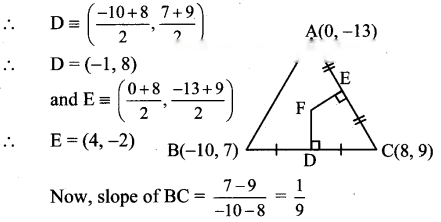
D(- 1, 8), E(4, – 2), F(- 5, – 3) are midpoints of sides BC, CA and AB of AABC. Find i. equations of sides of ΔABC. ii. co-ordinates of the circumcentre of ΔABC.
Solution & Step-by-Step Answer:
Let A(x1, y1), B(x2, y2) and C(x3, y3) be the vertices of ΔABC. Given, points D, E and F are midpoints of sides BC, CA and AB respectively of ΔABC. ∴ x1 + x2 = -10 …………. (v) and y1 + y2 = – 6 …………(vi) For x-coordinates: Adding (i), (iii) and (v), we get 2x1 + 2x2 + 2x3 = – 4 ∴ x1 + x2 + x3 = -2 …………..(vii) Solving (i) and (vii), we get x1 = 0 Solving (iii) and (vii), we get x2 = – 10 Solving (v) and (vii), we get x3 = 8
For y-coordinates:
ii. Here, A(0, – 13), B(- 10, 7), C(8, 9) are the vertices of ΔABC.
Question 20
Maharashtra Board Solution
0(0, 0), A(6, 0) and B(0, 8) are vertices of a triangle. Find the co-ordinates of the incentre of ∆OAB.
Solution & Step-by-Step Answer:
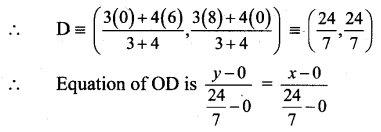
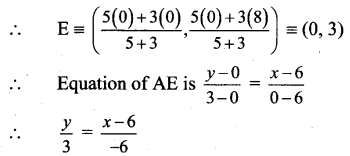
Let bisector of ∠O meet AB at point D and bisector of ∠A meet BO at point E ∴ Point D divides seg AB in the ratio l(OA): l(OB) and point E divides seg BO in the ratio l(AB): l(AO) Let I be the incentre of ∠OAB. ∴ Point D divides AB internally in 6 : 8 i.e. 3 :4 ∴ y = x …(i) Now, by distance formula, l(AB) = {aligned} &={(6-0)^{2}+(0-8)^{2}} \\ &=√(36+64)=10 {aligned} l(AO) = = 6 ∴ Point E divides BO internally in 10 : 6 i.e. 5:3 ∴ -2y = x – 6 ∴ x + 2y = 6 …(ii) To find co-ordinates of incentre, we have to solve equations (i) and (ii). Substituting y = x in (ii), we get x + 2x = 6 ∴ x = 2 Substituting the value of x in (i), we get y = 2 ∴ Co-ordinates of incentre I ≡ (2, 2).
Alternate Method:
|