Maharashtra State Board 11th Maths Solutions Chapter 7 Conic Sections Ex 7.2
(i) Length of major axis = 2a = 2(5) = 10
Length of minor axis = 2b = 2(3) = 6
Lengths of the principal axes are 10 and 6.
(ii) We know that e =
=
=
=
Co-ordinates of the foci are S(ae, 0) and S'(-ae, 0),
i.e., S(5(), 0) and S'(-5(), 0)
i.e., S(4, 0) and S'(-4, 0)
(iii) Equations of the directrices are x = ±
=
=
(iv) Length of latus rectum =
(v) Distance between foci = 2ae
= 2(5)()
= 8
(vi) Distance between directrices =
=
=
(b) Given equation of the ellipse is 3x2+ 4y2= 12
Comparing this equation with , we get
a2= 4 and b2= 3
a = 2 and b = √3
Since a > b,
X-axis is the major axis and Y-axis is the minor axis.
(i) Length of major axis = 2a = 2(2) = 4
Length of minor axis = 2b = 2√3
Lengths of the principal axes are 4 and 2√3.
(ii) We know that e =
=
=
Co-ordinates of the foci are S(ae, 0) and S'(-ae, 0),
i.e., S(2(), 0) and S'(-2(), 0)
i.e., S(1, 0) and S'(-1, 0)
(iii) Equations of the directrices are x = ±
=
= ±4
(iv) Length of latus rectum =
(v) Distance between foci = 2ae = 2(2)() = 2
(vi) Distance between directrices =
=
= 8
(c) Given equation of the ellipse is 2x2+ 6y2= 6
Comparing this equation with , we get
a2= 3 and b2= 1
a = √3 and b = 1
Since a > b,
X-axis is the major axis and Y-axis is the minor axis.
(i) Length of major axis = 2a = 2√3
Length of minor axis = 2b = 2(1) = 2
Lengths of the principal axes are 2√3 and 2.
(ii) We know that e =
=
=
Co-ordinates of the foci are S(ae, 0) and S'(-ae, 0),
i.e., S(√3(), o) and S'(-√3(), 0)
i.e., S(√2, 0) and S'(-√2, 0)
(iii) Equations of the directrices are x = ±,
=
=
(iv) Length of latus rectum =
(v) Distance between foci = 2ae
=
= 2√2
(vi) Distance between directrices =
=
=
= 3√2
(d) Given equation of the ellipse is 3x2+ 4y = 1.
Comparing this equation with , we get
a2= and b2=
a = and b =
Since a > b,
X-axis is the major axis and Y-axis is the minor axis.
(i) Length of major axis = 2a = 2() =
Length of minor axis = 2b = 2() = 1
Lengths of the principal axes are and 1.
(ii) We know that e =
e =
Co-ordinates of the foci are S(ae, 0) and S'(-ae, 0),
i.e., S and S’
i.e., S(, 0) and S'(-, 0)
(iii) Equations of the directrices are x = ±,
=
=
(iv) Length of latus rectum =
=
=
(v) Distance between foci = 2ae
=
=
(vi) Distance between directrices =
=
=
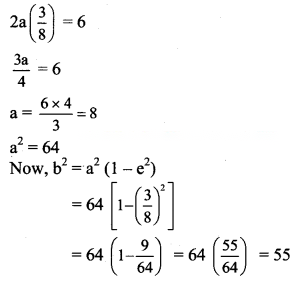
(ii) Let the required equation of ellipse be , where a > b.
Length of major axis = 2a
Given, length of major axis = 10
2a = 10
a = 5
a2= 25
Distance between foci = 2ae
Given, distance between foci = 8
2ae = 8
2(5)e = 8
The required equation of ellipse is .
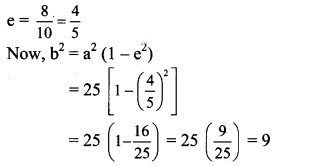
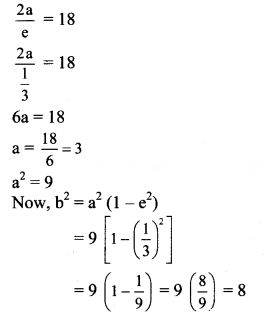
(iii) Let the required equation of ellipse be , where a > b.
Given, eccentricity (e) =
Distance between directrices =
Given, distance between directrices = 18
The required equation of ellipse is
(iv) Let the required equation of ellipse be , where a > b.
Length of minor axis = 2b
Given, length of minor axis = 16
2b = 16
b = 8
b2= 64
Given, eccentricity (e) =
Now, b2= a2(1 – e2)
The required equation of ellipse is .

(v) Let the required equation of ellipse be , where a > b.
Distance between foci = 2ae
Given, distance between foci = 6
2ae = 6
ae = 3
a = …….(i)
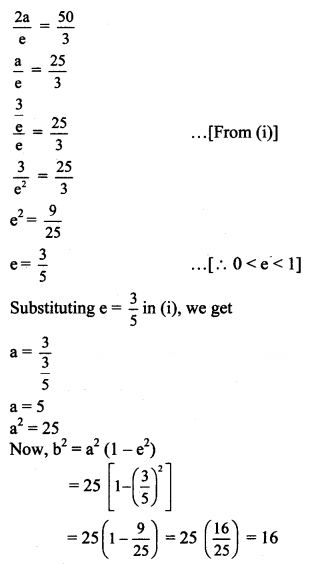
Distance between directrices =
Given, distance between directrices =
The required equation of ellipse is .
(vi) Given, the length of the latus rectum is 6, and co-ordinates of foci are (±2, 0).
The foci of the ellipse are on the X-axis.
Let the required equation of ellipse be , where a > b.
Length of latus rectum =
= 6
b2= 3a …..(i)
Co-ordinates of foci are (±ae, 0)
ae = 2
a2e2= 4 …..(ii)
Now, b2= a2(1 – e2)
b2= a2– a2e2
3a = a2– 4 …..[From (i) and (ii)]
a2– 3a – 4 = 0
a2– 4a + a – 4 = 0
a(a – 4) + 1(a – 4) = 0
(a – 4) (a + 1) = 0
a – 4 = 0 or a + 1 = 0
a = 4 or a = -1
Since a = -1 is not possible,
a = 4
a2= 16
Substituting a = 4 in (i), we get
b2= 3(4) = 12
The required equation of ellipse is .
(vii) Let the required equation of ellipse be , where a > b.
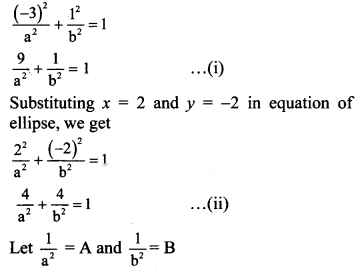
The ellipse passes through the points (-3, 1) and (2, -2).
Substituting x = -3 and y = 1 in equation of ellipse, we get
Equations (i) and (ii) become
9A + B = 1 …..(iii)
4A + 4B = 1 …..(iv)
Multiplying (iii) by 4, we get
36A + 4B = 4 …..(v)
Subtracting (iv) from (v), we get
32A = 3
A =
Substituting A = in (iv), we get
4() + 4B = 1
+ 4B = 1
4B = 1 –
4B =
B =

(viii) Let the required equation of ellipse be , where a > b.
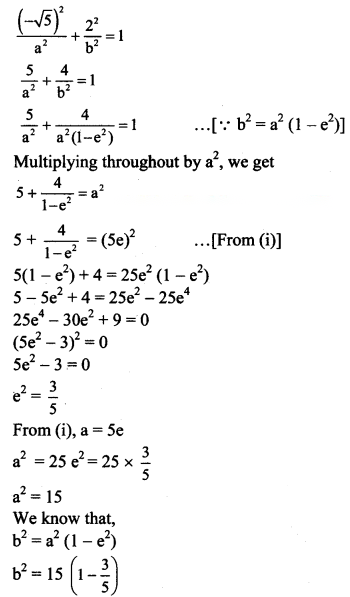
Distance between directrices =
Given, distance between directrices = 10
= 10
a = 5e …..(i)
The ellipse passes through (-√5, 2).
Substituting x = -√5 and y = 2 in equation of ellipse, we get
b2= 15()
b2= 6
The required equation of ellipse is .
(ix) Let the required equation of ellipse be , where a > b.
Given, eccentricity (e) =
The ellipse passes through (2, ).
Substituting x = 2 and y = in equation of ellipse, we get
The required equation of ellipse is .

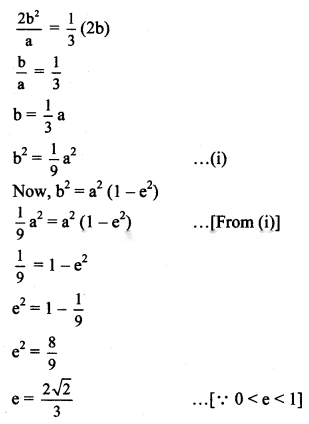


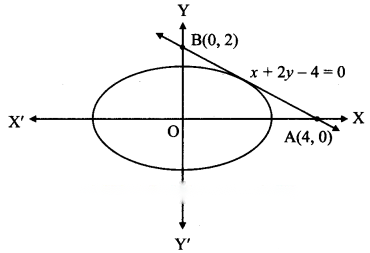


(ii) Given equation of the ellipse is 4x2+ 7y2= 28.
Comparing this equation with , we get
a2= 7 and b2= 4
Equations of tangents to the ellipse having slope m are
y = mx ±
Since (3, -2) lies on both the tangents,
-2 = 3m ±
-2 – 3m = ±
Squaring both the sides, we get
9m2+ 12m + 4 = 7m2+ 4
2m2+ 12m = 0
2m(m + 6) = 0
m = 0 or m = -6
These are the slopes of the required tangents.
By slope point form y – y1= m(x – x1),
the equations of the tangents are
y + 2 = 0(x – 3) and y + 2 = -6(x – 3)
y + 2 = 0 and y + 2 = -6x + 18
y + 2 = 0 and 6x + y – 16 = 0
(iii) Given equation of the ellipse is 2x2+ y2= 6.
Comparing this equation with , we get
a2= 3 and b2= 6
Equations of tangents to the ellipse having slope m are
y = mx ±
Since (2, 1) lies on both the tangents,
1 = 2m ±
1 – 2m = ±
Squaring both the sides, we get
1 – 4m + 4m2= 3m2+ 6
m2– 4m – 5 = 0
(m – 5)(m + 1) = 0
m = 5 or m = -1
These are the slopes of the required tangents.
By slope point form y – y1= m(x – x1),
the equations of the tangents are
y – 1 = 5(x – 2) and y – 1 = -1(x – 2)
y – 1 = 5x – 10 and y – 1 = -x + 2
5x – y – 9 = 0 and x + y – 3 = 0
(iv) Given equation of the ellipse is x2+ 4y2= 9.
Comparing this equation with , we get
a2= 9 and b2=
Slope of the line 2x + 3y – 5 = 0 is .
Since the given line is parallel to the required tangents, slope of the required tangents is
m =
Equations of tangents to the ellipse having slope m are
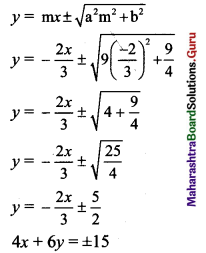
(v) Given equation of the ellipse is .
Comparing this equation with , we get
a2= 25 and b2= 4
Slope of the given line x + y + 1 = 0 is -1.
Since the given line is parallel to the required tangents,
the slope of the required tangents is m = -1.
Equations of tangents to the ellipse
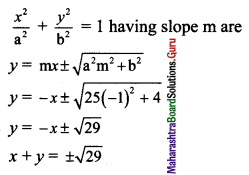
(vi) Given equation of the ellipse is 5x2+ 9y2= 45.
Comparing this equation with , we get
a2= 9 and b2= 5
Slope of the given line 3x + 2y + 1 = 0 is
Since the given line is perpendicular to the required tangents, slope of the required tangents is
m =
Equations of tangents to the ellipse
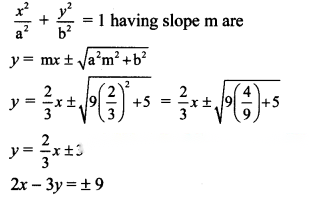
(vii) Given equation of the ellipse is x2+ 4y2= 20.
Comparing this equation with , we get
a2= 20 and b2= 5
Slope of the given line 4x + 3y = 7 is .
Since the given line is perpendicular to the required tangents,
slope of the required tangents is m = .
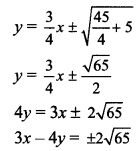
Equations of tangents to the ellipse having slope m are
y = mx ±
y =
Alternate method:
The locus of the point of intersection of perpendicular tangents is the director circle of an ellipse.
The equation of the director circle of an ellipse is x2+ y2= a2+ b2
Here, a2= 5 and b2= 3
x2+ y2= 5 + 3
x2+ y2= 8, which is the required equation of the locus.