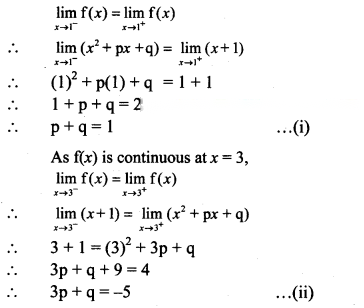
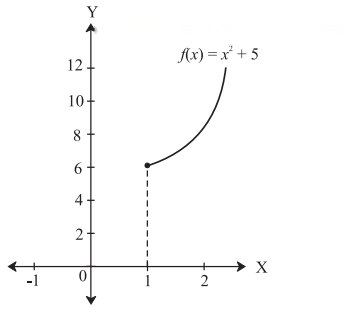
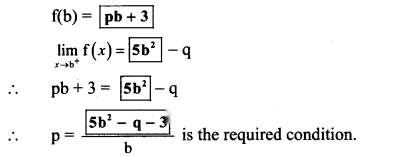
Maharashtra State Board 11th Maths Solutions Chapter 8 Continuity Ex 8.1
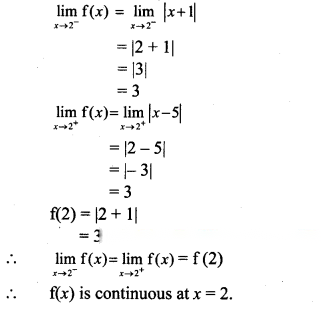
(ii) f(x) = sin x, for x ≤
= cos x, for x > , at x =
Solution:

(iii) f(x) = , for x ≠ 3
= 8 for x = 3, at x = 3.
Solution:
f(3) = 8 ….(given)
∴ f(x) is discontinuous at x = 3.
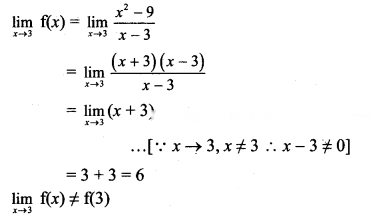
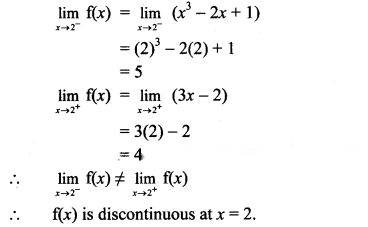
(ii) f(x) = , for x ≠ 1
= 20, for x = 1, at x = 1.
Solution:

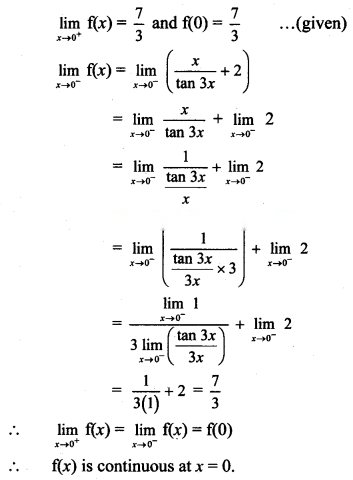
(iii) f(x) = , for x < 0
= , for x ≥ 0, at x = 0.
Solution:
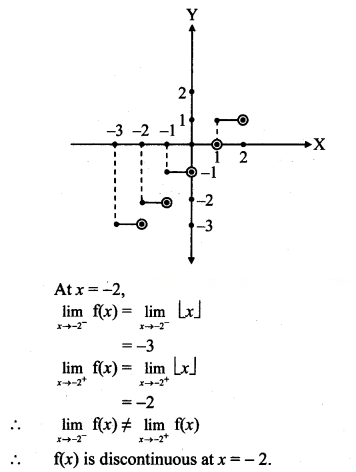

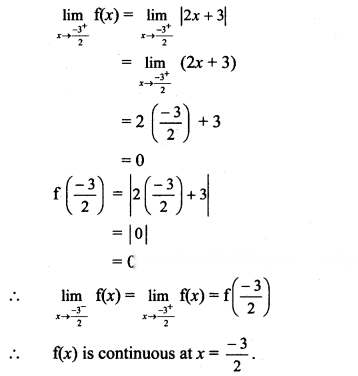
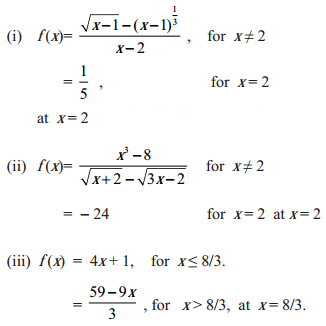
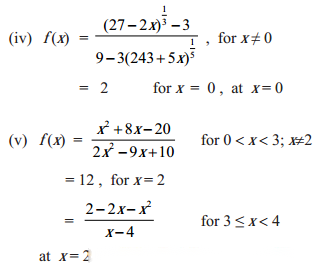
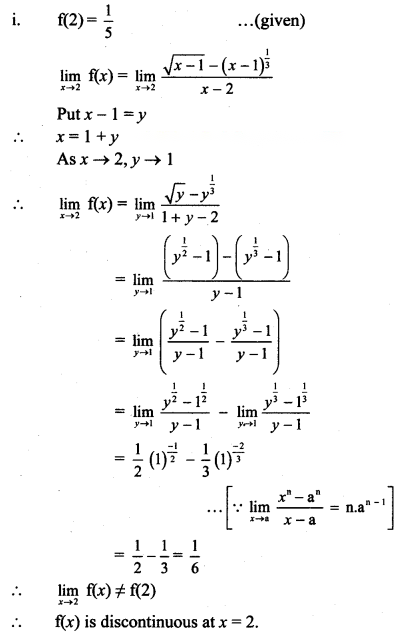
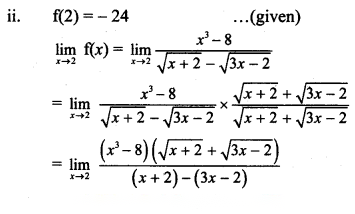
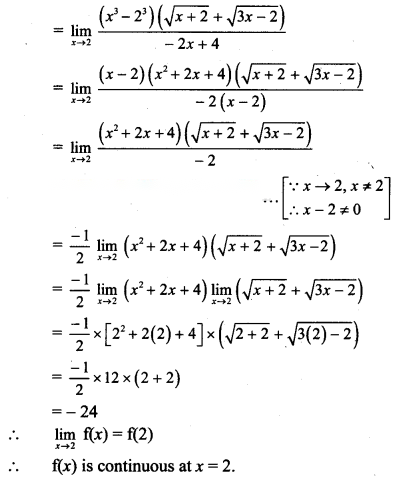
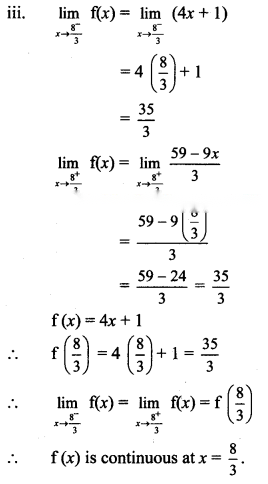
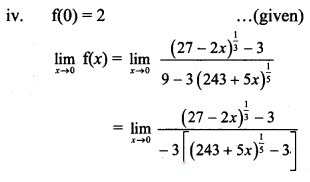
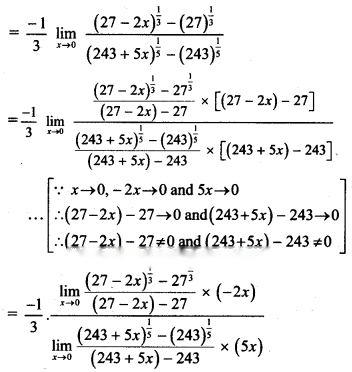
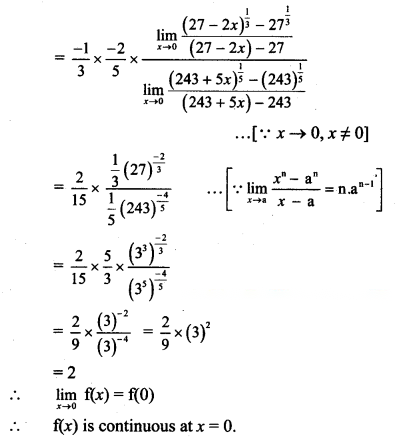
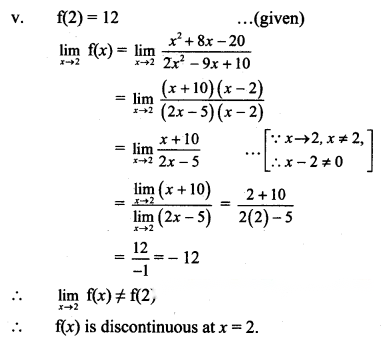
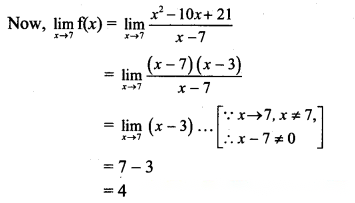
(ii) f(x) = x2+ 3x – 2, for x ≤ 4
= 5x + 3, for x > 4.
Solution:
f(x) = x2+ 3x – 2, x ≤ 4
= 5x + 3, x > 4
f(x) is a polynomial function for both the intervals.
∴ f(x) is continuous for both the given intervals.
Let us test the continuity at x = 4.
∴ f(x) is discontinuous at x = 4.
∴ f(x) has a jump discontinuity at x = 4.

(iii) f(x) = x2– 3x – 2, for x < -3 = 3 + 8x, for x > -3.
Solution:
f(x) = x2– 3x – 2, x < -3 = 3 + 8x, x > -3
f(x) is a polynomial function for both the intervals.
∴ f(x) is continuous for both the given intervals.
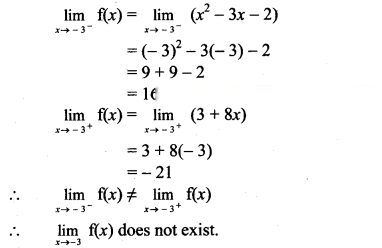
Let us test the continuity at x = -3.
∴ f(x) is discontinuous at x = -3.
∴ f(x) has a jump discontinuity at x = -3
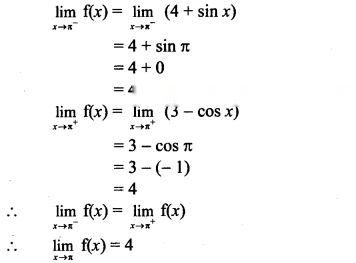
(iv) f(x) = 4 + sin x, for x < π = 3 – cos x for x > π.
Solution:
f(x) = 4 + sin x, x < π = 3 – cos x, x > π
sin x and cos x are continuous for all x ∈ R.
4 and 3 are constant functions.
∴ 4 + sin x and 3 – cos x are continuous for all x ∈ R.
∴ f(x) is continuous for both the given intervals.
Let us test the continuity at x = π.
But f(π) is not defined.
∴ f(x) has a removable discontinuity at x = π.
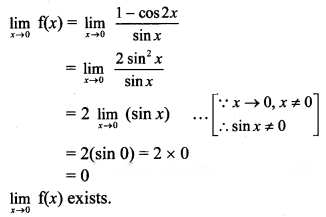
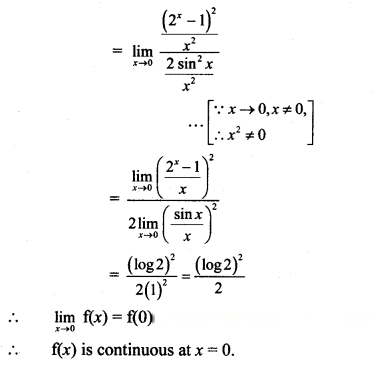
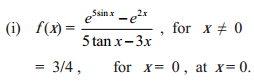
(ii) f(x) = , for x ≠ 0.
Solution:
f(x) = , for x ≠ 0
Here, f(0) is not defined.
Consider,
But f(0) is not defined.
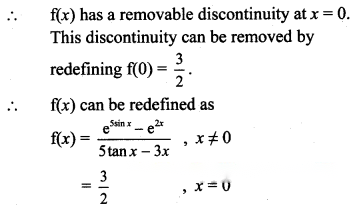
∴ f(x) has a removable discontinuity at x = 0.
∴ The extension of the original function is
f(x) = , x ≠ 0
= , x = 0
∴ f(x) is continuous at x = 0.
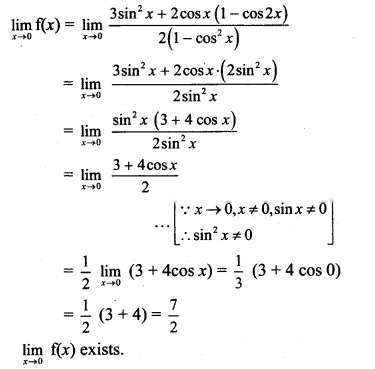
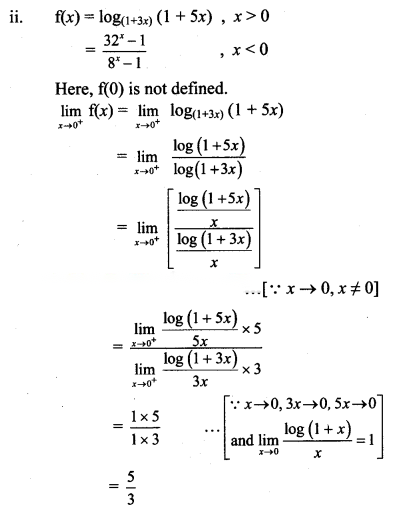
(iii) f(x) = , for x ≠ -1
Solution:
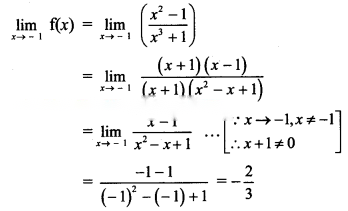
f(x) = , for x ≠ -1
Here, f(-1) is not defined.
Consider,
But f(-1) is not defined.
∴ f(x) has a removable discontinuity at x = -1.
∴ The extension of the original function is
f(x) = , x ≠ -1
= , x = -1
∴ f(x) is continuous at x =
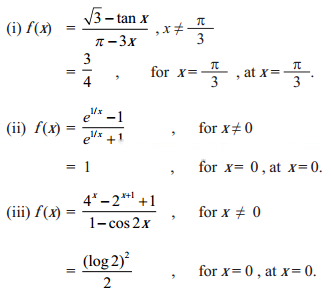
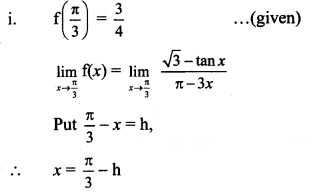


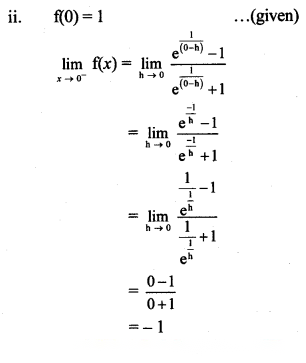
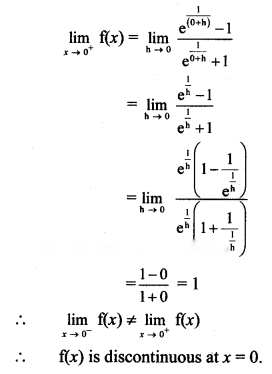




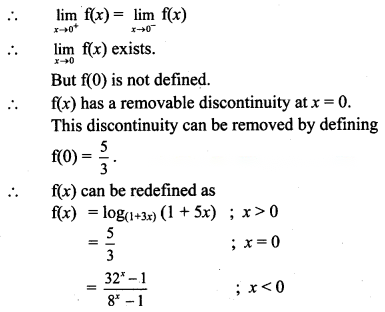
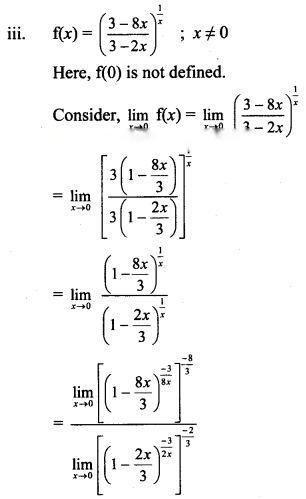
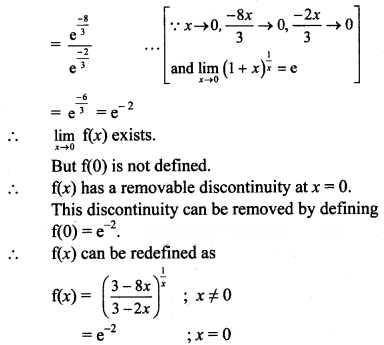
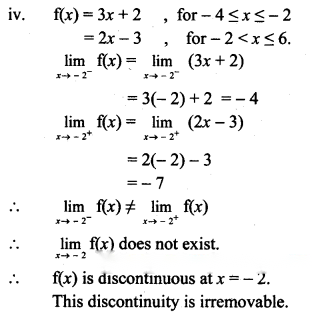

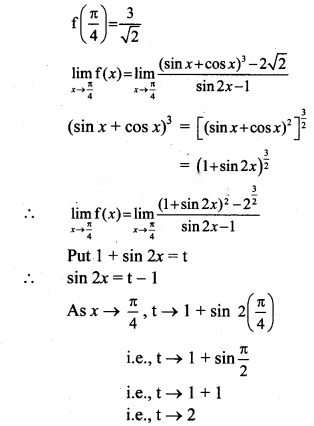
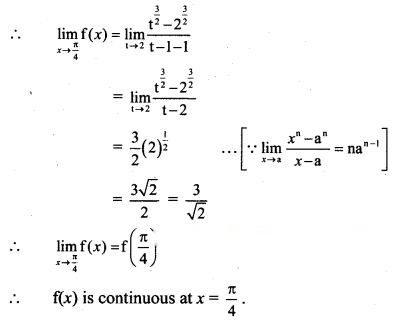
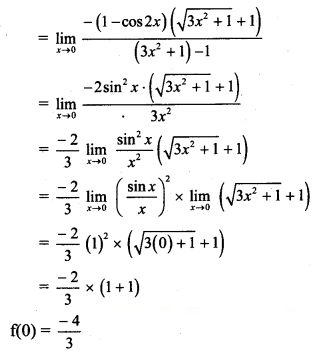
(ii) If f(x) = for x ≠ 0, is continuous at x = 0 then find f(0).
Solution:
f(x) is continuous at x = 0, …..(given)

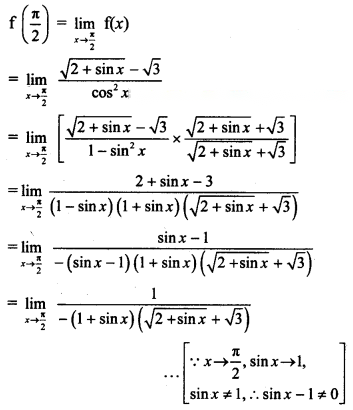
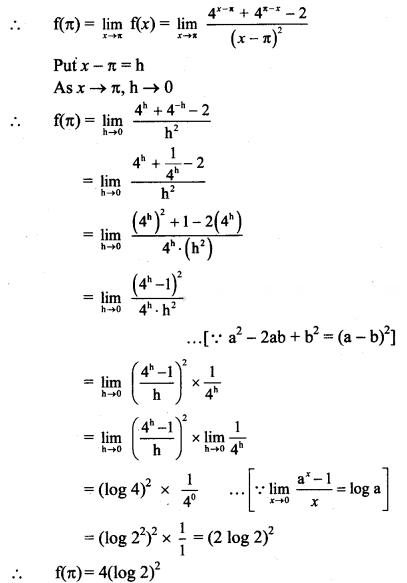
(iii) If f(x) = for x ≠ π, is continuous at x = π, then find f(π).
Solution:
f(x) is continuous at x = π, …..(given)

(ii) If f(x) = , for x ≠ 0
= k, for x = 0
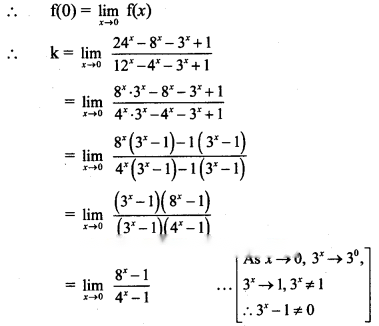
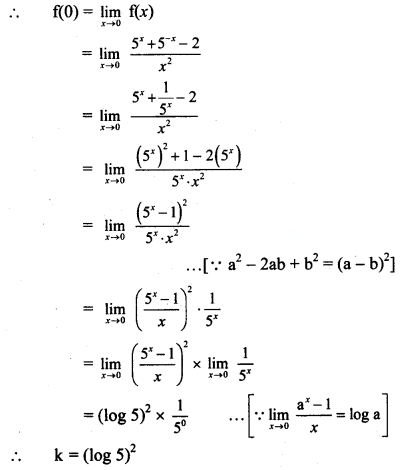
is continuous at x = 0, then find k.
Solution:
f(x) is continuous at x = 0 …..(given)
(iii) If f(x) = – a, for x > 0
= 4 for x = 0
= x2+ b – 3, for x < 0
is continuous at x = 0, find a and b.
Solution:
f(x) is continuous at x = 0 ……(given)

(iv) For what values of a and b is the function
f(x) = ax + 2b + 18, for x ≤ 0
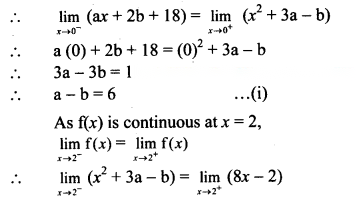
= x2+ 3a – b, for 0 < x ≤ 2 = 8x – 2, for x > 2,
continuous for every x?
Solution:
f(x) is continuous for every x …..(given)
∴ f(x) is continuous at x = 0 and x = 2.
As f(x) is continuous at x = 0,
∴ (2)2+ 3a – b = 8(2) – 2
∴ 4 + 3a – b = 14
∴ 3a – b = 10 …….(ii)
Subtracting (i) from (ii), we get
2a = 4
∴ a = 2
Substituting a = 2 in (i), we get
2 – b = 6
∴ b = -4
∴ a = 2 and b = -4
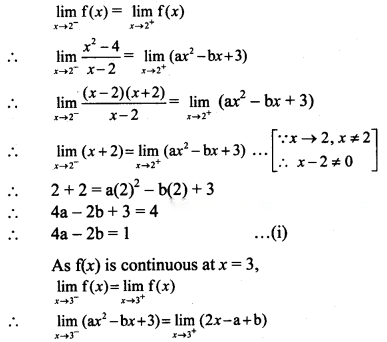
(v) For what values of a and b is the function
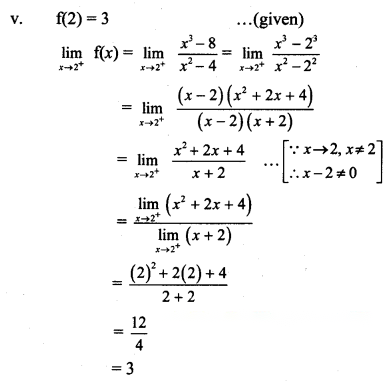
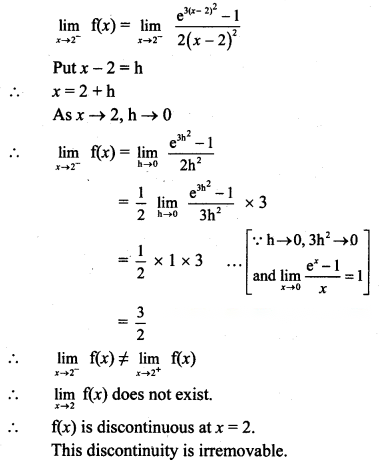
f(x) = , for x < 2
= ax2– bx + 3, for 2 ≤ x < 3
= 2x – a + b, for x ≥ 3
continuous for every x on R?
Solution:
f(x) is continuous for every x on R …..(given)
∴ f(x) is continuous at x = 2 and x = 3.
As f(x) is continuous at x = 2,
∴ a(3)2– b(3) + 3 = 2(3) – a + b
∴ 9a – 3b + 3 = 6 – a + b
∴ 10a – 4b = 3 …..(ii)
Multiplying (i) by 2, we get
8a – 4b = 2 ….(iii)
Subtracting (ii) from (iii), we get
-2a = -1
∴ a =
Substituting a = in (i), we get
4() – 2b = 1
∴ 2 – 2b = 1
∴ 1 = 2b
∴ b =
∴ a = and b =