Maharashtra State Board 11th Maths Solutions Chapter 9 Probability Ex 9.5
Question 1
Maharashtra Board Solution
If odds in favour of X solving a problem are 4 : 3 and odds against Y solving the same problem are 2 : 3. Find the probability of: (i) X solving the problem (ii) Y solving the problem
Solution & Step-by-Step Answer:
(i) Odds in favour of X solving a problem are 4 : 3. ∴ The probability of X solving the problem is P(X) =
(ii) Odds against Y solving the problem are 2 : 3.
∴ The probability of Y solving the problem is
P(Y) = 1 – P(Y’)
= 1 –
= 1 –
=
Question 2
Maharashtra Board Solution
The odds against John solving a problem are 4 to 3 and the odds in favour of Rafi solving the same problem are 7 to 5. What is the chance that the problem is solved when both of them try it?
Solution & Step-by-Step Answer:
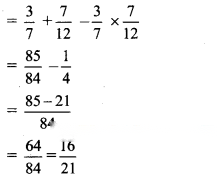
The odds against John solving a problem are 4 to 3. Let event P(A’) = P (John does not solve the problem) = = So, the probability that John solves the problem P(A) = 1 – P(A’) = 1 – = Similarly, Let P(B) = P(Rafi solves the problem) Since the odds in favour of Rafi solving the problem are 7 to 5, P(B) = = Required probability P(A ∪ B) = P(A) + P(B) – P(A ∩ B) Since A, B are independent events, P(A ∩ B) = P(A). P(B) ∴ Required probability = P(A) + P(B) – P(A). P(B)
Question 3
Maharashtra Board Solution
The odds against student X solving a statistics problem are 8 : 6 and odds in favour of student Y solving the same problem are 14 : 16. Find the chance that (i) the problem will be solved if they try it independently. (ii) neither of them solves the problem.
Solution & Step-by-Step Answer:
The odds against X solving a problem are 8 : 6. Let P(X’) = P(X does not solve the problem) = = So, the probability that X solves the problem P(X) = 1 – P(X’) = 1 – = Similarly, let P(Y) = P(Y solves the problem) Since odds in favour of Y solving the problem are 14 : 16, P(Y) = So, the probability that Y does not solve the problem P(Y’) = 1 – P(Y) = 1 – = (i) Required probability P(X ∪ Y) = P(X) + P(Y) – P(X ∩ Y) Since X and Y are independent events, P(X ∩ Y) = P(X). P(Y) ∴ Required probability = P(X) + P(Y) – P(X). P(Y) = =
(ii) Required probability = P(X’ ∩ Y’)
Since X and Y are independent events, X’ and Y’ are also independent events.
∴ Required probability = P(X’). P(Y’)
=
=
Question 4
Maharashtra Board Solution
The odds against a husband who is 60 years old, living till he is 85 are 7 : 5. The odds against his wife who is now 56, living till she is 81 are 5 : 3. Find the probability that (i) at least one of them will be alive 25 years hence. (ii) exactly one of them will be alive 25 years hence.
Solution & Step-by-Step Answer:
The odds against her husband living till he is 85 are 7 : 5. Let P(H’) = P(husband dies before he is 85) = So, the probability that the husband would be alive till age 85 P(H) = 1 – P(H’) = 1 – = Similarly, P(W’) = P(Wife dies before she is 81) Since the odds against wife will be alive till she is 81 are 5 : 3. ∴ P(W’) = So, the probability that the wife would be alive till age 81 P(W) = 1 – P(W’) = 1 – = (i) Required probability P(H ∪ W) = P(H) + P(W) – P(H ∩ W) Since H and W are independent events, P(H ∩ W) = P(H). P(W) ∴ Required probability = P(H) + P(W) – P(H). P(W) = = =
(ii) Required probability = P(H ∩ W’) + P(H’ ∩ W)
Since H and W are independent events, H’ and W’ are also independent events.
∴ Required probability = P(H). P(W’) + P(H’). P(W)
=
=
=
=
Question 5
Maharashtra Board Solution
There are three events A, B, and C, one of which must, and only one can happen. The odds against event A are 7 : 4 and odds against event B are 5 : 3. Find the odds against event C.
Solution & Step-by-Step Answer:
Since odds against A are 7 : 4, P(A) = Since odds against B are 5 : 3, P(B) = Since only one of the events A, B and C can happen, P(A) + P(B) + P(C) = 1 + + P(C) = 1 ∴ P(C) = 1 – ( + ) = 1 – = ∴ P(C’) = 1 – P(C) = 1 – = ∴ Odds against the event C are P(C’) : P(C) = : = 65 : 23
Question 6
Maharashtra Board Solution
In a single toss of a fair die, what are the odds against the event that number 3 or 4 turns up?
Solution & Step-by-Step Answer:
When a fair die is tossed, the sample space is S = {1, 2, 3, 4, 5, 6} ∴ n(S) = 6 Let event A: 3 or 4 turns up. ∴ A = {3, 4} ∴ n(A) = 2 ∴ P(A) = = P(A’) = 1 – P(A) = 1 – = ∴ Odds against the event A are P(A’) : P(A) = = 2 : 1
Question 7
Maharashtra Board Solution
The odds in favour of A winning a game of chess against B are 3 : 2. If three games are to be played, what are the odds in favour of A’s winning at least two games out of the three?
Solution & Step-by-Step Answer:
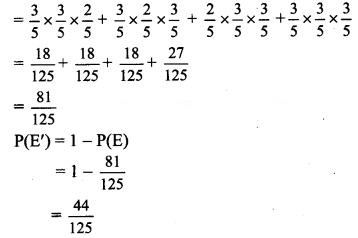
Let event A: A wins the game and event B: B wins the game. Since the odds in favour of A winning a game against B are 3 : 2, the probability of occurrence of event A and B is given by P(A) = and P(B) = Let event E: A wins at least two games out of three games. ∴ P(E) = P(A). P(A). P(B) + P(A). P(B). P(A) + P(B). P(A). P(A) + P(A). P(A). P(A) ∴ Odds in favour of A’s winning at least two games out of three are P(E) : P(E’) = = 81 : 44