Latest Maharashtra State Board (SSC & HSC) 2026-27 Syllabus Digest & Solutions Updated!
Class 11 (FYJC / HSC)Physics2026-27 Syllabus

Chapter 1 Units and Measurements Solutions

Complete Maharashtra State Board Balbharati & Yuvakbharati textbook solutions for Chapter 1 Units and Measurements. Step-by-step solved exercises, numerical problems, and digest answers.

29 Solved Questions11 Diagrams3176 words

Maharashtra State Board 11th Physics Solutions Chapter 1 Units and Measurements

1. Choose the correct option.

Question 1 Maharashtra Board Solution
[L1M1T-2] is the dimensional formula for (A) Velocity (B) Acceleration (C) Force (D) Work
Solution & Step-by-Step Answer:
(C) Force
Question 2 Maharashtra Board Solution
The error in the measurement of the sides of a rectangle is 1%. The error in the measurement of its area is (A) 1% (B) % (C) 2% (D) None of the above.
Solution & Step-by-Step Answer:
(C) 2%
Question 3 Maharashtra Board Solution
Light year is a unit of (A) Time (B) Mass (C) Distance (D) Luminosity
Solution & Step-by-Step Answer:
(C) Distance
Question 4 Maharashtra Board Solution
Dimensions of kinetic energy are the same as that of (A) Force (B) Acceleration (C) Work (D) Pressure
Solution & Step-by-Step Answer:
(C) Work
Question 5 Maharashtra Board Solution
Which of the following is not a fundamental unit? (A) cm (B) kg (C) centigrade (D) volt
Solution & Step-by-Step Answer:
(D) volt

2. Answer the following questions.

Question 1 Maharashtra Board Solution
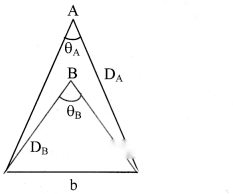
Star A is farther than star B. Which star will have a large parallax angle?
Solution & Step-by-Step Answer:
i). ‘b’ is constant for the two stars ∴ θ ∝

ii) As star A is farther i.e., DA> DB
⇒ θA< θB
Hence, star B will have larger parallax angle than star A.
Question 2 Maharashtra Board Solution
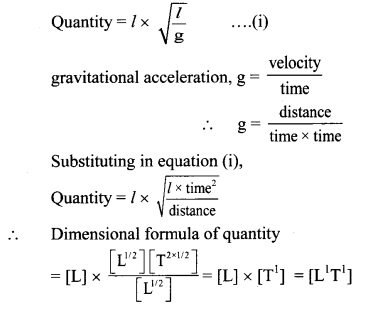
What are the dimensions of the quantity l , l being the length and g the acceleration due to gravity?
Solution & Step-by-Step Answer:
[Note: When power of symbol expressing fundamental quantity appearing in the dimensional formula is not given, ills taken as 1.]

Question 3 Maharashtra Board Solution
Define absolute error, mean absolute error, relative error and percentage error.
Solution & Step-by-Step Answer:
Absolute error: a. For a given set of measurements of a quantity, the magnitude of the difference between mean value (Most probable value) and each individual value is called absolute error (∆a) in the measurement of that quantity. b. absolute error = |mean value – measured value| ∆a1 = |amean – a1| Similarly, ∆a2 = |amean – a2|............. ∆an = |amean – an|

Mean absolute error:
For a given set of measurements of a same quantity the arithmetic mean of all the absolute errors is called mean absolute error in the measurement of that physical quantity.
∆amean=

Relative error:
The ratio of the mean absolute error in the measurement of a physical quantity to its arithmetic mean value is called relative error.
Relative error =

Percentage error:
The relative error represented by percentage (i.e., multiplied by 100) is called the percentage error.
Percentage error = × 100%
[Note: Considering conceptual conventions question is modified to define percentage error and not mean percentage error.]

Question 4 Maharashtra Board Solution
Describe what is meant by significant figures and order of magnitude.
Solution & Step-by-Step Answer:
Significant figures:

Rules for determining significant figures:

Order of magnitude:
The magnitude of any physical quantity can be expressed as A × 10nwhere ‘A’ is a number such that 0.5 ≤ A < 5 then, ‘n’ is an integer called the order of magnitude.
Examples:

Question 5 Maharashtra Board Solution
If the measured values of two quantities are A ± ∆A and B ± ∆B, ∆A and ∆B being the mean absolute errors. What is the maximum possible error in A ± B? Show that if Z =
Solution & Step-by-Step Answer:
Maximum possible error in (A ± B) is (∆A + ∆B). Errors in divisions: i) A Suppose, Z = and measured values of A and B are (A ± ∆A) and (B ± ∆B) then, ∴ Maximum relative error of

ii) Thus, when two quantities are divided, the maximum relative error in the result is the sum of relative errors in each quantity.

Question 6 Maharashtra Board Solution
Derive the formula for kinetic energy of a particle having mass m and velocity v using dimensional analysis
Solution & Step-by-Step Answer:
Kinetic energy of a body depends upon mass (m) and velocity (v) of the body. Let K.E. ∝ mx vy ∴ K.E. = kmx vy …….. (1) where, k = dimensionless constant of proportionality. Taking dimensions on both sides of equation (1), [L2M1T-2] – [L0M1T0]x [L1M0T-1]y = [L0MxT0] [LyM0T-y] = [L0+yMx+0T0-y] [L2M1T2] = [LyMxT-y] …………. (2) Equating dimensions of L, M, T on both sides of equation (2), x = 1 and y = 2, Substituting x, y in equation (1), we have K.E. = kmv2

3. Solve numerical examples.

Question 1 Maharashtra Board Solution
The masses of two bodies are measured to be 15.7 ± 0.2 kg and 27.3 ± 0.3 kg. What is the total mass of the two and the error in it?
Solution & Step-by-Step Answer:
Given: A ± ∆A = 15.7 ± 0.2kg and B ± ∆B = 27.3 ± 0.3 kg. To find: Total mass (Z), and total error (∆Z) Formulae: i. Z = A + B

ii) ±∆Z = ±∆A ± ∆B
Calculation: From formula (i),
Z = 15.7 + 27.3 = 43 kg
From formula (ii),
± ∆Z (± 0.2) + (± 0.3)
=±(0.2 + 0.3)
= ± 0.5 kg
Total mass is 43 kg and total error is ± 0.5 kg.

Question 2 Maharashtra Board Solution
The distance travelled by an object in time (100 ± 1) s is (5.2 ± 0.1) m. What is the speed and it’s relative error?
Solution & Step-by-Step Answer:
Given: Distance (D ± ∆D) = (5.2 ± 0.1) m, time(t ± ∆t) = (100 ± 1)s. To find: Speed (v), maximum relative error

Formulae: i. v =
ii.

Calculation: From formula (i),
v = = 0.052 m/s
From formula (ii),

=
= ± 0.029 rn/s
The speed is 0.052 m/s and its maximum relative error is ± 0.029 m/s.
[Note: Framing of numerical is modified to make it specific and meaningful.]
Question 3 Maharashtra Board Solution
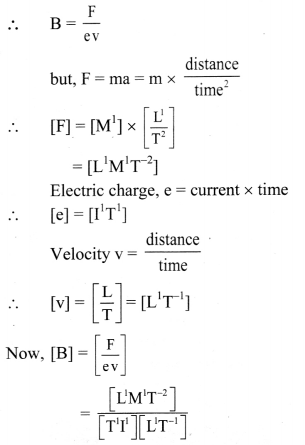
An electron with charge e enters a uniform. magnetic field with a velocity . The velocity is perpendicular to the magnetic field. The force on the charge e is given by || = Bev Obtain the dimensions of .
Solution & Step-by-Step Answer:
Given: || = B e v Considering only magnitude, given equation is simplified to, F = B e v ∴ B = [L0M1T-2I-1] [Note: The answer given above is calculated in accordance with textual method considering the given data.]

Question 4 Maharashtra Board Solution
A large ball 2 m in radius is made up of a rope of square cross section with edge length 4 mm. Neglecting the air gaps in the ball, what is the total length of the rope to the nearest order of magnitude?
Solution & Step-by-Step Answer:
Volume of ball = Volume enclosed by rope. π (radius)3 = Area of cross-section of rope × length of rope. ∴ length of rope l = Given: r = 2 m and Area = A = 4 × 4 = 16 mm2 = 16 × 10-6 m2 ∴ l = = × 10-6 m ≈ 2 × 10⁶ m. Total length of rope to the nearest order of magnitude = 106 m = 103 km
Question 5 Maharashtra Board Solution
Nuclear radius R has a dependence on the mass number (A) as R = 1.3 × 10⁻¹⁶ A m. For a nucleus of mass number A=125, obtain the order of magnitude of R expressed in metre.
Solution & Step-by-Step Answer:
R= 1.3 × 10⁻¹⁶ × A m For A = 125 R= 1.3 × 10-16 × (125) = 1.3 × 10-16 × 5 = 6.5 × 10-16 = 0.65 × 10⁻¹⁵ m ∴ Order of magnitude = -15 [Note: Taking the standard value of nuclear radius R = 1.3 × 10-155 m, the order of magnitude comes to be 10-14 m.]
Question 6 Maharashtra Board Solution
In a workshop a worker measures the length of a steel plate with a Vernier callipers having a least count 0.01 cm. Four such measurements of the length yielded the following values: 3.11 cm, 3.13 cm, 3.14 cm, 3.14 cm. Find the mean length, the mean absolute error and the percentage error in the measured value of the length.
Solution & Step-by-Step Answer:
Given: a1 = 3.11 cm, a2 = 3.13 cm, a3 = 3.14 cm. a4 = 3.14cm Least count L.C. = 0.01 cm. To find. i. Mean length (amean) ii. Mean absolute error (∆amean) iii. Percentage error.

Formulae: i. amean=
ii. ∆an= |amean– an|
iii. ∆amean=
iv. Percentage error = × 100

Calculation: From formula (i),
amean=
= 3.13 cm
From formula (ii),
∆a1= |3.13 – 3.11| = 0.02 cm
∆a2= |3.13 – 3.13| = 0
∆a3= |3.13 – 3.14| = 0.01 cm
∆a4= |3.13 – 3.14| = 0.01 cm
From formula (iii),
∆amean= = 0.01 cm
From formula (iii).
% error = × 100
=
= 0.3196
……..(using reciprocal table)
= 0.32%

i. Mean length is 3.13 cm.
ii. Mean absolute error is 0.01 cm.
iii. Percentage error is 0.32 %.
[Note: As per given data of numerical, percentage error calculation upon rounding off yields percentage error as 0.32%]

Question 7 Maharashtra Board Solution
Find the percentage error in kinetic energy of a body having mass 60.0 ± 0.3 g moving with a velocity 25.0 ± 0.1 cm/s.
Solution & Step-by-Step Answer:
Given: m = 60.0 g, v = 25.0 cm/s. ∆m = 0.3 g, ∆v = 0.1 cm/s To find: Percentage error in E Formula: Percentage error in E × 100%

Calculation: From formula,
Percentage error in E
= × 100%
= 1.3%
The percentage error in energy is 1.3%.

Question 8 Maharashtra Board Solution
In Ohm’s experiments, the values of the unknown resistances were found to be 6.12 Ω, 6.09 Ω, 6.22 Ω, 6.15 Ω. Calculate the mean absolute error, relative error and percentage error in these measurements.
Solution & Step-by-Step Answer:
Given: a1 = 6.12 Ω, a2 = 6.09 Ω, a3 = 6.22 Ω, a4 = 6.15 Ω,

To find:

i) Absolute error (∆amean)
ii) Relative error
iii) Percentage error

Formulae:

i) amean=
ii) ∆an= |amean– an|
iii) ∆amean=
iv) Percentage error = × 100

From formula (ii),
∆a1= |6.145 – 6.12|= 0.025
∆a2= |6.145 – 6.09| = 0.055
∆a3= |6.145 – 6.22| = 0.075
∆a4= |6.l45 – 6.15| = 0.005
From formula (iii),
∆amean=
= 0.04 Ω
From formula (iv),
Relative error = = 0.0065 Ω
From formula (v).
Percentage error = 0.0065 100 = 0.65%

i. The mean absolute error is 0.04 Ω.
ii. The relative error is 0.0065 Ω.
iii. The percentage error is 0.65%.
[Note: Framing of numerical is modified to reach the answer given to the numerical.]
Question 9 Maharashtra Board Solution
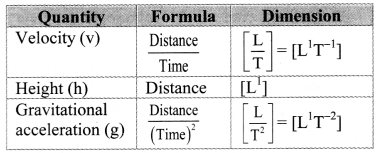
An object is falling freely under the gravitational force. Its velocity after travelling a distance h is v. If v depends upon gravitational acceleration g and distance, prove with dimensional analysis that v = k where k is a constant.
Solution & Step-by-Step Answer:
Given = v = k k being constant is assumed to be dimensionless. Dimensions of L.H.S. = [v] = [L1T-1] Dimension of R.H.S. = = [L1T-2] × [L1] = [L2T-2] = [L1T-1] As, [L.H.S.] = [R.H.S.], => v = kis dimensionally correct equation.

Question 10 Maharashtra Board Solution
v = at + + v0 is a dimensionally valid equation. Obtain the dimensional formula for a, b and c where v is velocity, t is time and v0 is initial velocity.
Solution & Step-by-Step Answer:
Solution: Given: y = at + + + v0

As only dimensionally identical quantities can be added together or subtracted from each other, each term on R.H.S. has dimensions of L.H.S. i.e., dimensions of velocity.

∴ [LH.S.] = [v] = [L1T-1]
This means, [at] = [v] = [L1T-1]
Given, t = time has dimension [T-1]
∴ [a] = = [L1T-2] = L1M0T-2]
Similarly, [c] = [t] = [T1] = [L0M0T1]
∴ = [v] = [L1T-1]
∴ [b] = [L1T-1] × [T1] = [L1] = [L1M0T0]

Question 11 Maharashtra Board Solution
The length, breadth and thickness of a rectangular sheet of metal are 4.234 m, 1.005 m, and 2.01 cm respectively. Give the area and volume of the sheet to correct significant figures.
Solution & Step-by-Step Answer:
Given: l = 4.234 m, b = 1.005 m, t = 2.01 cm = 2.01 × 10⁻² m = 0.0201 m

To find:
i) Area of sheet to correct significant figures (A)
ii) Volume of sheet to correct significant figures (V)
Formulae: i. A = 2(lb + bt + tl)
iii) V = l × b × t

Calculation: From formula (i),
A = 2(4.234 × 1.005 + 1.005 × 0.0201 +0.0201 × 4.234)
= 2 |[antilog(log 4.234 + logl.005) + antiiog(log 1.005 + log0.0201) + antilog(log 0.0201 + log 4.234)]}
= 2{[antilog(0.6267 + 0.0021) + antilog(0.0021 + .3010) + antilog (.3010 + 0.6267)]}
= 2 {[antilog(0.6288) + antilog (.9277)]}
= 2 [4.254 + 0.02009 + 0.08467]
= 2 [4.35876]
= 8.71752m2

In correct significant figure,
A = 8.72 m2 From formula (ii),
V =4.234 × 1.005 × 0.0201
= antilog [log (4.234) + log (1.005) + log (0.0201)]
= antilog [0.6269 – 0.0021 – .3032]
= antilog [0.6288 – .3032]
= antilog [ 2.9320]
= 8.551 × 10-2
= 0.08551 m3
In correct significant figure (rounding off),
V = 0.086 m3

i.) Area of sheet to correct significant figures is 8.72 m2.
ii) Volume of sheet to correct significant figures is 0.086 m3.
[Note: The given solution is arrived to by considering a rectangular sheet.]

Question 12 Maharashtra Board Solution
If the length of a cylinder is l = (4.00 ± 0.001) cm, radius r = (0.0250 ± 0.001) cm and mass m = (6.25 ± 0.01) gm. Calculate the percentage error in the determination of density.
Solution & Step-by-Step Answer:
Given: l = (4.00 ± 0.001) cm, In order to have same precision, we use, (4.000 ± 0.001), r = (0.0250 ± 0.00 1) cm, In order to have same precision, we use, (0.025 ± 0.001) m = (6.25 ± 0.01) g To find: percentage error in density

Formulae:
i) Relative error in volume,
….(∵ Volume of cylinder, V = πr2l)

ii) Releative error
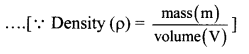
iii) Percentage error= Relative error × 100%

Calculation.
From formulae (i) and (ii),

=
= 0.00 16 + 0.08 + 0.00025
= 0.08 185
From formula (iii).
% error in density = × 100
= 0.08185 × 100
= 8.185%
Percentage error in density is 8.185%.

Question 13 Maharashtra Board Solution
When the planet Jupiter is at a distance of 824.7 million kilometers from the Earth, its angular diameter is measured to be 35.72″ of arc. Calculate the diameter of the Jupiter.
Solution & Step-by-Step Answer:
Given: Angular diameter (a) = 35.72″ = 35.72″ × 4.847 × 10⁻⁶ rad 1.73 × 10⁻⁴ rad

Distance from Earth (D)
= 824.7 million km
= 824.7 × 10⁶km
= 824.7 × 10⁹m.

To find: Diameter of Jupiter (d)
Formula: d = α D
Calculation: From formula,
d = 1.73 × 10-4× 824.7 × 109
= 1.428 × 10⁸m
= 1.428 × 10⁵km
Diameter of Jupiter is 1.428 × 10⁵km.
Question 14 Maharashtra Board Solution
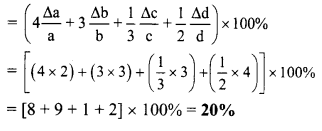
If the formula for a physical quantity is X = and if the percentage error in the measurements of a, b, c and d are 2%, 3%, 3% and 4% respectively. Calculate percentage error in X.
Solution & Step-by-Step Answer:
Given X = Percentage error in a, b, c, d is respectively 2%, 3%, 3% and 4%. Now, Percentage error in X

Question 15 Maharashtra Board Solution
Write down the number of significant figures in the following: 0.003 m2, 0.1250 gm cm-2, 6.4 × 10⁶ m, 1.6 × 10⁻¹⁹ C, 9.1 × 10⁻³¹ kg.
Solution & Step-by-Step Answer:

Question 16 Maharashtra Board Solution
The diameter of a sphere is 2.14 cm. Calculate the volume of the sphere to the correct number of significant figures.
Solution & Step-by-Step Answer:
Volume of sphere = πr3 = × 3.142 × ()3 ………….. (∵ r = ) = × 3.142 × (1.07)3 = 1.333 × 3.142 × (1.07)3 = {antilog [log (1.333) + log(3.142)+3 log(1.07)]} = {antilog [0.1249 + 0.4972 + 3 (0.0294)]) = {antilog [0.6221 + 0.0882]} = {antilog [0.7103]} = 5.133cm3 In multiplication or division, the final result should retain as many significant figures as there are in the original number with the least significant figures. Volume in correct significant figures ∴ 5.13 cm3

11th Physics Digest Chapter1 Units and MeasurementsIntext Questions and Answers

Can you recall (Textbook Page No. 1)

Question 1 Maharashtra Board Solution
i) What is a unit? ii) Which units have you used in the laboratory for measuring a. length b. mass c. time d. temperature? iii. Which system of units have you used?
Solution & Step-by-Step Answer:

Can you tell? (Textbook Page No. 8)

Question 1 Maharashtra Board Solution
If ten students are asked to measure the length of a piece of cloth upto a mm, using a metre scale, do you think their answers will be identical? Give reasons.
Solution & Step-by-Step Answer:
Answers of the students are likely to be different. Length of cloth needs to be measured up to a millimetre (mm) length. Hence, to obtain accurate and precise reading one must use measuring instrument having least count smaller than 1 mm.

But least count of metre scale is 1 mm. As a result, even smallest uncertainty in reading would vary reading significantly. Also, skill of students doing measurement may also introduce uncertainty in observation.
Hence, their answers are likely to be different.

Activity (Textbook Page No. 10)

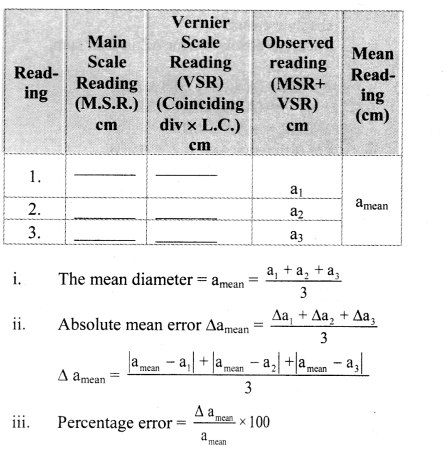
Perform an experiment using a Vernier callipers of least count 0.01cm to measure the external diameter of a hollow cylinder. Take 3 readings at different positions on the cylinder and find (i) the mean diameter (ii) the absolute mean error and (iii) the percentage error in the measurement of diameter.
Answer:
Given: L.C. = 0.01 cm
To measure external diameter of hollow cylinder readings are taken as follows:

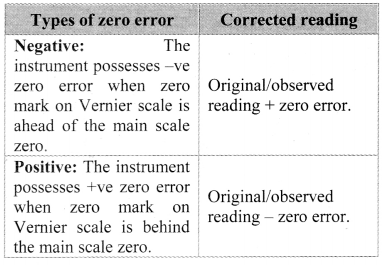
[Note: The above table is made assuming zero error in Vernier calipers. If caliper has positive or negative zero error, the zero error correction needs to be introduced into observed reading.]
Internet my friend (Textbook Page No. 12)

i. ideoiectures.net/mit801f99_lewin_lec0l/
ii. hyperphysicsphy-astr.gsu.ed u/libase/hfra me. html

[Students can use links given above as a reference and collect information about units and measurements]