Maharashtra State Board Class 11 Political Science Solutions Chapter 2 Liberty and Rights
1A. Choose the correct alternative and complete the following statements.
1B. Complete the following sentence by using appropriate reason.
1C. State the appropriate concept for the given statement.
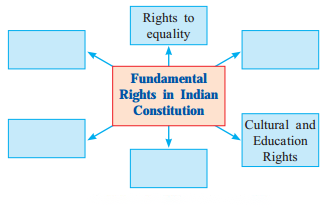
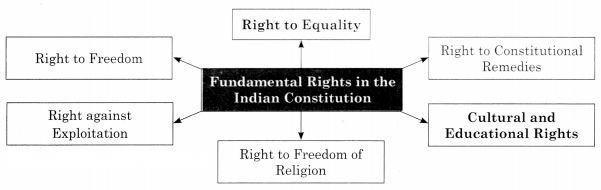
2. Complete the concept map.
3. State whether the following statements are true or false with reasons.
4. Explain the co-relation between the following.
Negative liberty opposes all restraints on liberty i.e., the State should not interfere in the social, economic life of the individual. It opposes any coercion, interference, or force on part of the State. The base negative aspect of liberty is the freedom of thought. Bentham argues that every person knows how to protect their own interest and hence no obstruction should be brought by the State.
John Stuart Mill suggests that negative liberty should be rejected only if it adversely impacts society. Hayek described liberty as a hurdle-less situation while Nozick suggested that the individual should be free from social, economic, and State restrictions. Berlin explains that negative liberty is opposition to restraints on the choice of alternatives.
The positive aspect of liberty as advocated by Jean-Jacques Rousseau and Herbert Marcuse emerged from modern liberalism. It states that liberty affects equality and justice. The law guides the individual towards the enrichment of their personality. Rousseau advocated the idea of State control over the individual since the State is a sovereign power that represents the ‘General Will’. Similarly, Marcuse advocates State interference and collective control as essential in community life.
We can conclude in the two statements of Isaiah Berlin.
Rights may be classified as natural rights, moral rights or legal (civil-political) rights.
Natural Rights e.g., the right to life, are parts of human nature and reason. They are not dependent on the laws of any government or the customs of any culture. They are universal and inalienable. They are considered beyond the authority of any government or international body to dismiss. The idea of human rights is closely related to that of natural rights. In the United States Declaration of Independence, natural rights mentioned are ‘Life, Liberty, and pursuit of Happiness. Our natural rights as human beings include being treated justly regardless of race, religion, gender, region, etc.
John Locke and Thomas Hobbes strongly advocated natural rights. Natural rights are important because without them we would have no claim to freedom. Legal rights refer to rights according to law. These rights are granted by the State to the people and exist differently in different countries. They are justiciable and codified in law. Such rights are neither universal nor inalienable. Legal rights include civil rights and political rights.
5. Answer the following questions.
Human rights can be classified as
The implementation of human rights requires favorable political, socio-economic conditions in the state. In the absence of such, these rights may be violated or denied as happens in the case of women, children, displaced persons, minorities, etc.
According to him, the impact of the action is not considered important and hence it is not measured. Therefore, this principle does not give importance to quality. For example, this concept does not make a qualitative difference between choosing one’s education, profession, or suffer deprivation. He would rather give importance to give an opportunity to do these actions than the outcome of the action itself.
Isaiah Berlin has mentioned the following features of negative liberty.
6. Answer the following in detail with reference to the given points.
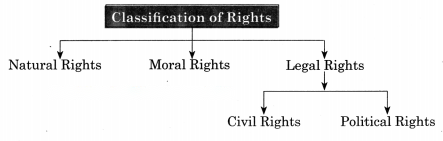
(ii) Legal Rights: These rights refer to rights according to law. These rights are granted by the State to the people and exist differently in different countries. They are justiciable and codified in law. Such rights are neither universal nor inalienable. Legal rights include civil rights and political rights.
(iii) Human Rights: These rights are those rights that we are entitled to simply because we are human beings. Henry Thoreau first described natural rights as human rights. These are basic rights of people anywhere in the world to be free from exploitation, injustice, and want, to lead a dignified existence, and to develop to the fullest extent. The UNO adopted the Universal Declaration of Human Rights on 10th December 1948. These rights are dynamic i.e. they develop with changing times. UDHR expresses belief in the liberty and equality of human beings and promotes a culture of peace and cooperation.
Human rights can be classified as
The implementation of human rights requires favorable political, socio-economic conditions. In the absence of such, these rights may be violated or denied as in the case of women, children, displaced persons, minorities, etc.
Activity 1 (Text Book Page No. 17)
Make a list of Civil Rights in India.
Answer:
Civil rights in India include
Activity 2 (Text Book Page No. 15)
Discuss and make a note of examples of human rights violations.
Answer:
Human rights violations are noticed in many countries of the world.