Maharashtra State Board Class 11 Political Science Solutions Chapter 7 Public Administration
1A. Choose the correct alternative and complete the following statements.
1B. Identify the incorrect pair in every set, correct it and rewrite.
1C. State the appropriate concept for the given statements.
2. State whether the following statements are true or false with reasons.
3. Explain the co-relation between the following.
The differences between private and public administration relate to aspects like scope, motive, responsibility, weakness, and financial control. Private administration is business-like with a narrower scope, wealth creation as the motive, responsibility to the owners, fewer chances of red-tapism, and internal financial control.
Public administration is bureaucratic with a very wide scope and motive as public service, responsibility to the ministers, intrinsic weakness of red-tapism, and external financial controls.
Rural administration includes three tiers i.e., Zilla Parishad, Panchayat Samiti, and Gram Panchayat. Developmental administration includes Chief Executive Officer, Block Development Officer, and Gram Sevak. There is also the Collector and Tehsildar.
4. Answer the following.

(i) At the national level, the work of the Central Government is conducted by various ministries (departments). For example, there are ministries of Agriculture, Health, Home, Defence, etc. Each ministry (or department) is headed by a Minister. Below the Minister is the bureaucracy or the administrative machinery. Besides the ministries, there are such institutions as the Election Commission, Union Public Service Commission. NITI Aayog, etc. These also require administrators or a bureaucracy.
(ii) At the State level also, there are various ministries and commissions that do the work of the government. The ministries of the State are also headed by a Minister and staffed by the bureaucracy.
(iii) At the local level, the administration is of two types: urban and rural administration. At the district level_ the highest administrative officer is the collector. In large cities, the Municipal Commissioner is in charge of the Municipality or Municipal Corporation. In rural areas, at the level of the Tehsil, the Tehsildar looks after the administration.
(iv) There is a close link between political leadership and administrative machinery. At the national, state levels and local levels, the political leaders are closely linked to the administrative machinery.
(v) The recruitment for all administrative posts at all levels is done through competitive examinations conducted by the government. At the central government level, the UPSC and Staff Selection Commission are the bodies that conduct these examinations.
Public policy can be understood in three steps.
5. Answer the following in detail with reference to the given points.
The executive branch of government consists of the Political Executive (council of ministers) and Permanent/ Non-political Executive or Bureaucracy. Public Administration as a subject studies the activity and process of the government. According to Waldo, ‘Public Administration is the art and science of management as applied to the affairs of the state’.
Public Administration broadly includes the following:
Scope of public Administration.
Public Administration can be studied as two categories.
(a) Narrow perspective – It focuses on aspects related only to the executive branch of government. Gullick and Urwick sum this view in the acronym POSDCORB to denote Planning, Organisation, Staffing, Directing, Coordinating, Reporting, Budgeting.
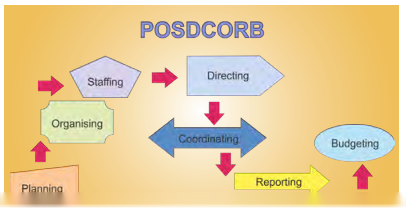
(b) Broad perspective – This differs from the narrow, managerial view of public administration. It includes activities of all three branches of the government, their interrelationships. Specialized government functions such as defense, finance, health care, etc. as well as collaborations with private groups e.g., NGO’s in providing services to the community. This view is concerned with techniques of administration (POSDCORB) as well as with substantive matters of administration.
According to Woodrow Wilson, ‘Administration is the most obvious part of the government- it is a government inaction, the most visible, operative side of the government.’
Activity (Text Book Page No.63)