Maharashtra State Board Class 11 Psychology Solutions Chapter 6 Stress
1A. Complete the following statements.
1B. State whether the following statements are true or false. If false, correct them, If true, explain why.
1C. Identify the odd item from the following.
Question i.
Unchallenging job, Unemployment, Leisure, Lack of purposeful activity
Answer:
Leisure
Question ii.
Eustress, Hyper stress, Frustration, Distress, Hypo stress
Answer:
Frustration
Question iii.
Attack, Withdrawal, Defence mechanism, Compromise
Answer:
Defence mechanism
Question iv.
Withdrawal, Projection, Sublimation, Rationalisation, Displacement
Answer:
Withdrawal
1D. Match the following pairs.
A | B |
1. Two negative goals | a) Defence mechanism |
2. Problem-focused coping | b) Hypo stress |
3. Vacation after sufficient work | c) Avoidance-Avoidance conflict |
4. Lack of challenging work | d) Direct way of coping with stress |
5. Emotion-focused coping | e) Approach-Avoidance conflict |
f) Leisure |
A | B |
1. Two negative goals | c) Avoidance-Avoidance conflict |
2. Problem-focused coping | a) Defence mechanism |
3. Vacation after sufficient work | e) Approach-Avoidance conflict |
4. Lack of challenging work | b) Hypo stress |
5. Emotion-focused coping | d) Direct way of coping with stress 2. Answer the following questions in around 35-40 words each. Question (i). Question (ii). Question (iii). Question (iv). Question (v). 3. Compare and contrast with examples.
Question 1
Maharashtra Board Solution
Eustress and Distress
Solution & Step-by-Step Answer:
Question 2
Maharashtra Board Solution
Hypo stress and Hyper stress
Solution & Step-by-Step Answer:
Question 3
Maharashtra Board Solution
Emotion-focused coping and Problem-focused coping
Solution & Step-by-Step Answer:
Question 4
Maharashtra Board Solution
Attack and Withdrawal
Solution & Step-by-Step Answer:
Question 5
Maharashtra Board Solution
Compromise and Withdrawal
Solution & Step-by-Step Answer:
Question 6
Maharashtra Board Solution
Projection and Rationalization
Solution & Step-by-Step Answer:
4(1). What are the possible consequences? Question (a). Question (b). Question (c). Question (d). 4(2). Identify the defense mechanism used in each of the following examples. Question (a). Question (b). Question (c). Question (d). 4(3). Identify the conflict of motive that is experienced by the person in the following situation. Question (a). Question (b). Question (c). Question (d). Question (e). 5. Write short notes in 35-40 words each.
Question 1
Maharashtra Board Solution
Types of stress
Solution & Step-by-Step Answer:
Question 2
Maharashtra Board Solution
Relationship between stress level and performance
Solution & Step-by-Step Answer:
Question 3
Maharashtra Board Solution
Direct ways to cope with stress
Solution & Step-by-Step Answer:
Question 4
Maharashtra Board Solution
Defense mechanisms
Solution & Step-by-Step Answer:
6. Answer the following questions in 150-200 words each.
Question 1
Maharashtra Board Solution
Give the definition of stress and explain different types of stress.
Solution & Step-by-Step Answer:
According to Richard Lazarus, ‘stress is a feeling experienced when an individual feels that the demands exceed the personal and social resources an individual is able to mobilize’. The types of stress are as follows:
Question 2
Maharashtra Board Solution
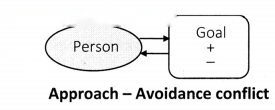
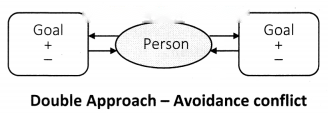
What is meant by conflict of motives? Explain the different types of conflicts with examples. Illustrate your answer with appropriate figures.
Solution & Step-by-Step Answer:
Conflict of motives refers to the clash between two or more equally strong and incompatible motives occurring at the same time that compels an individual to make a choice, which in turn leads to stress. The types of conflict are: i. Approach-Approach conflict: There is a conflict between two positive and attractive goals. The decision will depend on the attractiveness of the goal and its valence may change, e.g. Bhoomi wants to take up two courses but they are both scheduled at the same time.
ii. Avoidance-Avoidance conflict: The conflict involves two goals with negative values. An individual is forced to make a choice between two negative and unattractive goals, e.g. Ritu must work at a job which she dislikes, or else she must remain unemployed.
iii. Approach-Avoidance conflict: There is only one goal and it has positive as well as a negative value. This type of conflict is very difficult to resolve. There are three possible reactions in such a situation: give importance to a positive value, be cautious about the negative value and leave the goal altogether, e.g. Aryan receives a letter of acceptance from a college of his choice but it is very expensive.
iv. Double Approach-Avoidance conflict: An individual faces conflict between two or more goals that have an equal positive or negative value. However, an individual is always disappointed with the choice he makes as he has to lose the other goal, e.g. Richa has to choose between two boys for marriage. One is handsome but boring. The other one is fun but not good-looking.
Activities [Note: The answers to activities will be very subjective. The answers provided are for reference. Students are expected to perform these activities on their own.] Activity 2 (Textbook Page No. 61) Look at the following examples of stress. Try to find a pattern in them and make a definition of stress for yourself. Activity 6 (Textbook Page No. 66) Try to find examples of the given types of conflicts in your life or around you. How are these types of conflicts resolved? Are they? How does one deal with the resulting stress? All these types of conflicts are difficult to resolve but solving them is also very important. Everybody deals with the resulting stress in different ways. Ideally, we should weigh the pros and cons of every situation and then come to a conclusion. |