Maharashtra State Board 12th Biology Solutions Chapter 1 Reproduction in Lower and Higher Plants
1. Multiple Choice Questions
Solution & Step-by-Step Answer:
(a) sticky pollen with a rough surface
Solution & Step-by-Step Answer:
(d) Megaspore mother cell
Solution & Step-by-Step Answer:
(c) Secondary nucleus and endosperm
Solution & Step-by-Step Answer:
(a) Geitonogamy
Solution & Step-by-Step Answer:
(d) Synergids
Solution & Step-by-Step Answer:
(c) polar nuclei and male gamete
Solution & Step-by-Step Answer:
(d) Pollen grain
2. Very Short Answer Questions
Solution & Step-by-Step Answer:
Stigmatic surface.
Solution & Step-by-Step Answer:
6 cells, 2 synergids, 1 egg cell, 3 antipodals.
Solution & Step-by-Step Answer:
Angiosperms have phenomenon of double fertilization in which both the male gametes are utilized, one for fusion with egg cell to form zygote and other for fusion with secondary nucleus to form endosperm.
Solution & Step-by-Step Answer:
It is the process of formation of haploid megaspores from diploid megaspore mother cell.
Solution & Step-by-Step Answer:
Transfer of pollen grains in pollination process through agency of water is known as hydrophily.
Solution & Step-by-Step Answer:
Tapetum
Solution & Step-by-Step Answer:
The condition in which fruit is developed without the process of fertilization is called parthenocarpy.
Solution & Step-by-Step Answer:
Apomixis is formation of embryos without formation of gametes hence there is no need of pollination and fertilization.
Solution & Step-by-Step Answer:
Ovary develops into fruit and ovules into seed.
Solution & Step-by-Step Answer:
Filiform apparatus guides the pollen tube towards egg cell.
3. Short Answer Questions
Solution & Step-by-Step Answer:
Solution & Step-by-Step Answer:
Solution & Step-by-Step Answer:
Solution & Step-by-Step Answer:
4. Long Answer Questions
Solution & Step-by-Step Answer:
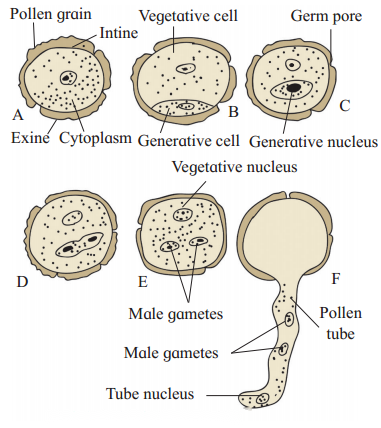
Double fertilization: (1) Out of the two male gametes produced by the male gametophyte in angiosperms, one unites with the female gamete and the other with the secondary nucleus. Since both the male gametes take part in fertilization and fertilization occurs twice, it is called double fertilization.
(2) During double fertilization, the pollen tube on reaching the ovule enters the embryo sac through micropyle and bursts in one of the synergids. Owing to this, the two male gametes contained in the pollen tube, are set free.

(3) Out of the two male gametes, one unites with the egg or female gamete and the other unites with the secondary nucleus of the embryo sac, forming a triploid or triple fusion nucleus, called the primary endosperm nucleus. The process involving the fusion of one of the male gametes with the egg nucleus, resulting in the formation of a diploid zygote is called syngamy.
(4) The reproductive process in which non-motile male nuclei are carried to the egg cell through a pollen tube is called siphonogamy.
(5) After fertilization, zygote develops into an embryo. Certain changes take place in the ovule leading to the development of a seed.
Solution & Step-by-Step Answer:
Solution & Step-by-Step Answer:
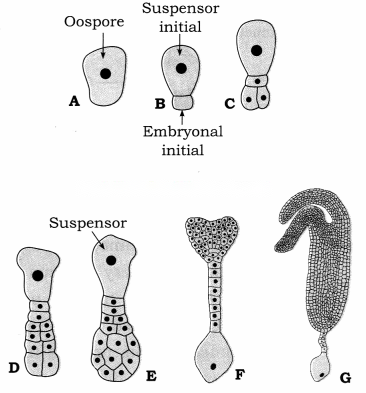
Development of embryo (dicot) in angio- sperm: The oospore undergoes a transverse division to form a large basal cell towards the micropyle and a small apical or terminal cell towards the chalaza of the embryo sac. This two celled structure is called proembryo. The basal cell or suspensor initial undergoes repeated transverse divisions to form a multicellular structure called suspensor. The suspensor pushes the embryo towards the endosperm to draw its nutrition.
Solution & Step-by-Step Answer:
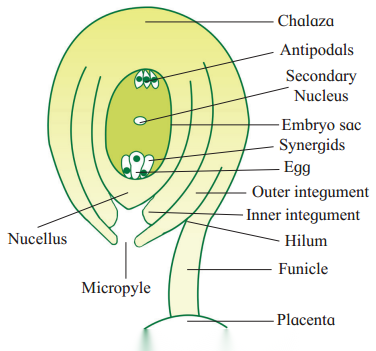
Components of Embryo sac.
5. Fill in the Blanks
Solution & Step-by-Step Answer:
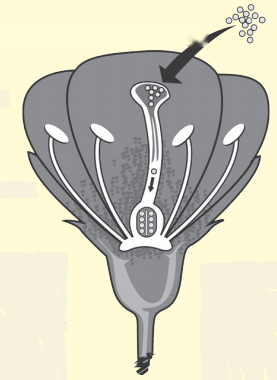
biotic agents
Solution & Step-by-Step Answer:
androecium, pollen grains
Solution & Step-by-Step Answer:
male
Solution & Step-by-Step Answer:
embryo sac
Solution & Step-by-Step Answer:
Fertilization
Solution & Step-by-Step Answer:
thalamus
Solution & Step-by-Step Answer:
Pollination
Solution & Step-by-Step Answer:
style
Solution & Step-by-Step Answer:
petals, fragrance, nectar
Solution & Step-by-Step Answer:
Calyx.
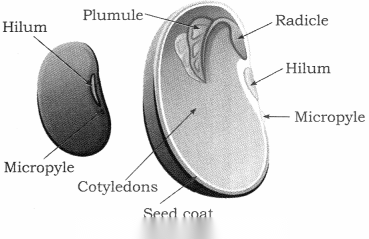
6. Label the Parts of seed.
Answer:

7. Match the following
Column I (Structure Before seed formation) | Column II (Structure After seed formation) |
A. Funiculus | i. Hilum |
B. Scar of Ovule | ii. Tegmen |
C. Zygote | iii. Testa |
D. Inner Integument | iv. Stalk of Seed |
| v. Embryo |
(a) A-v, B-i, C-ii, D-iv
(b) A-iii, B-iv, C-i, D-v
(c) A-iv, B-i, C-v D-ii
(d) A-iv, B-v C-iii, D-ii
Answer:
(c) A-iv, B-i, C-v D-ii