Maharashtra State Board 12th Biology Solutions Chapter 13 Organisms and Populations
1. Multiple choice questions
2. Very short answer questions.
b. Parasitism
Answer:
The interaction between two species in which one parasitic species derives benefit from the other host species by harming it is called parasitism.
c. Camouflage
Answer:
Camouflage is the disguising colouration or behaviour to merge with the surrounding so that prey or predator can remain hidden.
b. Leopard and lion competing for a same prey. Sheep and cow competing for grazing in the same land.
Protocooperation:
3. Short answer questions.
Hibernation | Aestivation |
1. Hibernation is winter sleep shown by some warm-blooded and some cold-blooded animals. | 1. Aestivation is the type of summer sleep, shown by cold-blooded animals. |
2. It is for the whole winter. | 2. It is of short duration. |
3. The animals look out for the warmer place to enter into hibernation. | 3. Animals search for the moist, shady and cool place to sleep. |
4. Metabolic activities of hibernators slowdown in this dormant stage. | 4. Metabolic activities of aestivators remain low during aestivation period. |
5. Hibernation helps in maintaining the body temperature and prevents any internal body damage due to low temperatures.E.g. Bats, birds, mammals, insects, etc. show hibernation. | 5. Aestivation helps in maintaining the body temperature by avoiding the excessive water loss and thus prevents any internal body damaged due to high temperatures.E.g. Bees, snails, earthworms, salamanders, frogs, earthworms, crocodiles, tortoise, etc. show aestivation. |
b. Ectotherms and Endotherms
Answer:
Ectotherms | Endotherms |
1. Ectotherms do not have ability to generate heat in the body. | 1. Endotherms possess the ability to generate their own body heat. |
2. Ectotherms depend on the environmental sources to heat their bodies. E.g sunlight. | 2. Endotherms do not depend upon outside sources to generate heat. |
3. Most ectotherms are confined to warmer parts of the world. | 3. Endotherms inhabit coldest parts of the earth. |
4. Body temperature of ectotherms fluctuate according to ambient temperature. | 4. Body temperatures of endotherms remain constant and do not show fluctuations as per ambient temperatures. |
5. Metabolic rate of ectotherms is low.E.g. Amphibians and reptiles. | 5. Metabolic rate of endotherms is high.E.g. Mammals and birds |
c. Parasitism and Mutualism
Answer:
Parasitism | Mutualism |
1. Parasitism is the relationship where only one organism receive benefits, while the other is harmed in return. | 1. Mutualism is the relationship where both the organisms of distinct species are benefited. |
2. Parasite cannot survive without host but if the host is overexploited then parasite too dies. | 2. Both the species are dependent on each other for their benefits and survival. |
3. Parasitism can be facultative or obligatory. | 3. Mutualism is obligatory relationship. |
4. Parasitism is a negative interaction. | 4. Mutualism is a positive interaction. |
b. Adaptations of plants to water scarcity
Or
Adaptations in desert plants.
Answer:
c. Behavioural adaptations in animals
Answer:
Community:
Several populations of different species in a particular area makes a community.
4. Long answer questions.
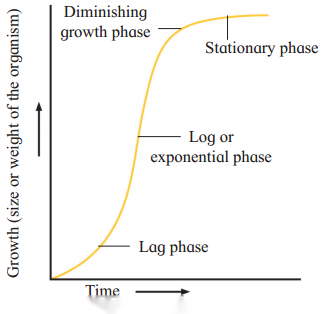
2. Mortality:
3. Density:
The density of a population in a given habitat during a given period fluctuates due to changes in four basic processes, viz.
4. Sex ratio : Ratio of the number of individuals of one sex (male) to that of the other sex (female) is called sex ratio. In nature male, female ratio is always 1 : 1. This 1 : 1 ratio is called evolutionary stable strategy of ESS for each population.
5. Age distribution and age pyramid : This parameter is important for human population. Each population is composed of individuals of different ages. The age distribution is plotted for the population, the resulting structure is called an age pyramid. For making the age pyramid, the entire population is divided into three age groups as Pre-Reproductive (age 0-14 years), Reproductive (age 15-44 years) and Post-reproductive (age 45 -85+ years).
6. Growth : Growth of a population causes rise in its density. The size and density are dynamic parameters as they keep on changing with time, and various factors including food, predation pressure and adverse weather. From the density, one comes to know if the population is flourishing or declining.