Maharashtra State Board 12th Biology Solutions Chapter 6 Plant Water Relation
1. Multiple Choice Questions
2. Very short answer question
3. Answer the Following Questions
Role of transpiration:
Limitation of this theory:
(ii) Diffusion
Answer:
It is the movement of ions/ atoms/molecules of a substance from the region of higher concentration to the region of their lower concentration.
(iii) Plasmolysis
Answer:
Exo-osmosis in a living cell when placed in hypertonic solution is called plasmolysis.
(iv) Imbibition
Answer:
It is swelling up of hydrophilic colloids due to adsorption of water.
(v) Guttation
Answer:
The loss of water in the form of liquid is called guttation.
(vi) Transpiration
Answer:
The loss of water from plant body in the form of vapour is called transpiration.
(vii) Ascent of sap
Answer:
The transport of water with dissolved minerals in it from root to other aerial parts of plant against the gravity is called ascent of sap.
(viii) Active absorption
Answer:
Water absorption by activity of root which is against the D.PD. gradient along with expenditure of A.T.E energy generated by respiration is the process of active absorption.
(ix) Diffusion Pressure Deficit (D.P.D.)
Answer:
The difference in the diffusion pressures of pure solvent and the solvent in a solution is called diffusion pressure deficit.
(x) Turgor pressure
Answer:
It is the pressure exerted by turgid cell sap on to the cell membrane and cell wall.
(xi) Water potential
Answer:
Chemical potential of water is called water potential.
(xii) Wall pressure
Answer:
Thick and rigid cell wall exerts a counter pressure to turgor pressure developed on the cell sap is called wall pressure that operates in opposite direction.
(xiii) Root pressure
Answer:
As absorption of water by root hair being a continuous process, a sort of hydrostatic pressure is developed in living cells of root, this is called root pressure.
Osmotic Pressure (O.R) | Turgor Pressure (T.P.) |
1. The pressure exerted due to osmosis is called osmotic pressure. | 1. The pressure exerted by turgid cell sap on cell membrane and cell wall, is called turgor pressure. |
2. It is pressure caused by water when it moves by osmosis. | 2. It is pressure caused by content of cell (cell sap). |
3. It is generated by the osmotic flow of water through a semipermeable membrane. | 3. It is maintained by osmosis. |
4. Long answer questions
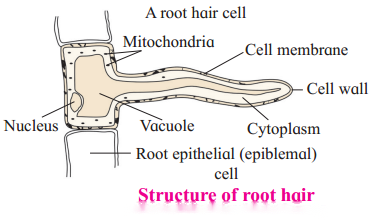
(2) It is technique of growing plants by supplying all necessary nutrients in the water supply given to plant.
(3) A nutrient medium is prepared by dissolving necessary salts of micronutrients and macronutricnts In desired quantity and roots of plants are suspended in this liquid with appropriate support.
(4) Hydroponics is of great use in studying the deficiency symptoms of different mineral nutrients.
(5) The plants uptake mineral nutrients in the form of dissolved ions with the help of root hairs from the surrounding medium or nutrient solution supplied.
(6) While preparing the required nutricnt medium particular nutrient can be totally avoided and then the effect of lack of that nutrient can be studied in variation of plant growth.
(7) Any visible change noticed from normal structure and function of the plant is the symptom or hunger sign considered.
(8) For e.g. Yellowing of leaf is observed due to loss of chlorophyll pigments or Chiorosis is noticed if Magnesium is lacking as it is a structural componen of chlorophyll pigment.