Balbharati Maharashtra State Board12th Commerce Maths Digest PdfChapter 2 Insurance and Annuity Miscellaneous Exercise 2 Questions and Answers.
Maharashtra State Board 12th Commerce Maths Solutions Chapter 2 Insurance and Annuity Miscellaneous Exercise 2
(I) Choose the correct alternative.
Question 1
Maharashtra Board Solution
“A contract that pledges payment of an agreed-upon amount to the person (or his/her nominee) on the happening of an event covered against” is technically known as (a) Death coverage (b) Saving for future (c) Life insurance (d) Provident fund
Solution & Step-by-Step Answer:
(c) Life insurance
Question 2
Maharashtra Board Solution
Insurance companies collect a fixed amount from their customers at a fixed interval of time. This amount is called (a) EMI (b) Installment (c) Contribution (d) Premium
Solution & Step-by-Step Answer:
(d) Premium
Question 3
Maharashtra Board Solution
Following are different types of insurance. I. Life insurance II. Health insurance III. Liability insurance (a) Only I (b) Only II (c) Only III (d) All the three
Solution & Step-by-Step Answer:
(d) All the three
Question 4
Maharashtra Board Solution
By taking insurance, an individual (a) Reduces the risk of an accident (b) Reduces the cost of an accident (c) Transfers the risk to someone else (d) Converts the possibility of large loss to the certainty of a small one
Solution & Step-by-Step Answer:
Converts the possibility of large loss to the certainty of a small one
Question 5
Maharashtra Board Solution
You get payments of ₹ 8,000 at the beginning of each year for five years ta 6%, what is the value of this annuity? (a) ₹ 34,720 (b) ₹ 39,320 (c) ₹ 35,720 (d) ₹ 40,000
Solution & Step-by-Step Answer:
(c) ₹ 35,720
Question 6
Maharashtra Board Solution
In an ordinary annuity, payments or receipts occur at (a) Beginning of each period (b) End of each period (c) Mid of each period (d) Quarterly basis
Solution & Step-by-Step Answer:
(b) End of each period
Question 7
Maharashtra Board Solution
The amount of money today which is equal to a series of payments in the future is called (a) Normal value of the annuity (b) Sinking value of the annuity (c) Present value of the annuity (d) Future value of the annuity
Solution & Step-by-Step Answer:
(c) Present value of the annuity
Question 8
Maharashtra Board Solution
Rental payment for an apartment is an example of (a) Annuity due (b) Perpetuity (c) Ordinary annuity (d) Installment
Solution & Step-by-Step Answer:
(b) Perpetuity
Question 9
Maharashtra Board Solution
_________ is a series of constant cash flows over a limited period of time. (a) Perpetuity (b) Annuity (c) Present value (d) Future value
Solution & Step-by-Step Answer:
(b) Annuity
Question 10
Maharashtra Board Solution
A retirement annuity is particularly attractive to someone who has (a) A severe illness (b) Risk of low longevity (c) Large family (d) Chance of high longevity
Solution & Step-by-Step Answer:
(d) Chance of high longevity
(II) Fill in the blanks.
Question 1
Maharashtra Board Solution
An installment of money paid for insurance is called _________
Solution & Step-by-Step Answer:
premium
Question 2
Maharashtra Board Solution
General insurance covers all risks except _________
Solution & Step-by-Step Answer:
life
Question 3
Maharashtra Board Solution
The value of insured property is called _________
Solution & Step-by-Step Answer:
property value
Question 4
Maharashtra Board Solution
The proportion of property value to insured is called _________
Solution & Step-by-Step Answer:
policy value
Question 5
Maharashtra Board Solution
The person who receive annuity is called _________
Solution & Step-by-Step Answer:
Annuitant
Question 6
Maharashtra Board Solution
The payment of each single annuity is called _________
Solution & Step-by-Step Answer:
installment
Question 7
Maharashtra Board Solution
The intervening time between payment of two successive installments is called as _________
Solution & Step-by-Step Answer:
payment period
Question 8
Maharashtra Board Solution
An annuity where payments continue forever is called _________
Solution & Step-by-Step Answer:
perpetuity
Question 9
Maharashtra Board Solution
If payments of an annuity fall due at the beginning of every period, the series is called _________
Solution & Step-by-Step Answer:
annuity due
Question 10
Maharashtra Board Solution
If payments of an annuity fall due at the end of every period, the series is called annuity _________
Solution & Step-by-Step Answer:
immediate
(III) State whether each of the following is True or False.
Question 1
Maharashtra Board Solution
General insurance covers life, fire, and theft.
Solution & Step-by-Step Answer:
False
Question 2
Maharashtra Board Solution
The amount of claim cannot exceed the amount of loss.
Solution & Step-by-Step Answer:
True
Question 3
Maharashtra Board Solution
Accident insurance has a period of five years.
Solution & Step-by-Step Answer:
False
Question 4
Maharashtra Board Solution
Premium is the amount paid to the insurance company every month.
Solution & Step-by-Step Answer:
True
Question 5
Maharashtra Board Solution
Payment of every annuity is called an installment.
Solution & Step-by-Step Answer:
False
Question 6
Maharashtra Board Solution
Annuity certainly begins on a fixed date and ends when an event happens.
Solution & Step-by-Step Answer:
True
Question 7
Maharashtra Board Solution
Annuity contingent begins and ends on certain fixed dates.
Solution & Step-by-Step Answer:
False
Question 8
Maharashtra Board Solution
The present value of an annuity is the sum of the present value of all installments.
Solution & Step-by-Step Answer:
True
Question 9
Maharashtra Board Solution
The future value of an annuity is the accumulated value of all installments.
Solution & Step-by-Step Answer:
False
Question 10
Maharashtra Board Solution
The sinking fund is set aside at the beginning of a business.
Solution & Step-by-Step Answer:
True
(IV) Solve the following problems.
Question 1
Maharashtra Board Solution
A house valued at ₹ 8,00,000 is insured at 75% of its value. If the rate of premium is 0.80%. Find the premium paid by the owner of the house. If the agent’s commission is 9% of the premium, find the agent’s commission.
Solution & Step-by-Step Answer:
Property value = ₹ 8,00,000 Policy value = 75% × 8,00,000 = ₹ 6,00,000 ∵ Rate of Premium = 0.80% ∴ Amount of Premium = 0.80% × 6,00,000 = ₹ 4,800 ∵ Rate of commission = 9% ∴ Agent commission = 9% × 4800 = ₹ 432
Question 2
Maharashtra Board Solution
A shopkeeper insures his shop and godown are valued at ₹ 5,00,000 and ₹ 10,00,000 respectively for 80% of their values. If the rate of premium is 8%, find the total annual premium.
Solution & Step-by-Step Answer:
Property value of shop = ₹ 5,00,000 ∴ Policy value = 80% × 5,00,000 = ₹ 4,00,000 ∵ Rate of Premium = 8% ∴ Amount of premium = 8% × 4,00,000 = ₹ 32,000 ∵ Property value of Godown = ₹ 10,00,000 ∴ Policy value = 80% × 10,00,000 = ₹ 8,00,000 ∵ Rate of Premium = 8% ∴ Amount of Premium = 8% × 8,00,000 = ₹ 64,000 ∴ Total annual Premium = 64,000 + 32,000 = ₹ 96,000
Question 3
Maharashtra Board Solution
A factory building is insured for of its value at a rate of premium of 2.50%. If the agent is paid a commission of ₹ 2,812.50, which is 7.5% of the premium, find the value of the building.
Solution & Step-by-Step Answer:
Let the Property value be ₹ x ∴ Policy value = ₹ ∵ Rate of premium = 2.50% ∴ Amount of premium = × 2.50% = ₹ ∵ Rate of Agent commission = 7.5% ∴ Agent commission = 7.5% × ∴ 2812.50 = ∴ 2812.50 × 640 = x ∴ x = ₹ 18,00,000 ∴ Value of the building is ₹ 18,00,000.
Question 4
Maharashtra Board Solution
A merchant takes a fire insurance policy to cover 80% of the value of his stock. Stock worth ₹ 80,000 was completely destroyed in a fire. While the rest of the stock was reduced to 20% of its value. If the proportional compensation under the policy was ₹ 67,200, find the value of the stock.
Solution & Step-by-Step Answer:
Let the Property value be ₹ x ∴ Policy value 80% × x = ₹ ∵ Complete loss = ₹ 80,000 ∴ Partial loss = 20% × (x – 8,00,000) = ∴ Total loss = 80,000 + = + 64,000 ∵ Claim = ₹ 67,200 ∴ x = ₹ 1,00,000 ∴ The value of the stock is ₹ 1,00,000.

Question 5
Maharashtra Board Solution
A 35-year old person takes a policy for ₹ 1,00,000 for a period of 20 years. The rate of premium is ₹ 76 and the average rate of bonus is ₹ 7 per thousand p.a. If he dies after paying 10 annual premiums, what amount will his nominee receive?
Solution & Step-by-Step Answer:
Policy value = ₹ 1,00,000 Period of Policy = 20 years ∵ Rate of premium = ₹ 76 per thousand ∴ Amount of premium = × 1,00,000 = ₹ 7,600 ∴ Total Premium = 7,600 × 10 = ₹ 76,000 ∴ Rate of Bonus = ₹ 7 per thousand p.a ∴ Total Bonus = × 1,00,000 = ₹ 7,000 ∴ Amount received by Nominee = Policy value + Bonus earned = 1,00,000 + 7,000 = ₹ 1,07,000
Question 6
Maharashtra Board Solution
15,000 articles costing ₹ 200 per dozen were insured against fire for ₹ 1,00,000. If 20% of the articles were burnt completely and 2,400 other articles were damaged to the extent of 80% of their value, find the amount that can be claimed under the policy.
Solution & Step-by-Step Answer:
Total Articles = 15,000 ∴ Property value = × 200 = 2,50,000 ∵ Policy value = ₹ 1,00,000 ∴ Complete loss = 20% × 2,50,000 = ₹ 50,000 ∴ Partial loss = 80% × × 200 = ₹ 3,20,000 ∴ Total loss = 32,000 + 50,000 = ₹ 82,000 ∴ Claim = × Loss = × 82,000 = ₹ 32,800
Question 7
Maharashtra Board Solution
For what amount should a cargo worth ₹ 25,350 be insured so that in the event of a total loss, its value, as well as the cost of insurance, may be recovered when the rate of premium is 2.5%.
Solution & Step-by-Step Answer:
Let the policy value be ₹ 100 which includes the cost of insurance and premium ∴ Property value = 100 – 2.50 = ₹ 97.50 If the value of the cargo is ₹ 97.50, then the policy value is ₹ 100. If the value of the cargo is ₹ 25,350, then Policy value = = ₹ 26,000
Question 8
Maharashtra Board Solution
A cargo of grain is insured at % to cover 70% of its value. ₹1,008 is the amount of premium paid. If the grain is worth ₹ 12 per kg, how many kg of the grain did the cargo contain?
Solution & Step-by-Step Answer:
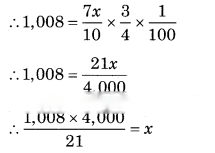
Let the Property value be ₹ x ∴ policy value = 70% × x = ₹ ∵ Rate of premium = % ∴ Amount of premium = Rate × Policy value ∴ x = ₹ 1,92,000 ∵ Rate of Jowar = ₹ 12/kg ∴ Quantity of Jowar = = 16,000 kgs
Question 9
Maharashtra Board Solution
4,000 bedsheets worth ₹ 6,40,000 were insured for of their value. Some of the bedsheets were damaged in the rainy season and were reduced to 40% of their value. If the amount recovered against damage was ₹ 32,000. Find the number of damaged bedsheets.
Solution & Step-by-Step Answer:
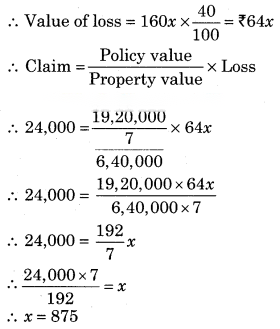
∵ Property value = ₹ 6,40,000 ∴ Policy value = 6,40,000 × = ₹ ∴ Cost of one Bedsheet = = ₹ 160 Let ‘x’ bedsheets be damaged. ∴ Cost of x bedsheets = ₹ 160x ∴ 875 Bedsheets damaged.
Question 10
Maharashtra Board Solution
A property valued at ₹ 7,00,000 is insured to the extent of ₹ 5,60,000 at % less 20%. Calculate the saving made in the premium. Find the amount of loss that the owner must bear, including premium, if the property is damaged to the extent of 40% of its value.
Solution & Step-by-Step Answer:
∵ Property value = ₹ 7,00,000 ∵ Policy value = ₹ 5,60,000 ∵ Rate of premium = % ∴ Amount of premium = % × 5,60,000 = ₹ 3,500 New rate of premium = % less 20% = – [20% x ] = – = % ∴ Amount of premium = % × 5,60,000 = ₹ 2,800 ∴ Saving made in premium = 3,500 – 2,800 = ₹ 700 ∴ Loss = 7,00,000 × 40% = 2,80,000 ∴ Claim = × Loss = × 2,80,000 = ₹ 2,24,000 ∴ Loss bear by owner = loss – claim + premium = 2,80,000 – 2,24,000 + 2,800 = ₹ 58,800
Question 11
Maharashtra Board Solution
Stocks in a shop and godown worth ₹ 75,000 and ₹ 1,30,000 respectively were insured through an agent who receive 15% of the premium as commission. If the shop was insured for 80% and godown for 60% of the value, find the amount of agent’s commission when the premium was 0.80% less 20%. If the entire stock in the shop and 20% stock in the godown is destroyed by fire, find the amount that can be claimed under the policy.
Solution & Step-by-Step Answer:
∵ Rate of premium = 0.80% less 20% = 0.80 – 20% × 0.80 = 0.80 – 0.16 = 0.64% For Shop ∵ Property value = ₹ 75,000 ∴ Policy value = 80% × 75,000 = ₹ 60,000 ∴ Premium = 0.64% × 60,000 = ₹ 384 ∵ Loss = ₹ 75,000 ∵ Claim = × Loss = × 75,000 = ₹ 60,000 For Godown ∵ Property value = ₹ 1,30,000 ∴ Policy value = 60% × 1,30,000 = ₹ 78,000 ∴ Premium = 0.64% × 78,000 = ₹ 499.2 Loss = 20% × 1,30,000 = ₹ 26,000 ∴ Claim = × Loss = × 26,000 = ₹ 15,600 Total claim = 16,600 + 60,000 = ₹ 75,600 ∵ Rate of commission = 15% ∴ Agent commission = 15% × [384 + 499.2] = 15% × 883.2 = ₹ 132.48
Question 12
Maharashtra Board Solution
A person holding a life policy of ₹ 1,20,000 for a term of 25 years wants to discontinue after paying a premium for 8 years at the rate of ₹ 58 per thousand p.a. Find the amount of paid-up value he will receive on the policy. Find the amount he will receive if the surrender value granted is 35% of the premium paid, excluding the first year’s premium.
Solution & Step-by-Step Answer:
Policy value = ₹ 1,20,000 ∵ Rate of premium = ₹ 58 per thousand p.a. ∴ Premium for 8 years = × 1,20,000 = ₹ 55,680 ∴ Amount of 1st premium = = ₹ 6,960 ∵ Paid-up value of policy = × Policy value = × 1,20,000 = ₹ 38,400 ∵ Surrender value = 35% × [Total premium – 1st year premium] = 35% × [55,680 – 6,960] = 35% × 48,720 = ₹ 17,052
Question 13
Maharashtra Board Solution
A godown valued at ₹ 80,000 contained stock worth ₹ 4,80,000. Both were insured against fire. Godown for ₹ 50,000 and stock for 80% of its value. A part of stock worth ₹ 60,000 was completely destroyed and the rest was reduced to 60% of its value. The amount of damage to the godown is ₹ 40,000. Find the amount that can be claimed under the policy.
Solution & Step-by-Step Answer:
For Godown ∵ Property value = ₹ 80,000 ∵ Policy value = ₹ 50,000 ∵ Loss = ₹ 40,000 ∵ Claim = × Loss = × 40,000 = ₹ 25,000 For stock ∵ Property value = ₹ 4,80,000 ∵ Policy value = 80% × 4,80,000 = ₹ 3,84,000 ∵ Complete loss = ₹ 60,000 ∴ Partial loss = (100 – 60)% × [4,80,000 – 60,000] = 40% × 4,20,000 = ₹ 1,68,000 ∴ Total loss = 1,68,000 + 60000 = ₹ 2,28,000 ∴ Claim = × Loss = × 2,28,000 = ₹ 1,82,400 ∴ Total claim = 25,000 + 1,82,400 = ₹ 2,07,400
Question 14
Maharashtra Board Solution
Find the amount of an ordinary annuity if a payment of ₹ 500 is made at the end of every quarter for 5 years at the rate of 12% per annum compounded quarterly. [Given: (1.03)20 = 1.8061]
Solution & Step-by-Step Answer:
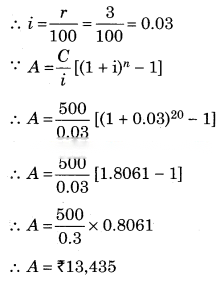
∵ C = ₹ 500 ∵ r = 12% p.a. compounded quarterly, ∴ r = = 3% ∵ n = 5 years But, payment is made quarterly ∴ n = 5 × 4 = 20
Question 15
Maharashtra Board Solution
Find the amount a company should set aside at the end of every year if it wants to buy a machine expected to cost ₹ 1,00,000 at the end of 4 years and interest rate is 5% p.a. compounded annually.
Solution & Step-by-Step Answer:
∵ A = ₹ 1,00,000 ∵ r = 5% p.a. ∴ i = = 0.05 ∵ n = 4 years ∵ A = ∴ 1,00,000 = [(1 + 0.05)4 – 1] ∴ 1,00,000 × 0.05 = C [(1.05)4 – 1] ∴ 5,000 = C(1.2155 – 1) ∴ 5,000 = C × 0.2155 ∴ = C ∴ C = ₹ 23,201.86
Question 16
Maharashtra Board Solution
Find the least number of years for which an annuity of ₹ 3,000 per annum must run in order that its amount exceeds ₹ 60,000 at 10%compounded annually. [Given: (1.1)11 = 2,8531, (1.1)12 = 3.1384]
Solution & Step-by-Step Answer:
∵ A = ₹ 60,000 ∵ C = ₹ 3,000 ∵ r = 10% p.a. ∴ i = = 0.1 ∵ A = ∴ 60,000 = ∴ 60,000 = 30,000[(1.1)n – 1] ∴ + 1 = (1.1)n ∴ 2 + 1 = (1.1)n ∴ 3 = (1.1)n Taking log ∴ log 3 = log (1.1)n ∴ log 3 = n log(1.1) ∴ = n ∴ n = = 11.52 ~ 12 years
Question 17
Maharashtra Board Solution
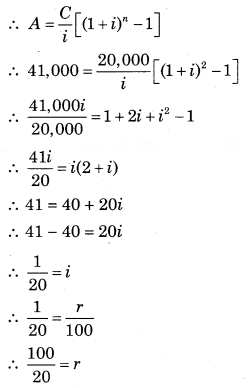
Find the rate of interest compounded annually if an ordinary annuity of ₹ 20,000 per year amounts to ₹ 41,000 in 2 years.
Solution & Step-by-Step Answer:
∵ C = ₹ 20,000 ∵ A = ₹ 41,000 ∵ n = 2 years ∴ r = 5% p.a.
Question 18
Maharashtra Board Solution
A person purchases a television by paying ₹ 20,000 in cash and promising to pay ₹ 1,000 at the end of every month for the next 2 years. If money is worth 12% p.a., converted monthly. Find the cash price of the television. [Given: (1.01)-24 = 0.7880]
Solution & Step-by-Step Answer:
Down payment = ₹ 20,000 ∵ n = 2 years But, EMI Payable monthly ∴ n = 2 × 12 = 24 ∵ r = 12% p.a. compounded monthly ∴ P = 1,00,00 × 0.2120 ∴ P = ₹ 21,200 Cash price = Present value + Down payment = 21,200 + 20,000 = ₹ 41,200

Question 19
Maharashtra Board Solution
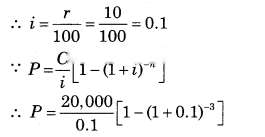
Find the present value of an annuity immediate of ₹ 20,000 per annum for 3 years at 10% p.a. compounded annually. [Given: (1.1)-3 = 0.7513]
Solution & Step-by-Step Answer:
∵ C = ₹ 20,000 ∵ n = 3 years ∵ r = 10% p.a. ∴ P = 2,00,000 [1 – 0.7513] ∴ P = 2,00,000 [0.2487] ∴ P = ₹ 49,740
Question 20
Maharashtra Board Solution
A man borrowed some money and paid it back in 3 equal installments of ₹ 2,160 each. What amount did he borrow if the rate of interest was 20% per annum compounded annually? Also, find the total interest charged. [Given: (1.2)-3 = 0.5788]
Solution & Step-by-Step Answer:
∵ C = ₹ 2,160 ∵ n = 3 ∵ r = 20% p.a. ∴ P = ₹ 6,251.04 ∴ Total amount paid = 2,160 × 3 = ₹ 6,480 ∴ Interest = 6,480 – 6,251.04 = ₹ 228.96

Question 21
Maharashtra Board Solution
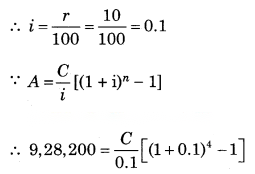
A company decides to set aside a certain amount at the end of every year to create a sinking fund that should amount to ₹ 9,28,200 in 4 years at 10% p.a. Find the amount to be set aside every year. [Given: (1.1)4 = 1.4641]
Solution & Step-by-Step Answer:
∵ A = ₹ 9,28,200 ∵ n = 4 years ∵ r = 10% p.a. ∴ 9,28,200 × 0.1 = C[1.4641 – 1] ∴ 92,820 = C × 0.4641 ∴ = C ∴ C = ₹ 2,00,000
Question 22
Maharashtra Board Solution
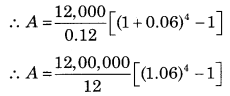
Find the future value after 2 years if an amount of ₹ 12,000 is invested at the end of every half-year at 12% p.a. compounded half-yearly. [Given: (1.06)4 = 1.2625]
Solution & Step-by-Step Answer:
∵ n = 2 years Payable half yearly, n = 2 × 2 = 4 ∵ C = ₹ 12,000 ∵ r = 12% p.a. Compounded half yearly ∴ A = 1,00,000 [1.2625 – 1] ∴ A = 1,00,000 × 0.2625 ∴ A = ₹ 26,250

Question 23
Maharashtra Board Solution
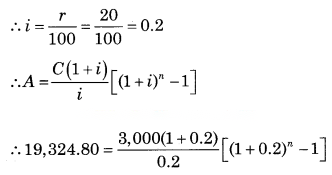
After how many years would an annuity due of ₹ 3,000 p.a. accumulated ₹ 19,324.80 at 20% p.a. compounded annually? [Given: (1.2)4 = 2.0736]
Solution & Step-by-Step Answer:
∵ C = ₹ 3,000 ∵ A = ₹ 9,324.80 ∵ r = 20% p.a. ∴ 19,324.80 = 15,000 × 1.2[(1.2)n – 1] ∴ 19,324.80 = 18,000[(1.2)n – 1] ∴ + 1 = (1.2)n ∴ 1.0736 + 1 = (1.2)n ∴ 2.0736 = (1.2)n ∴ (1.2)4 = (1.2)n ∴ n = 4 years
Question 24
Maharashtra Board Solution
Some machinery is expected to cost 25% more over its present cost of ₹ 6,96,000 after 20 yeas. The scrap value of the machinery will realize ₹ 1,50,000. What amount should be set aside at the end of every year at 5% p.a. compound interest for 20 years to replace the machinery? [Given: (1.05)20 = 2655]
Solution & Step-by-Step Answer:
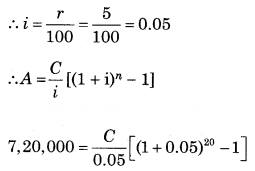
Present cost = ₹ 6,96,000 Expected cost = 25% × 6,96,000 + 6,96,000 = 1,74,000 + 6,96,000 = ₹ 8,70,000 ∴ Scrap value = ₹ 1,50,000 ∴ Sinking fund = 8,70,000 – 1,50,000 = ₹ 7,20,000 ∴ A = ₹ 7,20,000, n = 20 years, r = 5% p.a. ∴ 7,20,000 × 0.05 = C[(1.05)20 – 1] ∴ 36,000 = C[2.655 – 1] ∴ 36,000 = C × 1.655 ∴ = C ∴ C = ₹ 21,752.27