Balbharati Maharashtra State Board12th Commerce Maths Solution Book PdfChapter 2 Matrices Miscellaneous Exercise 2 Questions and Answers.
Maharashtra State Board 12th Commerce Maths Solutions Chapter 2 Matrices Miscellaneous Exercise 2
(I) Choose the correct alternative.
Solution & Step-by-Step Answer:
(c)
Solution & Step-by-Step Answer:
(b) scalar matrix
Solution & Step-by-Step Answer:
(d) null matrix
Solution & Step-by-Step Answer:
(c) a6 Hint: adj A = ∴ |adj A| = a2(a4 – 0) = a6
Solution & Step-by-Step Answer:
(a)
Solution & Step-by-Step Answer:
(a) diag [1/d1, 1/d2, 1/d3, …, 1/dn]
Solution & Step-by-Step Answer:
(b) (A + mI) Hint: A2 + mA + nI = 0 ∴ (A2 + mA + nI). A-1 = 0. A-1 ∴ A(AA-1) + m(AA-1) + nIA-1 = 0 ∴ AI + mI + nA-1 = 0 ∴ nA-1 = -A – mI ∴ A-1 = (A + mI)
Solution & Step-by-Step Answer:
(d) Hint: B-1 = B ∴ B2 = B.B-1 = I
Solution & Step-by-Step Answer:
(c ) ±5 Hint: |A|= = α2 – 16 ∴ |A3| = |A|3 = (α2 – 16)3 = 729 ∴ α2 – 16 = 9 ∴ α2 = 25 ∴ α = ±5
Solution & Step-by-Step Answer:
(a) AB = BA Hint: A2 – B2 = (A – B)(A + B) ∴ A2 – B2 = A2 + AB – BA – B2 ∴ 0 = AB – BA ∴ AB = BA
Solution & Step-by-Step Answer:
(b)
Solution & Step-by-Step Answer:
(b) 5 Hint: A(adj A) = |A|.I
Solution & Step-by-Step Answer:
(d) 1/det(A) Hint: AA-1 = I ∴ |A|.|A-1| = 1 ∴ |A-1| =
Solution & Step-by-Step Answer:
(c)
Solution & Step-by-Step Answer:
(b) (1, 0)
(II) Fill in the blanks:
Solution & Step-by-Step Answer:
column
Solution & Step-by-Step Answer:
2 × 3
Solution & Step-by-Step Answer:
2
Solution & Step-by-Step Answer:
-1
Solution & Step-by-Step Answer:
3
Solution & Step-by-Step Answer:
-2
Solution & Step-by-Step Answer:
|A|
Solution & Step-by-Step Answer:
A
Solution & Step-by-Step Answer:
-1
Solution & Step-by-Step Answer:
(III) State whether each of the following is True or False:
Solution & Step-by-Step Answer:
True
Solution & Step-by-Step Answer:
False
Solution & Step-by-Step Answer:
True
Solution & Step-by-Step Answer:
False
Solution & Step-by-Step Answer:
False
Solution & Step-by-Step Answer:
False
Solution & Step-by-Step Answer:
False
Solution & Step-by-Step Answer:
False
Solution & Step-by-Step Answer:
False
Solution & Step-by-Step Answer:
True.
(IV) Solve the following:
Solution & Step-by-Step Answer:
Let A = Since, A is singular matrix, |A| = 0 ∴ = 0 ∴ 7k – 15 = 0 ∴ k =
Solution & Step-by-Step Answer:
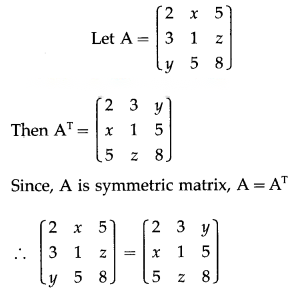
By equality of matrices, x = 3, y = 5 and z = 5.
Solution & Step-by-Step Answer:
From (1) and (2), (A + B) + C = A + (B + C).


Solution & Step-by-Step Answer:
Solution & Step-by-Step Answer:
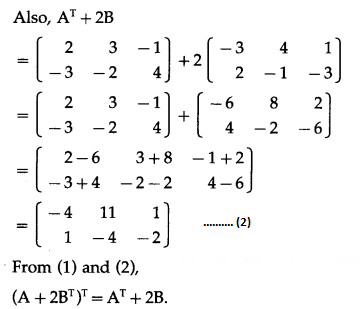
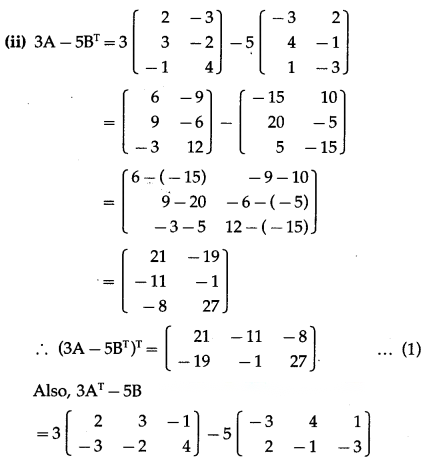
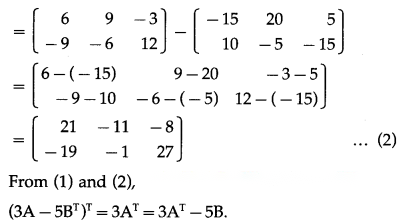
Solution & Step-by-Step Answer:
∴ BA is also a singular matrix. Hence, AB and BA are both singular matrices.

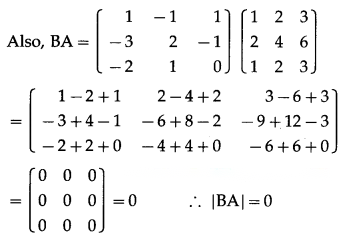
Solution & Step-by-Step Answer:
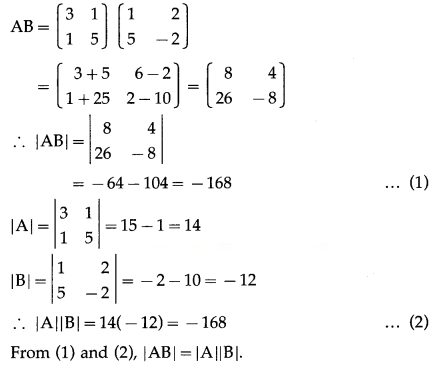
Solution & Step-by-Step Answer:

Solution & Step-by-Step Answer:
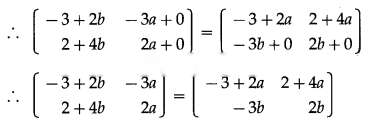
(A + B)(A – B) = A2 – B2 ∴ A2 – AB + BA – B2 = A2 – B2 ∴ -AB + BA = 0 ∴ AB = BA By equality of matrices, -3 + 2b = -3 + 2a ……..(1) -3a = 2 + 4a ……..(2) 2 + 4b = -3b ……..(3) 2a = 2b ……..(4) From (2), 7a = -2 ∴ a = From (3), 7b = -2 ∴ b = These values of a and b also satisfy equations (1) and (4). Hence, a = and b =

Solution & Step-by-Step Answer:

Solution & Step-by-Step Answer:
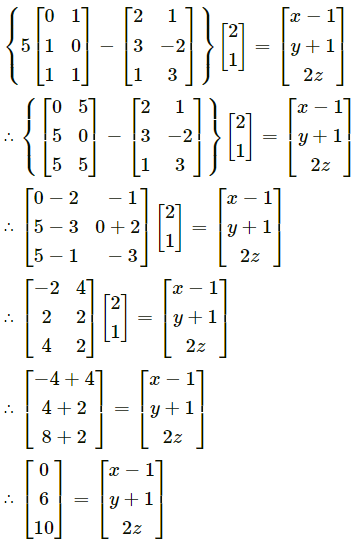
∴ By equality of matrices, we get x – 1 = 0 ∴ x = 1 y + 1 = 6 ∴ y = 5 2z = 10 ∴ z = 5
Solution & Step-by-Step Answer:


Solution & Step-by-Step Answer:

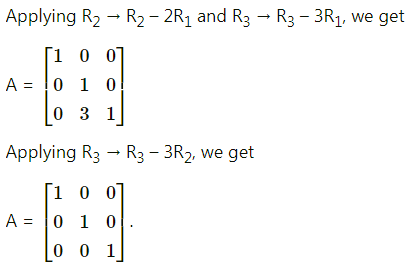
Solution & Step-by-Step Answer:
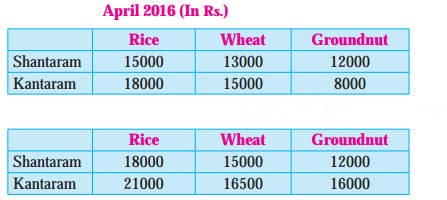
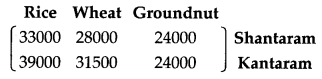
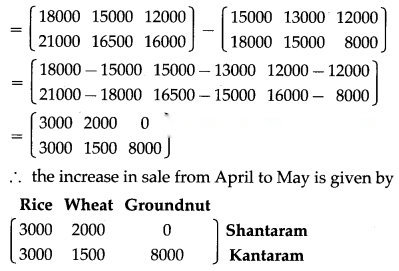
The given information can be written in matrix form as: (i) The total sale in ₹ for two months of each farmer for each crop can be obtained by the addition A + B. Now, A + B ∴ total sale in ₹ for two months of each farmer for each crop is given by Hence, the total sale for Shantaram are ₹ 33000 for Rice, ₹ 28000 for Wheat, ₹ 24000 for Groundnut, and for Kantaram are ₹ 39000 for Rice, ₹ 31500 for Wheat, ₹ 24000 for Groundnut. (ii) The increase in sales from April to May for every crop of each farmer can be obtained by the subtraction of A from B. Now, B – A Hence, the increase in sales from April to May of Shantam is ₹ 3000 in Rice, ₹ 2000 in Wheat, nothing in Groundnut and of Kantaram are ₹ 3000 in Rice, ₹ 1500 in Wheat, ₹ 8000 in Groundnut.


Solution & Step-by-Step Answer:
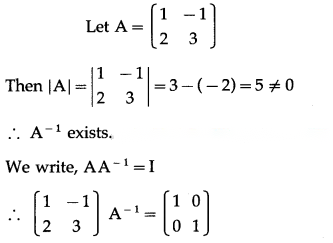
Let A = Then |A| = = 1 – 0 = 1 ≠ 0 ∴ A is a non-singular matrix. Hence, A-1 exists.
(ii) ≤ft[{array}{ll}
1 & 1 \\
1 & 1
{array}
Solution:
Let A = ≤ft[{array}{ll}
1 & 1 \\
1 & 1
{array}
Then |A| = ≤ft|{array}{ll}
1 & 1 \\
1 & 1
{array}
= 1 – 1
= 0
∴ A is a singular matrix.
Hence, A-1does not exist.
(iii) ≤ft[{array}{lll}
3 & 4 & 3 \\
1 & 1 & 0 \\
1 & 4 & 5
{array}
Solution:
Let A = ≤ft[{array}{lll}
3 & 4 & 3 \\
1 & 1 & 0 \\
1 & 4 & 5
{array}
Then |A| = ≤ft|{array}{lll}
3 & 4 & 3 \\
1 & 1 & 0 \\
1 & 4 & 5
{array}
= 3(5 – 0) – 4(5 – 0) + 3(4 – 1)
= 15 – 20 + 9
= 4 ≠ 0
∴ A is a non-singular matrix.
Hence, A-1exists.
(iv) ≤ft[{array}{lll}
1 & 2 & 3 \\
2 & 4 & 5 \\
2 & 4 & 6
{array}
Solution:
Let A = ≤ft[{array}{lll}
1 & 2 & 3 \\
2 & 4 & 5 \\
2 & 4 & 6
{array}
Then |A| = ≤ft|{array}{lll}
1 & 2 & 3 \\
2 & 4 & 5 \\
2 & 4 & 6
{array}
= 1(24 – 20) – 2(12 – 10) + 3(8 – 8)
= 4 – 4 + 0
= 0
∴ A is a singular matrix.
Hence, A-1does not exist.
Solution & Step-by-Step Answer:
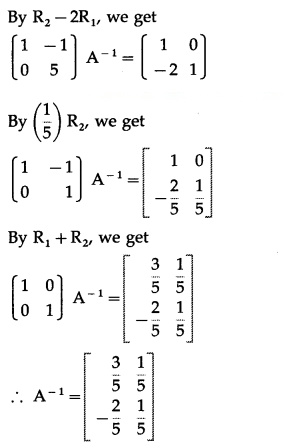
(ii) ≤ft[{array}{ll}
2 & 1 \\
7 & 4
{array}
Solution:
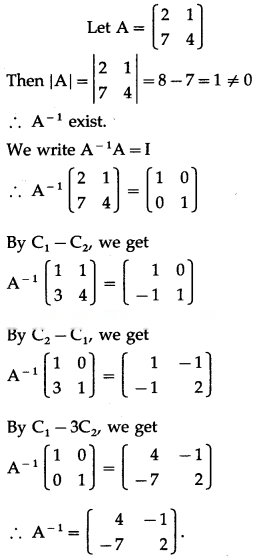
(iii) ≤ft[{array}{ccc}
2 & -3 & 3 \\
2 & 2 & 3 \\
3 & -2 & 2
{array}
Solution:


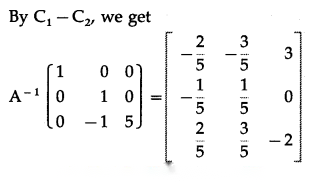
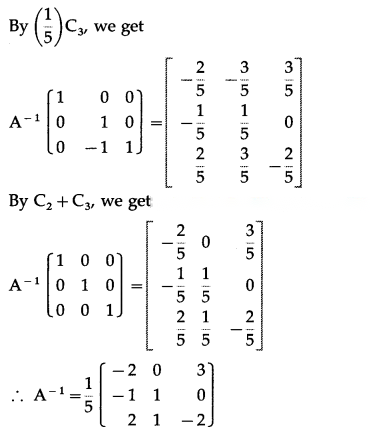
(iv) ≤ft[{array}{ccc}
2 & 0 & -1 \\
5 & 1 & 0 \\
0 & 1 & 3
{array}
Solution:

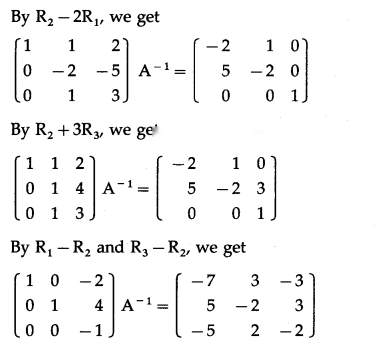
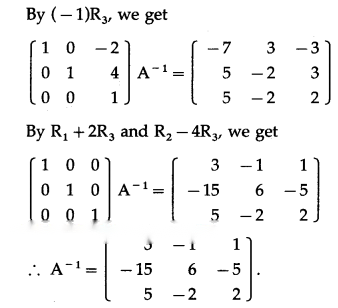
Solution & Step-by-Step Answer:
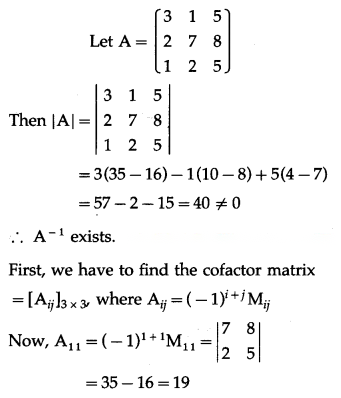

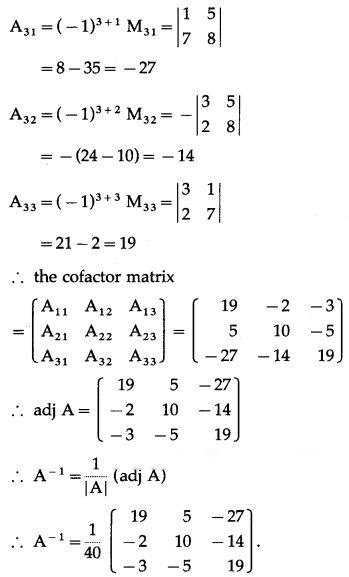
Solution & Step-by-Step Answer:
The given equations are 4x – 3y = 2 3x – 4y = -6 These equations can be written in matrix form as: By equality of matrices, x = , y = is the required solution.
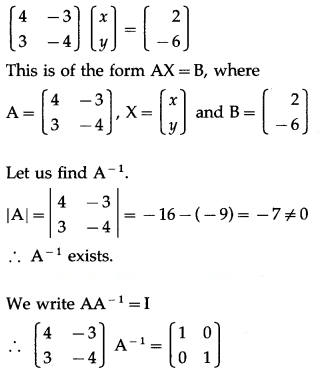
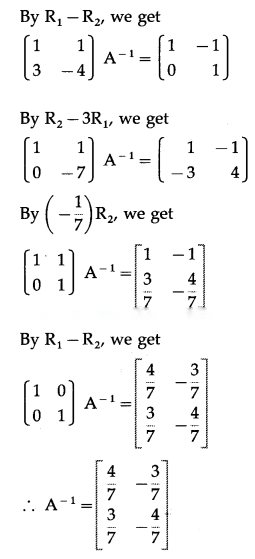
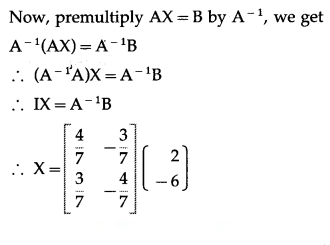

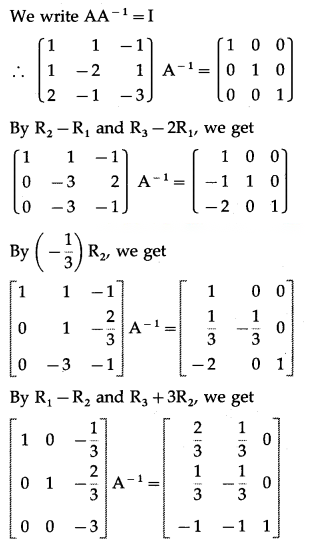
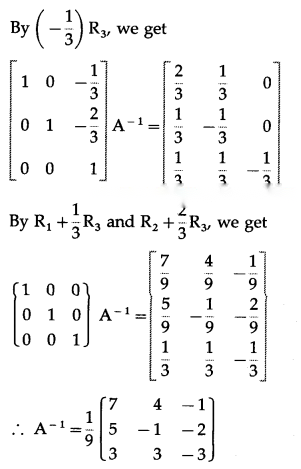
(ii) x + y – z = 2, x – 2y + z = 3 and 2x – y – 3z = -1
Solution:
The given equations can be written in matrix form as:
By equality of matrices,
x = 3, y = 1, z = 2 is the required solution.
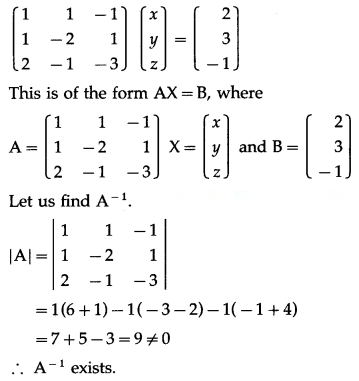

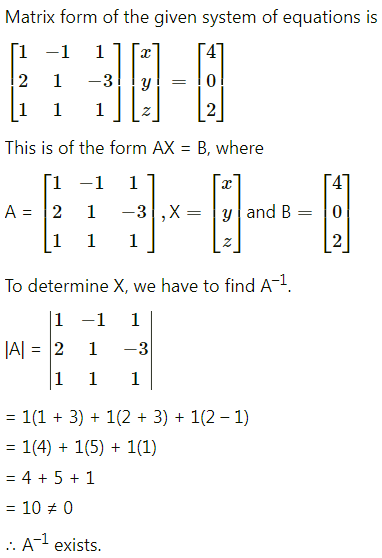
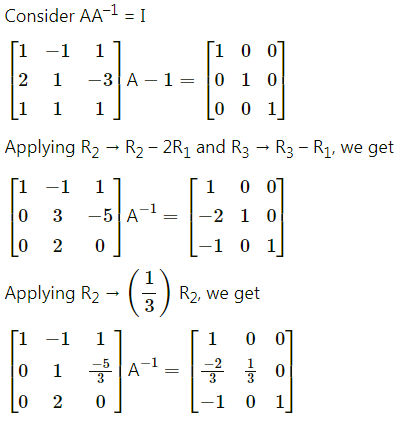
(iii) x – y + z = 4, 2x + y – 3z = 0 and x + y + z = 2
Solution:
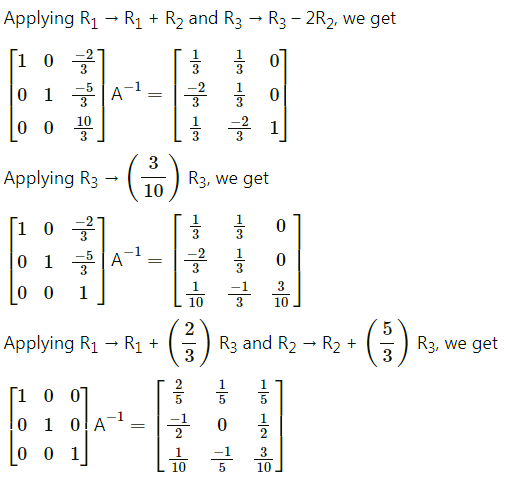

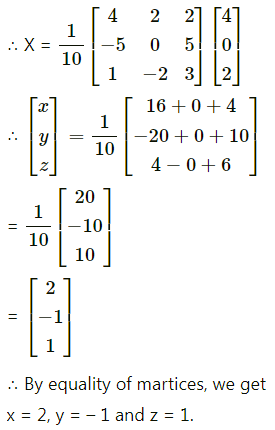
Solution & Step-by-Step Answer:
The given equation can be written in matrix form as: By R2 – 5R1, we get By equality of matrices, 2x + y = 5 …….(1) -7x = -28 ……(2) From (2), x = 4 Substituting x = 4 in (1), we get 2(4) + y = 5 ∴ y = -3 Hence, x = 4 and y = -3 is the required solution.
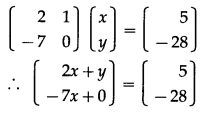
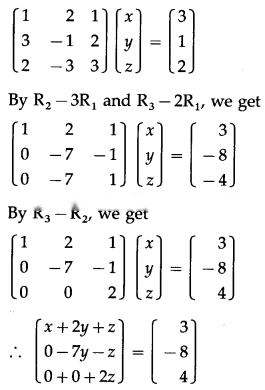
(ii) x + 2y + z = 3, 3x – y + 2z = 1 and 2x – 3y + 3z = 2
Solution:
The given equations can be written in matrix form as:
By equality of matrices,
x + 2y + z = 3 …….(1)
-7y – z = -8 …….(2)
2z = 4 …….(3)
From (3), z = 2
Substituting z = 2 in (2), we get
-7y – 2 = -8
∴ -7y = -6
∴ y =
Substituting y = , z = 2 in (1), we get
x + 2() + 2 = 3
x = 3 – 2 – =
Hence, x = , y = and z = 2 is the required solution.
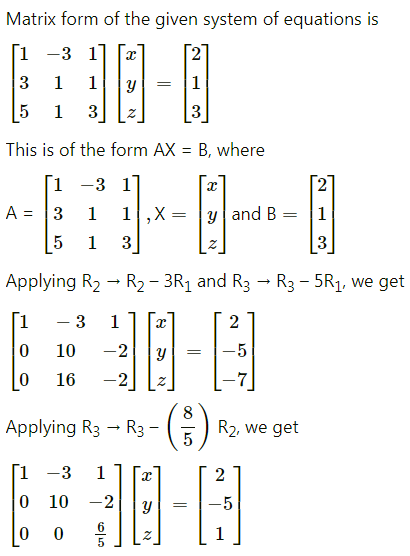
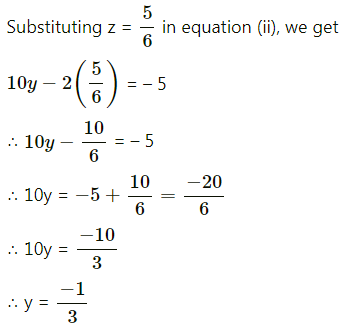
(iii) x – 3y + z = 2, 3x + y + z = 1 and 5x + y + 3z = 3.
Solution:


Solution & Step-by-Step Answer:
Let the three numbers be x, y, and z. According to the given condition, x + y + z = 6 3z + y = 11, i.e. y + 3z = 11 and x + z = 2y, i.e. x – 2y + z = 0 Hence, the system of linear equations is x + y + z = 6 y + 3z = 11 x – 2y + z = 0 These equations can be written in matrix form as: By equality of matrices, x + y + z = 6 …….(1) y + 3z = 11 ………(2) -3y = -6 ………(3) From (3), y = 2 Substituting y = 2 in (2), we get 2 + 3z = 11 ∴ 3z = 9 ∴ z = 3 Substituting y = 2, z = 3 in (1), we get x + 2 + 3 = 6 ∴ x = 1 ∴ x = 1, y = 2, z = 3 Hence, the required numbers are 1, 2 and 3.
