Latest Maharashtra State Board (SSC & HSC) 2026-27 Syllabus Digest & Solutions Updated!
Class 12 (HSC Board)Commerce Mathematics & Statistics2026-27 Syllabus

Chapter 8 Differential Equation and Applications Miscellaneous Exercise 8 Solutions

Complete Maharashtra State Board Balbharati & Yuvakbharati textbook solutions for Chapter 8 Differential Equation and Applications Miscellaneous Exercise 8. Step-by-step solved exercises, numerical problems, and digest answers.

39 Solved Questions26 Diagrams1964 words

Balbharati Maharashtra State BoardStd 12 Commerce Statistics Part 1 Digest PdfChapter 8 Differential Equation and Applications Miscellaneous Exercise 8 Questions and Answers.

Maharashtra State Board 12th Commerce Maths Solutions Chapter 8 Differential Equation and Applications Miscellaneous Exercise 8

(I) Choose the correct option from the given alternatives:

Question 1 Maharashtra Board Solution
The order and degree of are respectively. (a) 3, 1 (b) 1, 3 (c) 3, 3 (d) 1, 1
Solution & Step-by-Step Answer:
(a) 3, 1
Question 2 Maharashtra Board Solution
The order and degree of are respectively (a) 3, 1 (c) 3, 3 (b) 1, 3 (d) 1, 1
Solution & Step-by-Step Answer:
(c) 3, 3
Question 3 Maharashtra Board Solution
The differential equation of y = k1 + is (a) (b) (c) (d)
Solution & Step-by-Step Answer:
(b)
Question 4 Maharashtra Board Solution
The differential equation of y = k1 ex + k2 e-x is (a) (b) (c) (d)
Solution & Step-by-Step Answer:
(a)
Question 5 Maharashtra Board Solution
The solution of = 1 is (a) x + y = c (b) xy = c (c) x2 + y2 = c (d) y – x = c
Solution & Step-by-Step Answer:
(d) y – x = c
Question 6 Maharashtra Board Solution
The solution of is (a) x3 + y3 = 7 (b) x2 + y2 = c (c) x3 + y3 = c (d) x + y = c
Solution & Step-by-Step Answer:
(c) x3 + y3 = c
Question 7 Maharashtra Board Solution
The solution of x = y log y is (a) y = aex (b) y = be2x (c) y = be-2x (d) y = eax
Solution & Step-by-Step Answer:
(d) y = eax
Question 8 Maharashtra Board Solution
Bacterial increases at a rate proportional to the number present. If the original number M doubles in 3 hours, then the number of bacteria will be 4M in (a) 4 hours (b) 6 hours (c) 8 hours (d) 10 hours
Solution & Step-by-Step Answer:
(b) 6 hours
Question 9 Maharashtra Board Solution
The integrating factor of – y = ex is (a) x (b) -x (c) ex (d) e-x
Solution & Step-by-Step Answer:
(c) ex
Question 10 Maharashtra Board Solution
The integrating factor of – y = ex is e-x, then its solution is (a) ye-x = x + c (b) yex = x + c (c) yex = 2x + c (d) ye-x = 2x + c
Solution & Step-by-Step Answer:
(a) ye-x = x + c

(II) Fill in the blanks:

Question 1 Maharashtra Board Solution
The order of highest derivative occurring in the differential equation is called ________ of the differential equation.
Solution & Step-by-Step Answer:
order
Question 2 Maharashtra Board Solution
The power of the highest ordered derivative when all the derivatives are made free from negative and/or fractional indices if any is called ________ of the differential equation.
Solution & Step-by-Step Answer:
degree
Question 3 Maharashtra Board Solution
A solution of differential equation that can be obtained from the general solution by giving particular values to the arbitrary constants is called _________
Solution & Step-by-Step Answer:
Answer: particular
Question 4 Maharashtra Board Solution
Order and degree of a differential equation are always _________ integers.
Solution & Step-by-Step Answer:
positive
Question 5 Maharashtra Board Solution
The integrating factor of the differential equation – y = x is _________
Solution & Step-by-Step Answer:
e-x
Question 6 Maharashtra Board Solution
The differential equation by eliminating arbitrary constants from bx + ay = ab is _________
Solution & Step-by-Step Answer:

(III) State whether each of the following is True or False:

Question 1 Maharashtra Board Solution
The integrating factor of the differential equation – y = x is e-x.
Solution & Step-by-Step Answer:
True
Question 2 Maharashtra Board Solution
The order and degree of a differential equation are always positive integers.
Solution & Step-by-Step Answer:
True
Question 3 Maharashtra Board Solution
The degree of a differential equation is the power of the highest ordered derivative when all the derivatives are made free from negative and/or fractional indices if any.
Solution & Step-by-Step Answer:
True
Question 4 Maharashtra Board Solution
The order of highest derivative occurring in the differential equation is called the degree of the differential equation.
Solution & Step-by-Step Answer:
False
Question 5 Maharashtra Board Solution
The power of the highest ordered derivative when all the derivatives are made free from negative and/or fractional indices if any is called the order of the differential equation.
Solution & Step-by-Step Answer:
False
Question 6 Maharashtra Board Solution
The degree of the differential equation is not defined.
Solution & Step-by-Step Answer:
True

(IV) Solve the following:

Question 1 Maharashtra Board Solution
Find the order and degree of the following differential equations: (i)
Solution & Step-by-Step Answer:
The given differential equation is ∴ This D.E. has highest order derivative with power 3 ∴ order = 3 and degree = 3

(ii)
Solution:
The given differential equation is
This D.E. has highest order derivative with power 2.
∴ order = 1, degree = 2.

Question 2 Maharashtra Board Solution
Verify that y = log x + c is a solution of the differential equation .
Solution & Step-by-Step Answer:
y = log x + c Differentiating both sides w.r.t. x, we get ∴ x = 1 Differentiating again w.r.t. x, we get ∴ This shows that y = log x + c is a solution of the D.E.
Question 3 Maharashtra Board Solution
Solve the following differential equations: (i) = 1 + x + y + xy
Solution & Step-by-Step Answer:
= 1 + x + y + xy ∴ = (1 + x) + y(1 + x) = (1 + x)(1 + y) ∴ dy = (1 + x) dx Integrating, we get ∫ dy = ∫(1 + x) dx ∴ log|1 + y| = x + + c This is the general solution.

(ii)
Solution:

∴ from (1), the general solution is
y = x log x – x + c, i.e. y = x(log x – 1) + c.

(iii) dr = ar dθ – θ dr
Solution:
dr = ar dθ – θ dr
∴ dr + θ dr = ar dθ
∴ (1 + θ) dr = ar dθ

On integrating, we get

∴ log |r| = a log |1 + θ| + c
This is the general solution.

(iv) Find the differential equation of the family of curves y = ex(ax + bx2), where a and b are arbitrary constants.
Solution:
y = ex(ax + bx2)
ax + bx2= ye-x…….(1)
Differentiating (1) w.r.t. x twice and writing as y1and as y2, we get


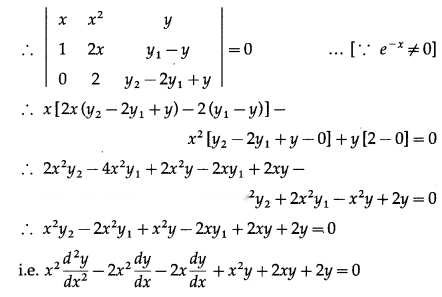
This is the required differential equation.

Question 4 Maharashtra Board Solution
Solve when x = and y = .
Solution & Step-by-Step Answer:

Question 5 Maharashtra Board Solution
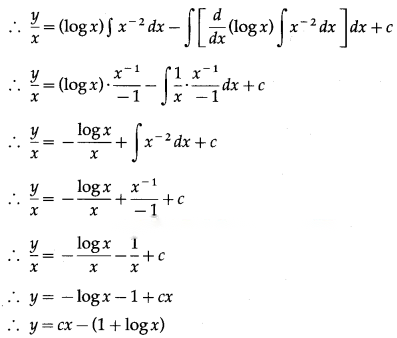
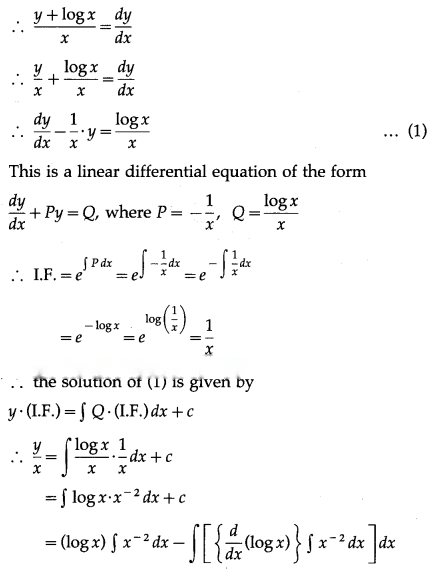
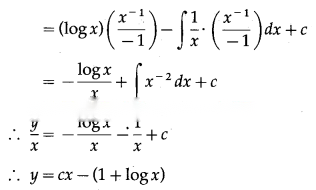
Solve y dx – x dy = -log x dx.
Solution & Step-by-Step Answer:
y dx – x dy = -log x dx ∴ y dx – x dy + log x dx = 0 ∴ x dy = (y + log x) dx ∴ ∴ …….(1) This is the linear differential equation of the form This is the general solution.

Question 6 Maharashtra Board Solution
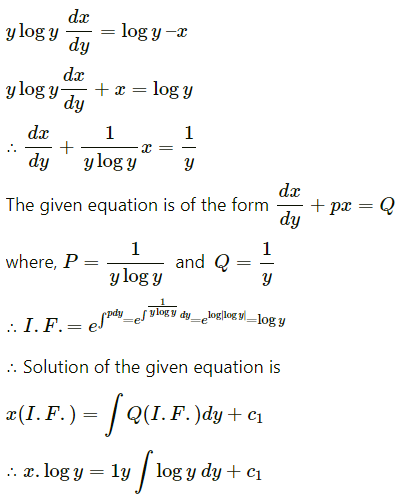
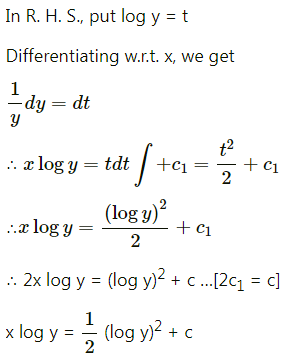
Solve y log y + x – log y = 0.
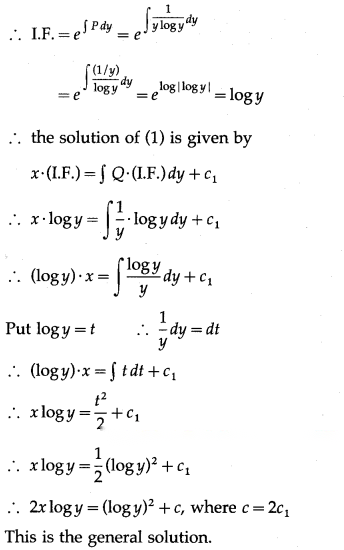
Solution & Step-by-Step Answer:

Question 7 Maharashtra Board Solution
Solve (x + y) dy = a2 dx
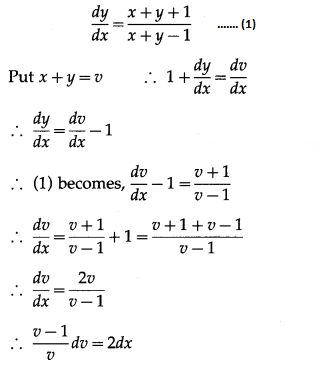
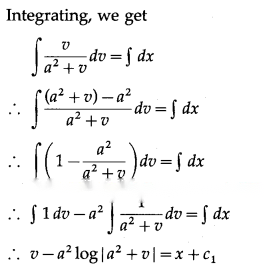
Solution & Step-by-Step Answer:

Question 8 Maharashtra Board Solution
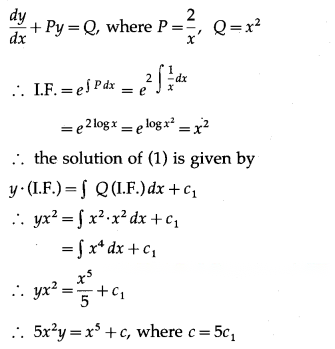
Solve
Solution & Step-by-Step Answer:
……..(1) This is a linear differential equation of the form This is the general solution.
Question 9 Maharashtra Board Solution
The rate of growth of the population is proportional to the number present. If the population doubled in the last 25 years and the present population is 1 lakh, when will the city have a population of 400000?
Solution & Step-by-Step Answer:
Let P be the population at time t years. Then the rate of growth of the population is which is proportional to P. ∴ ∝ P ∴ = kP, where k is a constant ∴ = k dt On integrating, we get ∴ log P = kt + c The population doubled in 25 years and present population is 1,00,000. ∴ initial population was 50,000 i.e. when t = 0, P = 50000 ∴ log 50000 = k × 0 + c ∴ c = log 50000 ∴ log P = kt + log 50000 When t = 25, P = 100000 ∴ log 100000 = k × 25 + log 50000 ∴ 25k = log 100000 – log 50000 = log() ∴ k = log 2 ∴ log P = log 2 + log 50000 If P = 400000, then log 400000 = log 2 + log 50000 ∴ log 400000 – log 50000 = log 2 ∴ log() = ∴ log 8 = ∴ 8 = ∴ = (2)3 ∴ = 3 ∴ t = 75 ∴ the population will be 400000 in (75 – 25) = 50 years.
Question 10 Maharashtra Board Solution
The resale value of a machine decreases over a 10 years period at a rate that depends on the age of the machine. When the machine is x years old, the rate at which its value is changing is ₹ 2200(x – 10) per year. Express the value of the machine as a function of its age and initial value. If the machine was originally worth ₹ 1,20,000 how much will it be worth when it is 10 years old?
Solution & Step-by-Step Answer:
Let V be the value of the machine after x years. Then rate of change of the value is which is 2200(x – 10) ∴ = 2200(x – 10) ∴ dV = 2200(x – 10) dx On integrating, we get ∫dV = 2200∫(x – 10) dx ∴ V = 2200[ – 10x] + c Initially, i.e. at x = 0, V = 120000 ∴ 120000 = 2200 × 0 + c = c ∴ c = 120000 ∴ V = 2200[ – 10x] + 120000 …….(1) This gives value of the machine in terms of initial value and age x. We have to find V when x = 10. When x = 10, from (1) V = 2200[ – 100] + 120000 = 2200 [-50] + 120000 = -110000 + 120000 = 10000 Hence, the value of the machine after 10 years will be ₹ 10000.
Question 11 Maharashtra Board Solution
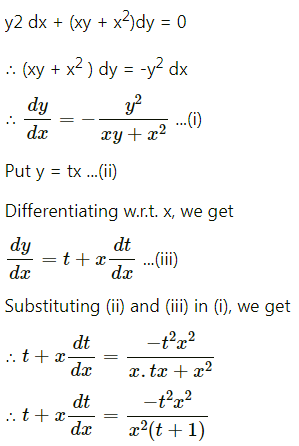
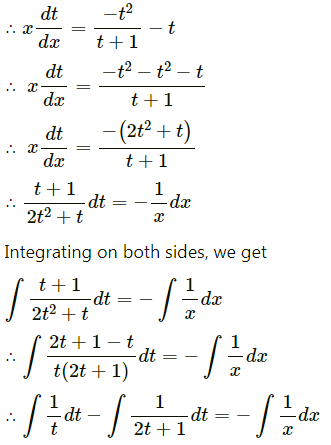
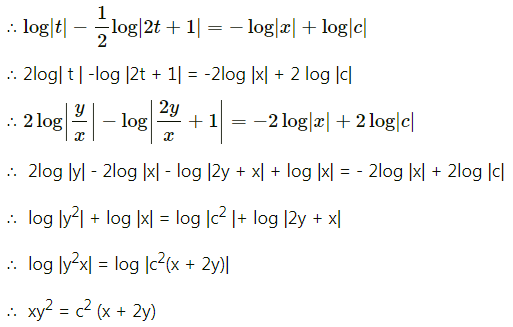
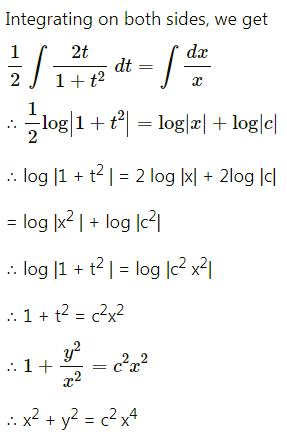
Solve y2 dx + (xy + x2) dy = 0
Solution & Step-by-Step Answer:

Question 12 Maharashtra Board Solution
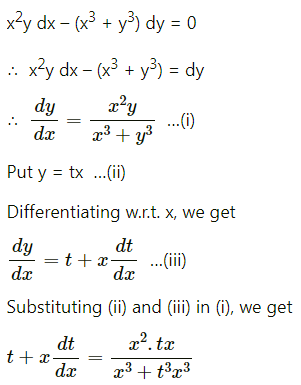
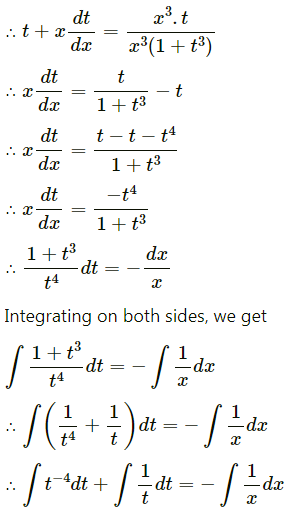
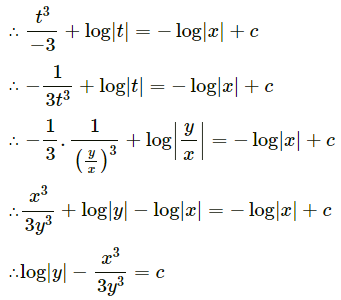
Solve x2y dx – (x3 + y3) dy = 0
Solution & Step-by-Step Answer:

Question 13 Maharashtra Board Solution
Solve yx = x2 + 2y2
Solution & Step-by-Step Answer:

Question 14 Maharashtra Board Solution
Solve (x + 2y3) = y
Solution & Step-by-Step Answer:
(x + 2y3) = y ∴ x + 2y3 = y This is the general solution.

Question 15 Maharashtra Board Solution
Solve y dx – x dy + log x dx = 0
Solution & Step-by-Step Answer:
y dx – x dy + log x dx = 0 ∴ (y + log x) dx = x dy This is the general solution.
Question 16 Maharashtra Board Solution
Solve = log x dx
Solution & Step-by-Step Answer:
= log x dx ∴ dy = log x dx On integrating, we get ∫dy = ∫log x. 1 dx ∴ y = (log x) ∫1 dx – ∴ y = (log x). x – ∴ y = x log x – ∫1 dx ∴ y = x log x – x + c This is the general solution.
Question 17 Maharashtra Board Solution
y log y = log y – x
Solution & Step-by-Step Answer: