Maharashtra State Board Class 12 Economics Solutions Chapter 6 Index Numbers
1. Choose the correct option:
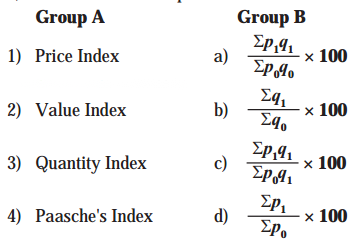
2. Complete the Correlation:
1) Price Index: Inflation :: ………………. : Agricultural production
2) ……………….: Base year prices :: P1: Current year prices
3) Laaspeyre’s index : ………………. :: Paasches index : Current year quantities
4) ……………….: Single variable :: Composite index: Group of variables
Answers:
3. Solve the following:
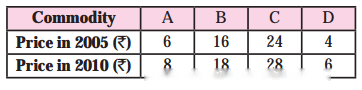
Commodity | Base Year price 2005 (P0) | Current Year price 2006 |
A | 6 | 8 |
B | 16 | 18 |
C | 24 | 28 |
D | 4 | 6 |
Total | Σp0= 50 | Σp1= 60 |
Steps:
Add the price of base year (p0)
Add the price of current year (p1)
P01= x 100
= x 100
= 120
Hence P01= 120
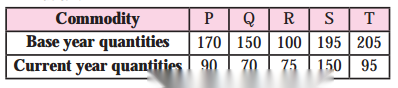
Commodity | Base Year Qty.(q0) | Current Year Qty. (p1) |
P | 170 | 90 |
Q | 150 | 70 |
R | 100 | 75 |
S | 195 | 150 |
T | 205 | 95 |
Total | Σp0= 820 | Σp1= 480 |
Steps : Add quantities of base year (q0).
Add quantities of current year (q ).
Q01= x 100
= x 100
= 58.53
Hence, Q01= 58.53
As quantity in the current year has fallen Q01is less than loo.
4. Distinguish between:
Simple Index Number | Weighted Index Number |
(a) Simple index number is a simple average of index number of individual goods. | (a) Weighted index number is a weighted average of products after assigning suitable weights to individual goods. |
(b) It is easy to calculate. | (b) It is difficult to calculate. |
(c) All commodities are given equal importance. | (c) All commodities are given different levels of importance. |
(d) It gives rough estimates of price change | (d) It gives an accurate estimate of price change. |
(e) It is less used in practice. | (e) It is mostly used in practice. |
Price Index Number | Quantity Index Number |
(a) Price index number measures the changes in price over a period of time. | (a) Quantity index number measures the changes in quantity over a period of time. |
(b) It can be used for measuring the changes in prices as well as other purpose e.g. in fixing wages, interest rates, tax rates, etc. | (b) It can be used only for measuring the changes in the quantities e.g. of items like exports, imports, etc. |
(c) It is a very popular concept and can be easily calculated and understood. | (c) It is not so popular as it cannot be easily calculated. |
Laspeyre’s Index Number | Paasche’s Index Number |
(a) Laspeyre uses base year quantity (Q0) as weights to calculate index numbers. | (a) Paasche uses current year quantity (Qt) as weights to calculate index number. |
(b) He gave this formula P01= [where P01= Price index numberp0= Price of the base year | (b) He gave this formula = P01= [where P01= Price index numberp0= Price of the base year |
(c) He is a German Economist who gave the method of calculating Index Number in the year 1871.. | (c) He is a German Statistician who devised the method of calculating Index Number in the year 1874. |
5. State with reasons whether you agree or disagree with the following statements:
6. Answer the following:
(1) Help in formulating Policies : Index numbers help the government and business organisations in framing their suitable economic policies for agriculture and industrial sector, wage and dearness allowance policies, etc.
(2) Help in the study of Trends and Tendencies : Index numbers study the relative changes in the level of phenomenon of different periods of time, so they can be used to predict future events. The economists can study the general trends of changes in price levels, agricultural and industrial production, export, imports, etc.
(3) Economic Barometer : Just as barometer is used to measure atmospheric pressure, index numbers measure the level of economic and business behaviour. They are very important for an economist, businessman, planners, policy makers, etc.
(4) Helps in Measurement of Inflation :
It helps the government to take measures against inflation by giving additional D.A. to the employees on the basis of Dearness Index.
(5) Help to adjust National Income : By comparing current year’s national product prices with the base year’s prices, the Domestic Product (GDP) produced. Hence, this shows changes in real national income.
(6) To present Financial Data in Real Income : Index numbers are used to adjust price change, wage change, etc. Thus deflating helps to present the financial data at constant prices.
(Note: Deflating means to make adjustments in the original data)
(7) Helps in determining Depreciation
Cost: The price index helps in determining the depreciation cost of durable goods. At the time of inflation, it is useful to know the original cost of the commodities.
7. Answer in detail:
2. Selection of a Base Year : It is important to select a base year against which comparisons are made. So base year or reference year should be
(i) a recent year and not a distant past.
(ii) it should be normal and free from natural calamities, war, etc.
3. Selection of Commodities: When the cost c of living index number of the middle class jj families is to be constructed, the items that are used by middle class families in everyday life should be included and items like big cars, AC’s, etc. should not be included.
4. Selection of Prices : Prices differ from city to city and even from shop to shop in the same city. Hence, we should take a few standard shops from where middle class families buy goods and take the average of the prices of goods sold by them. Otherwise index number
constructed may be misleading.
5. Selection of suitable Average : An ; index number is a special kind of average, Generally arithmetic mean is commonly ? used for construction of index number as it is simple to calculate.
6. Selection of Formula : Number of formulae can be used for construction, of index numbers. Economists have to decide which formula to use for the construction of a particular index number.
7. Assigning proper Weights : Weights refer to the relative importance of different items in the construction of an index number. ( Weights may either be quantity weights (q) or value weights (p). All weights may not be equally important. Therefore, by s assigning specific weights better result can be obtained.
Index Questions
Find out (Textbook Page 58) :
(a) List of crops included in the Index of Agricultural Production in India.
Answer:
Food grains : Rice, Wheat, Jowar, Bajra, Maize, Ragi, Barley and Small Millets. Gram, Tur and other pulses.
Fibres: Cotton, Jute, Mesta and Sannhemp.
Non-food grains : Oilseeds Groundnut, Sesame, Rapeseed and Mustard, Linseed, Castorseed, Safflower, Nigerseed, Soyabean, Sunflower, Coconut and Cottonseed.
Plantation crops: Tea, Coffee and Rubber.
Condiments and Spices : Pepper, Ginger, Garlic, Chillies, Turmeric, Arecanut, Coriander and Cardamom.
Fruits and Vegetables : Potato, Onion, Banana, Cashewnut, Tapioca and Sweet Potato.
Other Crops : Sugarcane, Tobacco and Guarseed.
(b) List of products included in the Index j of Industrial Production in India.
Answer:
Index of Industrial Production in ; India includes – Consumer Durable goods, Consumer non-durable goods, manufacturing goods, mining, electricity, infrastructure or construction goods, etc.
Find out (Textbook Page 59) :
Newspaper headlines related to the following types of index numbers :
(a) Price Index
(b) Agricultural Productivity Index
(c) Index of Industrial Production
(d) Equity Share Price Index
Answer:
[Students should do this activity by themselves.]