BalbhartiYuvakbharati English 12th DigestChapter 1.7 Why We Travel Notes, Textbook Exercise Important Questions and Answers.
Maharashtra State Board Class 12 English Yuvakbharati Solutions Chapter 1.7 Why We Travel
12th English Digest Chapter 1.7 Why We Travel Textbook Questions and Answers

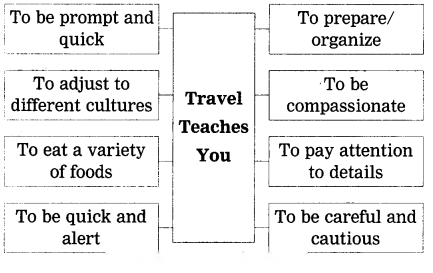


(A1)
(A2)
Question (i)
Read the sentence ‘If a diploma can famously ……………. in cultural relativism.’ of this extract on page 67 of the textbook. Pick the sentence which gives the meaning of the above statement from the alternatives given below.
(a) A diploma certificate can be used as a passport and a passport can be used as a diploma certificate.
(b) If one has a diploma, he does not need a passport and if he has a passport, he does not need a diploma.
(c) One can acquire permission to travel to foreign countries for educational purposes based on one’s academic achievements, and travelling to foreign countries enriches one the most regarding the knowledge and wisdom of the world.
Answer:
(c) One can acquire permission to travel to foreign countries for educational purposes based on one’s academic achievements, and travelling to foreign countries enriches one the most regarding the knowledge and wisdom of the world.
Question (ii)
Prepare a list of the litterateurs and their quotations mentioned by the writer in the extract.
Answer:
Names of the litterateurs: Camus, Christopher Isherwood
Quotations: Camus said, “What gives value to travel is fear”- Christopher Isherwood once said, “The ideal travel book should be perhaps a little like a crime story in which you’re in search of something.”
Question (iii)
‘The real voyage of discovery consists not in seeing new places but in seeing with new eyes.’ – Marcel Proust. Justify with the help of the text.
Answer:
This means that we don’t really have to discover new landscapes or new sights to be in the real process of discovery. Often, we simply need to change our perspective, the way we look at things, to understand them and to raise them to a new, exhilarating level.
Question (iv)
Read the third paragraph and find the difference between a tourist and a traveller as revealed through the complaints made by them.
Answer:
1. A tourist is someone who does not leave his assumptions at home and complains, ‘Nothing here is the way it is at home’.
2. A traveller is someone who leaves his assumptions at home but grumbles, ‘Everything here is the same as it is in Cairo – or Cuzco or Kathmandu.’
Question (v)
Write sentences from the extract conveying the fact that travelling brings together the various cultures of the different parts of the world.
Answer:
1. You can teach them what they have to celebrate as much as you celebrate what they have to teach.
2. This, I think, is how tourism, which so obviously destroys cultures, can also resuscitate or revive them, how it has created new “traditional” dances in Bali, and caused craftsmen in India to pay s new attention to their works.
Question (vi)
By quoting Camus, the writer has stated that travelling emancipates us from circumstances and all the habits behind which we hide. Write in detail your views about that.
Answer:
When we are at home, we have set ideas and habits, which we are reluctant to change. We dress in a particular way and we behave in a particular way, because the people around us know us and expect that behaviour. We hide behind all this. However, when we travel, no one knows us and there are no expectations about a particular type of behaviour, dress or habits. Hence, we have a feeling of freedom and emancipation from our circumstances and habits.
(A3)
Question (i)
Read the following groups of words:

Discuss in pairs and make a list of some more adjectives like this and make sentences using them.
Answer:
1. burnt cottage
2. disturbed night
3. hidden house
4. missing necklace
5. probing questions
6. standing instructions
Sentences:
1. burnt cottage – The mystery of the burnt cottage was finally solved.
2. disturbed night – Rohan had a disturbed night because of the noise from the road construction.
3. hidden house – I could see the hidden house only after climbing a hill.
4. missing necklace – The detective was sure that the missing necklace would be soon found.
5. probing questions – The lawyer asked the witness some probing questions.
6. standing instructions – The queen had given standing instructions that she was never to be disturbed while sleeping.
(A4)
Question (ii)
Combine the two sentences into one using the word given in the brackets:
(a) I go to Iceland. I visit the lunar spaces within me. (to)
(b) We have the opportunity. We come into contact with more essential parts of ourselves, (of)
(c) Romantic poets inaugurated an era of travel. They were great apostles of open eyes.
(d) The travel spins us around. It shows us the sights and values ordinarily ignored, (showing)
Answer:
(a) I go to Iceland to visit the lunar spaces within me.
(b) We have the opportunity of coming into contact with more essential parts of ourselves.
(c) Romantic poets, being great apostles of open eyes, inaugurated an era of travel.
(d) The travel spins us around, showing us the sights and values ordinarily ignored.
Question (iii)
Read the sentences given below and state whether the underlined words are gerunds or present participles.
(a) As it’s a hot day, many people are swimming
(b) This is a swimming pool.
(c) It’s very bad that children are begging.
(d) Begging is a curse on humanity.
Answer:
(a) present participle
(b) present participle
(c) present participle
(d) gerund
(A5)
(A6)
Question 1
Maharashtra Board Solution
There is a boom in ‘Travel and Tourism’ career. Find information about different options in this field. |
(A7)
Question (i)
Find information about:
(a) Fa Hien
(b) Huen Tsang
(c) Ibn Batuta
(d) Marco Polo
(e) Sir Richard Burton
Question (ii)
Further reading:
Yuvakbharati English 12th Digest Chapter 1.7 Why We Travel Additional Important Questions and
Read the extract and complete the activities given below:
Global Understanding:
Question 1
Maharashtra Board Solution
Write the name of the litterateur and his quotation mentioned by the writer in the extract.
Solution & Step-by-Step Answer:
block bg-white dark:bg-slate-900/80 border-l-4 border-emerald-500 rounded-r-xl p-5 my-3 shadow-xs border border-slate-200/60 dark:border-slate-800">
Solution & Step-by-Step Answer:
Name of the litterateur – George Santayana. Quotation: George Santayana writes, “We need sometimes to escape into open solitudes, into aimlessness, into the moral holiday of running some pure hazard, in order to sharpen the edge of life, to taste hardship, and to be compelled to work desperately for a moment at no matter what.”
Question 2
Maharashtra Board Solution
Based on the extract, complete the web: (The answers are given directly and underlined.)
Solution & Step-by-Step Answer:
Question 3
Maharashtra Board Solution
From the extract, write the names of:
Solution & Step-by-Step Answer:
1. 2 litterateurs : Proust, Hazlitt 2. 2 places : Bali, Tibet
Question 4
Maharashtra Board Solution
Pick out the false statements and write them correctly : 1. Holidays help you to appreciate your own home more. 2. Tourism can also revive cultures. 3. The writer spent many days in Bali in temples. 4. The writer finds Iceland full of chatter and routine.
Solution & Step-by-Step Answer:
False statements: 3. The writer spent many days in Bali in temples. 4. The writer finds Iceland full of chatter and routine.
Corrected statements:
Question 5
Maharashtra Board Solution
Write the name of the litterateur and his quotation mentioned by the writer in the extract.
Solution & Step-by-Step Answer:
Name of the litterateur – Oliver Cromwell Quotation : “A man never goes so far as when he doesn’t know where he is going.”
Question 6
Maharashtra Board Solution
Write if the following statements are True or False. Correct the false statements : 1. The posters at McDonald’s outlet in Kyoto have pictures of places in San Francisco. 2. The young people in Kyoto McDonald’s outlet look very American. 3. The writer was born in America. 4. Cities like Sydney and Toronto are a mix of many cultures. True statements: 1. The posters at McDonald’s outlet in Kyoto have pictures of places in San Francisco. 4. Cities like Sydney and Toronto are a mix of many cultures. |

False statements:
2. The young people in Kyoto McDonald’s outlet look very American.
3. The writer was born in America.
Corrected statements:
2. The young people in Kyoto McDonald’s outlet look very Japanese.
3. The writer was born in England.
Question 7
Maharashtra Board Solution
Write from the extract:
Solution & Step-by-Step Answer:
block bg-white dark:bg-slate-900/80 border-l-4 border-emerald-500 rounded-r-xl p-5 my-3 shadow-xs border border-slate-200/60 dark:border-slate-800">
Solution & Step-by-Step Answer:
1. Names of 4 cities: Kyoto, Toronto, Sydney, Addis Ababa 2. Names of two food items: Teriyaki McBurgers, Bacon Potato Pies.
Question 8
Maharashtra Board Solution
Write the name of the litterateurs and their quotations mentioned by the writer in the extract.
Solution & Step-by-Step Answer:
Names of the litterateurs: Sir John Mandeville, Emerson, Thoreau and Sir Thomas Browne. Quotations: Emerson said, “Travelling is a fool’s paradise.” Thoreau said, “I have travelled a good deal in Concord.” Sir Thomas Browne sagely put it, “We carry within us the wonders we seek without us. There is Africa and her prodigies in us.”
Complex Factual:
Question 1
Maharashtra Board Solution
Write sentences from the extract conveying the fact that travelling brings together the various cultures of the different parts of the world :
Solution & Step-by-Step Answer:
1. We can become a kind of carrier pigeon in transporting back and forth what every culture needs. 2. I find that I always take Michael Jordan posters to Kyoto, and bring woven ikebana baskets back to California. 3. We become walking video screens and living newspapers, the only channels that can take people out of the censored limits of their homelands. 4. In closed or impoverished places, like Pagan or Lhasa or Havana, we are the eyes and ears of the people we meet, their only contact with the world outside and, very often, the closest, quite literally, they will ever come to Michael Jackson or Bill Clinton. 5. Not the least of the challenges of travel, therefore, is learning how to import – and export – dreams with tenderness. 6. We carry values and beliefs and news to the places we go.
Question 2
Maharashtra Board Solution
Complete the following: Travel spins us round in two ways at once:
Solution & Step-by-Step Answer:
Travel spins us round in two ways at once: It shows us the sights and values and issues that we might ordinarily ignore. It also shows us all the parts of ourselves that might otherwise grow rusty. For in travelling to a truly foreign place, we inevitably travel to moods and states of mind that we’d otherwise ignore.
Question 3
Maharashtra Board Solution
Write sentences from the extract conveying the fact that travelling brings together the various cultures of the different parts of the world.
Solution & Step-by-Step Answer:
1. For when we go to France, we often migrate to French, and the more childlike self, simple and polite, that speaking a foreign language educes. 2. Even when I’m not speaking pidgin English in Hanoi, I’m simplified in a positive way, and concerned not with expressing myself, but simply making sense.
Question 4
Maharashtra Board Solution
Write sentences from the extract conveying the fact that travelling brings together the various cultures of the different parts of the world.
Solution & Step-by-Step Answer:
1. When we go abroad we are objects of scrutiny as much as the people we scrutinize, and we are being consumed by the cultures we consume, as much on the road as when we are at home. 2. At the very least, we are objects of speculation (and even desire), who can seem as exotic to the people around us as they do to us.
Question 5
Maharashtra Board Solution
Write the sentences from the extract conveying the fact that travelling brings together the various cultures of the different parts of the world.
Solution & Step-by-Step Answer:
1. When you go to a McDonald’s outlet in Kyoto, you will find Teriyaki McBurgers and Bacon Potato Pies. 2. The placemats offer maps of the great temples of the city, and the posters all around broadcast the wonders of San Francisco. 3. And-most crucial of all-the young people eating their Big Macs, with baseball caps worn backwards, and tight 501 jeans, are still utterly and inalienably Japanese in the way they move, they nod, they sip their Oolong teas – and never to be mistaken for the patrons of a McDonald’s outlet in Rio, Morocco or Managua. 4. These days a whole new realm of exotica arises out of the way one culture colours and appropriates the products of another, 5. The other factor complicating and exciting all of this is people, who are, more and more, themselves as many-tongued and mongrel as cities like Sydney or Toronto or Hong Kong. 6. Besides, even those who don’t move around the world find the world moving more and more around them. Walk just six blocks, in Queens or Berkeley, and you’re travelling through several cultures in as many minutes; get into a cab outside the White House, and you’re often in a piece of Addis Ababa.
Question 6
Maharashtra Board Solution
Complete the following:
Solution & Step-by-Step Answer:
1. Travel is a voyage into the imagination and is the conspiracy of perception and imagination. 2. Sir John Mandeville never visited the Far East but yet gave colourful accounts of it. 3. Emerson and Thoreau insist that reality is our creation and we invent the places we see as much as we do the books we read.
Question 7
Maharashtra Board Solution
Complete the following, giving examples: (The answer is given directly.) The finest recent travel books are those that:
Solution & Step-by-Step Answer:
1. undertake a parallel journey, matching the physical steps of a pilgrimage with the metaphysical steps of a questioning e.g. in Peter Matthiessen’s great “The Snow Leopard”. 2. chronicle a trip to the farthest reaches of human strangeness e.g. Oliver Sacks’ “Island of the Color-Blind,” which features a journey not just to a remote atoll in the Pacific, but to a realm where people actually see light differently).
Inference/Interpretation/Analysis:
Question 1
Maharashtra Board Solution
Guess the difference : travel and travail:
Solution & Step-by-Step Answer:
Travel guides us towards a better balance of wisdom and compassion, of seeing the world clearly and truly. Travail means agony, or hard toil, which will be the result of laborious travelling and hardships.
Question 2
Maharashtra Board Solution
Describe the changes that come into us because of travels, especially to foreign countries.
Solution & Step-by-Step Answer:
When we go abroad, we stay up late, do impulsive things and leave ourselves open to various experiences. We live for the moment, without any past or future; only the present. We may even become mysterious-to others, at first, and sometimes even to ourselves, behaving in new ways. We feel younger, as if we have been reborn.
Question 3
Maharashtra Board Solution
Explain in your own words how travel can be a kind of ‘monasticism’.
Solution & Step-by-Step Answer:
‘Monasticism’ means living like monks, living a self-disciplined life that is isolated from other people. When we travel, even if we are living in a luxury hotel, we live more simply than we normally do at home. We have no more possessions than what we can carry, we surrender ourselves to chance, and to whatever may come in our way. Hence, travel can be a kind of ‘monasticism’.
Question 4
Maharashtra Board Solution
Travelling abroad make us the object of scrutiny. Justify this statement,
Solution & Step-by-Step Answer:
When we go abroad, the local people there are curious about us and our culture. We seem exotic and different to them and they scrutinize our ways and behaviour to learn and understand more about us.
Question 5
Maharashtra Board Solution
The writer calls himself ‘many-tongued’ and ‘mongrel’. Give reasons.
Solution & Step-by-Step Answer:
‘Many-tongued’ means that he knows many languages; ‘mongrel’ here means someone who has a mixed upbringing, someone of mixed cultures. The writer knows many languages. He was born of Indian parents, in England, and he moved to America when he was 7 years old. Hence, he says that he cannot really call himself an Indian, an American or an Englishman.
Question 6
Maharashtra Board Solution
‘Get into a cab outside the White House, and you’re often in a piece of Addis Ababa.’ Explain the meaning of this sentence.
Solution & Step-by-Step Answer:
Addis Ababa is the capital of Ethiopia, Africa. The sentence means that the driver of the cab outside the White House was probably an African American, may be originally from Africa.
Question 7
Maharashtra Board Solution
“We carry within us the wonders we seek without us.” Explain.
Solution & Step-by-Step Answer:
This means that all the wonders and emotions are within us, and if we wish to, we can tap these forces. Everything is within our own hearts and imagination. Everything is internal. Whatever we find outside has first to be inside us for us to experience it. There is no necessity for any separate outside happenings for us to feel anything.
Personal Response:
Question 1
Maharashtra Board Solution
Name the places you would like to visit the most. Give reasons to support your
Solution & Step-by-Step Answer:
Answer: I like to travel but I have not had much opportunity yet. I love seeing new places and meeting new people. I would love to travel to the North-Eastern parts of India and to foreign countries. I am also a nature lover and would love seeing high mountains, clear lakes and green pastures.
Question 2
Maharashtra Board Solution
‘Travel helps you to appreciate your own home more’. Justify this statement.
Solution & Step-by-Step Answer:
Holidays, especially holidays abroad, can certainly help us to appreciate our own homes more. For example, if we go to the African desert and see the problems they have with potable water supply, we will appreciate our own water resources more. If we see the problems faced by people living in very cold climates, we will appreciate the heat in our country, and even be grateful for it.
Question 3
Maharashtra Board Solution
Do you think that people travel more, or in a different way, as compared to people fifty years back? Explain your view.
Solution & Step-by-Step Answer:
Yes, people certainly travel more today. They also travel for different reasons. Fifty years back, in India, people generally travelled only for religious reasons or to meet relatives and family. Travelling for sightseeing was rarer. Today, in addition to these reasons, people also travel for fun, relaxation and sight-seeing. People also go on holidays abroad, which was not done often earlier.
Question 4
Maharashtra Board Solution
Do you think that we must always seek new experiences and new places? Or do you feel that the best place is home, and we must never move?
Solution & Step-by-Step Answer:
If we just stick to our own homes, we will be like the frog in the pond, which thought its small pond was the whole world. This is not advisable in the world of today. To be happy and successful, we must be broad-minded and unbiased. We must see what the world and other cultures have to offer. We must try to imbibe the best from other cultures and places.
Language Study:
Question 1
Maharashtra Board Solution
We carry values and beliefs and news to the places we go. (Rewrite using ‘not only but also.)
Solution & Step-by-Step Answer:
We carry not only values and beliefs but also news to the places we go.
Question 2
Maharashtra Board Solution
Travel is the best way we have of rescuing the humanity of places. (Use an infinitive in place of the gerund.)
Solution & Step-by-Step Answer:
Travel is the best way we have to rescue the humanity of places.
Question 3
Maharashtra Board Solution
The beauty of this process was best described by George Santayana. (Rewrite beginning George Santayana)
Solution & Step-by-Step Answer:
George Santayana best described the beauty of this process.
Question 4
Maharashtra Board Solution
Yet for me the first great joy of travelling is simply the luxury of leaving all my beliefs and certainties at home. (Pick out the finite verb and say whether the sentence is simple, compound or complex.)
Solution & Step-by-Step Answer:
finite verb-is; simple sentence
Question 5
Maharashtra Board Solution
Pick out the phrasal verb from this sentence: Abroad is the place where we stay up late.
Solution & Step-by-Step Answer:
stay up
Question 6
Maharashtra Board Solution
Travelling is a way to reverse time. (Identify the part of speech of the underlined word.)
Solution & Step-by-Step Answer:
travelling – gerund
Question 7
Maharashtra Board Solution
I tend to believe more abroad than I do at home. (Rewrite using as….as..)
Solution & Step-by-Step Answer:
I tend not to believe as much at home as I do abroad.
Question 8
Maharashtra Board Solution
Pick out the phrasal verb from these sentences:
Solution & Step-by-Step Answer:
1. I remember, in fact, after my first trip to Southeast Asia, more than a decade ago, how I would come back to my apartment in New York. 2. All, in that sense, believed in, “being moved” Answer: 1. come back 2. believed in
Question 9
Maharashtra Board Solution
Anyone witnessing this strange scene would have drawn the right conclusion. (Rewrite using ‘who’)
Solution & Step-by-Step Answer:
Anyone who witnessed this strange scene would have drawn the right conclusion.
Question 10
Maharashtra Board Solution
I remember how I would come back to my apartment in New York. (Rewrite using ‘used, to’.)
Solution & Step-by-Step Answer:
I remember how I used to come back to my apartment in New York.
Question 11
Maharashtra Board Solution
We have to carry our sense of destination. (Rewrite beginning‘Our sense….’)
Solution & Step-by-Step Answer:
Our sense of destination has to be carried by us.
Question 12
Maharashtra Board Solution
The most valuable Pacifies we explore will always be the vast expanses within us. (Rewrite using more…than..)
Solution & Step-by-Step Answer:
We will never explore more valuable Pacifies than the vast expanses within us.
Question 13
Maharashtra Board Solution
It keeps the mind nimble. (Rewrite using the present perfect tense of the verb.)
Solution & Step-by-Step Answer:
It has kept the mind nimble.
Vocabulary:
Question 1
Maharashtra Board Solution
Guess the meaning: riches are differently dispersed
Solution & Step-by-Step Answer:
cultures that are rich in ways different from ours.
Question 2
Maharashtra Board Solution
Find out a past/present participle from the extract that has been used as an adjective :
Solution & Step-by-Step Answer:
crooked angle (crooked-past participle)
Question 3
Maharashtra Board Solution
Find out two pairs of antonyms from the extract:
Solution & Step-by-Step Answer:
1. lose × find 2. ignorance × knowledge
Question 4
Maharashtra Board Solution
Guess the difference between provisional and provincial.
Solution & Step-by-Step Answer:
Provisional means temporary, whereas provincial means limited in outlook narrow.
Question 5
Maharashtra Board Solution
Find out from the extract a few past / present participles that have been used as adjectives: 1. walking video screens 2. censored limits 3. living newspapers 4. impoverished places
Solution & Step-by-Step Answer:
censored, impoverished – past participles used as adjectives walking, living – present participles used as adjectives
Question 6
Maharashtra Board Solution
Pick out four proper nouns for places from the extract.
Solution & Step-by-Step Answer:
Kyoto, Pagan, Lhasa, Havana.
Question 7
Maharashtra Board Solution
Find from the extract one word for the following : 1. A Japanese art of flower arrangement 2. Satisfaction of one with oneself or one’s own achievements.
Solution & Step-by-Step Answer:
1. ikebana 2. complacencies
Question 8
Maharashtra Board Solution
Complete the table with the words given in the brackets: (values celebrate now deeply discovery apprehend wonderfully distant quietude foreign appreciative spins)
Solution & Step-by-Step Answer:
Question 9
Maharashtra Board Solution
Find out a past/present participle from the extract that has been used as an adjective:
Solution & Step-by-Step Answer:
searching questions (searching – present participle)
Question 10
Maharashtra Board Solution
Discuss the pun implied by the writer, ecstasy (ex-stasis):
Solution & Step-by-Step Answer:
ecstasy – great joy. ex-stasis – previous period of inactivity or boredom. The words sound alike but have different meanings.
Question 11
Maharashtra Board Solution
Guess the meaning: |