Balbharti12th Maharashtra State Board Maths Solutions BookPdf Chapter 4 Pair of Straight Lines Miscellaneous Exercise 4 Questions and Answers.
Maharashtra State Board 12th Maths Solutions Chapter 4 Pair of Straight Lines Miscellaneous Exercise 4
I : Choose correct alternatives.
Question 1.
If the equation 4x2+ hxy + y2= 0 represents two coincident lines, then h = _________.
(A) ± 2
(B) ± 3
(C) ± 4
(D) ± 5
Solution:
(C) ± 4
II. Solve the following.
Question 1.
Find the joint equation of lines:
(i) x – y = 0 and x + y = 0
Solution:
The joint equation of the lines x – y = 0 and
x + y = 0 is
(x – y)(x + y) = 0
∴ x2– y2= 0.
(ii) x + y – 3 = 0 and 2x + y – 1 = 0
Solution:
The joint equation of the lines x + y – 3 = 0 and 2x + y – 1 = 0 is
(x + y – 3)(2x + y – 1) = 0
∴ 2x2+ xy – x + 2xy + y2– y – 6x – 3y + 3 = 0
∴ 2x2+ 3xy + y2– 7x – 4y + 3 = 0.
(iii) Passing through the origin and having slopes 2 and 3.
Solution:
We know that the equation of the line passing through the origin and having slope m is y = mx. Equations of the lines passing through the origin and having slopes 2 and 3 are y = 2x and y = 3x respectively.
i.e. their equations are
2x – y = 0 and 3x – y = 0 respectively.
∴ their joint equation is (2x – y)(3x – y) = 0
∴ 6x2– 2xy – 3xy + y2= 0
∴ 6x2– 5xy + y2= 0.
(iv) Passing through the origin and having inclinations 60° and 120°.
Solution:
Slope of the line having inclination θ is tan θ.
Inclinations of the given lines are 60° and 120°
∴ their slopes are m1= tan60° = and
m2= tan 120° = tan (180° – 60°)
= -tan 60° = –
Since the lines pass through the origin, their equa-tions are
y = x and y= –x
i.e., x – y = 0 and x + y = 0
∴ the joint equation of these lines is
(x – y)(x + y) = 0
∴ 3x2– y2= 0.
(v) Passing through (1, 2) amd parallel to the co-ordinate axes.
Solution:
Equations of the coordinate axes are x = 0 and y = 0
∴ the equations of the lines passing through (1, 2) and parallel to the coordinate axes are x = 1 and y =1
i.e. x – 1 = 0 and y – 2 0
∴ their combined equation is
(x – 1)(y – 2) = 0
∴ x(y – 2) – 1(y – 2) = 0
∴ xy – 2x – y + 2 = 0
(vi) Passing through (3, 2) and parallel to the line x = 2 and y = 3.
Solution:
Equations of the lines passing through (3, 2) and parallel to the lines x = 2 and y = 3 are x = 3 and y = 2.
i.e. x – 3 = 0 and y – 2 = 0
∴ their joint equation is
(x – 3)(y – 2) = 0
∴ xy – 2x – 3y + 6 = 0.
(vii) Passing through (-1, 2) and perpendicular to the lines x + 2y + 3 = 0 and 3x – 4y – 5 = 0.
Solution:
Let L1and L2be the lines passing through the origin and perpendicular to the lines x + 2y + 3 = 0 and 3x – 4y – 5 = 0 respectively.
Slopes of the lines x + 2y + 3 = 0 and 3x – 4y – 5 = 0 are and respectively.
∴ slopes of the lines L1and L2are 2 and respectively.
Since the lines L1and L2pass through the point (-1, 2), their equations are
∴ (y – y1) = m(x – x1)
∴ (y – 2) = 2(x + 1)
⇒ y – 1 = 2x + 2
⇒ 2x – y + 4 = 0 and
∴ (y – 2) = (x + 1)
⇒ 3y – 6 = (-4)(x + 1)
⇒ 3y – 6 = -4x + 4
⇒ 4x + 3y – 6 + 4 = 0
⇒ 4x + 3y – 2 = 0
their combined equation is
∴ (2x – y + 4)(4x + 3y – 2) = 0
∴ 8x2+ 6xy – 4x – 4xy – 3y2+ 2y + 16x + 12y – 8 = 0
∴ 8x2+ 2xy + 12x – 3y2+ 14y – 8 = 0
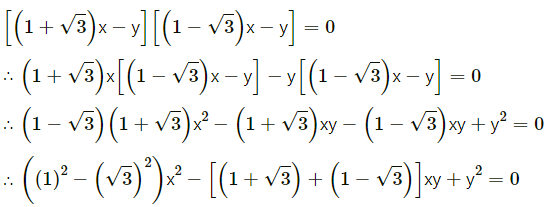
(viii) Passing through the origin and having slopes 1 + and 1 –
Solution:
Let l1and l2be the two lines. Slopes of l1is 1 + and that of l2is 1 –
Therefore the equation of a line (l1) passing through the origin and having slope is
y = (1 + )x
∴ (1 + )x – y = 0..(1)
Similarly, the equation of the line (l2) passing through the origin and having slope is
y = (1 – )x
∴ (1 – )x – y = 0 …(2)
From (1) and (2) the required combined equation is
∴ (1 – 3)x2– 2xy + y2= 0
∴ -2x2– 2xy + y2= 0
∴ 2x2+ 2xy – y2= 0
This is the required combined equation.
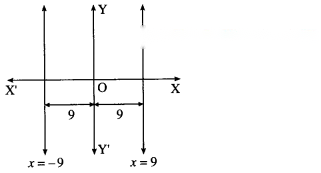
(ix) Which are at a distance of 9 units from the Y – axis.
Solution:
Equations of the lines, which are parallel to the Y-axis and at a distance of 9 units from it, are x = 9 and x = -9
i.e. x – 9 = 0 and x + 9 = 0
∴ their combined equation is
(x – 9)(x + 9) = 0
∴ x2– 81 = 0.
(x) Passing through the point (3, 2), one of which is parallel to the line x – 2y = 2 and other is perpendicular to the line y = 3.
Solution:
Let L1be the line passes through (3, 2) and parallel to the line x – 2y = 2 whose slope is
∴ slope of the line L1is .
∴ equation of the line L1is
y – 2 = (x – 3)
∴ 2y – 4 = x – 3 ∴ x – 2y + 1 = 0
Let L2be the line passes through (3, 2) and perpendicular to the line y = 3.
∴ equation of the line L2is of the form x = a.
Since L2passes through (3, 2), 3 = a
∴ equation of the line L2is x = 3, i.e. x – 3 = 0
Hence, the equations of the required lines are
x – 2y + 1 = 0 and x – 3 = 0
∴ their joint equation is
(x – 2y + 1)(x – 3) = 0
∴ x2– 2xy + x – 3x + 6y – 3 = 0
∴ x2– 2xy – 2x + 6y – 3 = 0.
(xi) Passing through the origin and perpendicular to the lines x + 2y = 19 and 3x + y = 18.
Solution:
Let L1and L2be the lines passing through the origin and perpendicular to the lines x + 2y = 19 and 3x + y = 18 respectively.
Slopes of the lines x + 2y = 19 and 3x + y = 18 are and = -3 respectively.
Since the lines L1and L2pass through the origin, their equations are
y = 2x and y = x
i.e. 2x – y = 0 and x – 3y = 0
∴ their combined equation is
(2x – y)(x – 3y) = 0
∴ 2x2– 6xy – xy + 3y2= 0
∴ 2x2– 7xy + 3y2= 0.
(ii) 4x2+ 4xy + y2= 0
Solution:
Comparing the equation 4x2+ 4xy + y2= 0 with ax2+ 2hxy + by2= 0, we get,
a = 4, 2h = 4, i.e. h = 2 and b = 1
∴ h2– ab = (2)2– 4(1) = 4 – 4 = 0
Since the equation 4x2+ 4xy + y2= 0 is a homogeneous equation of second degree and h2– ab = 0, the given equation represents a pair of lines which are real and coincident.
(iii) x2– y2= 0
Solution:
Comparing the equation x2– y2= 0 with ax2+ 2hxy + by2= 0, we get,
a = 1, 2h = 0, i.e. h = 0 and b = -1
∴ h2– ab = (0)2– 1(-1) = 0 + 1 = 1 > 0
Since the equation x2– y2= 0 is a homogeneous equation of second degree and h2– ab > 0, the given equation represents a pair of lines which are real and distinct.
(iv) x2+ 7xy – 2y2= 0
Solution:
Comparing the equation x2+ 7xy – 2y2= 0
a = 1, 2h = 7 i.e., h = and b = -2
∴ h2– ab = – 1(-2)
= + 2
= i.e. 14.25 = 14 > 0
Since the equation x2+ 7xy – 2y2= 0 is a homogeneous equation of second degree and h2– ab > 0, the given equation represents a pair of lines which are real and distinct.
(v) x2– 2 xy – y2= 0
Solution:
Comparing the equation x2– 2 xy – y2= 0 with ax2+ 2hxy + by2= 0, we get,
a = 1, 2h= -2, i.e. h = – and b = 1
∴ h2– ab = (-)2– 1(1) = 3 – 1 = 2 > 0
Since the equation x2– 2xy – y2= 0 is a homo¬geneous equation of second degree and h2– ab > 0, the given equation represents a pair of lines which are real and distinct.
(ii) x2– 4y2= 0
Solution:
x2– 4y2= 0
∴ x2– (2y)2= 0
∴(x – 2y)(x + 2y) = 0
∴ the separate equations of the lines are
x – 2y = 0 and x + 2y = 0.
(iii) 3x2– y2= 0
Solution:
3x2– y2= 0
∴ ( x)2– y2= 0
∴ (x – y)(x + y) = 0
∴ the separate equations of the lines are
x – y = 0 and x + y = 0.
(iv) 2x2+ 2xy – y2= 0
Solution:
2x2+ 2xy – y2= 0
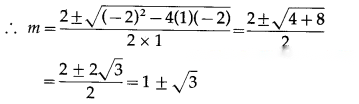
∴ The auxiliary equation is -m2+ 2m + 2 = 0
∴ m2– 2m – 2 = 0
m1= 1 + and m2= 1 – are the slopes of the lines.
∴ their separate equations are
y = m1x and y = m2x
i.e. y = (1 + )x and y = (1 – )x
i.e. ( + 1)x – y = 0 and ( – 1)x + y = 0.
(ii) 2x2– 3xy – 9y2= 0
Solution:
Comparing the equation 2x2– 3xy – 9y2= 0 with ax2+ 2hxy + by2= 0, we get,
a = 2, 2h = -3, b = -9
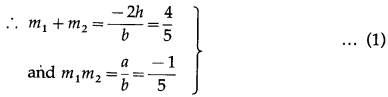
Let m1and m2be the slopes of the lines represented by 2x2– 3xy – 9y2= 0
∴ m1+ m2= and m1m2= …(1)
Now, required lines are perpendicular to these lines
∴ their slopes are and
Since these lines are passing through the origin, their separate equations are
y = x and y = x
i.e. m1y = -x and m2y = -x
i.e. x + m1y = 0 and x + m2y = 0
∴ their combined equation is
(x + m1y)(x + m2y) = 0
∴ x2+ (m1+ m2)xy + m1m2y2= 0
∴ x2+ xy + y2= 0 …[By (1)]
∴ 9x2– 3xy – 2y2= 0
(iii) x2+ xy – y2= 0
Solution:
Comparing the equation x2+ xy – y2= 0 with ax2+ 2hxy + by2= 0, we get,
a = 1, 2h = 1, b = -1
Let m1and m2be the slopes of the lines represented by x2+ xy – y2= 0
∴ m1+ m2= and m1m2= = -1..(1)
Now, required lines are perpendicular to these lines
∴ their slopes are and
Since these lines are passing through the origin, their separate equations are
y = x and y = x
i.e. m1y = -x and m2y = -x
i.e. x + m1y = 0 and x + m2y = 0
∴ their combined equation is
(x + m1y)(x + m2y) = 0
∴ x2+ (m1+ m2) + m1m2y2= 0
∴ x2+ 1xy + (-1)y2= 0 …[By (1)]
∴ x2+ xy – y2= 0
(ii) The sum of slopes of the lines given by 2x2+ kxy – 3y2= 0 is equal to their product.
Question is modified.
The sum of slopes of the lines given by x2+ kxy – 3y2= 0 is equal to their product.
Solution:
Comparing the equation x2+ kxy – 3y2= 0, with ax2+ 2hxy + by2= 0, we get,
a = 1, 2h = k, b = -3
Let m1and m2be the slopes of the lines represented by x2+ kxy – 3y2= 0.
∴ m1+ m2=
and m1m2=
Now, m1+ m2= m1m2… (Given)
∴
∴ k = -1.
(iii) The slope of one of the lines given by 3x2– 4xy + ky2= 0 is 1.
Solution:
The auxiliary equation of the lines given by 3x2– 4xy + ky2= 0 is km2– 4m + 3 = 0.
Given, slope of one of the lines is 1.
∴ m = 1 is the root of the auxiliary equation km2– 4m + 3 = 0.
∴ k(1)2– 4(1) + 3 = 0
∴ k – 4 + 3 = 0
∴ k = 1.
(iv) One of the lines given by 3x2– kxy + 5y2= 0 is perpendicular to the 5x + 3y = 0.
Solution:
The auxiliary equation of the lines represented by 3x2– kxy + 5y2= 0 is 5m2– km + 3 = 0.
Now, one line is perpendicular to the line 5x + 3y = 0, whose slope is .
∴ slope of that line = m =
∴ m = is the root of the auxiliary equation 5
5m2– km + 3 = 0.
∴ 5 – k + 3 = 0
∴ + 3 = 0
∴ 9 – 3k + 15 = 0
∴ 3k = 24
∴ k = 8.
(v) The slope of one of the lines given by 3x2+ 4xy + ky2= 0 is three times the other.
Solution:
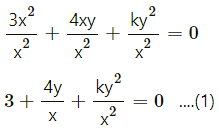
3x2+ 4xy + ky2= 0
∴ divide by x2
∴ y = mx
∴ = m
put = m in equation (1)
Comparing the equation km2+ 4m + 3 = 0 with ax2+ 2hxy+ by2= 0, we get,
a = k, 2h = 4, b = 3
m1= 3m2..(given condition)
m1+ m2=
m1m2=
m1+ m2=
4m2= …(m1= 3m2)
m2=
m1m2=
…(m1= 3m2)
…(m2= )
k2= k
k = 1 or k = 0
(vi) The slopes of lines given by kx2+ 5xy + y2= 0 differ by 1.
Solution:
Comparing the equation kx2+ 5xy +y2= 0 with ax2+ 2hxy + by2
a = k, 2h = 5 i.e. h =
m1+ m2= = -5
and m1m2= = k
the slope of the line differ by (m1– m2) = 1 …(1)
∴ (m1– m2)2= (m1+ m2)2– 4m1m2
(m1– m2)2= (-5)2– 4(k)
(m1– m2)2= 25 – 4k
1 = 25 – 4k..[By (1)]
4k = 24
k = 6
(vii) One of the lines given by 6x2+ kxy + y2= 0 is 2x + y = 0.
Solution:
The auxiliary equation of the lines represented by 6x2+ kxy + y2= 0 is
m2+ km + 6 = 0.
Since one of the line is 2x + y = 0 whose slope is m = -2.
∴ m = -2 is the root of the auxiliary equation m2+ km + 6 = 0.
∴ (-2)2+ k(-2) + 6 = 0
∴ 4 – 2k + 6 = 0
∴ 2k = 10 ∴ k = 5
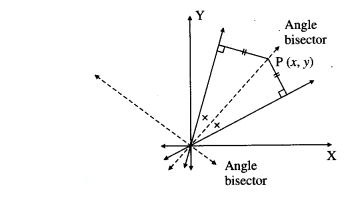
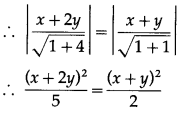
Question 12
Maharashtra Board Solution
If the line 4x – 5y = 0 coincides with one of the lines given by ax2 + 2hxy + by2 = 0, then show that 25a + 40h +16b = 0.
Solution & Step-by-Step Answer:
: The auxiliary equation of the lines represented by ax2 + 2hxy + by2 = 0 is bm2 + 2hm + a = 0 Given that 4x – 5y = 0 is one of the lines represented by ax2 + 2hxy + by2 = 0. The slope of the line 4x – 5y = 0 is ∴ m = is a root of the auxiliary equation bm2 + 2hm + a = 0. ∴ b + 2h + a = 0 ∴ + a = 0 ∴ 16b + 40h + 25a = 0 i.e. ∴ 25a + 40h + 16b = 0
|
Question 13
Maharashtra Board Solution
Show that the following equations represent a pair of lines. Find the acute angle between them : (i) 9x2 – 6xy + y2 + 18x – 6y + 8 = 0
Solution & Step-by-Step Answer:
block bg-white dark:bg-slate-900/80 border-l-4 border-emerald-500 rounded-r-xl p-5 my-3 shadow-xs border border-slate-200/60 dark:border-slate-800">
Solution & Step-by-Step Answer:
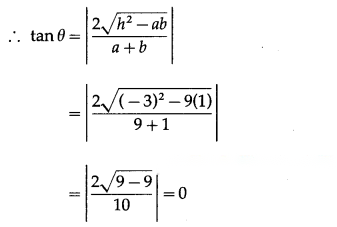
Comparing this equation with ax2 + 2hxy + by2 + 2gx + 2fy + c = 0, we get, a = 9, h = -3, b = 1, g = 9, f = -3 and c = 8. ∴ D = = 9(8 – 9) + 3(-24 + 27) + 9(9 – 9) = 9(-1) + 3(3) + 9(0) = -9 + 9 + 0 = 0 and h2 – ab = (-3)2 – 9(1) = 9 – 9 = 0 ∴ the given equation represents a pair of lines. Let θ be the acute angle between the lines. ∴ tan θ = tan0° ∴ θ = 0°.
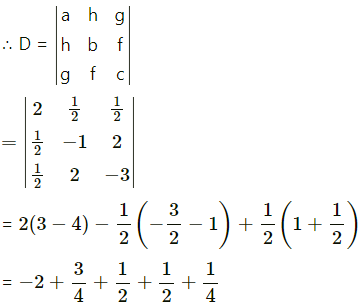
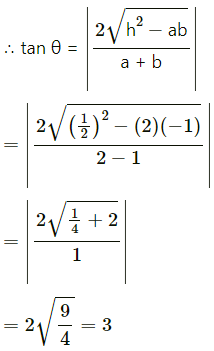
(ii) 2x2+ xy – y2+ x + 4y – 3 = 0
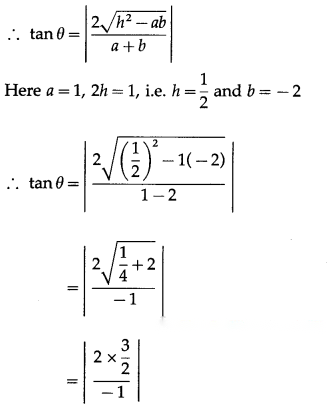
(iii) (x – 3)2+ (x – 3)(y – 4) – 2(y – 4)2= 0.
Question 14
Maharashtra Board Solution
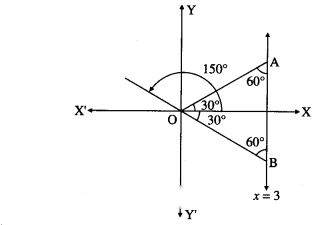
Find the combined equation of pair of lines through the origin each of which makes angle of 60° with the Y-axis.
Solution & Step-by-Step Answer:
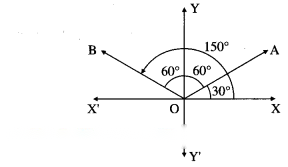
Let OA and OB be the lines through the origin making an angle of 60° with the Y-axis. Then OA and OB make an angle of 30° and 150° with the positive direction of X-axis. ∴ slope of OA = tan 30° = ∴ equation of the line OA is y = = x, i.e. x – y = 0 Slope of OB = tan 150° = tan (180° – 30°) = tan 30° = ∴ equation of the line OB is y = x, i.e. x + y = 0 ∴ required combined equation is (x – y)(x + y) = 0 i.e. x2 – 3y2 = 0.
Question 15
Maharashtra Board Solution
If lines representedby ax2 + 2hxy + by2 = 0 make angles of equal measures with the co-ordinate axes then show that a = ± b. OR Show that, one of the lines represented by ax2 + 2hxy + by2 = 0 will make an angle of the same measure with the X-axis as the other makes with the Y-axis, if a = ± b.
Solution & Step-by-Step Answer:
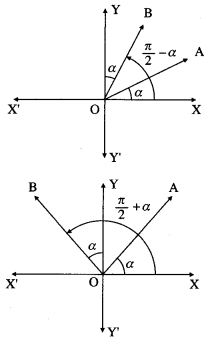
Let OA and OB be the two lines through the origin represented by ax2 + 2hxy + by2 = 0. Since these lines make angles of equal measure with the coordinate axes, they make angles ∝ and – ∝ with the positive direction of X-axis or ∝ and + ∝ with thepositive direction of X-axis. ∴ slope of the line OA = m1 = tan ∝ and slope of the line OB = m2 = tan( – ∝) or tan( + ∝) i.e. m2 = cot ∝ or m2 = -cot ∝ ∴ m1m2 – tan ∝ x cot ∝ = 1 OR m1m2 = tan ∝ (-cot ∝) = -1 i.e. m1m2 = ± 1 But m1m2 = ∴ = ±1 ∴ a = ±b This is the required condition.
Question 16
Maharashtra Board Solution
Show that the combined equation of a pair of lines through the origin and each making an angle of ∝ with the line x + y = 0 is x2 + 2(sec 2∝) xy + y2 = 0.
Solution & Step-by-Step Answer:
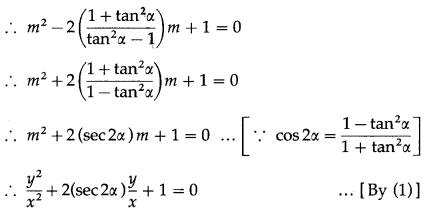
Let OA and OB be the required lines. Let OA (or OB) has slope m. ∴ its equation is y = mx … (1) It makes an angle ∝ with x + y = 0 whose slope is -1. m +1 ∴ tan ∝ = Squaring both sides, we get, tan2∝ = ∴ tan2∝(1 – 2m + m2) = m2 + 2m + 1 ∴ tan2∝ – 2m tan2∝ + m2tan2∝ = m2 + 2m + 1 ∴ (tan2∝ – 1)m2 – 2(1 + tan2∝)m + (tan2∝ – 1) = 0 ∴ y2 + 2xysec2∝ + x2 = 0 ∴ x2 + 2(sec2∝)xy + y2 = 0 is the required equation.
Question 17
Maharashtra Board Solution
Show that the line 3x + 4y+ 5 = 0 and the lines (3x + 4y)2 – 3(4x – 3y)2 =0 form an equilateral triangle.
Solution & Step-by-Step Answer:
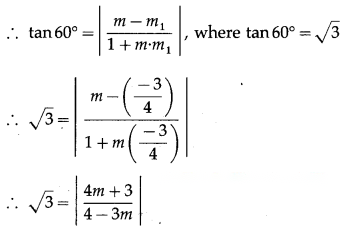
The slope of the line 3x + 4y + 5 = 0 is Let m be the slope of one of the line making an angle of 60° with the line 3x + 4y + 5 = 0. The angle between the lines having slope m and m1 is 60°. On squaring both sides, we get, 3 = ∴ 3 (4 – 3m)2 = (4m + 3)2 ∴ 3(16 – 24m + 9m2) = 16m2 + 24m + 9 ∴ 48 – 72m + 27m2 = 16m2 + 24m + 9 ∴ 11m2 – 96m + 39 = 0 This is the auxiliary equation of the two lines and their joint equation is obtained by putting m = . ∴ the combined equation of the two lines is 11 – 96 + 39 = 0 ∴ + 39 = 0 ∴ 11y2 – 96xy + 39x2 = 0 ∴ 39x2 – 96xy + 11y2 = 0. ∴ 39x2 – 96xy + 11y2 = 0 is the joint equation of the two lines through the origin each making an angle of 60° with the line 3x + 4y + 5 = 0. The equation 39x2 – 96xy + 11y2 = 0 can be written as : -39x2 + 96xy – 11y2 = 0 i.e., (9x2 – 48x2) + (24xy + 72xy) + (16y2 – 27y2) = 0 i.e. (9x2 + 24xy + 16y2) – (48x2 – 72xy + 27y2) = 0 i.e. (9x2 + 24xy + 16y2) – 3(16x2 – 24xy + 9y2) = 0 i.e. (3x + 4y)2 – 3(4x – 3y)2 = 0 Hence, the line 3x + 4y + 5 = 0 and the lines (3x + 4y)2 – 3(4x – 3y)2 form the sides of an equilateral triangle.
Question 18
Maharashtra Board Solution
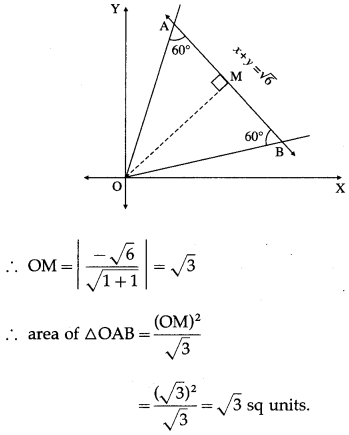
Show that lines x2 – 4xy + y2 = 0 and x + y = form an equilateral triangle. Find its area and perimeter.
Solution & Step-by-Step Answer:
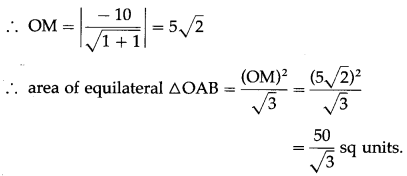
x2 – 4xy + y2 = 0 and x + y = form a triangle OAB which is equilateral. Let OM be the perpendicular from the origin O to AB whose equation is x + y = In right angled triangle OAM, sin 60° = ∴ = ∴ OA = 2 ∴ length of the each side of the equilateral triangle OAB = 2 units. ∴ perimeter of ∆ OAB = 3 × length of each side = 3 × 2 = 6 units.
Question 19
Maharashtra Board Solution
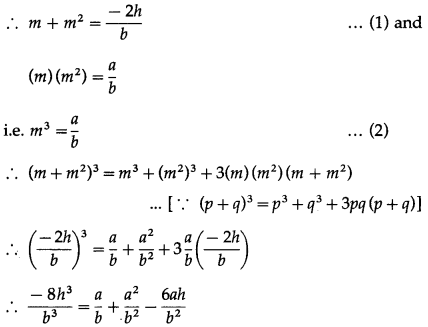
If the slope of one of the lines given by ax2 + 2hxy + by2 = 0 is square of the other then show that a2b + ab2 + 8h3 = 6abh.
Solution & Step-by-Step Answer:
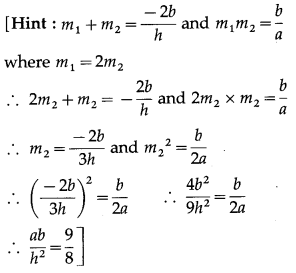
Let m be the slope of one of the lines given by ax2 + 2hxy + by2 = 0. Then the other line has slope m2 Multiplying by b3, we get, -8h3 = ab2 + a2b – 6abh ∴ a2b + ab2 + 8h3 = 6abh This is the required condition.
Question 20
Maharashtra Board Solution
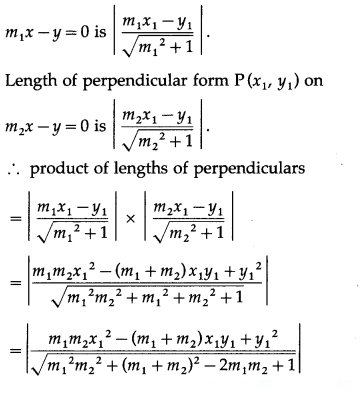
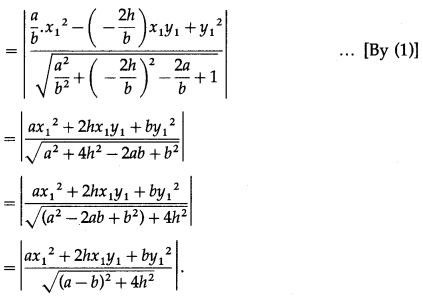
Prove that the product of lengths of perpendiculars drawn from P (x1, y1) to the lines repersented by ax2 + 2hxy + by2 = 0 is
Solution & Step-by-Step Answer:
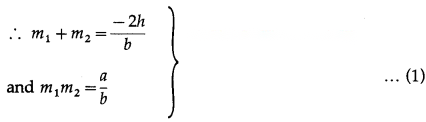
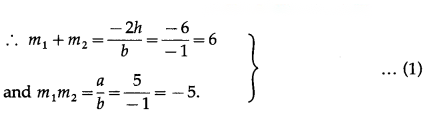
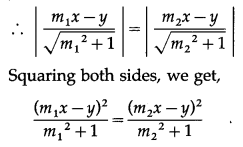
Let m1 and m2 be the slopes of the lines represented by ax2 + 2hxy + by2 = 0. ∴ m1 + m2 = and m1m2 = …(1) The separate equations of the lines represented by ax2 + 2hxy + by2 = 0 are y = m1x and y = m2x i.e. m1x – y = 0 and m2x – y = 0 Length of perpendicular from P(x1, 1) on
Question 21
Maharashtra Board Solution
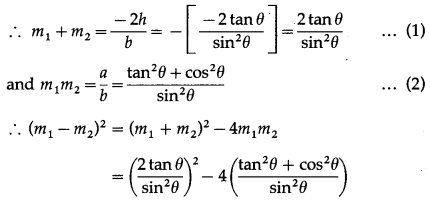
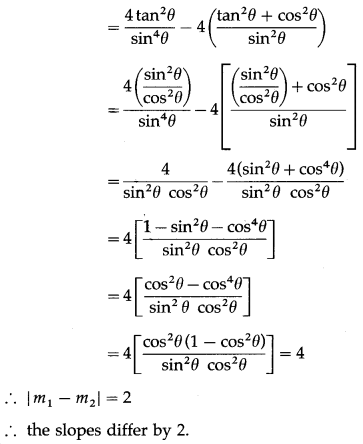
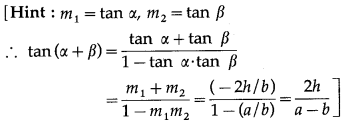
Show that the difference between the slopes of lines given by (tan2θ + cos2θ )x2 – 2xytanθ + (sin2θ )y2 = 0 is two.
Solution & Step-by-Step Answer:
Comparing the equation (tan2θ + cos2θ)x2 – 2xy tan θ + (sin2θ) y2 = 0 with ax2 + 2hxy + by2 = 0, we get, a = tan2θ + cos2θ, 2h = -2 tan θ and b = sin2θ Let m1 and m2 be the slopes of the lines represented by the given equation.
Question 22
Maharashtra Board Solution
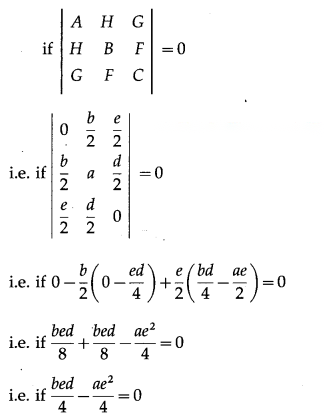
Find the condition that the equation ay2 + bxy + ex + dy = 0 may represent a pair of lines.
Solution & Step-by-Step Answer:
Comparing the equation ay2 + bxy + ex + dy = 0 with Ax2 + 2Hxy + By2 + 2Gx + 2Fy + C = 0, we get, A = 0, H = , B = a,G = , F = , C = 0 The given equation represents a pair of lines, i.e. if bed – ae2 = 0 i.e. if e(bd – ae) = 0 i.e. e = 0 or bd – ae = 0 i.e. e = 0 or bd = ae This is the required condition.
Question 23
Maharashtra Board Solution
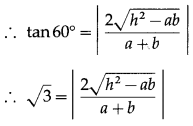
If the lines given by ax2 + 2hxy + by2 = 0 form an equilateral triangle with the line lx + my = 1 then show that (3a + b)(a + 3b) = 4h2.
Solution & Step-by-Step Answer:
Since the lines ax2 + 2hxy + by2 = 0 form an equilateral triangle with the line lx + my = 1, the angle between the lines ax2 + 2hxy + by2 = 0 is 60°. ∴ 3(a + b)2 = 4(h2 – ab) ∴ 3(a2 + 2ab + b2) = 4h2 – 4ab ∴ 3a2 + 6ab + 3b2 + 4ab = 4h2 ∴ 3a2 + 10ab + 3b2 = 4h2 ∴ 3a2 + 9ab + ab + 3b2 = 4h2 ∴ 3a(a + 3b) + b(a + 3b) = 4h2 ∴ (3a + b)(a + 3b) = 4h2 This is the required condition.
Question 24
Maharashtra Board Solution
If line x + 2 = 0 coincides with one of the lines represented by the equation x2 + 2xy + 4y + k = 0 then show that k = -4.
Solution & Step-by-Step Answer:
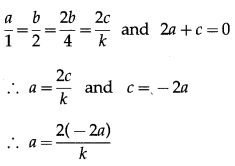
One of the lines represented by x2 + 2xy + 4y + k = 0 … (1) is x + 2 = 0. Let the other line represented by (1) be ax + by + c = 0. ∴ their combined equation is (x + 2)(ax + by + c) = 0 ∴ ax2 + bxy + cx + 2ax + 2by + 2c = 0 ∴ ax2 + bxy + (2a + c)x + 2by + 2c — 0 … (2) As the equations (1) and (2) are the combined equations of the same two lines, they are identical. ∴ by comparing their corresponding coefficients, we get, ∴ 1 = ∴ k = -4.
Question 25
Maharashtra Board Solution
Prove that the combined equation of the pair of lines passing through the origin and perpendicular to the lines represented by ax2 + 2hxy + by2 = 0 is bx2 – 2hxy + ay2 = 0
Solution & Step-by-Step Answer:
Let m1 and m2 be the slopes of the lines represented by ax2 + 2hxy + by2 = 0. Now, required lines are perpendicular to these lines. ∴ their slopes are and and Since these lines are passing through the origin, their separate equations are y = x and y = x i.e. m1y= -x and m2y = -x i.e. x + m1y = 0 and x + m2y = 0 ∴ their combined equation is (x + m1y)(x + m2y) = 0 ∴ x2 + (m1 + m2)xy + m1m2y2 = 0 ∴ x2x + y2 = 0 ∴ bx2 – 2hxy + ay2 = 0.
Question 26
Maharashtra Board Solution
If equation ax2 – y2 + 2y + c = 1 represents a pair of perpendicular lines then find a and c.
Solution & Step-by-Step Answer:
The given equation represents a pair of lines perpendicular to each other. ∴ coefficient of x2 + coefficient of y2 = 0 ∴ a – 1 = 0 ∴ a = 1 With this value of a, the given equation is x2 – y2 + 2y + c – 1 = 0 Comparing this equation with Ax2 + 2Hxy + By2 + 2Gx + 2Fy + C = 0, we get, A = 1, H = 0, B = -1, G = 0, F = 1, C = c – 1 Since the given equation represents a pair of lines, D = = 0 ∴ = 0 ∴ 1(-c + 1 – 1) – 0 + 0 = 0 ∴ -c = 0 ∴ c = 0. Hence, a = 1, c = 0.
|