Balbharti12th Maharashtra State Board Maths Solutions BookPdf Chapter 5 Vectors Miscellaneous Exercise 5 Questions and Answers.
Maharashtra State Board 12th Maths Solutions Chapter 5 Vectors Miscellaneous Exercise 5
I) Select the correct option from the given alternatives :
Question 1.
If || = 2, || = 3 || = 4 then [ + + – ] is equal to
(A) 24
(B) -24
(C) 0
(D) 48
Solution:
(C) 0
Solution & Step-by-Step Answer:
(b)

Solution & Step-by-Step Answer:
(B)
Solution & Step-by-Step Answer:
(b)

Solution & Step-by-Step Answer:
(A) 7
Solution & Step-by-Step Answer:
(D) 60º or 120º
Solution & Step-by-Step Answer:
(C)
Solution & Step-by-Step Answer:
(A) 4, 3, -5
Solution & Step-by-Step Answer:
(B) 2
Solution & Step-by-Step Answer:
(B) the unit vector along the line
Solution & Step-by-Step Answer:
(A) [0, 6]
Solution & Step-by-Step Answer:
(B) form an equilateral triangle
Solution & Step-by-Step Answer:
(A) 9p2 = 4q2
Solution & Step-by-Step Answer:
(A)
Solution & Step-by-Step Answer:
(A) 30º
Solution & Step-by-Step Answer:
(B)
Solution & Step-by-Step Answer:
(C) 1
Solution & Step-by-Step Answer:
(B) The geometric mean of a and b
Solution & Step-by-Step Answer:
(a)

Solution & Step-by-Step Answer:
(A)
II Answer the following :
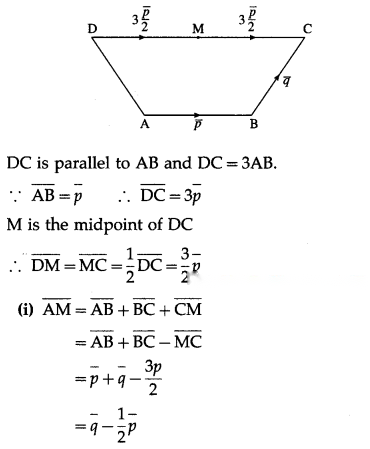
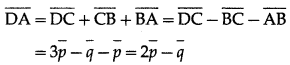
1) ABCD is a trapezium with AB parallel to DC and DC = 3AB. M is the mid-point of DC,
= and = . Find in terms of and .
(i)
Solution:
(ii)
Solution:

(iii)
Solution:

(iv)
Solution:
Solution & Step-by-Step Answer:
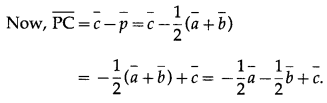
P is the mid-point of AB. ∴ = , where is the position vector of P.
Solution & Step-by-Step Answer:
Solution & Step-by-Step Answer:
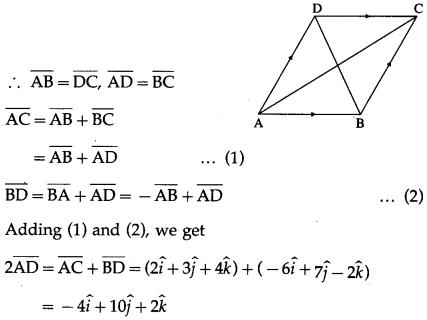
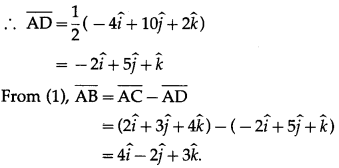
ABCD is a parallelogram
Solution & Step-by-Step Answer:
Let ABC be a triangle with = , = . By triangle law of vectors Hence, the length of third side is 3 units.
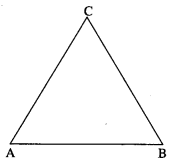
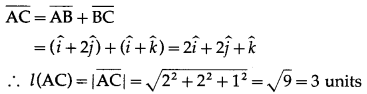
Solution & Step-by-Step Answer:
+ + = 0 ∴ – = + Taking dot product of both sides with itself, we get
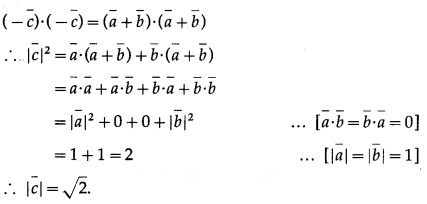
Solution & Step-by-Step Answer:
The position vectors , , of the points A, B, C are ∴ ∆ ABC is right angled at A.
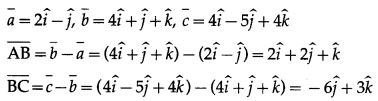
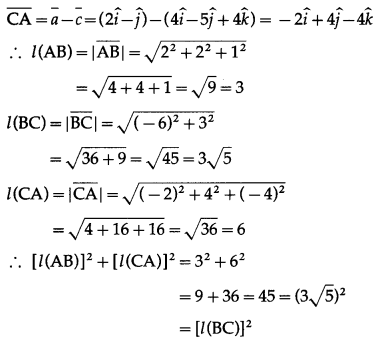
(ii) L(3, -2, -3), M(7, 0, 1), N (1, 2, 1)
Solution:
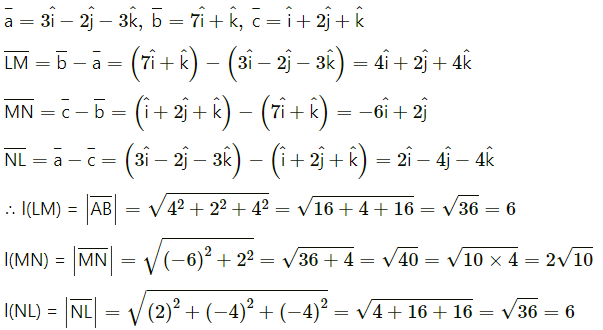
The position vectors bar , , of the points L M, N are
l(LM) = 6, l(MN) = 2, l(NL) = 6
∆LMN is sosceles
Solution & Step-by-Step Answer:
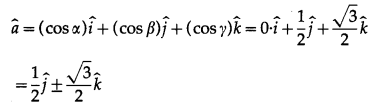
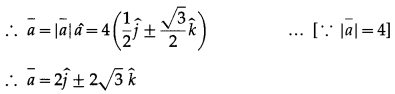
Let α, β, γ be the direction angles of Since lies in YZ-plane, it is perpendicular to X-axis ∴ α = 90° It is given that β= 60° ∵ cos2α + cos2β + cos2γ = 1 ∴ cos290° + cos260° + cos2γ = 1 ∴ 0 + + cos2γ = 1 ∴ cos2γ = 1 – ∴ cos γ = Unit vector along a is given by
(ii) It lies in XZ plane and makes 45º with positive Z-axis and || = 10
Solution:
Solution & Step-by-Step Answer:
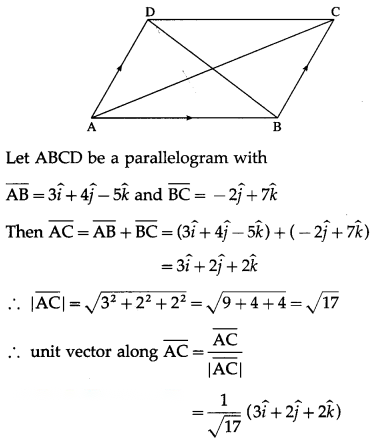
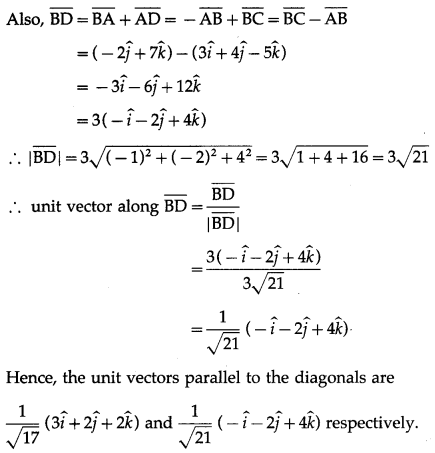
Solution & Step-by-Step Answer:
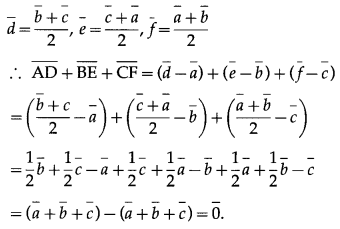
Let , , , , , be the position vectors of the points A, B, C, D, E, F respectively. Since D, E, F are the midpoints of BC, CA, AB respec-tively, by the midpoint formula
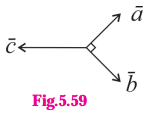
Solution & Step-by-Step Answer:
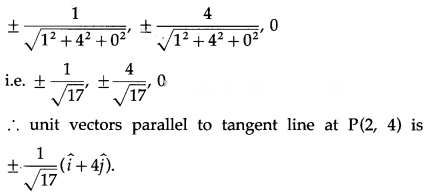
Differentiating y = x2 w.r.t. x, we get = 2x Slope of tangent at P(2, 4) = = 2 × 2 = 4 ∴ the equation of tangent at P is y – 4 = 4(-2) ∴ y = 4x – 4 ∴ y = 4x is equation of line parallel to the tangent at P and passing through the origin O. 4x = y, z = 0 ∴ , z = 0 ∴ the direction ratios of this line are 1, 4, 0 ∴ its direction cosines are
Solution & Step-by-Step Answer:
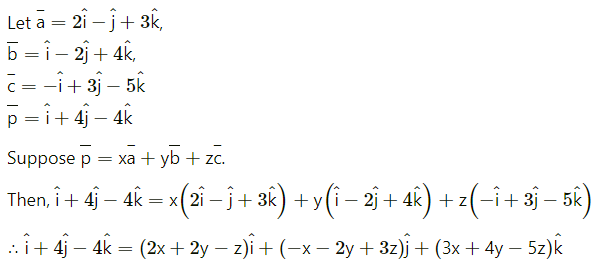
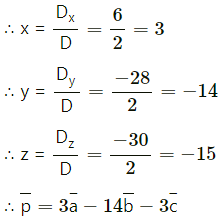
By equality of vectors, 2x + 2y – z = 1 -x – 2y + 3z = 4 3x + 4y – 5z = -4 We have to solve these equations by using Cramer’s Rule. D = = 2(10 – 12) – 2(5 – 9) – 1(-4 + 6) = -4 + 8 – 2 = 2 ≠ 0 Dx = = 1(10 – 12) – 2(-20 + 12) – 1 (16 – 8) = -2 + 16 – 8 = 6 Dy = = 2(-20 + 12) – 1(5 – 9) – 1(4 – 12) = -16 – 4 – 8 = -28 Dz = = 2(8 – 16) – 2(4 – 12) + 1(-4 + 6) = -16 – 16 + 2 = -30
Solution & Step-by-Step Answer:
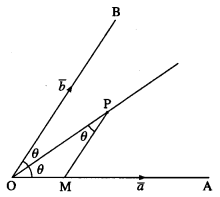
Choose any point P on the angle bisector of ∠AOB. Draw PM parallel to OB. ∴ ∠OPM = ∠POM = ∠POB Hence, OM = MP ∴ OM and MP is the same scalar multiple of unit vectors and along these directions,
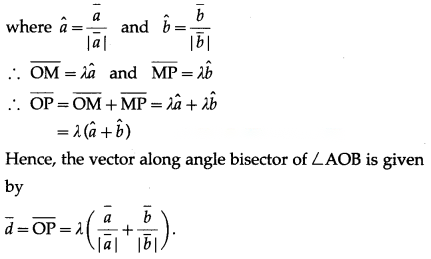
Solution & Step-by-Step Answer:
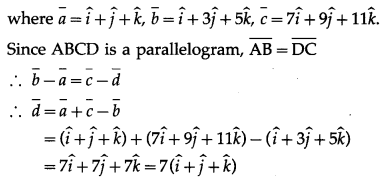
Let ABCD be a parallelogram. Let , , , be the position vectors of the vertices A, B, C, D of the parallelogram, Hence, the position vector of the fourth vertex is 7( + + ).
Solution & Step-by-Step Answer:
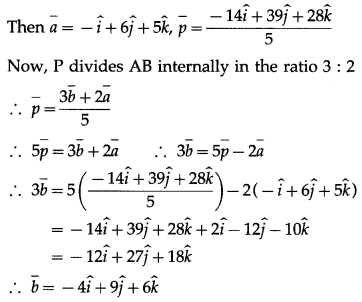
Let A, B and P have position vectors , and respectively. ∴ coordinates of B are (-4, 9, 6).
Solution & Step-by-Step Answer:
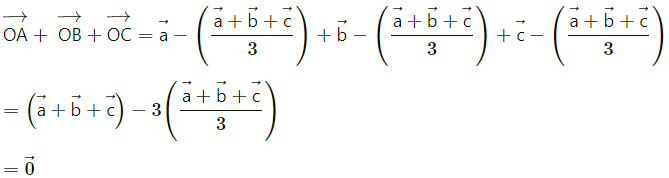
Let , and are the position vectors of the vertices A, B and C respectively. Then we know that the position vector of the centroid O of the triangle is Therefore sum of the three vectors , and , is Hence, Sum os the three vectors determined by the medians of a triangle directed from the vertices is zero.
Solution & Step-by-Step Answer:
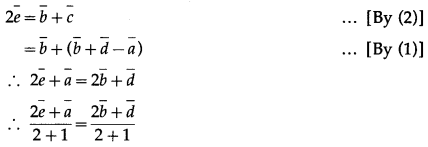
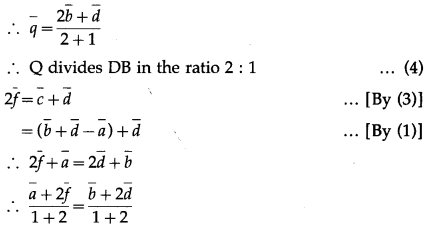
LHS is the position vector of the point on AE and RHS is the position vector of the point on DB. But AE and DB meet at Q. LHS is the position vector of the point on AF and RHS is the position vector of the point on DB. But AF and DB meet at P. ∴ ∴ P divides DB in the ratio 1 : 2 … (5) From (4) and (5), if follows that P and Q trisect DB.
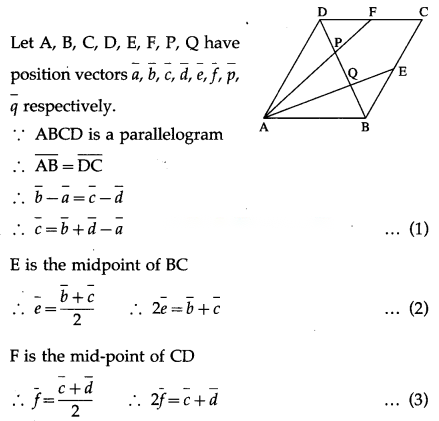
Solution & Step-by-Step Answer:
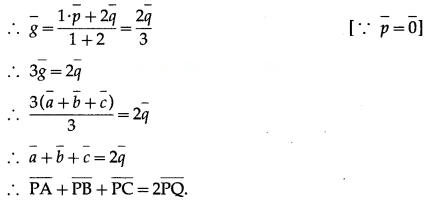
Let G be the centroid of the ∆ ABC. Let A, B, C, G, Q have position vectors , , , , w.r.t. P. We know that Q, G, P are collinear and G divides segment QP internally in the ratio 1 : 2.
Solution & Step-by-Step Answer:
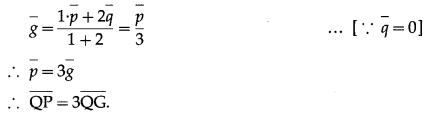
Let and be the position vectors of P and G w.r.t. the circumcentre Q. i.e. = p and = g. We know that Q, G, P are collinear and G divides segment QP internally in the ratio 1 : 2 ∴ by section formula for internal division,
Solution & Step-by-Step Answer:
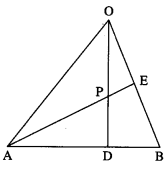
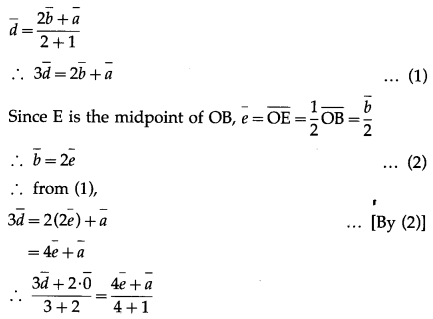
Let A, B, D, E, P have position vectors , , , , respectively w.r.t. O. ∵ AD : DB = 2 : 1. ∴ D divides AB internally in the ratio 2 : 1. Using section formula for internal division, we get LHS is the position vector of the point which divides OD internally in the ratio 3 : 2. RHS is the position vector of the point which divides AE internally in the ratio 4 : 1. But OD and AE intersect at P ∴ P divides OD internally in the ratio 3 : 2. Hence, OP : PD = 3 : 2.
Solution & Step-by-Step Answer:
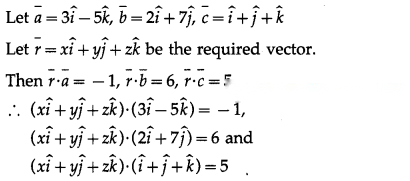
∴ 3x – 5z= -1 … (1) ∴ 2x + 7y = 6 … (2) ∴ x + y + z = 5 … (3) From (3), z = 5 – x – y Substituting this value of z in (1), we get ∴ 3x – 5(5 – x – y)= -1 ∴ 8x + 5y = 24 … (4) Multiplying (2) by 4 and subtracting from (4), we get 8x + 5y – 4(2x + 7y) = 24 – 6 × 4 ∴ -23y = 0 ∴ y = 0 Substituting y = 0 in (2), we get ∴ 2x = 6 ∴ x = 3 Substituting x = 3 in (1), we get ∴ 3(3) – 5z = -1 ∴ 5z = -10 ∴ z = 2 ∴ Hence, the required vector is
Solution & Step-by-Step Answer:
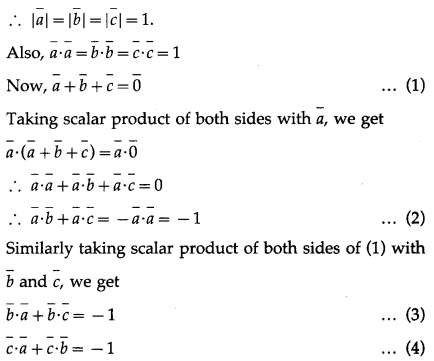
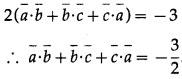
, , are unit vectors Adding (2), (3), (4) and using the fact that scalar product commutative, we get
Solution & Step-by-Step Answer:
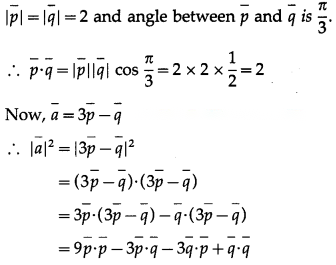
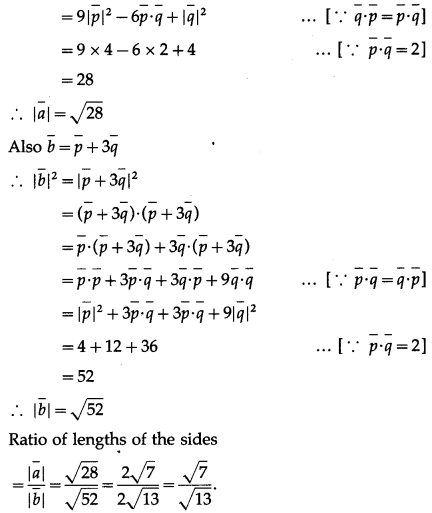
Hence, the ratio of the lengths of the sides is : .
Solution & Step-by-Step Answer:
By equality of vectors 3m + x = 5 … (1) y = -2 and m – 3x = 5 From (1) and (2) 3m + x = m – 3x ∴ 2m = -4x m ∴ m = -2x Substituting m = -2x in (1), we get ∴ -6x + x = 5 ∴ -5x = 5 ∴ x = -1 ∴ m = -2x = 2
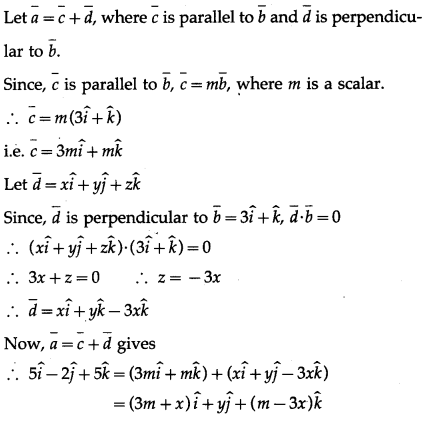
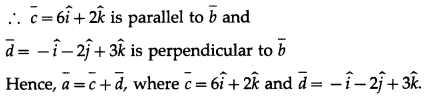
Solution & Step-by-Step Answer:
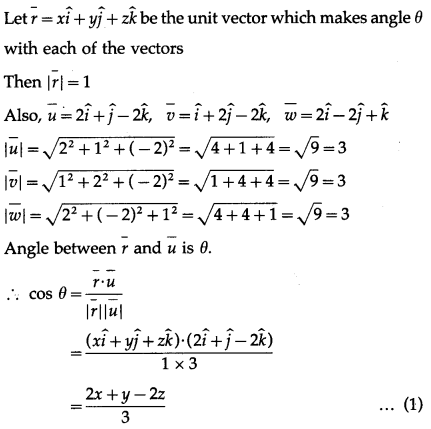
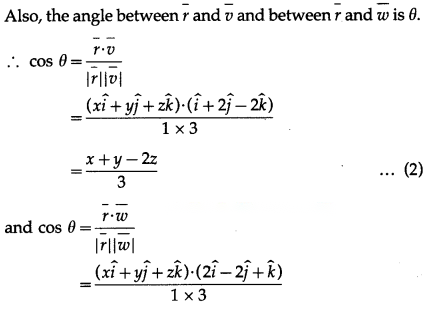
Solution & Step-by-Step Answer:
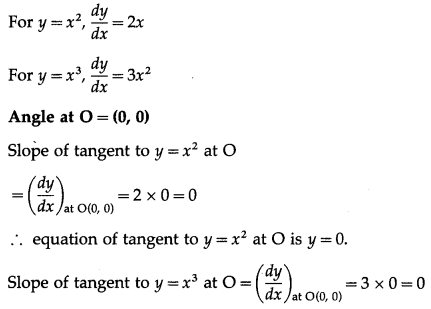
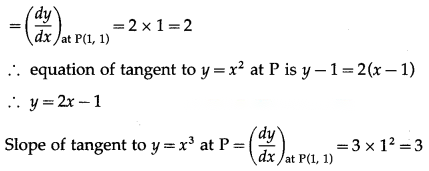
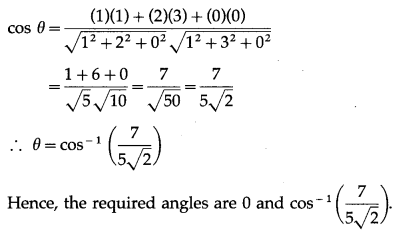
The angle between the curves is same as the angle between their tangents at the points of intersection. We find the points of intersection of y = x2 … (1) and y = x3 … (2) From (1) and (2) x3 = x2 ∴ x3 – x2 = 0 ∴ x2(x – 1) = 0 ∴ x = 0 or x = 1 When x = 0, y = 0. When x = 1, y = 1. ∴ equation of tangent to y = x3 at P is y = 0. ∴ the tangents to both curves at (0, 0) are y = 0 ∴ angle between them is 0. Angle at P = (1, 1) Slope of tangent to y = x2 at P ∴ equation of tangent to y = x3 at P is y – 1 = 3(x – 1) y = 3x – 2 We have to find angle between y = 2x – 1 and y = 3x – 2 Lines through origin parallel to these tagents are y = 2x and y = 3x ∴ and These lines lie in XY-plane. ∴ the direction ratios of these lines are 1, 2, 0 and 1, 3, 0. The angle θ between them is given by
Solution & Step-by-Step Answer:
Let =
(ii)
Solution:
Solution & Step-by-Step Answer:
=
Solution & Step-by-Step Answer:
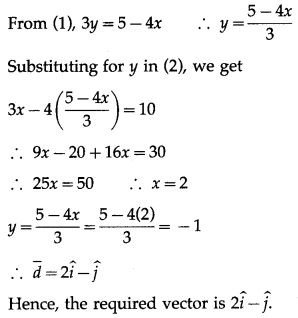
Let, if possible, a line in space make angles and with X-axis and Y-axis. ∴ cos2γ = 1 – This is not possible, because cos γ is real ∴ cos2γ cannot be negative. Hence, there is no line in space which makes angles and with X-axis and Y-axis.
Solution & Step-by-Step Answer:
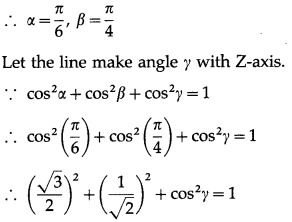
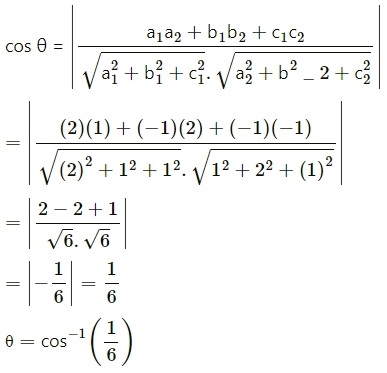
Given 6mn – 2nl + 5lm = o 3l + m +5n = 0. From (2), m = 3l – 5n Putting the value of m in equation (1), we get, ⇒ 6n(-3l – 5n) – 2nl + 5l(-3l – 5n) = 0 ⇒ -18nl- 30n – 2nl- 15l2 – 25nl = 0 ⇒ – 30n2 – 45nl – 15l2 = 0 ⇒ 2n2 + 3nl + l2 = 0 ⇒ 2n2 + 2nl + nl + l2 = 0 ⇒ (2n + l) (n + l) = 0 ∴ 2n + l = 0 OR n + l = 0 ∴ l = -2n OR l = -n ∴ l = -2n From (2), 3l + m + 5n = 0 ∴ -6n + m + 5n = 0 ∴ m = n i.e. (-2n, n, n) = (-2, 1, 1) ∴ l = -n ∴ -3n + m + 5n = 0 ∴ m = -2n i.e. (-n, -2n, n) = (1, 2, -1) (a1, b1, c1) = (-2, 1, 1) and (a2, b3, c3) = (1, 2, -1)
Solution & Step-by-Step Answer:
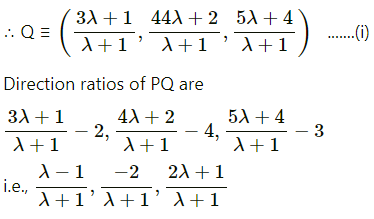
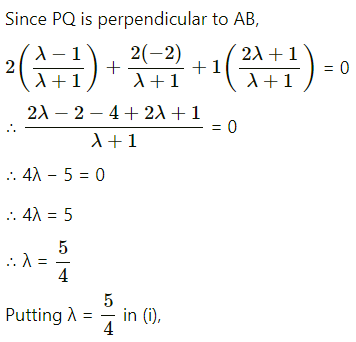
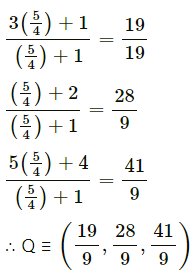
Let PQ be the perpendicular drawn from point P(2, 4, 3) to the line joining the points A(1, 2, 4) and B (3, 4, 5). Let Q divides AB internally in the ratio λ : 1 Now, direction ratios of AB are, 3 – 1, 4 – 2, 5 – 4 i.e., 2, 2, 1. Coordinates of Q are,
Solution & Step-by-Step Answer:
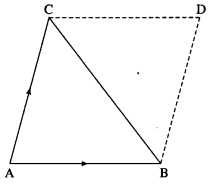
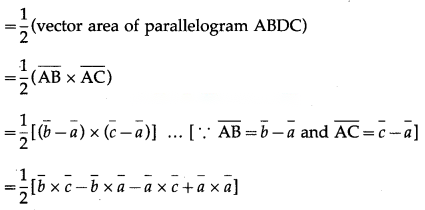
Consider the triangle ABC. Complete the parallelogram ABDC. Vector area of ∆ABC
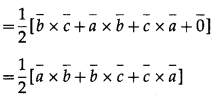
Solution & Step-by-Step Answer:
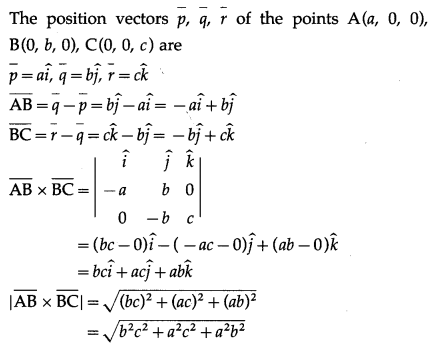
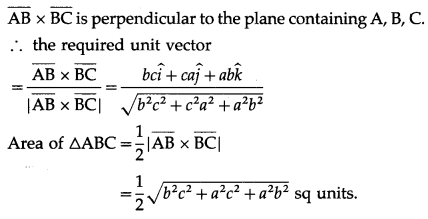
Solution & Step-by-Step Answer:
This is the scalar product of two vectors. Therefore, this expression is meaningful and it is a scalar.
(b)
Solution:
This expression is meaningless because is a vector, is a scalar and vector product of vector and scalar is not defined.
(c)
Solution:
This is vector product of two vectors. Therefore, this expression is meaningful and it is a vector.
(d)
Solution:
This is meaningless because is a vector, is a scalar and scalar product of vector and scalar is not defined.
(e)
Solution:
This is meaningless because are scalars and cross product of two scalars is not defined.
(f)
Solution:
This is scalar product of two vectors. Therefore, this expression is meaningful and it is a scalar.
(g)
Solution:
This is meaningless because is a vector, scalar and scalar product of vector and scalar is not defined.
(h)
Solution:
This is a scalar multiplication of a vector. Therefore, this expression is meaningful and it is a vector.
(i)
Solution:
This is the product of two scalars. Therefore, this expression is meaningful and it is a scalar.
(j)
Solution:
This is the scalar product of two vectors. Therefore, this expression is meaningful and it is a scalar.
(k)
Solution:
This is the sum of scalar and vector which is not defined. Therefore, this expression is meaningless.
(l)
Solution:
This is meaningless because is a vector, is a scalar and the scalar product of vector and scalar is not defined.
Solution & Step-by-Step Answer:
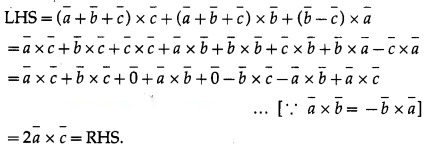
Solution & Step-by-Step Answer:
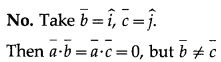
(b) If then is ?
Solution:
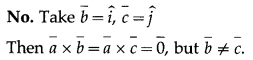
(c) If and then is ?
Solution:
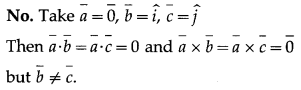
Solution & Step-by-Step Answer:
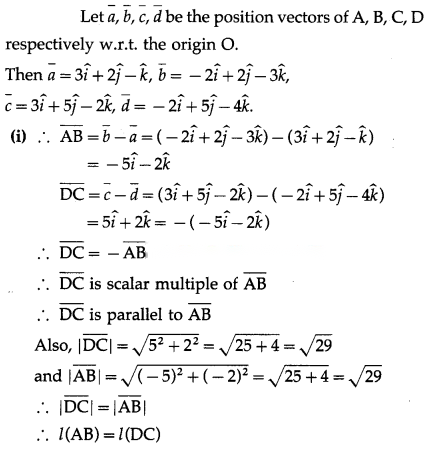
∴ opposite sides AB and DC of ABCD are parallel and equal. ∴ ABCD is a parallelogram.
(ii) find its area.
Solution:
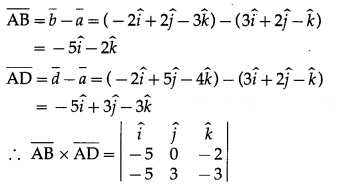
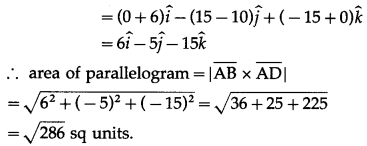
Solution & Step-by-Step Answer:
Let A, B, C, D have position vectors , , , respectively. Consider
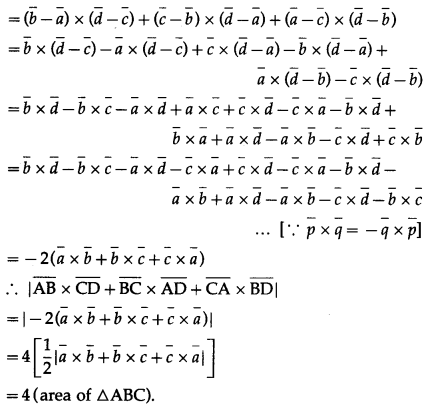
Solution & Step-by-Step Answer:
∴ is perpendicular to and both ∴ is parallel to × ∴ = m( × ), m is a scalar.
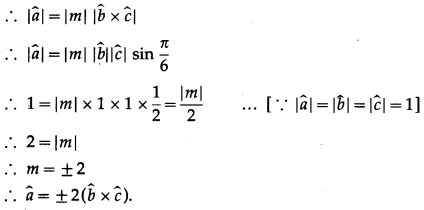
Solution & Step-by-Step Answer:
Let = , = , = Let V be the volume of the parallelopiped formed by .
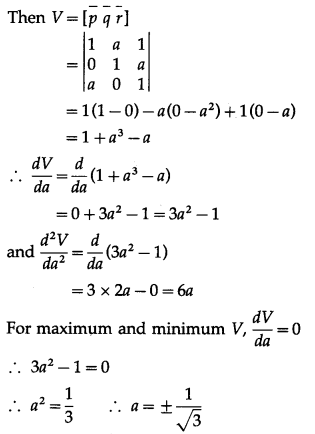
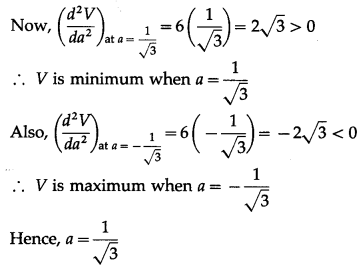
Solution & Step-by-Step Answer:
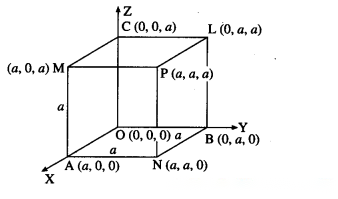
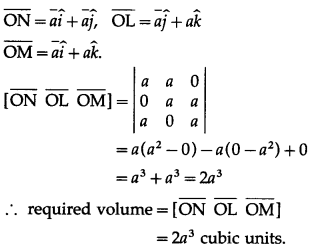
Take origin O as one vertex of the cube and OA, OB and OC as the positive directions of the X-axis, the Y-axis and the Z-axis respectively. Here, the sides of the cube are OA = OB = OC = a ∴ the coordinates of all the vertices of the cube will be O = (0, 0, 0) A = (a, 0, 0) B = (0, a, 0) C = (0, 0, a) N = (a, a, 0) L = (0, a, a) M = (a, 0, a) P = (a, a, a) ON, OL, OM are the three diagonals which meet at the vertex O
Solution & Step-by-Step Answer:
Solution & Step-by-Step Answer:
Solution & Step-by-Step Answer:
Let = , = and = be the co-terminus edges of a parallelopiped. Then volume of the parallelopiped = = = 0(0 – 1) – 1(0 – 1) + 1(1 – 0) = 0 + 1 + 1 = 2cu units. Also, volume of tetrahedron = = cubic units.
Solution & Step-by-Step Answer:
Solution & Step-by-Step Answer:
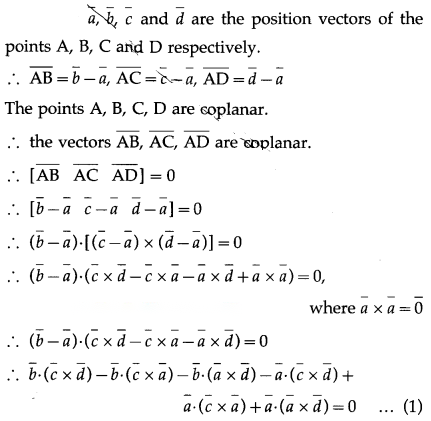
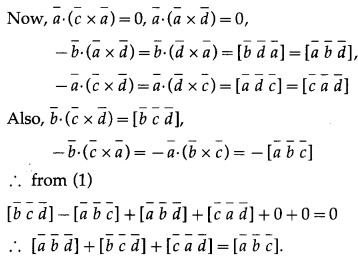
Solution & Step-by-Step Answer:
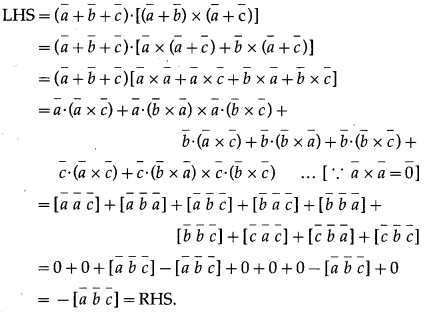
Solution & Step-by-Step Answer:
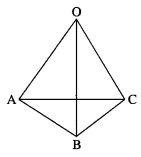
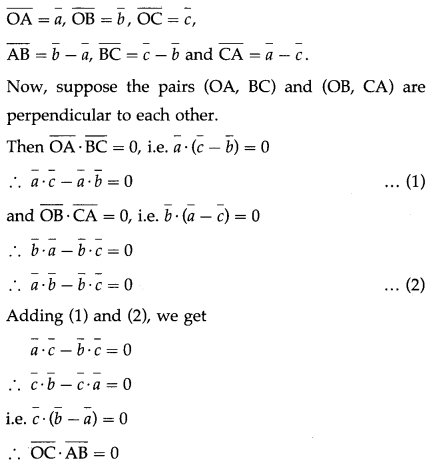
Let O-ABC be a tetrahedron. Then o (OA, BC), (OB, CA) and (OC, AB) are the pair of opposite edges. Take O as the origin of reference and let and ∴ the third pair (OC, AB) is perpendicular.