Balbharti12th Maharashtra State Board Maths Solutions BookPdf Chapter 6 Differential Equations Miscellaneous Exercise 6 Questions and Answers.
Maharashtra State Board 12th Maths Solutions Chapter 6 Differential Equations Miscellaneous Exercise 6
(I) Choose the correct option from the given alternatives:
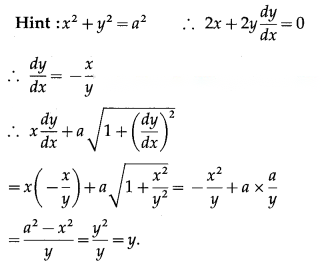

Hint:
y + x = 0
∴ ∫y dy + ∫x dx = c
∴
∴ x2+ y2= 2c which is a circle.
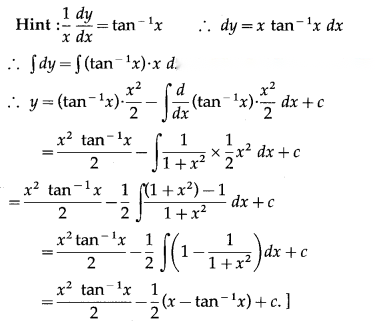
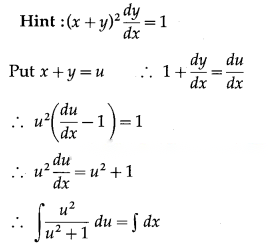
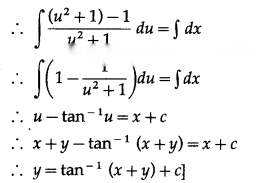
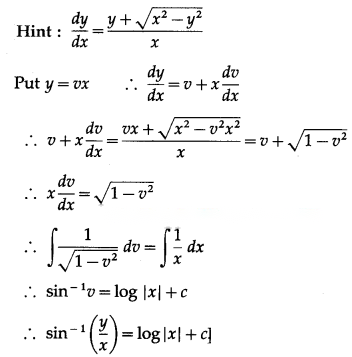
Hint:
= sec x – y tan x
∴ + y tan x = sec x
I.F. = = sec x
∴ the solution is
y. sec x = ∫sec x. sec x dx + c
∴ y sec x = tan x + c
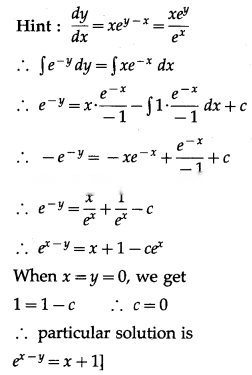
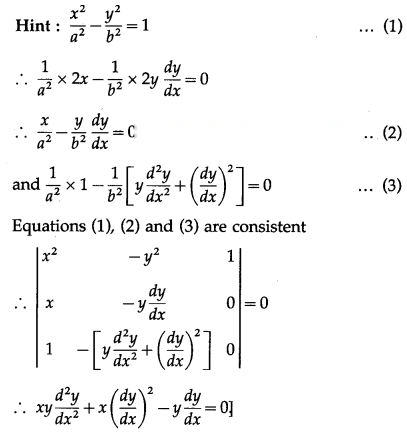
(II) Solve the following:
(ii)
Solution:
The given D.E. is
This D.E. has highest order derivative with power 10.
∴ the given D.E. is of order 3 and degree 10.
(iii)
Solution:
The given D.E. is
On cubing both sides, we get
This D.E. has highest order derivative with power 3.
∴ the given D.E. is of order 2 and degree 3.
(iv)
Solution:
The given D.E. is
This D.E. has the highest order derivative with power 4.
∴ the given D.E. is of order 1 and degree 4.
(v)
Solution:
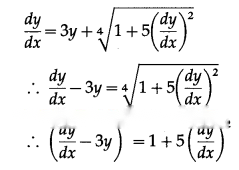
The given D.E. is
This D.E. has highest order derivative .
∴ order = 4
Since this D.E. cannot be expressed as a polynomial in differential coefficient, the degree is not defined.
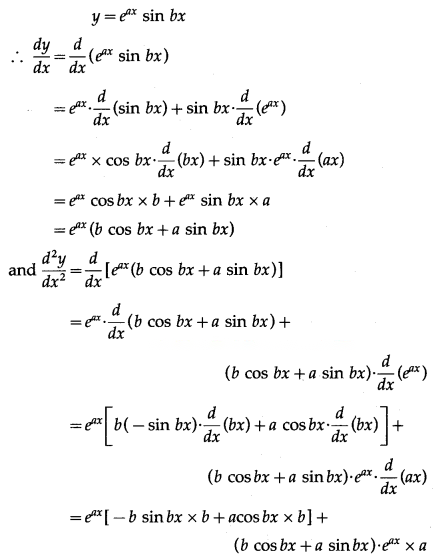
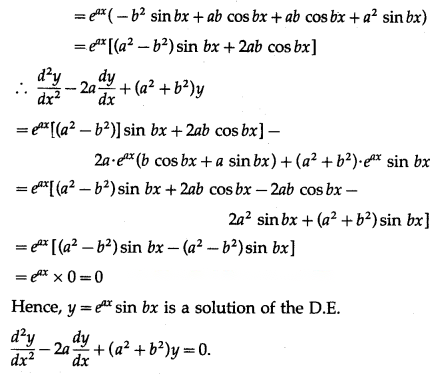
(ii) y = eaxsin bx;
Solution:
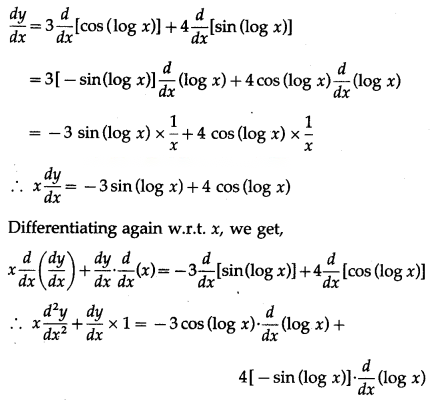
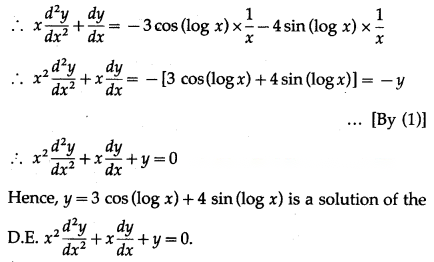
(iii) y = 3 cos(log x) + 4 sin(log x);
Solution:
y = 3 cos(log x) + 4 sin (log x) …… (1)
Differentiating both sides w.r.t. x, we get
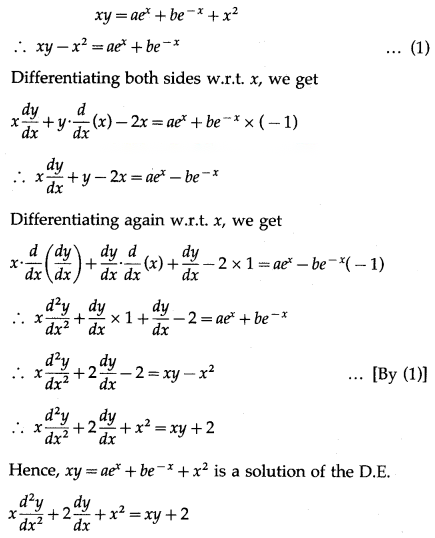
(iv) xy = aex+ be-x+ x2;
Solution:
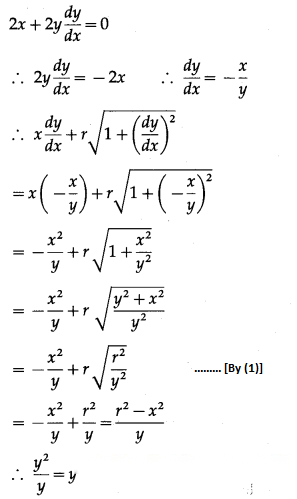
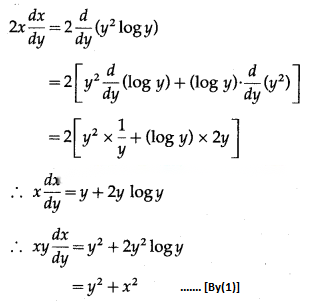
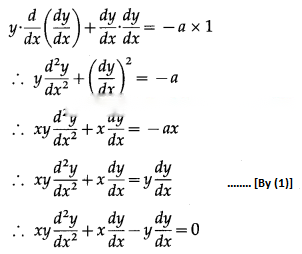
(v) x2= 2y2log y, x2+ y2= xy
Solution:
x2= 2y2log y ……(1)
Differentiating both sides w.r.t. y, we get
∴ x2+ y2= xy
Hence, x2= 2y2log y is a solution of the D.E.
x2+ y2= xy
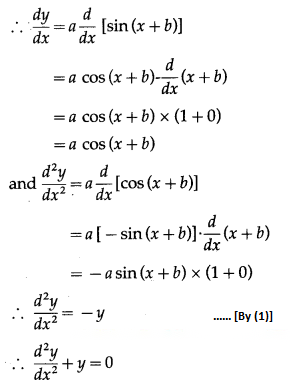
(ii) y = a sin(x + b)
Solution:
y = a sin(x + b)
This is the required D.E.
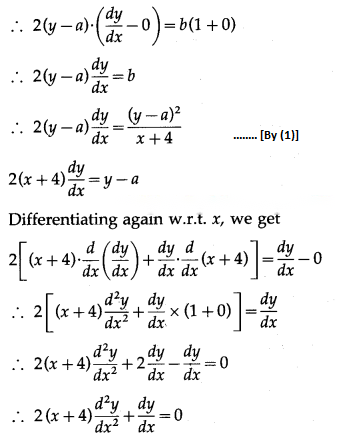
(iii) (y – a)2= b(x + 4)
Solution:
(y – a)2= b(x + 4) …….(1)
Differentiating both sides w.r.t. x, we get
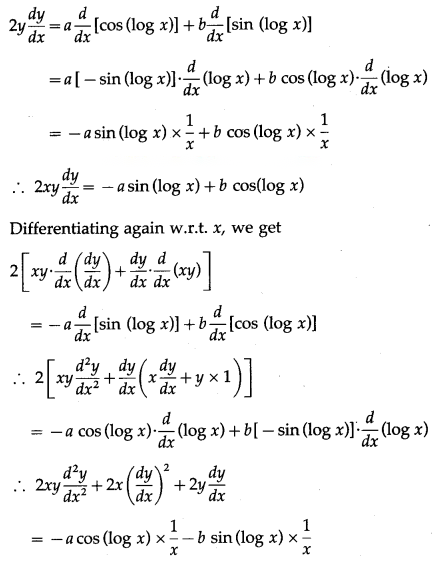
(iv) y =
Solution:
y =
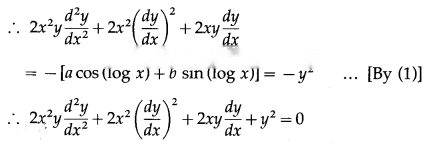
∴ y2= a cos (log x) + b sin (log x) …….(1)
Differentiating both sides w.r.t. x, we get
(v) y = Ae3x+1+ Be-3x+1
Solution:
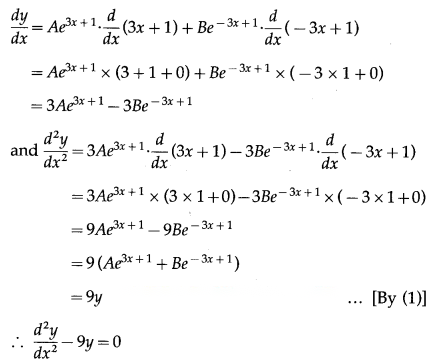
y = Ae3x+1+ Be-3x+1…… (1)
Differentiating twice w.r.t. x, we get
This is the required D.E.
(ii) all parabolas which have 4b as latus rectum and whose axis is parallel to Y-axis.
Solution:
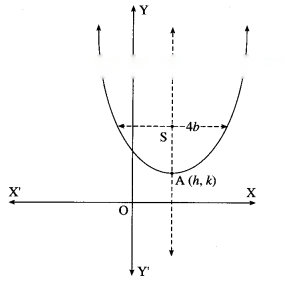
Let A(h, k) be the vertex of the parabola which has 4b as latus rectum and whose axis is parallel to the Y-axis.
Then equation of the parabola is
(x – h)2= 4b(y – k) ……. (1)
where h and k are arbitrary constants.
Differentiating both sides of (1) w.r.t. x, we get
2(x – h). (x – h) = 4b. (y – k)
∴ 2(x – h) x (1 – 0) = 4b( – 0)
∴ (x – h) = 2b
Differentiating again w.r.t. x, we get
1 – 0 = 2b
∴ 2b – 1 = 0
This is the required D.E.
(iii) an ellipse whose major axis is twice its minor axis.
Solution:
Let 2a and 2b be lengths of the major axis and minor axis of the ellipse.
Then 2a = 2(2b)
∴ a = 2b
∴ equation of the ellipse is
∴
∴
∴ x2+ 4y2= 4b2
Differentiating w.r.t. x, we get
2x + 4 × 2y = 0
∴ x + 4y = 0
This is the required D.E.
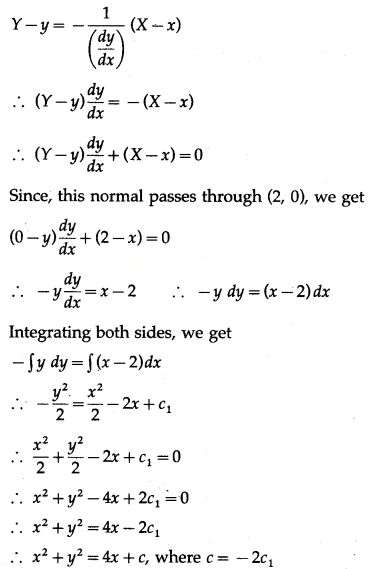
(iv) all the lines which are normal to the line 3x + 2y + 7 = 0.
Solution:
Slope of the line 3x – 2y + 7 = 0 is .
∴ slope of normal to this line is
Then the equation of the normal is
y = x + k, where k is an arbitrary constant.
Differentiating w.r.t. x, we get
∴ 3 + 2 = 0
This is the required D.E.
(v) the hyperbola whose length of transverse and conjugate axes are half of that of the given hyperbola .
Solution:
The equation of the hyperbola is
i.e.,
Comparing this equation with , we get
a2= 16k, b2= 36k
∴ a = 4√k, b = 6√k
∴ l(transverse axis) = 2a = 8√k
and l(conjugate axis) = 2b = 12√k
Let 2A and 2B be the lengths of the transverse and conjugate axes of the required hyperbola.
Then according to the given condition
2A = a = 4√k and 2B = b = 6√k
∴ A = 2√k and B = 3√k
∴ equation of the required hyperbola is
i.e.,
∴ 9x2– 4y2= 36k, where k is an arbitrary constant.
Differentiating w.r.t. x, we get
9 × 2x – 4 × 2y = 0
∴ 9x – 4y = 0
This is the required D.E.
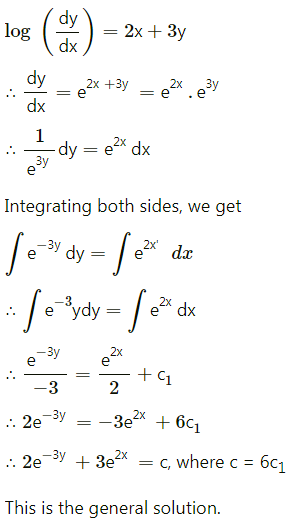
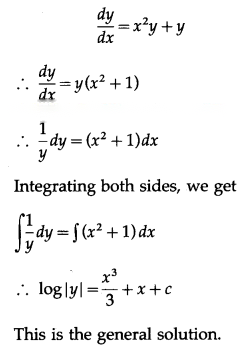
(ii) = x2y + y
Solution:
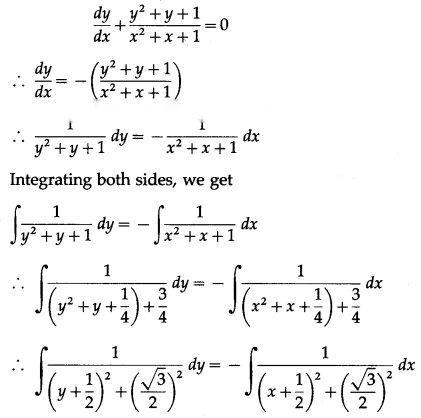
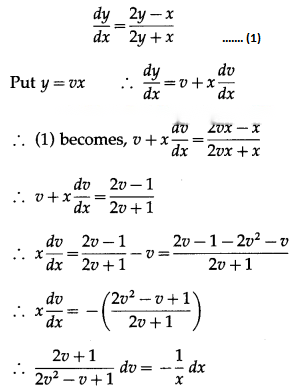
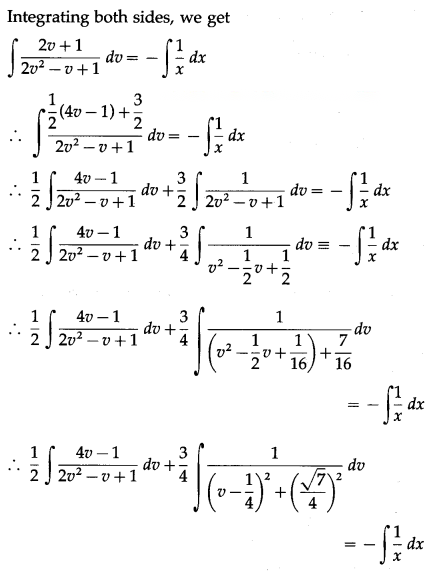
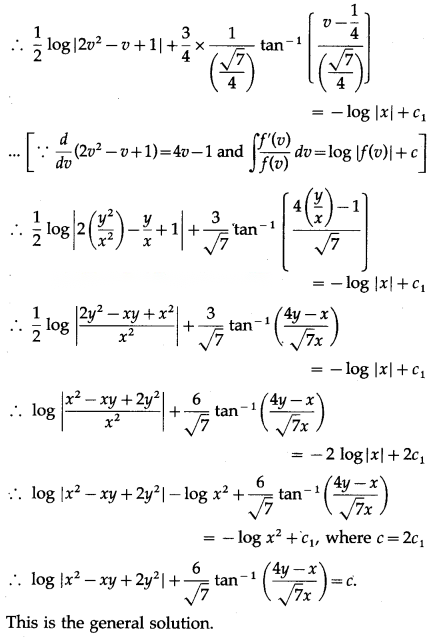
(iii)
Solution:
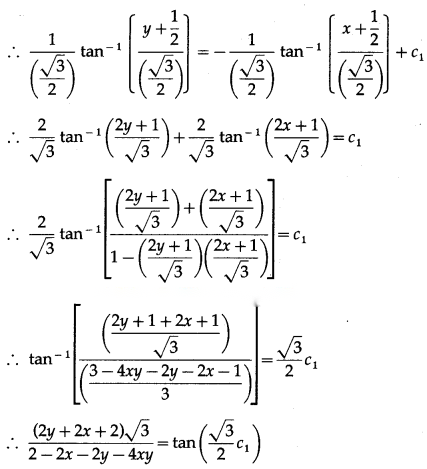
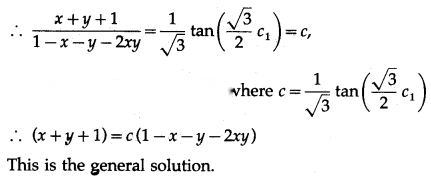
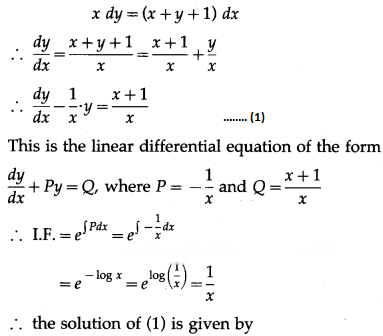
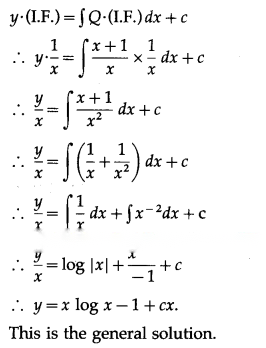
(iv) x dy = (x + y + 1) dx
Solution:
(v) + y cot x = x2cot x + 2x
Solution:
+ y cot x = x cot x + 2x ……..(1)
This is the linear differential equation of the form
+ Py = Q, where P = cot x and Q = x2cot x + 2x
∴ I.F. =
=
=
= sin x
∴ the solution of (1) is given by
y(I.F.) = ∫Q. (I.F.) dx + c
∴ y sin x = ∫(x2cot x + 2x) sin x dx + c
∴ y sinx = ∫(x2cot x. sin x + 2x sin x) dx + c
∴ y sinx = ∫x2cos x dx + 2∫x sin x dx + c
∴ y sinx = x2∫cos x dx – ∫[ ∫cos x dx] dx + 2∫x sin x dx + c
∴ y sin x = x2(sin x) – ∫2x(sin x) dx + 2∫x sin x dx + c
∴ y sin x = x2sin x – 2∫x sin x dx + 2∫x sin x dx + c
∴ y sin x = x2sin x + c
∴ y = x2+ c cosec x
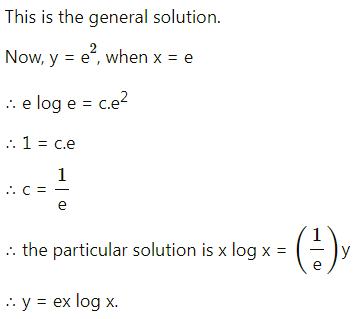
This is the general solution.
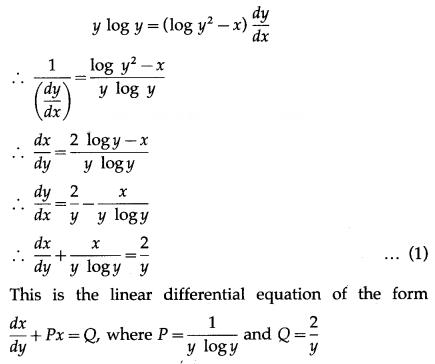
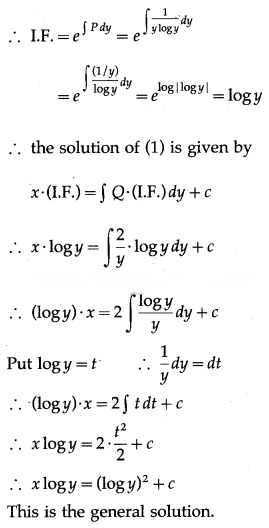
(vi) y log y = (log y2– x)
Solution:
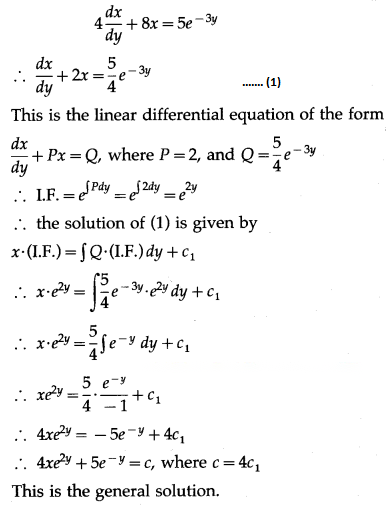
(vii) 4 + 8x = 5e-3y
Solution:
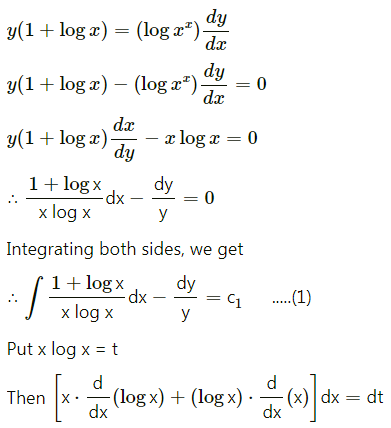
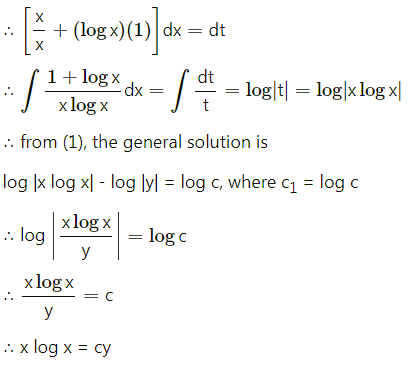
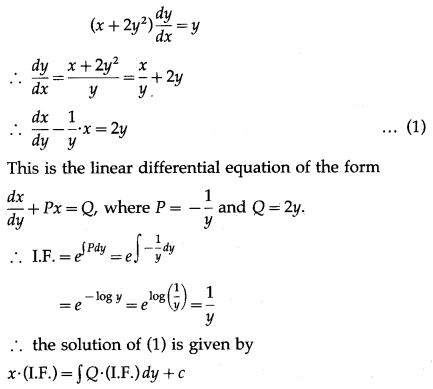
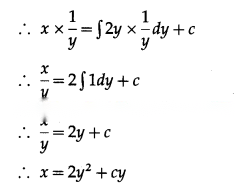
(ii) (x + 2y2) = y, when x = 2, y = 1
Solution:
This is the general solution.
When x = 2, y = 1, we have
2 = 2(1)2+ c(1)
∴ c = 0
∴ the particular solution is x = 2y2.
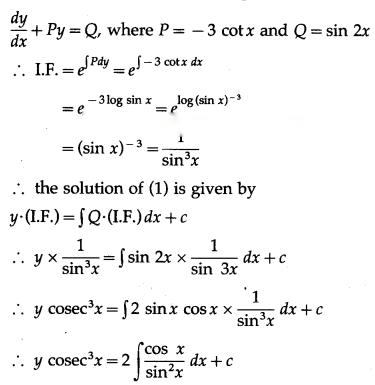
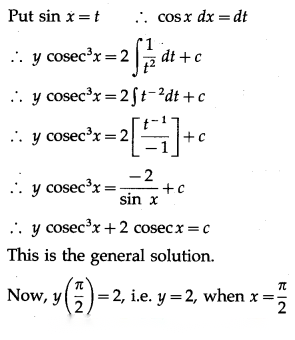
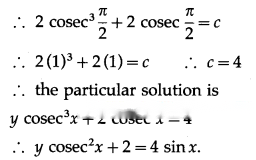
(iii) – 3y cot x = sin 2x, when y() = 2
Solution:
– 3y cot x = sin 2x
= (3 cot x) y = sin 2x ……..(1)
This is the linear differential equation of the form
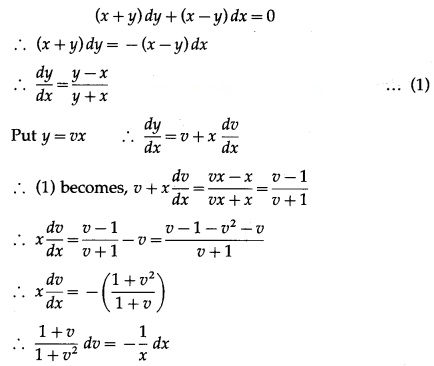
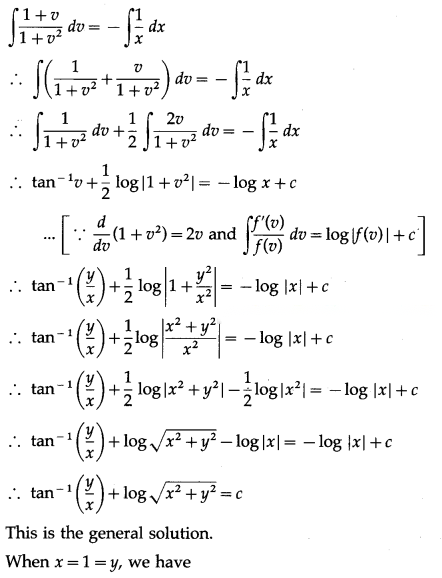
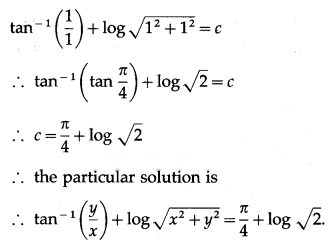
(iv) (x + y) dy + (x – y) dx = 0; when x = 1 = y
Solution:
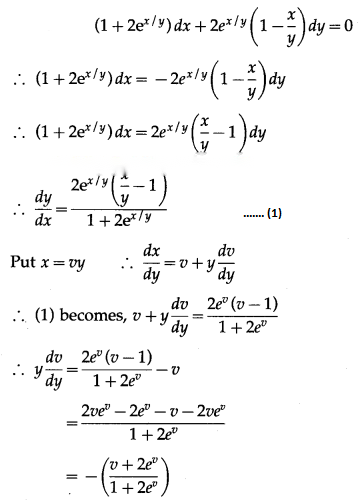
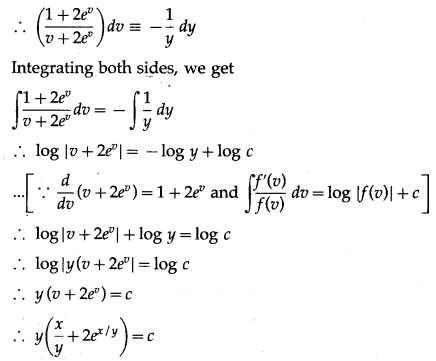
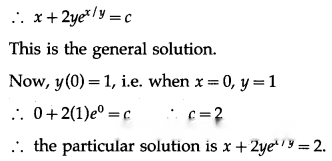
(v) , when y(0) = 1
Solution: