Balbharti12th Maharashtra State Board Maths Solutions BookPdf Chapter 7 Linear Programming Ex 7.4 Questions and Answers.
Maharashtra State Board 12th Maths Solutions Chapter 7 Linear Programming Ex 7.4
Question 1
Maharashtra Board Solution
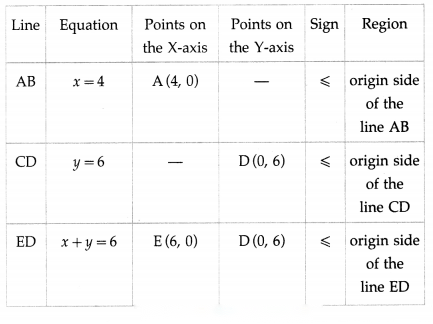
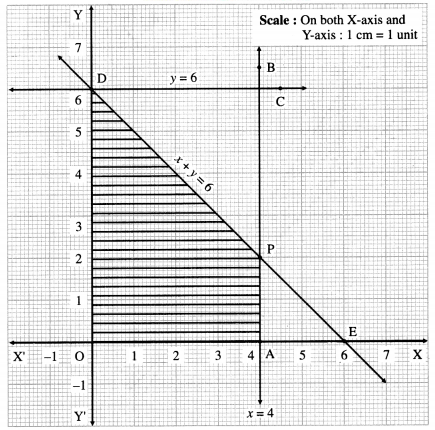
Maximize : z = 11x + 8y subject to x ≤ 4, y ≤ 6, x + y ≤ 6, x ≥ 0, y ≥ 0.
Solution & Step-by-Step Answer:
First we draw the lines AB, CD and ED whose equations are x = 4, y = 6 and x + y = 6 respectively. The feasible region is shaded portion OAPDO in the graph. The vertices of the feasible region are O (0, 0), A (4, 0), P and D (0, 6) P is point of intersection of lines x + y = 6 and x = 4. Substituting x = 4 in x + y = 6, we get 4 + y = 6 ∴ y = 2 ∴ P is (4, 2). ∴ the corner points of feasible region are O (0, 0), A (4, 0), P(4, 2) and D(0,6). The values of the objective function z = 11x + 8y at these vertices are z (O) = 11(0) + 8(0) = 0 + 0 = 0 z(a) = 11(4) + 8(0) = 44 + 0 = 44 z (P) = 11(4) + 8(2) = 44 + 16 = 60 z (D) = 11(0) + 8(2) = 0 + 16 = 16 ∴ z has maximum value 60, when x = 4 and y = 2.
Question 2
Maharashtra Board Solution
Maximize : z = 4x + 6y subject to 3x + 2y ≤ 12, x + y ≥ 4, x, y ≥ 0.
Solution & Step-by-Step Answer:
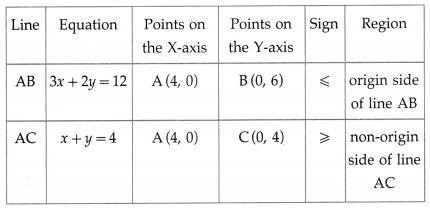
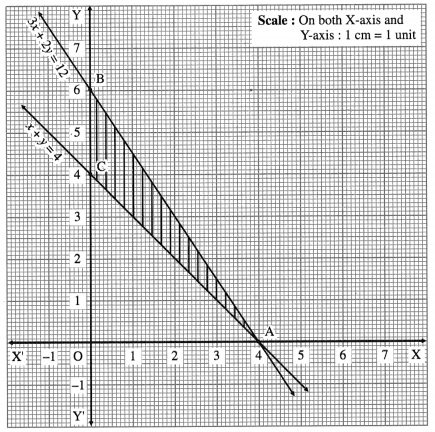
First we draw the lines AB and AC whose equations are 3x + 2y = 12 and x + y = 4 respectively. The feasible region is the ∆ABC which is shaded in the graph. The vertices of the feasible region (i.e. corner points) are A (4, 0), B (0, 6) and C (0, 4). The values of the objective function z = 4x + 6y at these vertices are z(a) = 4(4) + 6(0) = 16 + 0 = 16 z(B) = 4(0)+ 6(6) = 0 + 36 = 36 z(C) = 4(0) + 6(4) = 0 + 24 = 24 ∴ has maximum value 36, when x = 0, y = 6.
Question 3
Maharashtra Board Solution
Maximize : z = 7x + 11y subject to 3x + 5y ≤ 26 5x + 3y ≤ 30, x ≥ 0, y ≥ 0.
Solution & Step-by-Step Answer:
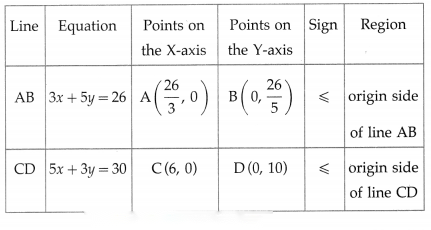
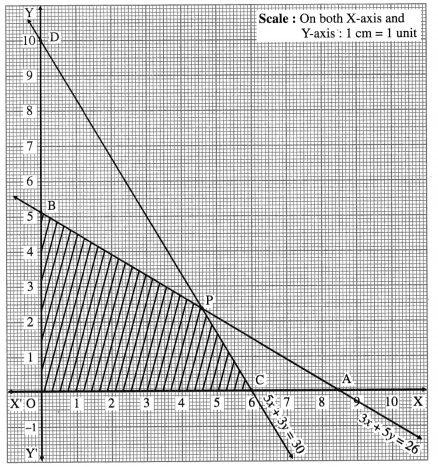
First we draw the lines AB and CD whose equations are 3x + 5y = 26 and 5x + 3y = 30 respectively. The feasible region is OCPBO which is shaded in the graph. The vertices of the feasible region are O (0, 0), C (6, 0), p and B(0, ) The vertex P is the point of intersection of the lines 3x + 5y = 26 … (1) and 5x + 3y = 30 … (2) Multiplying equation (1) by 3 and equation (2) by 5, we get 9x + 15y = 78 and 25x + 15y = 150 On subtracting, we get 16x = 72 ∴ x = = 4.5 Substituting x = 4.5 in equation (2), we get 5(4.5) + 3y = 30 22.5 + 3y = 30 ∴ 3y = 7.5 ∴ y = 2.5 ∴ P is (4.5, 2.5) The values of the objective function z = 7x + 11y at these corner points are z (O) = 7(0) + 11(0) = 0 + 0 = 0 z (C) = 7(6) + 11(0) = 42 + 0 = 42 z (P) = 7(4.5) + 11 (2.5) = 31.5 + 27.5 = 59.0 = 59 z(B) = 7(0) + 11 = 57.2 ∴ z has maximum value 59, when x = 4.5 and y = 2.5.
Question 4
Maharashtra Board Solution
Maximize : z = 10x + 25y subject to 0 ≤ x ≤ 3, 0 ≤ y ≤ 3, x + y ≤ 5 also find maximum value of z.
Solution & Step-by-Step Answer:
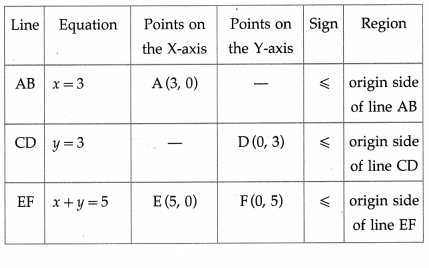
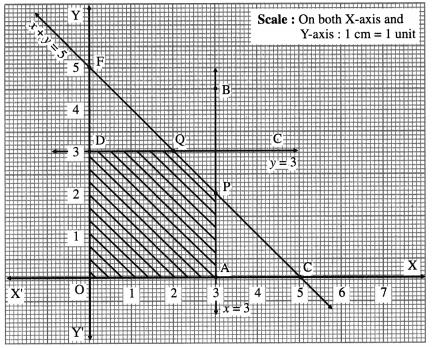
First we draw the lines AB, CD and EF whose equations are x = 3, y = 3 and x + y = 5 respectively. The feasible region is OAPQDO which is shaded in the i graph. The vertices of the feasible region are O (0, 0), A (3, 0), P, Q and D(0, 3). t P is the point of intersection of the lines x + y = 5 and x = 3. Substituting x = 3 in x + y = 5, we get 3 + y = 5 ∴ y = 2 ∴ P is (3, 2) Q is the point of intersection of the lines x + y = 5 and y = 3 Substituting y = 3 in x + y = 5, we get x + 3 = 5 ∴ x = 2 ∴ Q is (2, 3) The values of the objective function z = 10x + 25y at these vertices are z(O) = 10(0) + 25(0) = 0 + 0 = 0 z(a) = 10(3) + 25(0) = 30 + 0 = 30 z(P) = 10(3) + 25(2) = 30 + 50 = 80 z(Q) = 10(2) + 25(3) = 20 + 75 = 95 z(D) = 10(0)+ 25(3) = 0 + 75 = 75 ∴ z has maximum value 95, when x = 2 and y = 3.
Question 5
Maharashtra Board Solution
Maximize : z = 3x + 5y subject to x + 4y ≤ 24, 3x + y ≤ 21, x + y ≤ 9, x ≥ 0, y ≥ 0 also find maximum value of z.
Solution & Step-by-Step Answer:
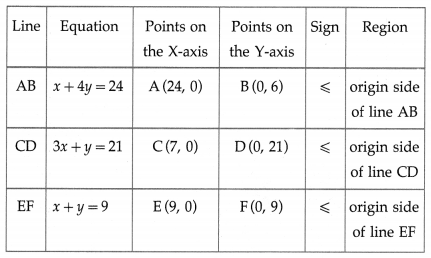
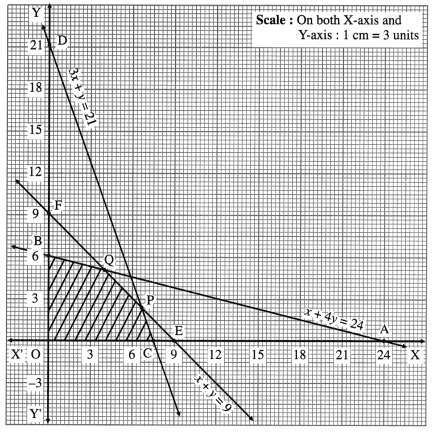
First we draw the lines AB, CD and EF whose equations are x + 4y = 24, 3x + y = 21 and x + y = 9 respectively. The feasible region is OCPQBO which is shaded in the graph. The vertices of the feasible region are O (0, 0), C (7, 0), P, Q and B (0, 6). P is the point of intersection of the lines 3x + y = 21 … (1) and x + y = 9 … (2) On subtracting, we get 2x = 12 ∴ x = 6 Substituting x = 6 in equation (2), we get 6 + y = 9 ∴ y = 3 ∴ P = (6, 3) Q is the point of intersection of the lines x + 4y = 24 … (3) and x + y = 9 … (2) On subtracting, we get 3y = 15 ∴ y = 5 Substituting y = 5 in equation (2), we get x + 5= 9 ∴ x = 4 ∴ Q = (4, 5) ∴ the corner points of the feasible region are 0(0,0), C(7, 0), P (6, 3), Q (4, 5) and B (0, 6). The values of the objective function 2 = 3x + 5y at these corner points are z(O) = 3(0)+ 5(0) = 0 + 0 = 0 z(C) = 3(7) + 5(0) = 21 + 0 = 21 z(P) = 3(6) + 5(3) = 18 + 15 = 33 z(Q) = 3(4) + 5(5) = 12 + 25 = 37 z(B) = 3(0)+ 5(6) = 0 + 30 = 30 ∴ z has maximum value 37, when x = 4 and y = 5.
Question 6
Maharashtra Board Solution
Minimize : z = 7x + y subject to 5x + y ≥ 5, x + y ≥ 3, x ≥ 0, y ≥ 0.
Solution & Step-by-Step Answer:
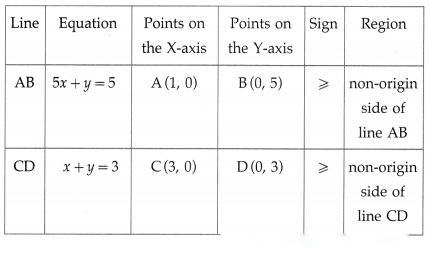
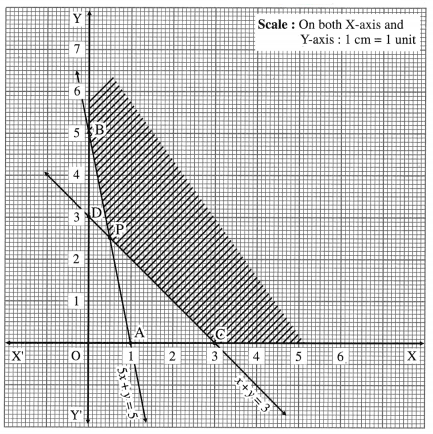
First we draw the lines AB and CD whose equations are 5x + y = 5 and x + y = 3 respectively. The feasible region is XCPBY which is shaded in the graph. The vertices of the feasible region are C (3, 0), P and B (0, 5). P is the point of the intersection of the lines 5x + y = 5 and x + y = 3 On subtracting, we get 4x = 2 ∴ x = Substituting x = in x + y = 3, we get + y = 3 ∴ y = ∴ P = The values of the objective function z = 7x + y at these vertices are z(C) = 7(3) + 0 = 21 z(B) = 7(0) + 5 = 5 ∴ z has minimum value 5, when x = 0 and y = 5.
Question 7
Maharashtra Board Solution
Minimize : z = 8x + 10y subject to 2x + y ≥ 7, 2x + 3y ≥ 15, y ≥ 2, x ≥ 0, y ≥ 0.
Solution & Step-by-Step Answer:
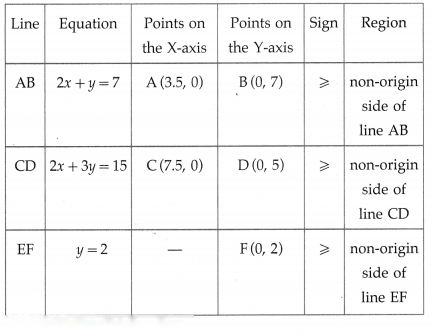
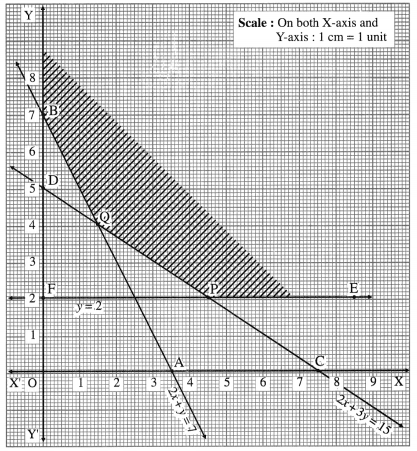
First we draw the lines AB, CD and EF whose equations are 2x + y = 7, 2x + 3y = 15 and y = 2 respectively. The feasible region is EPQBY which is shaded in the graph. The vertices of the feasible region are P, Q and B(0,7). P is the point of intersection of the lines 2x + 3y = 15 and y = 2. Substituting y – 2 in 2x + 3y = 15, we get 2x + 3(2) = 15 ∴ 2x = 9 ∴ x = 4.5 ∴ P = (4.5, 2) Q is the point of intersection of the lines 2x + 3y = 15 … (1) and 2x + y = 7 … (2) On subtracting, we get 2y = 8 ∴ y = 4 ∴ from (2), 2x + 4 = 7 ∴ 2x = 3 ∴ x = 1.5 ∴ Q = (1.5, 4) The values of the objective function z = 8x + 10y at these vertices are z(P) = 8(4.5) + 10(2) = 36 + 20 = 56 z(Q) = 8(1.5) + 10(4) = 12 + 40 = 52 z(B) = 8(0) +10(7) = 70 ∴ z has minimum value 52, when x = 1.5 and y = 4
Question 8
Maharashtra Board Solution
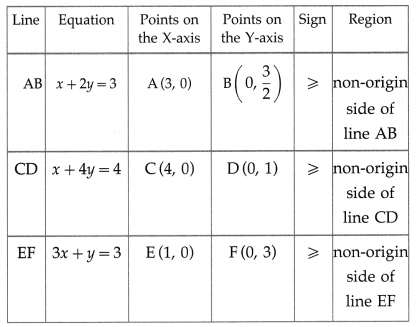
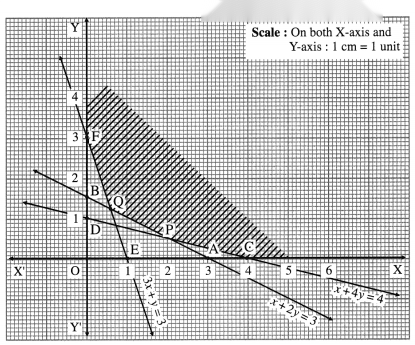
Minimize : z = 6x + 21y subject to x + 2y ≥ 3, x + 4y ≥ 4, 3x + y ≥ 3, x ≥ 0, y ≥ 0.
Solution & Step-by-Step Answer:
First we draw the lines AB, CD and EF whose equations are x + 2y = 3, x + 4y = 4 and 3x + y = 3 respectively. The feasible region is XCPQFY which is shaded in the graph. The vertices of the feasible region are C (4, 0), P, Q and F(0, 3). P is the point of intersection of the lines x + 4y = 4 and x + 2y = 3 On subtracting, we get 2y = 1 ∴ y = Substituting y = in x + 2y = 3, we get x + 2 = 3 ∴ x = 2 ∴ P = (2, ) Q is the point of intersection of the lines x + 2y = 3 … (1) and 3x + y = 3 ….(2) Multiplying equation (1) by 3, we get 3x + 6y = 9 Subtracting equation (2) from this equation, we get 5y = 6 ∴ y = ∴ from (1), x + 2 = 3 ∴ x = 3 – Q ≡ The values of the objective function z = 6x + 21y at these vertices are z(C) = 6(4) + 21(0) = 24 z(P) = 6(2) + 21 = 12 + 10.5 = 22.5 z(Q)= 6 + 21 = = 28.8 2 (F) = 6(0) + 21(3) = 63 ∴ z has minimum value 22.5, when x = 2 and y = .