Balbharti12th Maharashtra State Board Maths Solutions BookPdf Chapter 8 Binomial Distribution Miscellaneous Exercise 8 Questions and Answers.
Maharashtra State Board 12th Maths Solutions Chapter 8 Binomial Distribution Miscellaneous Exercise 8
(I) Choose the correct option from the given alternatives:
Solution & Step-by-Step Answer:
(b) 5
Solution & Step-by-Step Answer:
(d)
Solution & Step-by-Step Answer:
(d)
Solution & Step-by-Step Answer:
(c)
Solution & Step-by-Step Answer:
(b)
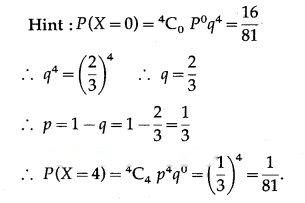
Solution & Step-by-Step Answer:
(c) 4
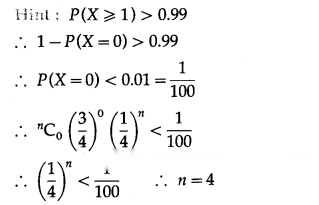
Solution & Step-by-Step Answer:
(b) 54
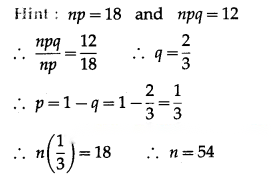
(II) Solve the following:
Solution & Step-by-Step Answer:
X ~ B(10, 0.2) ∴ n = 10, p = 0.2 ∴ q = 1 – p = 1 – 0.2 = 0.8 The p,m.f. of X is given by
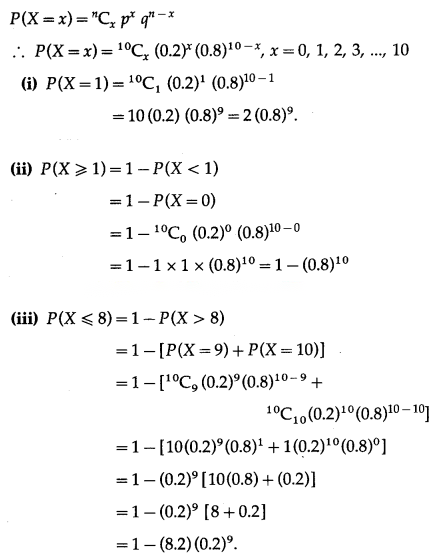
Solution & Step-by-Step Answer:
X ~ B(n, p) (i) Given: n = 10 and E(X) = 5 But E(X) = np ∴ np = 5. ∴ 10p = 5 ∴ p = ∴ q = 1 – p = 1 – = Var(X) = npq = 10()() = 2.5. Hence, p = and Var(X) = 2.5
(ii) Given: E(X) = 5 and Var(X) = 2.5
∴ np = 5 and npq = 2.5
∴
∴ q = 0.5 =
∴ p = 1 – q = 1 – =
Substituting p = in np = 5, we get
n() = 5
∴ n = 10
Hence, n = 10 and p =
Solution & Step-by-Step Answer:
Let X = number of heads. p = probability that coin tossed shows a head ∴ p = q = 1 – p = 1 – = Given: n = 10 ∴ X ~ B(10, ) The p.m.f. of X is given by P(X = x) =
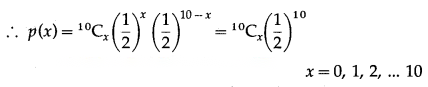
(i) P(coin shows heads 5 times) = P[X = 5]
Hence, the probability that can shows heads exactly 5 times =
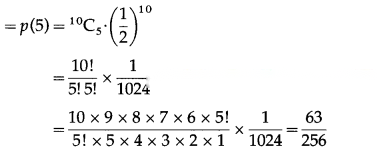
(ii) P(getting heads in first four tosses and tails in last six tosses) = P(X = 4)
Hence, the probability that getting heads in first four tosses and tails in last six tosses = .
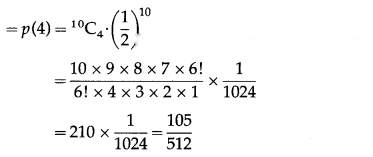
Solution & Step-by-Step Answer:
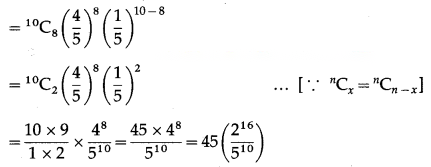
Let X = the number of bombs hitting the target. p = probability that bomb will hit the target ∴ p = 0.8 = ∴ q = 1 – p = 1 – = Given: n = 10 ∴ X ~ B(10, ) The p.m.f. of X is given as: P[X = x] = i.e.p(x) = P(exactly 2 bombs will miss the target) = P(exactly 8 bombs will hit the target) = P[X = 8] = p(8) Hence, the probability that exactly 2 bombs will miss the target = 45
Solution & Step-by-Step Answer:
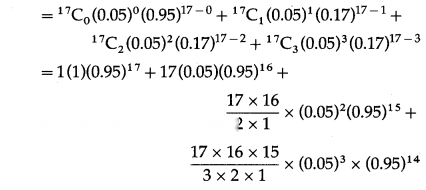
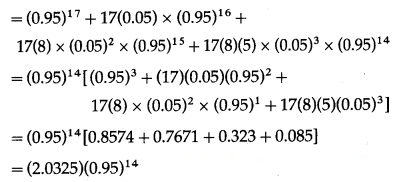
Let X = number of burst tyres. p = probability that a mountain bike travelling along a certain track will have a tyre burst. ∴ p = 0.05 ∴ q = 1 – p = 1 – 0.05 = 0.95 Given: n = 17 ∴ X ~ B(17, 0.05) The p.m.f. of X is given by P(X = x) = i.e.(x) = , x = 0, 1, 2, ……, 17 (i) P(exactly one has a burst tyre) P(X = 1) = p(1) = (0.05)1 (0.95)17-1 = 17(0.05) (0.95)16 = 0.85(0.95)16 Hence, the probability that riders has exactly one burst tyre = (0.85)(0.95)16
(ii) P(at most three have a burst tyre) = P(X ≤ 3)
= P(X = 0) + P(X = 1) + P(X = 2) + P(X = 3)
= p(0) + p(1) + p(2) + p(3)
Hence, the probability that at most three riders have burst tyre = (2.0325)(0.95)14.
(iii) P(two or more have tyre burst) = P(X ≥ 2)
= 1 – P(X < 2)
= 1 – [P(X = 0) + P(X = 1)]
= 1 – [p(0) + p(1)]
= 1 – [ (0.05)0(0.95)17+ (0.05)(0.95)16]
= 1 – [1(1)(0.95)17+ 17(0.05)(0.95)16]
= 1 – (0.95)16[0.95 + 0.85]
= 1 – (1.80)(0.95)16
= 1 – (1.8)(0.95)16
Hence, the probability that two or more riders have tyre burst = 1 – (1.8)(0.95)16.
Solution & Step-by-Step Answer:
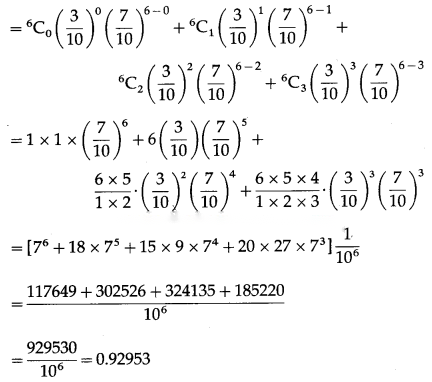
Let X = number of lamps burnt out in the classroom. p = probability of a lamp in a classroom will be burnt ∴ p = 0.3 = ∴ q = 1 – p = 1 – = Given: n = 6 ∴ X ~ B(6, ) The p.m.f. of X is given as: P[X = x] = i.e., p(x) = Since the classroom is unusable if the number of lamps burning in it is less than four, therefore P(classroom cannot be used) = P[X < 4] = P[X = 0] + P[X = 1] + P[X = 2] + P[X = 3] = p(0) + p(1) + p(2) + p(3) Hence, the probability that the classroom cannot be used on a random occasion is 0.92953.
Solution & Step-by-Step Answer:
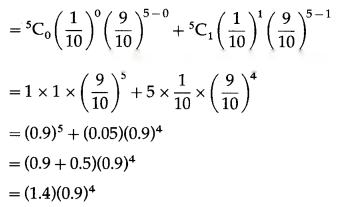
Let X = number of defective items. p = probability that item is defective ∴ p = ∴ q = 1 – p = 1 – = Given: n = 5 ∴ X ~ B(5, ) The p.m.f. of X is given as: P[X = x] = i.e., p(x) = P (store will receive at most one defective item) = P[X ≤ 1] =P[X = 0] + P[X = 1] = p(0) + p(1) Hence, the probability that the store will receive at most one defective item is (1.4)(0.9)4.
Solution & Step-by-Step Answer:
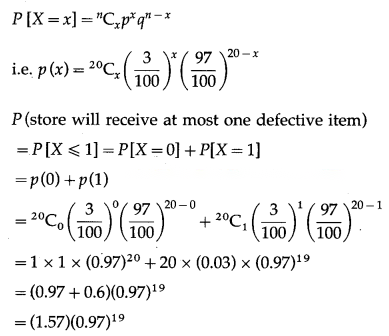
Let X = number of defective electronic devices. p = probability that device is defective ∴ p = 3% = ∴ q = 1 – p = 1 – = Given: n = 20 ∴ X ~ B(20, ) The p.m.f. of X is given as: Hence, the probability that the store will receive at most one defective item = (1.57)(0.97)19.
Solution & Step-by-Step Answer:
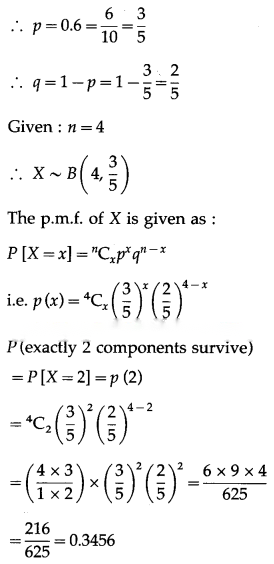
Let X = number of tested components survive. p = probability that the component survives the check test Hence, the probability that exactly 2 of the 4 tested components survive is 0.3456.
Solution & Step-by-Step Answer:
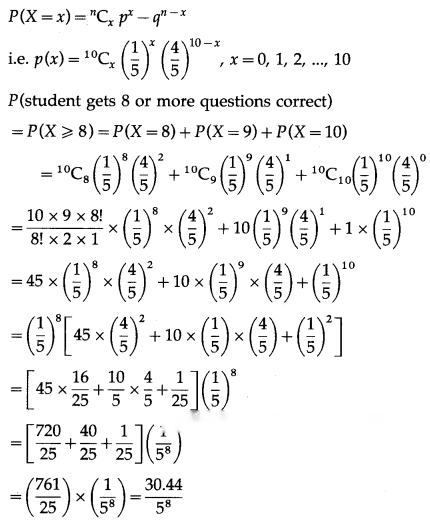
Let X = number of correct answers. p = probability that student gets correct answer ∴ p = ∴ q = 1 – p = 1 – = Given: n = 10 (number of total questions) ∴ X ~ B(10, ) The p.m.f. of X is given by Hence, the probability that student gets 8 or more questions correct =
Solution & Step-by-Step Answer:
Let X = number of machines which produce the bolts within specification. p = probability that a machine produce bolts within specification p = 0.998 and q = 1 – p = 1 – 0.998 = 0.002 Given: n = 8 ∴ X ~ B(8, 0.998) The p.m.f. of X is given by P(X = x) = i.e. p(x) = , x = 0, 1, 2, …, 8 (i) P(all 8 machines will produce all bolts within specification) = P[X = 8] = p(8) = (0.998)8 (0.002)8-8 = 1(0.998)8. (1) = (0.998)8 Hence, the probability that all 8 machines produce all bolts with specification = (0.998)8.
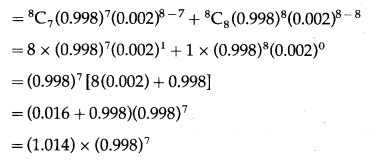
(ii) P(7 or 8 machines will produce all bolts within i specification) = P (X = 7) + P (X = 8)
Hence, the probability that 7 or 8 machines produce all bolts within specification = (1.014)(0.998)7.
(iii) P(at most 6 machines will produce all bolts with specification) = P[X ≤ 6]
= 1 – P[x > 6]
= 1 – [P(X = 7) + P(X = 8)]
= 1 – [P(7) + P(8)]
= 1 – (1.014)(0.998)7
Hence, the probability that at most 6 machines will produce all bolts with specification = 1 – (1.014)(0.998)7.
Solution & Step-by-Step Answer:
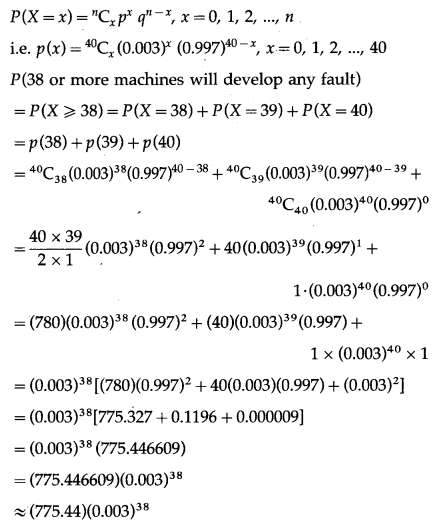
Let X = the number of machines who develop a fault. p = probability that a machine develops a fait within the first 3 years of use ∴ p = 0.003 and q = 1 – p = 1 – 0.003 = 0.997 Given: n = 40 ∴ X ~ B(40, 0.003) The p.m.f. of X is given by Hence, the probability that 38 or more machines will develop the fault within 3 years of use = (775.44)(0.003)38.
Solution & Step-by-Step Answer:
Let X = number of terminals which required attention during a week. p = probability that any terminal will require attention during a week ∴ p = 0.1 and q = 1 – p = 1 – 0.1 = 0.9 Given: n = 10 ∴ X ~ B(10, 0.1) The p.m.f. of X is given by P(X = x) = i.e. p(x) = , x = 0, 1, 2, …, 10 (i) P(no terminal will require attention) = P(X = 0) Hence, the probability that no terminal requires attention = (0.9)10
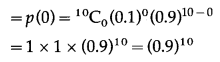
(ii) P(1 terminal will require attention)
Hence, the probability that 1 terminal requires attention = (0.9)9.
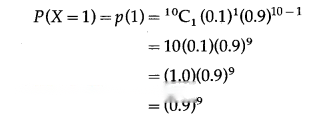
(iii) P(2 terminals will require attention)
Hence, the probability that 2 terminals require attention = (0.45)(0.9)8.
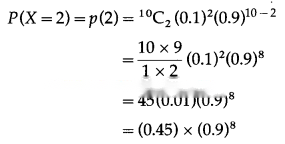
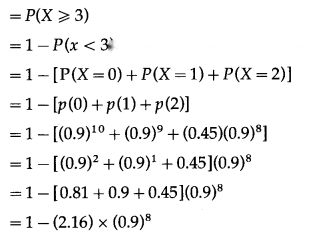
(iv) P(3 or more terminals will require attention)
Hence, the probability that 3 or more terminals require attention = 1 – (2.16) × (0.9)8.
Solution & Step-by-Step Answer:
Let X = number of pupils like Mathematics. p = probability that pupils like Mathematics
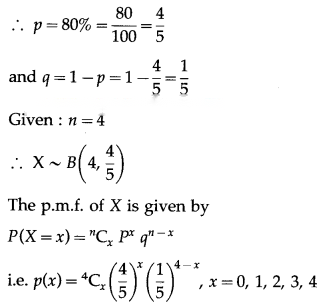
(i) The probabilities of obtaining an answer yes from 0, 1, 2, 3, 4 of pupils are P(X = 0), P(X = 1), P(X = 2), P(X = 3) and P(X = 4) respectively
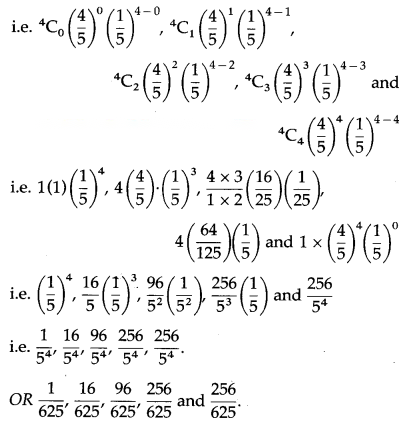
(ii) (a) P(visitor obtains the answer yes from at least 2 pupils when the number of pupils questioned remains at 4) = P(X ≥ 2)
= P(X = 2) + P(X = 3) + P(X = 4)
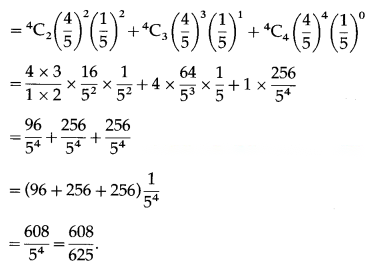
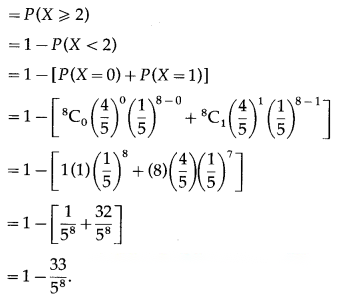
(b) P(the visitor obtains the answer yes from at least 2 pupils when number of pupils questioned is increased to 8)
Solution & Step-by-Step Answer:
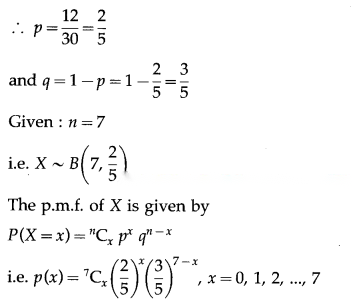
Let X = the number of days it rains in a week. p = probability that it rains
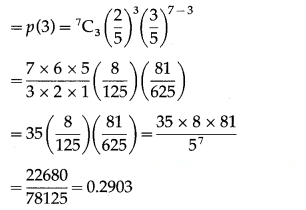
(i) P(it rains exactly 3 days of week) = P(X = 3)
Hence, the probability that it rains exactly 3 days of week = 0.2903.
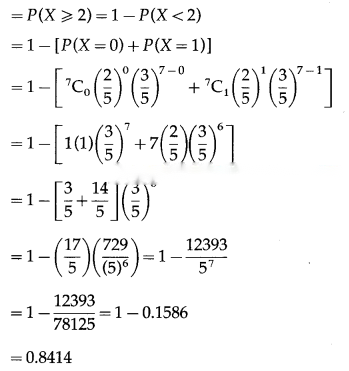
(ii) P(it will rain at least 2 days of the given week)
Hence, the probability that it rains at least 2 days of a given week = 0.8414
Solution & Step-by-Step Answer:
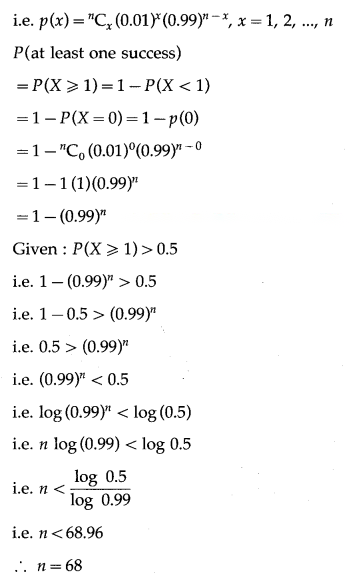
Let X = number of successes. p = probability of success in a single trial ∴ p = 0.01 and q = 1 – p = 1 – 0.01 = 0.99 ∴ X ~ B(n, 0.01) The p.m.f. of X is given by P(X = x) = Hence, the number of trials required in order to have a probability greater than 0.5 of getting at least one success is or 68.
Solution & Step-by-Step Answer:
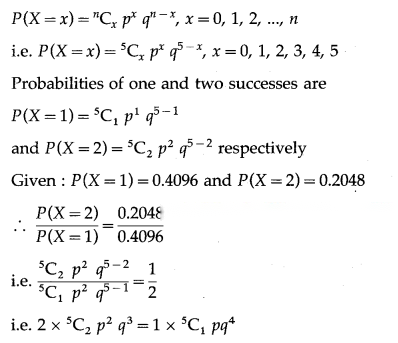
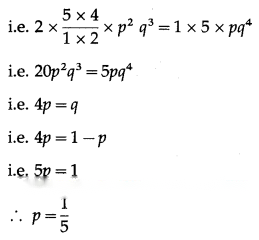
Given: X ~ B(n = 5, p) The probability of X success is Hence, the probability of success is .