Maharashtra State Board 12th Physics Solutions Chapter 8 Electrostatics
1. Choose the correct option
i) A parallel plate capacitor is charged and then isolated. The effect of increasing the plate separation on charge, potential, capacitance respectively are
(A) Constant, decreases, decreases
(B) Increases, decreases, decreases
(C) Constant, decreases, increases
(D) Constant, increases, decreases
Answer:
(A) Constant, decreases, decreases
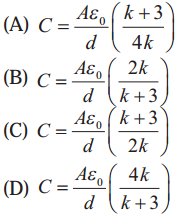
ii) A slab of material of dielectric constant k has the same area A as the plates of a parallel plate capacitor and has thickness (3/4d), where d is the separation of the plates. The change in capacitance when the slab is inserted between the plates is
Answer:
(D) C =
iii) Energy stored in a capacitor and dissipated during charging a capacitor bear a ratio.
(A) 1 : 1
(B) 1 : 2
(C) 2 : 1
(D) 1 : 3
Answer:
(A) 1 : 1
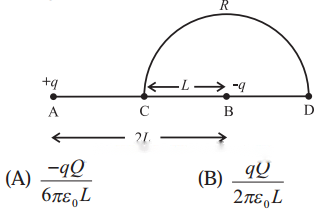
iv) Charge + q and -q are placed at points A and B respectively which are distance 2L apart. C is the mid point of A and B. The work done in moving a charge +Q along the semicircle CRD as shown in the figure below is
(C)
(D)
Answer:
(A)
v) A parallel plate capacitor has circular plates of radius 8 cm and plate separation 1mm. What will be the charge on the plates if a potential difference of 100 V is applied?
(A) 1.78 × 10⁻⁸C
(B) 1.78 × 10⁻⁵C
(C) 4.3 × 10⁴C
(D) 2 × 10⁻⁹C
Answer:
(A) 1.78 × 10⁻⁸C
2. Answer in brief.
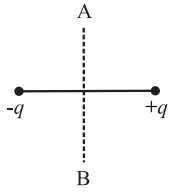
i) A charge q is moved from a point A above a dipole of dipole moment p to a point B below the dipole in equitorial plane without acceleration. Find the work done in this process.
Answer:
The equatorial plane of an electric dipole is an equipotential with V = 0. Therefore, the no work is done in moving a charge between two points in the equatorial plane of a dipole.
ii) If the difference between the radii of the two spheres of a spherical capacitor is increased, state whether the capacitance will increase or decrease.
Answer:
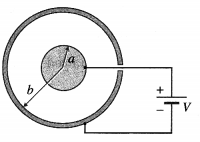
The capacitance of a spherical capacitor is C = 4πε0 where a and b are the radii of the concentric inner and outer conducting shells. Hence, the capacitance decreases if the difference b – a is increased.
iii) A metal plate is introduced between the plates of a charged parallel plate capacitor. What is its effect on the capacitance of the capacitor?
Answer:
Suppose the parallel-plate capacitor has capacitance C0, plates of area A and separation d. Assume the metal sheet introduced has the same area A.
Case (1) : Finite thickness t. Free electrons in the sheet will migrate towards the positive plate of the capacitor. Then, the metal sheet is attracted towards whichever capacitor plate is closest and gets stuck to it, so that its potential is the same as that of that plate. The gap between the capacitor plates is reduced to d – t, so that the capacitance increases.
Case (2) : Negligible thickness. The thin metal sheet divides the gap into two of thicknesses d1and d1of capacitances C1= ε0A/d1and C2= ε0A/d2in series.
Their effective capacitance is
C = = C0
i.e., the capacitance remains unchanged.
iv) The safest way to protect yourself from lightening is to be inside a car. Justify.
Answer:
There is danger of lightning strikes during a thunderstorm. Because trees are taller than people and therefore closer to the clouds above, they are more likely to get hit by lightnings. Similarly, a person standing in open ground is the tallest object and more likely to get hit by a lightning. But car with a metal body is an almost ideal Faraday cage. When a car is struck by lightning, the charge flows on the outside surface of the car to the ground but the electric field inside remains zero. This leaves the passengers inside unharmed.
v) A spherical shell of radius b with charge Q is expanded to a radius a. Find the work done by the electrical forces in the process.
Answer:
Consider a spherical conducting shell of radius r placed in a medium of permittivity ε. The mechanical force per unit area on the charged conductor is
f =
where a is the surface charge density on the conductor. Given the charge on the spherical shell is Q, (σ = Q/πr2. The force acts outward, normal to the surface.
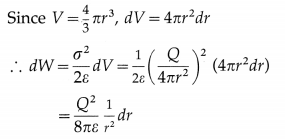
Suppose the force displaces a charged area element adS through a small distance dx, then the work done by the force is
dW = Fdx = ( dS) dx
During the displacement, the area element sweeps out a volume dV = dS ∙ dx.
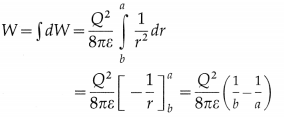
Therefore, the work done by the force in expanding the shell from radius r = b to r = a is
This gives the required expression for the work done.
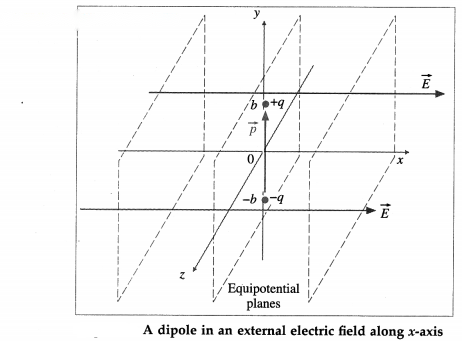
(b) From above figure, the dipole moment,
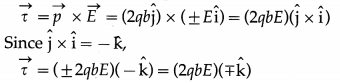
The torque on this dipole,
So that the magnitude of the torque is τ = 2qbE.
If is in the direction of the + x-axis, the torque is in the direction of – z-axis, while if is in the direction of the -x-axis, the torque is in the direction of + z-axis.
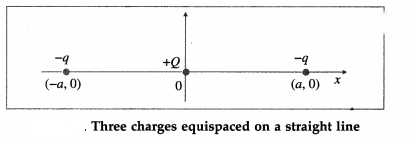
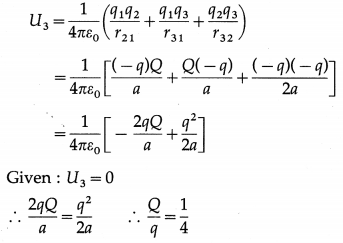
Since the battery is disconnected after it is charged, the charge Q on its plates, and consequently the product CV, remain unchanged.
On removing the dielectric completely, its capacitance becomes from Eq. (1),
C’ = ……………. (2)
that is, its capacitance decreases by the factor k. Since C’V’ = CV, its new voltage is
V’ = V = kV …………… (3)
so that its voltage increases by the factor k. The stored potential energy, U = QV, so that Q remaining constant, U increases by the factor k. The electric field, E = V/ d, so that E also increases by a factor k.
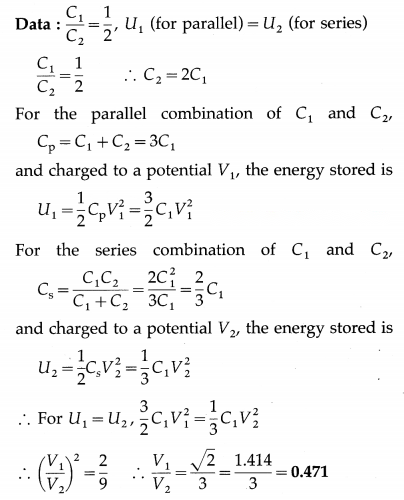
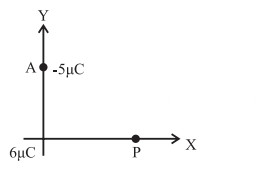
(a) The net electric potential at P due to the system of two charges is
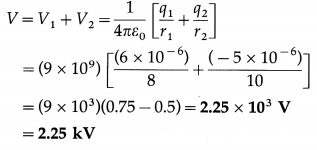
(b) The electric potential V at the point P is the negative of the work done per unit charge, by the electric field of the system of the charges q1and q2, in bringing a test charge from infinity to that point.
V =
∴ W = -qV= -(1.6 × 10⁻¹⁹)(2.25 × 10³)
= -3.6 × 10⁻¹⁶J= -2.25 keV
That is, in bringing the positively charged proton from a point of lower potential to a point of higher potential, the work done by the electric field on it is negative, which means that an external agent must bring the proton against the electric field of the system of the two source charges.
[Note : The potential V at a point is the work done per unit charge (Wext) by an external agent in bringing a test charge from infinity to that point. In the above case, the work done by an external agent will be positive. The question does not specify this.]
(ii) Q0= C0V = (26.55 × 10⁻¹²)(100)
= 26.55 × 10⁻¹⁰C = 2.655 nC
(iii) The dielectric of relative permittivity k1completely fills the space between the plates (∵t = d), so that the new capacitance is C = k1C0.
With the supply still connected, V remains the same.
∴ Q = CV = kC0V = kQ0=6(2.655 nF) = 15.93 nC
Therefore, the charge on the plates increases.
[Note: Ck1C0= 6(26.55 pF)= 159.3 pF.]
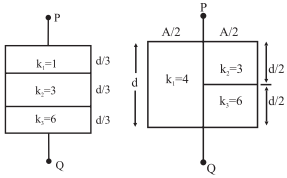
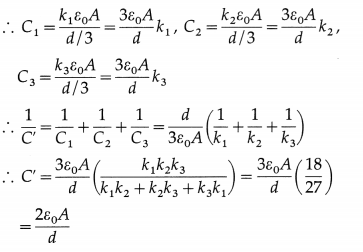
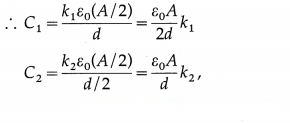
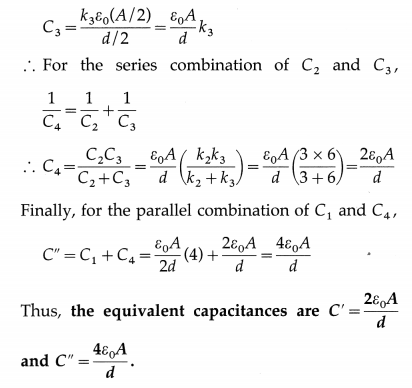
(ii) In figure, a series combination of two capacitors C2(k2= 3) and C3(k3= 6), of plate areas A/2 and plate separations d/2, is in parallel with a capacitor C1(k1= 4) of plate area A/2 and plate separation d.
12th Physics Digest Chapter 8 Electrostatics Intext Questions and Answers
Can you recall (Textbook Page No. 188)
We follow the same procedure with the electric force, which is also a conservative force with the only difference that while the gravitational force is always attractive, electric force can be attractive (for unlike charges) or repulsive (for like charges).
Remember this (Textbook Page No. 191)
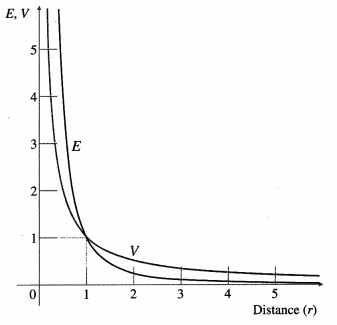
Use your brain power (Textbook Page No.194)
Do you know (Textbook Page No. 203)
Remember this (Textbook Page No. 205)
Parallel combination of capacitors
Remember this (Textbook Page No. 207)
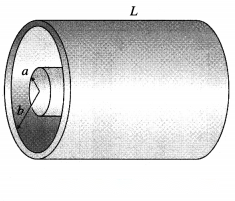
2. A cylindrical capacitor consists of a solid cylindrical conductor of radius a is surrounded by coaxial cylindrical shell of inner radius b. The length of both cylinders is L, such that L is much larger than b – a, the separation of the cylinders, so that edge effects can be ignored. The capacitance of the capacitor is C = .
The capacitance depends only on the geometrical factors, L, a and b, as for a parallel-plate capacitor.
3. A spherical capacitor which consists of two concentric spherical shells of radii a and b. The capacitance of the capacitor is C = 4πε0
Again, the capacitance depends only on the geometrical factors, a and b.