Maharashtra State Board Class 12 Political Science Solutions Chapter 4 Contemporary India: Challenges to Peace, Stability and National Integration
1. (A) Complete the following statements by selecting the appropriate option.
Solution & Step-by-Step Answer:
(c) 370
Solution & Step-by-Step Answer:
(d) Naxalbari
(B) Identify the incorrect pair in every set and correct it.
Solution & Step-by-Step Answer:
(b) Jaish-e-Mohammed – Uri attacks
Solution & Step-by-Step Answer:
(a) Boko Haram – Nigeria OR IRA – Ireland
(C) Complete the following statements by using appropriate reason.
Solution & Step-by-Step Answer:
(ii) the opposition parties ask them to do so.
Solution & Step-by-Step Answer:
(i) they weren’t from Kashmir.
2. (A) Find the odd word.
Solution & Step-by-Step Answer:
Nationalism (not a violent activity)
(B) State the appropriate concept for the given statements.
Solution & Step-by-Step Answer:
Terrorism
Solution & Step-by-Step Answer:
Good Governance
3. (A) Complete the concept maps.
Solution & Step-by-Step Answer:

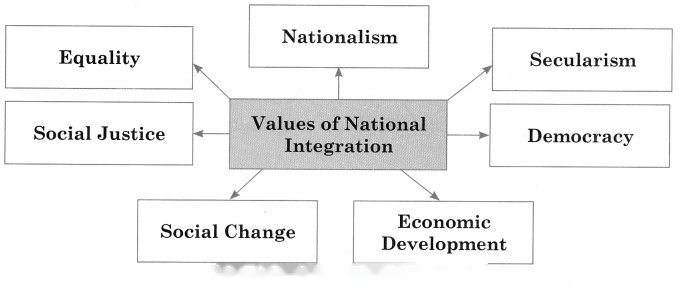
(B) State whether the following statements are true or false with reason.
Solution & Step-by-Step Answer:
This statement is True.
Solution & Step-by-Step Answer:
This statement is True.
4. Explain the correlation between the following.
Solution & Step-by-Step Answer:
National Unity is possible when citizens of that State exhibit psychological oneness, solidarity and shared values. It is not homogeneity but a form of ethnic, religious and linguistic acceptance. Regional aspirations occur in forms like demand for separate States, language issues, etc., Regional aspirations have their roots in historical/linguistic/cultural issues or may be a product of regional political outfits. Sometimes, regional aspirations may even become secessionist as in case of Khalistan movement. India has tried to reconcile regional aspirations with national unity by creating a federation with a strong centre, creating of smaller States as well as the linguistic reorganisation of States.
5. Express your opinion of the following.
Solution & Step-by-Step Answer:
Peace, stability and public order are necessary for nation’s progress and good life of citizens. An unruly society will lead to violence, loss of life, destruction of property, economic and political instability. Conflict resolution is linked to maintenance of law, order and peace. In the absence of order and stability, divisive tendencies will prevail, infrastructure will be targeted, investments will be discouraged thus becoming a barrier to economic growth. At a basic level, political stability is ensured using constitutional machinery and socio-economic development. In case of any problem occurring, the State tries to resolve it peacefully. In case the issue escalates or becomes violent, the State may employ force if necessary.
6. Answer the following question in 80 to 100 words.
Solution & Step-by-Step Answer:
Left Wing Extremism (also called Maoist movement or Naxalism) has major support base among landless labourers, dalits and tribals who experience a sense of oppression, injustice and neglect. The first attempt to promote a peasant struggle was the Telangana Movement (1946-51). The Naxal Movement originated in 1967 in Naxalbari (West Bengal) led by Kanu Sanyal and writings of Charu Majumdar.
Since 1980s the movement has taken a militant turn. In 2004 CPI (M-L), People’s War Group (PWG) and Maoist Communist Centre (MCC) of India merged to form CPI (Maoist) which aims to overthrow the government, Naxal activities aim to destroy public property and attack police and officials. The Red Corridor of naxal activities extends across States like Bihar, Jharkhand, Chhattisgarh, Maharashtra, Telangana, Andhra Pradesh, etc.
Some of their broad tactics are as follows:
Solution & Step-by-Step Answer:
The India Independence Act (1947) provided that princely States (562 existed then) could decide to join either Pakistan or remain independent. Maharaja Hari Singh of the Dogra dynasty delayed such a decision. In 1947, Kashmir’s population was 77% Muslim and 20% Hindu. The problem in the region began when Pakistan sent Pashtun tribal raiders in October 1947 to force Hari Singh to join Pakistan. However, the Maharaja appealed to India for help and signed the Instrument of Accession making the State as a part of India.
The Government of India sent troops to the region to drive away the infiltrators. This led to the first India-Pakistan conflict (1947-48). In 1965, Pakistan attacked India but the local Kashmiri population did not support Pakistan. In 1965, Amanullah Khan created the Plebiscite Front in Pakistan Occupied Kashmir. It’s militant wing i.e., National Liberation Front carried out sabotage activities in Jammu and Kashmir.
In 1977, the Plebiscite Front was renamed Jammu and Kashmir Liberation Front (JKLF). Similarly, Pakistan lent support to guerilla outfits in the region like Hizb-ul-Mujahideen. In the 1990s, as instances of militancy increased, the minority Pandit population was forced to flee from Kashmir. At this time, local insurgency grew into terrorism sponsored by Pakistan and having training camps in Pakistan Occupied Kashmir. Pan-Islamic terrorist groups like Lashkar-e-Taiba, Hizbul, etc., and several Pakistan based persons like Hafeez Sayed have promoted terror activities and radicalisation of the local population. In recent years stone pelting by young protestors has increased.
7. Answer the following in 150 to 200 words.
Explain the role of the State with help of given points.
(a) Peace and order
(b) Economic development
(c) National Building
(d) Governance
(e) Welfare
Activity
Trace the changes that have taken place in Art 370 of the Indian constitution.
Class 12 Political Science Chapter 4 Contemporary India: Challenges to Peace, Stability and National Integration Intext Questions and Answers
Activity (Text Book Page No. 39)
Solution & Step-by-Step Answer:
To spread awareness about them, fundamental duties were inserted in the Part IV Article 51(A) of the Constitution by the 42nd Constitutional Amendment, 1976. The fundamental duties include:
Solution & Step-by-Step Answer:
(i) Assam Oil Blockade (1980) The Assam Movement (1979-1985) led by the All Assam Students Union (AASU) and All Assam Gana Sangram Parishad (AAGSP) was against the illegal immigrants in Assam. There were a series of protests to compel the government to identify and expel illegal immigrants (mostly Bangladeshi) and to provide safeguards to the indigenous Assamese. Some of the protests were violent e.g., the Nellie massacre (1983). On 15th August 1985, the Assam Accord was signed between the Rajiv Gandhi Government and leaders of the Assam movement by which all migrants who had entered the State prior to January 1, 1966 were accepted.
The Oil Blockade was part of the Assam agitation. Crude oil from Assam was pumped to a refinery at Barauni (Bihari). However, AASU protested and blockaded oil supply in 1980. A committee was appointed to suggest a new location for refinery within Assam. They suggested Bongaigaon near West Bengal border. The oil blockade resulted in huge losses to the petroleum industry.
(ii) Assassination of Rajiv Gandhi (1991)
Assassination of Rajiv Gandhi, former Prime Minister of India (1984-1989) occurred as a result of suicide bombing in Sriperumbudur, Chennai on 21st May 1991. It was carried out by a member of LTTE (Sri Lanka) known as Thenmozhi Rajaratnam (Dhanu) At least 14 others were killed in the explosion of the RDX laden belt by Dhanu. The assassination was attributed to LTTE being antagonised by Mr. Rajiv Gandhi’s sending of Indian Peace Keeping Force (IPKF) to Sri Lanka and the signing of the Indo-Sri Lanka Peace Accord with President J. Jayewardene in 1987.