Maharashtra State Board Class 12 Psychology Solutions Chapter 2 Intelligence
1. Choose the correct option and complete the following statements.
2. State whether the following statements are true or false.
3. Answer the following in one sentence each.
4. Define / Explain the concepts in 25 – 30 words each.
A continued pattern of nourishing behaviour indicates a high level of social intelligence. Such persons are skilled at interacting with and understanding people around them. They respect and encourage others. They effectively comprehend social dynamics.
5. Write short notes on the following.
David Wechsler defines intelligence as, “the aggregate or global capacity of an individual to act purposefully, to think rationally and to deal effectively with his environment.”
Intelligence Quotient refers to a measurement of intelligence.. In 1912, William Stern introduced the concept of intelligence quotient (IQ). Terman, refined the formula for calculating IQ, which is as stated below-
IQ = × 100
Example: Ankush who is 10 years old has a Mental Age of 11 years. Let us calculate his IQ.
MA = 11 years CA = 10 years IQ = ?
IQ = × 100 = × 100 = 110
Ankush has an IQ of 110.
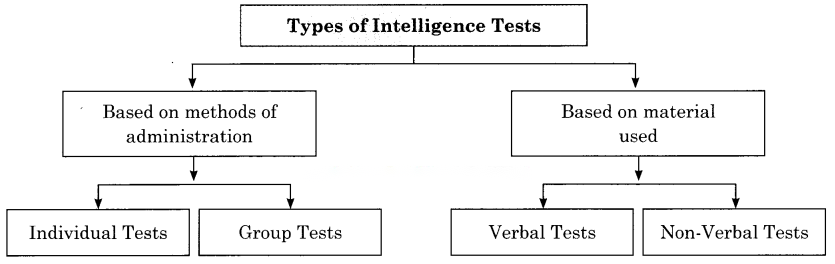
On the basis of material used in the tests, intelligence tests can be classified as Verbal tests and Non-verbal tests of intelligence. Intelligence tests that use language (words or numbers) for measuring intelligence are called verbal tests of intelligence. In these tests subjects are required to respond verbally to test items. Army Alpha Test, Wechsler’s Adult Intelligence Scale (WAIS), etc., are some of the examples of verbal tests of intelligence. These tests are language and culture bound and hence cannot be used with children, illiterates etc. However, they are useful in measuring higher mental abilities.
Intelligence tests that use pictures, designs, material objects, etc., to measure intelligence are called non-verbal tests of intelligence. In these tests language is not used to measure intelligence. In these tests subjects are not required to respond verbally to test items. Non-verbal tests are of two types viz.
Artificial intelligence can take decisions only on the basis of stored information and so cannot be an alternative to human intelligence. Artificial intelligence has immense applications in daily life as well as to solve critical problems. Artificial intelligence is used in devices like robots, computers, self-driving cars, automatic missiles, smart phones, medical diagnostic tools, etc.
6. Answer the following questions with the help of the given points.

(ii) Advantages-
(iii) Disadvantages-
(ii) Advantages-
(iii) Disadvantages-
7. Answer the following questions in Detail.
David Wechsler defines intelligence as, ‘the aggregate or global capacity of an individual to act purposefully, to think rationally and to deal effectively with his environment’. Many psychologists have contributed to the measurement of Intelligence.
Sir Francis Galton thought that he could determine intelligence by measuring the size of the human skull. He administered a battery of tests to measure variables such as head size, reaction time, visual acuity, etc. However, these tests did not prove useful to measure intelligence.
Raymond Cattell, used the term ‘mental test’ for the first time. Like his mentor, Sir Galton, Cattell also believed that intelligence is best measured by sensory tasks. However, be emphasized that test administration must be standardized.
In 1905, Alfied Binet in collaboration with Theodor Simon, published the First Scale of Intelligence. This scale was revised in 1908 and 1911. In 1916, Lewis Terman revised the scale, i.e., adapted few items, established new age norms etc. This came to be called ‘Stanford Binet Test’. Binet also introduced the concept of Mental Age. It is defined as the age at which the person successfully performs on all items of the test prepared for that age level.
In 1917, Robert Yerkes and his colleagues developed the Army Alpha (verbal test) and Army Beta (performance test) intelligence tests. These two tests were used to recruit soldiers. In 1939, during World War II also, to recruit army personnel, the Army General Classification Test was used.
In 1939, David Wechsler published the Wechsler-Bellevue Intelligence Test. In 1955, the test was revised and then called Wechsler Adult Intelligence Scale (WAIS). It has a verbal scale and performance scale. Wechsler also developed a test to measure intelligence of children, i.e., Wechsler Intelligence Scale for Children (WISC).
Mental Age – Alfred Binet introduced the concept of Mental Age. It is defined as the age at which the person successfully performs on all items of the test prepared for that age level. Mental Age need not correspond to Chronological Age. It Mental Age (MA) is the same as Chronological Age (CA), the person has average intelligence.
Intelligence Quotient – In 1912, William Stern introduced the concept of Intelligence Quotient (IQ). Terman, refined the formula for calculating IQ which is as stated below-
IQ = × 100 IQ made it possible to compare the intelligence of individuals of different age CA groups.
(ii) Group tests of intelligence-
Group test of intelligence are tests that can be administered to more than one person at a time, i.e., for mass testing, for e.g., Army Alpha and Army Beta Test, OTIS self-administrating tests, etc.
(iii) Verbal tests of intelligence-
Verbal tests of intelligence make use of words and numbers to measure intelligence and subjects respond verbally to the test items, for e.g., WAIS, Army Alpha Test, etc.
(vi) Non-verbal tests of intelligence-
Non-verbal tests of intelligence do not use language to measure intelligence. They make use of pictures, designs, objects, etc. Such tests may be (i) Performance tests, e.g., Koh’s Block Design Test or (ii) Paper-pencil test e.g., Raven’s Standard Progressive Matrices.
Application of Intelligence Testing
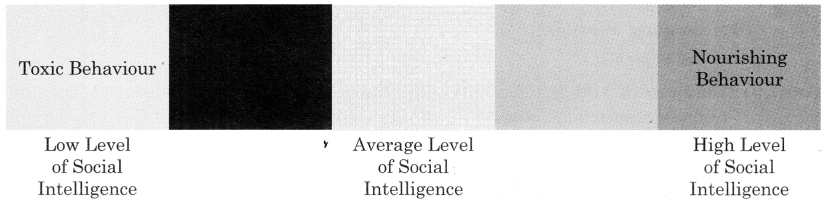
According to Karl Albrecht our behaviour towards others falls somewhere on a spectrum between toxic behaviour and nourishing behaviour. Devaluing others, refusing cooperation to others, negative talking, discouraging others, etc., are some of the examples of toxic behaviours. A continued pattern of toxic behaviour indicates a low level of social intelligence. Respecting others, cooperating with others, positive talking, encouraging others, etc., are some of the examples of nourishing behaviour. A continued pattern of nourishing behaviour indicates a high level of social intelligence.
The following are some of the characteristics of people having high social intelligence:
Class 12 Psychology Chapter 2 Intelligence Intext Questions and Answers
ACTIVITY (Textbook Page. No. 12)
Activity 1
Read the following sentences and decide whether the given sentences are the facts or just beliefs about intelligence :
(i) Intelligence is something that is inborn.
(ii) Students who are intelligent can get good marks in examinations.
(iii) Students who do not get good marks in examinations are less intelligent.
(iv) People who are intelligent are very smart.
(v) Intelligent people can impress anyone by their talk.
Answer:
[All the statements are just beliefs, not facts.]
Activity 2 (Textbook Page. No. 15)
Read the following examples. Using the formula, calculate the I.Q. of the following students:
(i) Aabha is a genius girl. Her chronological age is 8 years and her mental age is 14 years. Find out her I.Q.
(ii) Mayur has learning disabilities. His chronological age is 8 years and his mental age is 6 years. Find out his I.Q.
Answer:
(i) In case of Aabha – Mental Age (MA) = 14 years
Chronological Age (CA) = 8 years, IQ = ?
IQ = × 100 = × 100 = 175
IQ = 175.
(ii) In case of Mayur – Mental Age (MA) = 6 years.
Chronological Age (CA) = 8 years, IQ = ?
MA 6
IQ = × 100 = × 100 = 75
IQ = 75.
Activity 3 (Textbook Page. No. 16)
Make a chart listing the advantages and disadvantages of individual tests of intelligence.
Answer:
(i) Advantages-
(ii) Disadvantages-
Activity 4 (Textbook Page. No. 16)
Make a chart listing the advantages and disadvantages of group tests of intelligence.
Answer:
(i) Advantages-
(ii) Disadvantages-
Activity 5 (Textbook Page. No. 17)
Verbal test of intelligence Choose the correct option:
(i) Shoe – Foot : : Hat – ……………..
(a) Kitten
(b) Head
(c) Knife
Answer:
Shoe – Foot: : Hat – Head
(ii) Eye – Head : : Window – ………………
(a) Key
(b) Floor
(c) Room
Answer:
Eye – Head : : Window – Room
Activity 6 (Textbook Page. No. 19)
Read the examples given in Activity 6 on textbook page no. 18 and decide the positions of Chetan, Sagar and Anil on the following spectrum of behaviour:
Answer:

Activity 7 (Textbook Page. No. 20)
Study the differences between the characteristics of people having high emotional intelligence and low emotional intelligence and think about what you can do to develop your emotional intelligence?
Characteristics of people having high emotional intelligence | Characteristics of people having low emotional intelligence |
Emotionally stable, Patient | Emotionally unstable, Impatient |
Optimistic, Independent | Pessimistic, Dependent |
Happy, Enthusiastic | Sad, Apathetic |
Calm, Satisfied | Restless, Dissatisfied |
Answer:
I will try to develop emotional intelligence by adopting the following ways-
Activity 8 (Textbook Page. No. 20)
Discuss how the following devices use Artificial Intelligence:
(i) Computers
(ii) Self-driving cars
(iii) Robots
(iv) Medical diagnostic tools
(v) Translation devices
(vi) Automatic Missiles
(vii) Chatbots, etc.
Answer:
(i) Computers – AI is the ability of a computer programme to think and learn. It makes computers smart, i.e., work without being encoded with commands.
(ii) Self-driving cars – Autonomous driving is a key application of AI. Self-driving cars are equipped with multiple sensors such as cameras, radars, etc., which generate massive amount of data and simulate human perceptual and decision making processes in driving.
(iii) Robots – AI gives robots the computer vision to navigate, sense and calculate their reaction accordingly. Robots learn to perform tasks from humans through machine learning which is a part of computer programming and AI.
(iv) Medical diagnostic tools – Abnormalities in body fluids and tissue can be automatically detected using AI in medical diagnosis solutions. AI can help to speed up process of diagnosis, i.e., biomarkers.
(v) Translation devices-AI uses Neural Machine Translation (NMT), i.e., an electronic, neural network trained to recognize patterns in the input data set and translate it into desired output data, for e.g., a sentence in Japanese into English. It is more accurate than simple machine translation.
(vi) Automatic Missiles – AI is leading the world towards a battlefield that has no boundaries, may not even have humans involved and will be impossible to control across the human ecosystem in Cyberspace, Geospace and Space (CGS). It refers to the weaponisation of AI, i.e., a weapon system that can select human/ non-human targets without further intervention by a human operator.
(vii) Chatbots – AI makes it possible for chatbots to ‘learn’ by discovering patterns in data. A chatbot is a computer programme that imitates spoken and written conversation, i.e., voice commands and texts, for e.g., Siri.