Maharashtra State Board Class 12 Psychology Solutions Chapter 4 Cognitive Processes
1. Choose the correct option and complete the following statements.
2. Answer the following questions in 35 – 40 words each.
Some examples of top-down processes in perception are-
(a) Mr. Kumar lives in Flat A not in Flat
The circled item will be perceived as the letter B as the brain has used the context of the sentence.
(b) If you are asked to identify (a) the rat (b) the man, your perception will be likewise.
(c) the huamn mnid deos not raed ervey lteter by istlef but the wrod as a whole.


Most of you would be able to correctly read the above sentence as “The human mind does not read every letter by itself but the word as a whole”.
(ii) Learning by operant conditioning – Learning by operant conditioning was first explained by B. F. Skinner. He said that learning takes place to gain positive consequences or to avoid negative consequences.
3. Classify the following into Mental Representation, Concepts and Schemata.
(1) Image of your mother in your mind
(2) Building
(3) Tree
(4) School
(5) Theater
(6) Table
(7) Neil Armstrong
Answer:
Mental Representation | Concepts | Schemata |
Image of your mother in your mind | Building | School |
Neil Armstrong | Tree | Theatre |
Table |
4. Find the odd one out.
5. Identify if the following behaviours are due to learning or not. Give reasons for your answers.
6. Answer the following questions with the help of given points.
(ii) Generation alternative solutions – The person searches for possible solutions to the problem. Some solutions may be effective while other solutions have to be discarded, for e.g., Sunil finds maths difficult. He may think of solving more sums or of taking tuitions or of dropping the subject, etc.
(iii) Selecting a solution – The person selects what he considers the most effective solution, based on reasoning. This helps to resolve the problem in a realistic manner.
(iv) Implementing the solution and follow up on the solution – The person tries out the selected solution and evaluates the outcome i.e. whether it has helped to solve the problems. If the problem remains unresolved, the person may need to carry out the problem – solving procedure all over again.
The four stages in creative thinking are-
(i) Preparation – This involves formulating the problem and gathering information about it. Many tentative solutions are tried out and discarded. No progress seems to be made by the person.
(ii) Incubation – If the person does not get the required results, he/she may focus on things unrelated to that problem. The period helps to work out the problem without consciously thinking about it. Incubation period appears to be non-fruitful.
(iii) Illumination – After incubation, suddenly the correct solution appears to the person, due to which he/she experiences excitement. It seems that a solution has fallen into place.
(iv) Verification – The new solution may need to be evaluated a number of times. In most cases, minor changes will be required but sometimes it may demand a major overhaul of the entire process.
For e.g., A teacher asks the students to think of unusual uses for a bottle.
7. Answer the following questions in detail.
Some laws of perceptual organization are as follows:
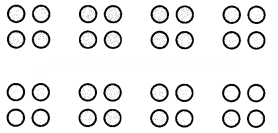
(i) Law of proximity – Stimuli that are near to each other are perceived as together, rather than stimuli that are far away from each other.
In the above figure, we perceive pairs of dots in each line because the dots which are near to each other are perceived together. So instead of perceiving a line of 8 dots, generally a line of four pairs of dots is perceived.
(ii) Law of similarity – Stimuli that are similar to each other are perceived together than stimuli that are distinct from each other.
In the above figure, we perceive 4 alternate vertical lines each of circles and crosses as similar stimuli are perceived together. Generally, we do not perceive 4 horizontal lines each having circles and crosses in alternate sequence.

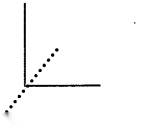
(iii) Law of continuity – There is a tendency to perceive a stimulus in continuation according to its established direction.
In the above figure, a straight vertical line and a straight horizontal line are perceived together as a letter ‘L’ and a cutting line is perceived separately as a line following the smoothest path. Generally, we do not perceive here four different lines going in different directions.
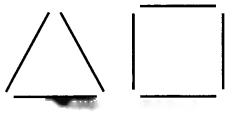
(iv) Law of closure – There is a tendency to fill in the gaps in an incomplete stimulus so as to perceive it as a meaningful figure.
In the above figure, we fill in the gaps and perceive it as a triangle and square. Generally, we do not perceive here the three or four separate lines going in different directions.
(ii) Concepts – They form the basis for all cognitive processes, acting as building blocks by connecting with each other to form more complex concepts. Concepts involve extraction of some ‘idea’ on the basis of similarities and differences among the sensations. A concept is an idea which represents a class of objects, situations, etc which differentiates it from other classes of objects, situations, etc., for e.g. a child forms a mental image of a ‘dog’. He derives an idea of something similar in all examples of ‘dog’ that he has seen i.e. tail, fur, barking, etc. Thus, he has formed concept of dog. If he mistakenly identifies as a cat as a dog. he is corrected by others. So he tries to compare the mental images of dogs and cats. He has now learned and refined two concepts viz. dog and cat.
(iii) Schema – It is an internal representation that organizes knowledge about related concepts and relationships among them. Schema involves arranging many concepts in a particular system or organisation. It describes a pattern of thought or behavior that organises categories of information and the relationships among them. A child tries to organise the concepts that he has learned in a systematic way to generate a higher order understanding of patterns about information collected, for e.g. when a child visits a ‘zoo’ for the first time, images and concepts such as of different animals, caves/cages, etc., are activated in the brain simultaneously. Thus, he is forming the schema of ‘zoo’.
Conclusion:- Mental representation is sensory experiences in the form of mental images in the brain. Many similar mental representations denote concepts while many concepts put in a particular relationship to each other is schema.
The distraction of attention refers to the drifting of attention from a specific stimulus to another stimulus. This occurs due to external factors such as intensity, novelty, movement, etc., of stimuli or internal factors like physical state, lack of interest, mental set, etc.
It is difficult to attend to a single stimulus for a long period of time. Our attention shifts from the original stimulus to another stimulus for a fraction of time and then come back to the original stimulus. This is called fluctuation of attention. It may be due to factors like fatigue, decreased interest, etc.
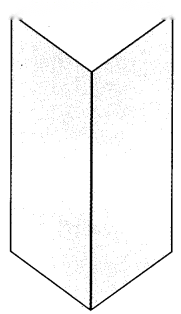
In most cases, fluctuation of attention is due to the limitations of human attention whereas distraction of attention is due to an external powerful stimulus that has drawn our attention. When attention fluctuates, it is for a very short period of time and then it returns to the original stimulus, i.e., it is a temporary shift in attention, e.g., look at the below figure. Attention fluctuates on observing the figure as a closed book or open book.
The distraction of attention arises when you are studying and the doorbell suddenly rings, you get up to answer the door. You may or may not be able to return to the original stimulus. Fluctuation of attention cannot be controlled totally but the distraction of attention should be avoided.
Class 12 Psychology Chapter 4 Cognitive Processes Intext Questions and Answers
ACTIVITIES (Textbook Page. No. 33)
Activity 1
Read the following examples and try to name the cognitive process described in each of them:
Answer: