Maharashtra State Board Class 12 Secretarial Practice Solutions Chapter 1 Introduction to Corporate Finance
1A. Select the correct answer from the options given below and rewrite the statements.
1B. Match the pairs:
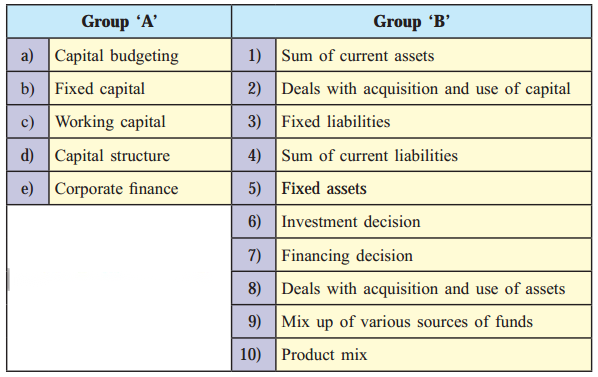
Group ‘A’ | Group ‘B’ |
(a) Capital budgeting | (6) Investment decision |
(b) Fixed capital | (5) Fixed assets |
(c) Working capital | (1) Sum of current assets |
(d) Capital structure | (9) Mix up various sources of funds |
(e) Corporate finance | (2) Deals with acquisition and use of capital |
1C. Write a word or term or a phrase that can substitute each of the following statements:
1D. State whether the following statements are True or False:
1E. Find the odd one.
1F. Complete the sentences.
1G. Select the correct option from the bracket.
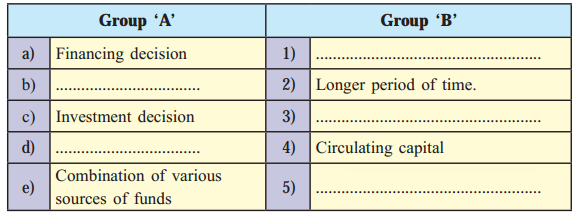
Group ‘A’ | Group ‘B’ |
(a) Financing decision | (1) To have the right amount of capital |
(b) Fixed capital | (2) Longer period of time |
(c) Investment decision | (3) Deploy funds in a systematic manner |
(d) Working capital | (4) Circulating capital |
(e) Combination of various sources of funds | (5) capital structure |
1H. Answer in one sentence.
1I. Correct the underlined word and rewrite the following sentences.
2. Explain the following terms/concepts.
3. Study the following case/situation and express your opinion.
1. The management of ‘Maharashtra State Road Transport Corporation’ wants to determine the size of working capital.
Question (a).
Being a public utility service provider will it need less working capital or more?
Answer:
MSRTC being a public utility service provider will need less working capital because of a continuous flow of cash from there, customers thus liabilities are taken care of.
Question (b).
Being a public utility service provider, will it need more fixed capital?
Answer:
Being a public utility service provider MSRTC will need a huge amount of funds to acquire fixed assets thus it will need more fixed capital.
Question (c).
Give one example of a public utility service that you come across on a day-to-day basis.
Answer:
The Indian Railways.
2. A company is planning to enhance its production capacity and is evaluating the possibility of purchasing new machinery whose cost is ₹ 2 crore or has alternative of machinery available on a lease basis.
Question (a).
What type of asset is machinery?
Answer:
Machinery is a Fixed Asset.
A fixed asset may be held for 5, 10 or 20 years and more. But if assets are acquired on a lease or rental basis, then less amount of funds for fixed assets will be needed for business.
Question (b).
Capital used for the purchase of machinery is fixed capital or working capital.
Answer:
Capital used for the purchase of machinery is fixed capital.
Question (c).
Does the size of a business determine the fixed capital requirement?
Answer:
Yes. Where a business firm is set up to carry on large-scale operations, its fixed capital requirements are likely to be high.
4. Distinguish between the following.
Points | Fixed Capital | Working Capital |
1. Meaning | Fixed capital refers to any kind of physical asset, a portion of total capital that is invested in fixed assets. | Working capital refers to the sum of current assets or gross working capital. |
2. Nature | It stays in the business almost permanently. | Working capital is circulatory capital. It keeps changing. |
3. Purpose | It is invested in fixed assets such as land, building, equipment, etc. | Working capital is invested in short-term assets such as cash, account receivable, inventory, etc. |
4. Sources | Fixed capital funding can come from selling shares, debentures, bonds, long-term loans, etc. | Working capital can be funded with short-term loans, deposits, trade credit, etc. |
5. Objectives of investors | Investors invest money in fixed capital hoping to make a future profit. | Investors invest money in working capital for getting immediate returns. |
6. Risk | Investment in fixed capital implies more risk. | Investment in working capital is less risky. Eg. Land, building, plant and machinery |
7. Decisions | Decisions relating to fixed capital investment are generally made by top-level management. Eg. Cash, bills receivable, inventories, cash at the bank | Decisions relating to working capital needs are generally made by middle-level or lower-level management. |
5. Answer in brief:
Components/Parts of Capital Structure:
There are four basic components of capital structure. They are as follows:
(i) Equity Share Capital:
(ii) Preference Share Capital:
(iii) Retained earnings:
(iv) Borrowed capital: It comprises of the following:
(ii) Size of business:
The size of a business also affects fixed capital needs. A general rule applies that the bigger the business, the higher the need for fixed capital. The size of the firm, either in terms of its assets or sales, affects the need for fixed capital.
(iii) Scope of business:
Some business firms that manufacture the entire range of their production would require a huge investment in fixed capital. However, those companies that are labour intensive and who do not use the latest technology may require less fixed capital and vice versa.
(iv) Extent of lease or rent:
Companies who take their assets on a lease basis or on a rental basis will require less amount of funds for fixed assets. On the other side, firms that purchase assets will naturally require more fixed capital in the initial stages.
Henry Hoagland expresses, “Corporate Finance deals primarily with the acquisition and use of capital by the business corporation”.
Following two decisions are the basis of corporate finances:
(i) Financing decision:
Every business firm must carefully estimate its capital needs i.e. working capital and fixed capital. The firm needs to mobilize funds from the right sources also maintaining the right combination of debt capital and equity capital. For this balance, a company may go for or raise equity capital or even opt for borrowed funds by way of debentures, public deposits term loans, etc. to raise funds.
(ii) Investment decision:
Once the capital needs are accessed, the finance manager needs to take correct decisions regarding the use of the funds in a systematic manner, productively, using effective cost control measures to generate high profits. Finding investments through proper decisions and using them successfully in business is called ‘capital budgeting
6. Justify the following statements.
7. Answer the following questions.
The importance of Corporate Finance are as follows:
(i) Helps in decision making:
Most important decisions of business enterprises are made on the basis of availability of funds, as without finance any function of business enterprise is difficult to be performed independently. Obtaining the funds from the right sources at a lower cost and productive utilization of funds would lead to higher profits. Thus corporate finance plays a significant role in the decision-making process.
(ii) Helps in raising capital for a project:
A new business venture needs to raise capital. Business firms can raise funds by issuing shares, debentures, bonds or even by taking loans from the banks.
(iii) Helps in Research and Development
Research and Development need to be undertaken by firms for growth and expansion of business and to enjoy a competitive advantage. Research and development mostly involve lengthy and detailed technical work for the execution of projects. Through surveys and market analysis etc. companies may have to upgrade old products or develop new products to face competition and attract consumers. Thus the availability of adequate finance helps to generate high efficiency.
(iv) Helps in the smooth running of the business firm:
A smooth flow of corporate finance is important to pay the salaries of employees on time, pay loans, and purchase the required raw materials. At the same time finance is needed for sales promotion of existing products and more so for the launch of new products effectively.
(v) Brings co-ordination between various activities:
Corporate finance plays a significant role in the coordination and control of all activities in an organization. Production activity requires adequate finance for the purchase of raw materials and meeting other day-to-day financial requirements for the smooth running of the production unit. If the production increases, sales will also increase by contributing the income of the concern and profit to increase.
(vi) Promotes expansion and diversification:
Corporate finance provides money for the purchase of modern machines and sophisticated technology. Modern machines and technology help to improve the performance of the firm in terms of profits. It also helps the firm to expand and diversify the business.
(vii) Managing risk:
Companies have to manage several risks such as sudden fall in sales, loss due to natural calamity, loss due to workers strikes, change in government policies, etc. Financial aids help in such situations to manage such risks.
(viii) Replace old assets:
Assets like plants and machinery have become old and outdated over the years. Finance is required to purchase new assets or replace the old assets with new assets having new technology and features.
(ix) Payment of dividend and interest:
Finance is needed to pay the dividend to shareholders, interest to creditors, bank, etc.
(x) Payment of taxes/fees:
The company has to pay taxes to the government such as Income tax, Goods and Service Tax (GST), and fees to the Registrar of Companies on various occasions. Finance is needed for paying these taxes and fees.
Factors determining/influencing working capital requirements are as follows:
(i) Nature of Business:
The working capital requirements are highly influenced by the nature of the business. Trading/ merchandising forms concerned with the distribution of goods require a huge amount of working capital to maintain a large stock of the variety of goods to meet customers’ demands are extend credit facilities to attract them. Whereas public utility concerns have to maintain small working capital because of a continuous flow of cash from their customers.
(ii) Size of business:
The size of a business also affects the requirements of working capital. Size of the firm refers to the scale of operation i.e. a firm with large scale operations will require more working capital and vice versa.
(iii) Volume of Sales:
The volume of sales and the size of the working capital have a direct relationship with each other. If the volume of sales increases there is an increase in the amount of working capital.
(iv) Production cycle:
The process of converting raw material into finished goods is called the ‘production cycle’. If the production cycle period is longer, the firm needs more amount of working capital. If the manufacturing cycle is short, it requires less working capital.
(v) Business cycle:
When there is a boom in the economy, sales will increase resulting in to increase in investment in stock. This will require additional working capital. During a recession period, sales will decline and consequently, the need for working capital will also decrease.
(vi) Terms of purchases and sales:
If credit terms of purchase are favourable and terms of sales are less liberal, then the requirement of cash will be less. Thus, the working capital requirement will be reduced.
A firm that enjoys more credit facilities needs less working capital. On the other hand, if a firm does not get proper credit for purchases and adopts a liberal credit policy for sales if requires more working capital.
(vii) Credit Control:
Credit control includes the factors such as volume of credit sales, the terms of credit sales, the collection policy etc. A firm with a good credit control policy will have more cash flow reducing the working capital requirement. Whereas if the firm’s credit policy is liberal there would be more requirements of the working capital.
(viii) Growth and Expansion:
Those firms which are growing and expanding at a rapid pace need more working capital compared to those firms which are stable in their growth.
(ix) Management ability:
The requirement of working capital is reduced if there is proper coordination in the production and distribution of goods. A firm stocking on heavy inventory calls for a higher level of working capital.
(x) External factors:
If the financial institutions and banks provide funds to the firm as and when required, the need for working capital is reduced.