Maharashtra State Board Class 12 Secretarial Practice Solutions Chapter 9 Depository System
1A. Select the correct answer from the options given below and rewrite the statements.
1B. Match the pairs.
Group ‘A’ | Group ‘B’ |
(a) Bad delivery | (1) 1956 |
(b) Depository Act | (2) A 12 digits number code |
(c) ISIN | (3) Connects Government and Bank |
(d) Depository Participant | (4) Second Depository in India |
(e) CDSL | (5) The issuer company |
(f) Depository | (6) Problem faced in physical mode |
(g) Beneficial owner | (7) A 10 digits number/code |
(8) Connect depository and investor | |
(9) First depository in the world | |
(10) Custodian of securities in electronic form | |
(11) Problem faced in electronic mode | |
(12) 1996 | |
(13) Government organization | |
(14) The investor |
Group ‘A’ | Group ‘B’ | ||||||||||||||||||||||||||||||||||||||||
(a) Bad delivery | (6) Problem faced in physical mode | ||||||||||||||||||||||||||||||||||||||||
(b) Depository Act | (12) 1996 | ||||||||||||||||||||||||||||||||||||||||
(c) ISIN | (2) A 12 digits number code | ||||||||||||||||||||||||||||||||||||||||
(d) Depository Participant | (8) Connect depository and investor | ||||||||||||||||||||||||||||||||||||||||
(e) CDSL | (4) Second Depository in India | ||||||||||||||||||||||||||||||||||||||||
(f) Depository | (10) Custodian of securities in electronic form | ||||||||||||||||||||||||||||||||||||||||
(g) Beneficial owner | (14) The investor 1C. Write a word or a term or a phrase that can substitute each of the following statements.
Question 1
Maharashtra Board Solution
This mode of holding securities may result in loss and theft of certificates.
Solution & Step-by-Step Answer:
Physical mode of securities
Question 2
Maharashtra Board Solution
The organization holds the securities in electronic mode.
Solution & Step-by-Step Answer:
Depository
Question 3
Maharashtra Board Solution
This system eliminates storing of certificates.
Solution & Step-by-Step Answer:
Depository system
Question 4
Maharashtra Board Solution
This system allows faster and easier transfer of securities.
Solution & Step-by-Step Answer:
Depository system
Question 5
Maharashtra Board Solution
The oldest Depository of India.
Solution & Step-by-Step Answer:
NSDL (National Security Depository limited)
Question 6
Maharashtra Board Solution
The country where the Depository system started for the first time.
Solution & Step-by-Step Answer:
Germany
Question 7
Maharashtra Board Solution
The registered owner of securities.
Solution & Step-by-Step Answer:
Beneficial Owner
Question 8
Maharashtra Board Solution
The agent of the Depository.
Solution & Step-by-Step Answer:
Depository Participant
Question 9
Maharashtra Board Solution
This process converts securities into an electronic form from a physical form.
Solution & Step-by-Step Answer:
Dematerialization
Question 10
Maharashtra Board Solution
This process converts securities into physical form from electronic form.
Solution & Step-by-Step Answer:
Rematerialization
Question 11
Maharashtra Board Solution
This means securities are without distinctive identity numbers.
Solution & Step-by-Step Answer:
Fungibility
Question 12
Maharashtra Board Solution
This is the unique code for security given in the Depository system.
Solution & Step-by-Step Answer:
International Securities Identification Number
1D. State whether the following statements are true or false.
Question 1
Maharashtra Board Solution
The physical mode of holding Securities is risky.
Solution & Step-by-Step Answer:
True
Question 2
Maharashtra Board Solution
Allotment of Securities takes a longer time when in physical mode.
Solution & Step-by-Step Answer:
True
Question 3
Maharashtra Board Solution
Transfer of Securities is easier in electronic mode.
Solution & Step-by-Step Answer:
True
Question 4
Maharashtra Board Solution
Bad delivery is likely in the Depository system.
Solution & Step-by-Step Answer:
False
Question 5
Maharashtra Board Solution
The depository system began in the USA for the first time in the world.
Solution & Step-by-Step Answer:
False
Question 6
Maharashtra Board Solution
India has a multi-depository system.
Solution & Step-by-Step Answer:
True
Question 7
Maharashtra Board Solution
The depository system is very similar to the banking system.
Solution & Step-by-Step Answer:
True
Question 8
Maharashtra Board Solution
DP is a constituent of the Depository system.
Solution & Step-by-Step Answer:
True
Question 9
Maharashtra Board Solution
DP is an Agent of the Depository.
Solution & Step-by-Step Answer:
True
Question 10
Maharashtra Board Solution
A bank can work as a DP.
Solution & Step-by-Step Answer:
True
Question 11
Maharashtra Board Solution
DRF is required for conversion from physical to electronic.
Solution & Step-by-Step Answer:
True
Question 12
Maharashtra Board Solution
ISIN is a unique code given to the specific Securities.
Solution & Step-by-Step Answer:
True
1E. Find the odd one.
Question 1
Maharashtra Board Solution
Elimination of storage of certificates, theft of certificates, torn certificates
Solution & Step-by-Step Answer:
Elimination of storage of certificates
Question 2
Maharashtra Board Solution
NSDL, CDSL, NBFC
Solution & Step-by-Step Answer:
NBFC
Question 3
Maharashtra Board Solution
Depository, DP, RBI
Solution & Step-by-Step Answer:
RBI
Question 4
Maharashtra Board Solution
DP, BO, State Government
Solution & Step-by-Step Answer:
State government
Question 5
Maharashtra Board Solution
Issuer, BO, Central Government
Solution & Step-by-Step Answer:
Central government
Question 6
Maharashtra Board Solution
DRF, RRF, PPF
Solution & Step-by-Step Answer:
PPF
1F. Complete the sentences.
Question 1
Maharashtra Board Solution
Central location for keeping Securities in demated form is ____________
Solution & Step-by-Step Answer:
Depository
Question 2
Maharashtra Board Solution
Freezing of debit/credit of Securities is possible in ____________
Solution & Step-by-Step Answer:
Dematerialized Securities
Question 3
Maharashtra Board Solution
First Depository of the world started in the year ____________
Solution & Step-by-Step Answer:
1947
Question 4
Maharashtra Board Solution
The Indian Depository Act was passed in the year ____________
Solution & Step-by-Step Answer:
1996
Question 5
Maharashtra Board Solution
Link between Depository and investor is ____________
Solution & Step-by-Step Answer:
Depository participant
Question 6
Maharashtra Board Solution
Account of Securities of the investor is maintained by ____________
Solution & Step-by-Step Answer:
Depository Participant
Question 7
Maharashtra Board Solution
The process which converts physical Securities in electronic form is ____________
Solution & Step-by-Step Answer:
Dematerialization
Question 8
Maharashtra Board Solution
The process which converts digital Securities in physical form is ____________
Solution & Step-by-Step Answer:
Rematerialization
Question 9
Maharashtra Board Solution
The issuer company must register with ____________
Solution & Step-by-Step Answer:
Depository
Question 10
Maharashtra Board Solution
The unique code identifying a security is ____________
Solution & Step-by-Step Answer:
(ISIN) International Securities Identification Number
Question 11
Maharashtra Board Solution
The first Depository of India is ____________
Solution & Step-by-Step Answer:
NSDL (National Security Depository Limited)
1G. Select the correct option from the bracket. Question (I).
(1999, Agent of Depository, Germany, Physical to electronic)
Question (II).
(12 digital code, NSDL, Electronic to physical, No distinctive number)
1H. Answer in one sentence.
Question 1
Maharashtra Board Solution
What is the Depository system?
Solution & Step-by-Step Answer:
A depository system is a system where Securities are held in electronic form.
Question 2
Maharashtra Board Solution
Give examples of actions termed as corporate action.
Solution & Step-by-Step Answer:
Payment of dividend, issue of Bonus Shares, offering of right Shares, Early Redemption of Debentures, Mergers and Acquisitions, etc.
Question 3
Maharashtra Board Solution
When was Depository Act passed in India?
Solution & Step-by-Step Answer:
Depository Act was passed in India in the year 1996.
Question 4
Maharashtra Board Solution
What is a DP?
Solution & Step-by-Step Answer:
DP means Depository participant, who is an agent of Depository.
Question 5
Maharashtra Board Solution
What is Dematerialisation?
Solution & Step-by-Step Answer:
Dematerialization is the process of converting physical Securities into electronic.
Question 6
Maharashtra Board Solution
What is Rematerialization?
Solution & Step-by-Step Answer:
Rematerialization is the process of converting electronic Securities into physical.
Question 7
Maharashtra Board Solution
What is ISIN?
Solution & Step-by-Step Answer:
ISIN is the unique code given to the specific Securities of the company. ISIN refers to ‘International Securities Identification Number’.
Question 8
Maharashtra Board Solution
Name the Depositories in India?
Solution & Step-by-Step Answer:
1I. Correct the underlined words and rewrite the following sentences.
Question 1
Maharashtra Board Solution
The electronic mode of holding Securities is risky.
Solution & Step-by-Step Answer:
The physical mode of holding Securities is risky.
Question 2
Maharashtra Board Solution
Allotment and Transfer of Securities are time-consuming in electronic mode.
Solution & Step-by-Step Answer:
Allotment and Transfer of Securities are time-consuming in physical mode.
Question 3
Maharashtra Board Solution
Banking system leads to a script less capital market.
Solution & Step-by-Step Answer:
Depository system leads to a scriptless capital market.
Question 4
Maharashtra Board Solution
Storage of certificates is not required in the physical mode of holding.
Solution & Step-by-Step Answer:
Storage of certificates is not required in the electronic mode of holding.
Question 5
Maharashtra Board Solution
India has a single Depository system.
Solution & Step-by-Step Answer:
India has a multi Depository system.
Question 6
Maharashtra Board Solution
Depository participant in India has to register under the Partnership Act.
Solution & Step-by-Step Answer:
Depository participant in India has to register under the Depository Act.
Question 7
Maharashtra Board Solution
Demat accounts are opened and maintained by the Depository.
Solution & Step-by-Step Answer:
Demat accounts are opened and maintained by the Depository Participant.
Question 8
Maharashtra Board Solution
Securities are fungible in physical mode.
Solution & Step-by-Step Answer:
Securities are fungible in electronic mode.
Question 9
Maharashtra Board Solution
ISIN is a code given to a company.
Solution & Step-by-Step Answer:
ISIN is a code given to the security of a company.
Question 10
Maharashtra Board Solution
ISIN of Indian government Securities is issued by NSDL.
Solution & Step-by-Step Answer:
ISIN of Indian government Securities is issued by RBI.
1J. Arrange in proper order.
Question 1
Maharashtra Board Solution
(a) Gets statement of Account (b) Open Demat Account (c) Submit DRF
Solution & Step-by-Step Answer:
(a) Submit DRF (b) Open Demat Account (c) Gets statement of Account
Question 2
Maharashtra Board Solution
(a) Investor (BO) submits an application for Securities to the issuer company (b) Depository intimates the DP about crediting Bo’s Account (c) Issuer company gives details of allotment to Depository.
Solution & Step-by-Step Answer:
(a) Investor (BO) submits an application for Securities to the issuer company (b) Issuer company gives details of allotment to Depository (c) Issuer company gives details of allotment to Depository
2. Explain the following terms/concepts.
Question 1
Maharashtra Board Solution
Depository System
Solution & Step-by-Step Answer:
Question 2
Maharashtra Board Solution
Dematerialization
Solution & Step-by-Step Answer:
Question 3
Maharashtra Board Solution
Rematerialization |
Question 4
Maharashtra Board Solution
Fungibility
Solution & Step-by-Step Answer:
block bg-white dark:bg-slate-900/80 border-l-4 border-emerald-500 rounded-r-xl p-5 my-3 shadow-xs border border-slate-200/60 dark:border-slate-800">
Solution & Step-by-Step Answer:
Question 5
Maharashtra Board Solution
ISIN
Solution & Step-by-Step Answer:
3. Study the following case/situation and express your opinion. 1. Mr. Z holds 100 shares of peculiar Co. Ltd. In physical mode and wishes to convert the same in electronic mode: Question (a). Question (b). Question (c). 2. Mr. R holds 100 shares of Peculiar Co. Ltd. In Demat mode. Question (a). Question (b). Question (c). 3. Mrs. Z wishes to open a Demat account in her name. Question (a). Question (b). Question (c). 4. Mr. L wants to demat his 25 shares of Peculiar Co. Ltd bearing certificate no 100 and distinctive no 76-100. Question (a). Question (b). Question (c). 5. Mr. S. holds 50 shares of Peculiar Co. Ltd in Demat form. The company has declared a dividend of Rs 5. Per-share and Bonus of 1 : 1 to its shareholders. Question (a). Question (b). Question (c). 4. Distinguish between the following.
Question 1
Maharashtra Board Solution
Dematerialization and Rematerialization.
Solution & Step-by-Step Answer:
5. Answer in brief.
Question 1
Maharashtra Board Solution
Explain the disadvantages of the physical mode of holding securities.
Solution & Step-by-Step Answer:
Securities mean shares, debentures, bonds, units of mutual funds, securities are held in physical form or paper form. Following are the problems/disadvantages of holding the securities in electronic form: (i) Risk factor: Paper certificates can be lost, damaged, torn, stolen, or misplaced during transit, etc.
(ii) Efforts in Duplicating: (iii) Delay in the allotment: (iv) Delay in Transfer and Transmission: (v) Risk of Bad Delivery:
Question 2
Maharashtra Board Solution
Explain any four advantages of the Depository system to investors.
Solution & Step-by-Step Answer:
Investor refers to the Beneficial Owner, the one who invests in the company’s securities. Advantages of Depository System to the Investor are as follows: (i) No Risk: Risks related to physical certificates like delays, loss of certificates, theft, mutilation, bad deliveries, etc. are totally eliminated.
(ii) Safety of Investment: (iii) Easy Transfer of Shares: (iv) Updated information: (v) Loan against securities: (vi) No ‘Lots’: (vii) Nomination Facility: (viii) Automatic Credit:
Question 3
Maharashtra Board Solution
Explain any four advantages of the Depository system to the company.
Solution & Step-by-Step Answer:
Benefits/Advantages of Depository System: (A) Investors: (i) Safety: A safe and secure way of holding securities is in electronic form/mode. The depository system is monitored by SEBI. The Investor can keep his account in a ‘Freeze/Lock’ mode to avoid/prevent unexpected debit or credit or both by giving instructions to the DP.
(ii) Easy Transfer of Shares: (iii) Update and Intimation: (iv) Automatic Credit: (B) Companies: (ii) Reduction in costs and efforts: (iii) Better Relationships: (iv) International Investment:
Question 4
Maharashtra Board Solution
Explain Depository as a constituent of Depository System.
Solution & Step-by-Step Answer:
Question 5
Maharashtra Board Solution
Explain DP as the constituent of the Depository System.
Solution & Step-by-Step Answer:
6. Justify the following statements.
Question 1
Maharashtra Board Solution
Electronic holding of securities is safer than physical holding.
Solution & Step-by-Step Answer:
Question 2
Maharashtra Board Solution
Depository provides easy and quicker transfer of shares.
Solution & Step-by-Step Answer:
Question 3
Maharashtra Board Solution
Depository System results in reduced time, cost and efforts.
Solution & Step-by-Step Answer:
Question 4
Maharashtra Board Solution
The depository system is very similar to the Banking system.
Solution & Step-by-Step Answer:
Question 5
Maharashtra Board Solution
DP is an important constituent of the Depository system.
Solution & Step-by-Step Answer:
Question 6
Maharashtra Board Solution
Depository system allows both: Physical to electronic and electronic to physical conversion.
Solution & Step-by-Step Answer:
Question 7
Maharashtra Board Solution
ISIN is a necessary component of Demat.
Solution & Step-by-Step Answer:
7. Answer the following.
Question 1
Maharashtra Board Solution
What is Depository System? Explain its advantages?
Solution & Step-by-Step Answer:
The depository system came into existence in the year 1996. It is a system where securities are held in electronic form. It also maintains accounts of the shareholder, enables transfer, collects dividends, bonus shares, etc. on behalf of the shareholder. In other words, it is also called a scriptless trading system.
Benefits/Advantages of Depository System: (ii) Easy Transfer of Shares: (iii) Update and Intimation: (iv) Automatic Credit: (B) Companies: (ii) Reduction in costs and efforts: (iii) Better Relationships: (iv) International Investment:
Question 2
Maharashtra Board Solution
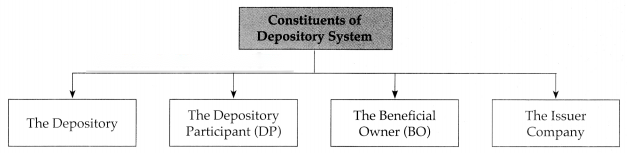
Explain the constituents of the depository system.
Solution & Step-by-Step Answer:
(i) Depository: (ii) Depository Participant: (iii) Beneficial Owner: (iv) Issuer Company: |