Maharashtra State Board Class 5 EVS Solutions Part 1 Chapter 2 Motions of the Earth
5th Std EVS 1 Digest Chapter 2 Motions of the Earth Textbook Questions and Answers
1. What is the Solution?
2. Use your brainpower!
Question (a)
How many rotations does the earth complete during one revolution around the sun?
Answer:
Earth makes 365 complete rotations and one quarter rotation.
Question (b)
It is sunrise at Itanagar in Arunachal Pradesh. Write the names of the following cities in the order in which the sun will rise there : Mumbai (Maharashtra), Kolkata (West Bengal), Bhopal (Madhya Pradesh), Nagpur (Maharashtra).
Answer:
Kolkata (West Bengal), Bhopal (Madhya Pradesh), Nagpur (Maharashtra), Mumbai (Maharashtra)
3. Fill in the blanks:
4. What is meant by each of the following terms:
Question (a)
Full moon
Answer:
At night, when we are able to see the entire illuminated part of the moon, it is called full moon.
Question (b)
New moon.
Answer:
At night, when we are not able to see the entire moon as it does not receive the sun’s light, it is called new moon.
Question (c)
Lunar month
Answer:
The period from one new moon to the next which is of 28 – 30 days is called a lunar month.
Question (d)
Tithi
Answer:
Each day of the lunar month is called a tithi.
5. Answer the following questions.
Question (a)
What is an equator?
Answer:
1. The imaginary4 circle exactly in between the north and south pole is called the equator.
2. The equator divides the earth into two equal parts.
Question (b)
What are the two parts of the earth made by the equator?
Answer:
The two equal parts of the earth made by the equator are called northern hemisphere and southern hemisphere respectively.
Environmental Studies Part 1 Standard 5th Solutions Chapter 2 Motions of the Earth Additional Important Questions and Answers
Fill in the blanks with the correct answers from the options given below:
Name the following:
’A’ | ‘B’ |
(1) The Waxing moon | (a) Krishna Paksha |
(2) The Waning moon | (b) 22 March to 23 September |
(3) Summer in northern hemisphere | (c) Shukla Paksha |
(4) Winter in northern hemisphere | (d) 23 September to 22 March |
’A’ | ‘B’ |
(1) The Waxing moon | (c) Shukla Paksha |
(2) The Waning moon | (a) Krishna Paksha |
(3) Summer in northern hemisphere | (b) 22 March to 23 September |
(4) Winter in northern hemisphere | (d) 23 September to 22 March Answer the following in one sentence:
Question 1
Maharashtra Board Solution
What is the name given to the changing shapes of the moon that we see?
Solution & Step-by-Step Answer:
The different shapes of the moon that we see are called the phases of the moon.
Question 2
Maharashtra Board Solution
What are the names of the days on which we see a round moon and on which day we see no moon at all?
Solution & Step-by-Step Answer:
The day we see a round moon is called Full Moon Day and the day we see no moon is called New Moon Day.
Question 3
Maharashtra Board Solution
What is a day?
Solution & Step-by-Step Answer:
The period of time that the earth takes to complete one rotation is called a day, that is 24 hours.
Question 4
Maharashtra Board Solution
What is the duration of a year?
Solution & Step-by-Step Answer:
There are about 365 days and 6 hours in a year.
Question 5
Maharashtra Board Solution
What causes the cycle of seasons?
Solution & Step-by-Step Answer:
The revolution of the earth and the inclination of its axis give rise to the cycle of seasons.
Question 6
Maharashtra Board Solution
What is the rotation of the earth?
Solution & Step-by-Step Answer:
The movement of the earth around itself is called ‘rotation of the earth’.
Question 7
Maharashtra Board Solution
What is ‘axis of rotation’?
Solution & Step-by-Step Answer:
The imaginary line around which the earth rotates is called its ‘axis of rotation’. It is an imaginery line between the north pole and south pole.
Question 8
Maharashtra Board Solution
What is the ‘equator of the earth’?
Solution & Step-by-Step Answer:
The imaginary line that divides the earth into two equal parts i.e. the northern hemisphere and southern hemisphere is called the equator of the earth.
Question 9
Maharashtra Board Solution
In which direction does the earth rotate?
Solution & Step-by-Step Answer:
The earth rotates from west to east.
Question 10
Maharashtra Board Solution
Into how many parts is the day divided?
Solution & Step-by-Step Answer:
The day is divided into two parts i.e. day and night.
Question 11
Maharashtra Board Solution
Into how many hours is the ‘day’ divided?
Solution & Step-by-Step Answer:
The day is divided into 24 hours.
Question 12
Maharashtra Board Solution
What is the revolution of the earth?
Solution & Step-by-Step Answer:
The movement of the earth around the sun in one year is called the revolution of the earth.
Question 13
Maharashtra Board Solution
Around whom does the moon revolve?
Solution & Step-by-Step Answer:
The moon revolves around the earth.
Question 14
Maharashtra Board Solution
What is waxing of the moon?
Solution & Step-by-Step Answer:
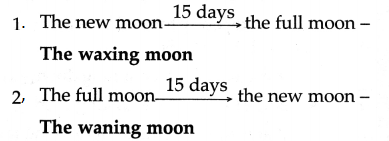
The moon takes a fortnight to move from new moon to full moon. This period of time is known as waxing of the moon.
Question 15
Maharashtra Board Solution
What is ‘waning of the moon’?
Solution & Step-by-Step Answer:
The moon takes a fortnight to move from a full moon to new moon. This period of time is known as waning of the moon.
Question 16
Maharashtra Board Solution
What is a lunar month?
Solution & Step-by-Step Answer:
The period from one new moon to the next is of 28 to 30 days. It is called the lunar month.
Question 17
Maharashtra Board Solution
What is’tithi’?
Solution & Step-by-Step Answer:
Every day of the Lunar month is called a ‘tithi’.
Give geographical reasons:
Question 1
Maharashtra Board Solution
The length of day and night is not always equal.
Solution & Step-by-Step Answer:
The length of day and night is not always equal because: 1. Of the earth’s inclined axis. 2. Its revolution around the sun.
Question 2
Maharashtra Board Solution
From 22 March to 23 September, northern hemisphere, experiences summer and southern hemisphere experiences winter.
Solution & Step-by-Step Answer:
1. From 22 March to 23 September the days are longer than the night in the northern hemisphere. 2. It is warmer here. 3. So, it is summer. 4. However, at this time southern hemisphere nights are longer than the days. 5. So it receives less heat. 6. Therefore, Southern hemisphere experiences winter.
Question 3
Maharashtra Board Solution
The sun, the moon and the earth are not always along a straight line.
Solution & Step-by-Step Answer:
1. The moon revolves around the earth. 2. The earth revolves around the sun. 3. These two orbits intersect. 4. Hence the sun, the moon and the earth are not always along a straight line.
Question 4
Maharashtra Board Solution
We see phases of the moon.
Solution & Step-by-Step Answer:
1. From the full moon to the new moon the illuminated part of the moon seen from the earth becomes smaller and smaller. 2. From new moon to full moon it again grows bigger and bigger. 3. Therefore we see phases of the moon.
Question 5
Maharashtra Board Solution
Waxing moon
Solution & Step-by-Step Answer:
The fortnight from new moon to full moon which is 14 to 15 days is called waxing moon. Here the moon seems to become bigger and bigger, i.e. it waxes.
Question 6
Maharashtra Board Solution
Waning moon
Solution & Step-by-Step Answer:
The fortnight from full moon to new moon which takes 14 to 15 days is called the waning moon. Here the moon seems to become smaller and smaller, i.e. it wanes.
Answer briefly:
Question 1
Maharashtra Board Solution
Explain ‘Phases of the moon’.
Solution & Step-by-Step Answer:
1. From the full moon to the new moon the illuminated5 part of the moon seen from the earth becomes smaller and smaller. 2. From new moon to full moon, the illuminated part of the moon grows bigger and bigger. 3. These different shapes of the moon that we see are called the ‘phases of the moon’.
Question 2
Maharashtra Board Solution
What are the effects of the rotation and revolution of the earth?
Solution & Step-by-Step Answer:
1. The rotation of the earth gives rise to day and night. 2. The revolution of the earth and the inclination6 of its axis give rise to the cycle of seasons.
Write short notes on:
Question 1
Maharashtra Board Solution
Leap year.
Solution & Step-by-Step Answer:
Question 2
Maharashtra Board Solution
Complete the following:
Solution & Step-by-Step Answer:
3. The fortnight of the waxing moon + the fortnight of the waning moon – A lunar month
Glossary: |