Maharashtra State Board Class 5 EVS Solutions Part 1 Chapter 23 Infectious Diseases and how to Prevent them
5th Std EVS 1 Digest Chapter 23 Infectious Diseases and how to Prevent them Textbook Questions and Answers
1. What’s the solution?
2. Use your brain power!
3. Answer the following in one or two sentences:
Question (a)
What is an infectious disease?
Answer:
When diseases spread from one person to another person, they are called infectious diseases.
Question (b)
What are the mediums of the spread of diseases?
Answer:
Diseases spread through mediums like food, water, air and insect bite. Sometimes it also spreads by coming in direct contact with a diseased person.
Question (c)
What happens when there is an epidemic of disease?
Answer:
When many people in one area get the same infectious disease at the same time, we say there is an epidemic of the disease. During an epidemic air and water gets contaminated with the disease germs and the disease spreads rapidly. Contaminated water also contaminates the food. If the epidemic is severe many people become serious and need to be hospitalised. To control the epidemic one needs to maintain hygiene and a clean surrounding.
Question (d)
What is vaccination?
Answer:
When a person is given a vaccine against a specific disease, he develops resistance to that disease. This process of giving vaccine is called vaccination. Whooping cough diphtheria and tetanus called triple vaccine is given.
Question (e)
Make a list of the vaccination given to a new bom baby.
Answer:
The table given below shows the list of vaccinations given to the new bom baby along with the schedule of when the vaccination is given:
Vaccine given | Disease against which it is given | Age of the new bom baby when it is given |
BCG Vaccine | Against Tuberculosis | within 15 days after baby is just born |
Hepa B vaccine | Jaundice caused by Hepatitis B vims | As soon as the baby is born |
Oral Polio | Against Polio | Within 2 weeks |
Triple vaccine | Against Diphteria, whooping cough and tetanus | After 6 weeks baby is born |
Triple vaccine is repeated twice again after 10 weeks and 14 weeks after the baby is bom. Hep. B vaccine is also repeated twice after 4 weeks and 8 weeks after birth. After completing a year the baby is given vaccine against measles, mumps and rubella. It is called MMR vaccine.
4. True or False:
Question (a)
Intestinal diseases spread though air.
Answer:
False
Question (b)
Some diseases are caused by the anger of gods
Answer:
False
5. Classify the diseases given below as diseases that spread through food, through water, and through air:
Through Food | Through Water | Through Air |
Typhoid | Typhoid | Tuberculosis |
Cholera | Cholera | Diphtheria |
Jaundice | Jaundice | Conjunctivitis |
Gastro Diarrhoea | Diarrhoea | Chickenpox |
6. Give reasons.
Question (a)
When there is an epidemic of cholera, we should boil water before drinking.
Answer:
Sometimes water gets mixed with faeces of person who is suffering from the cholera and it gets contaminated. When people drink this contaminated water an epidemic of cholera spreads.
Boiling the water kills the germs causing the disease and hence one is prevented from getting cholera.
Therefore during an epidemic of cholera one should boil water and drink.
Question (b)
We should not allow puddles of water to stand in our surroundings.
Answer:
When water stagnates in a puddle, mosquitoes lay eggs in the water and they increase in number. Mosquito bite spread malaria germs and people suffer from malaria. To prevent people from getting malaria mosquitoes should be stopped from breeding. To prevent mosquitoes from breeding we should not allow puddle of water to stand in our surrounding.
Environmental Studies Part 1 Standard 5th Solutions Chapter 23 Infectious Diseases and how to Prevent them Additional Important Questions and Answers
Fill in the blank with the correct answers from the options given below:
Group ‘A’ | Group ‘B’ |
(a) Ringworm | 1. Contaminated Air |
(b) Jaundice | 2. Direct contact |
(c) Tuberculosis | 3. Open wound contaminated with soil |
(d) Dengue | 4. Contaminated food and water |
(e) Tetanus | 5. Mosquito bite |
Group ‘A’ | Group ‘B’ |
(a) Ringworm | 2. Direct contact |
(b) Jaundice | 4. Contaminated food and water |
(c) Tuberculosis | 1. Contaminated Air |
(d) Dengue | 5. Mosquito bite |
(e) Tetanus | 3. Open wound contaminated with soil Name the following:
Question 1
Maharashtra Board Solution
Insect that causes Malaria.
Solution & Step-by-Step Answer:
Female Anopheles Mosquito
Question 2
Maharashtra Board Solution
Insect that causes Dengue.
Solution & Step-by-Step Answer:
Aedes mosquito
Question 3
Maharashtra Board Solution
Vaccine for diphtheria, whooping cough and tetanus (Given as injection).
Solution & Step-by-Step Answer:
Triple vaccine
Question 4
Maharashtra Board Solution
Microorganisms that are useful to us.
Solution & Step-by-Step Answer:
Microorganisms converting milk into yoghurt or microorganisms fermenting batter for idlis.
Question 5
Maharashtra Board Solution
Germicide used to kill microorganisms in the spittle of a person having tuberculosis.
Solution & Step-by-Step Answer:
Phenyl or dettol.
Question 5
Maharashtra Board Solution
State whether the following statements are True or False: |
Answer the following in one or two sentences:
Question 1
Maharashtra Board Solution
Name the disease that has been completely eradicated (that is it has completely disappeared) by vaccination.
Solution & Step-by-Step Answer:
The disease called small pox has been completely eradicated by vaccination. (Note : Now no one in the world is gets the scare or is suffering from small pox.)
Question 2
Maharashtra Board Solution
Which disease spreads through flea’s bite?
Solution & Step-by-Step Answer:
Fleas spread diseases like plague when they bite. (Note : Fleas are found on the bodies of pets like dogs, cat and also on rhodents like rats.)
Question 3
Maharashtra Board Solution
Why should we cover our nose and mouth when we cough or sneeze?
Solution & Step-by-Step Answer:
Disease of the throat and chest spread through the air. When other breathe the same air, germs enter their bodies. That is why we must cover our nose and mouth when we cough or sneeze.
Question 4
Maharashtra Board Solution
What is ‘food poisoning’?
Solution & Step-by-Step Answer:
Gastro or diarrhoea spreads through contaminated3 food. When we eat this food the disease spread is called food poisoning.
Question 5
Maharashtra Board Solution
Why should food always be kept covered?
Solution & Step-by-Step Answer:
When some flies sit on our food, the germs enter the food. Later when we eat this food the germs enter our body, so we must always cover the food.
Question 6
Maharashtra Board Solution
What is an epidemic?
Solution & Step-by-Step Answer:
When many people in one area get the same infectious disease all at the same time, we say that there is an epidemic of the disease.
Question 7
Maharashtra Board Solution
What precaution can be taken to prevent the spread of tuberculosis?
Solution & Step-by-Step Answer:
The spittle of a person who has tuberculosis is collected in a vessel and covered with a germicide like phenyl. Such precautions can help to prevent the disease from spreading.
Give scientific reasons:
Question 1
Maharashtra Board Solution
Doctors give tetanus vaccine after getting a cut or wound while handling a sharp instrument or after falling down and getting bruised badly while playing.
Solution & Step-by-Step Answer:
Tetanus germs are present in the soil, dung and dust. The sharp instrument may be dirty, so it may carry the tetanus germs. These germs may then spread though the wound and cause disease. To prevent tetanus germs from spreading doctors give the vaccine which help us develop resistance against this disease.
Question 2
Maharashtra Board Solution
A person suffering from a disease should cover the mouth when sneezing or coughing.
Solution & Step-by-Step Answer:
Disease causing organisms are present in the spit or saliva of the person. When they sneeze or cough these gems spread in the air and cause disease in other people. To prevent the spread of disease through the air a person suffering from a disease should cover the mouth while sneezing or coughing.
Question 3
Maharashtra Board Solution
Before eating or handling food one should wash the hands using soap and water.
Solution & Step-by-Step Answer:
Soap kills the germs which cause diseases and water washes them away. If our hand is dirty then they may contain disease causing germs. If we handle food, or eat food without washing, the germs will enter the food and contaminate it with these germs. This can cause intestinal diseases or food poisoning. Hence it is advised that one should wash the hands using soap and water before eating or handling food.
Question 4
Maharashtra Board Solution
People who are suffering from tuberculosis or swine flu are quarantined and kept in hospitals.
Solution & Step-by-Step Answer:
The diseases like tuberculosis and swine flu are infectious. They spread through air easily. Also the germs spread cause disease in a healthy person if the healthy person comes in contact directly with the diseased person. In hospitals there are separate wards for such diseased people, where extra care and precautions are taken to prevent spread of diseases. Therefore patients suffering from these diseases are quarantined and kept in hospital.
Can you tell:
Question 1
Maharashtra Board Solution
When your friends fall while playing and get hurt, does anyone tell you ‘Don’t go near them. You will also yet hurt’?
Solution & Step-by-Step Answer:
No, no one tells us like that because we will not get hurt because the friend is hurt.
Question 2
Maharashtra Board Solution
Suppose your mother has a headache. Do you also get a headache if you go near her?
Solution & Step-by-Step Answer:
No, I do not get a headache if I go near her.
Question 3
Maharashtra Board Solution
When is it that you are told not to go near a sick person, not to use their utensils for eating or drinking; not to use their hankies, towels or clothes?
Solution & Step-by-Step Answer:
We are told not to go near a sisk person when the person is suffering from cold, flu, is having high fever, or if the person is suffering from chicken pox, measles, mumps etc.
Question 4
Maharashtra Board Solution
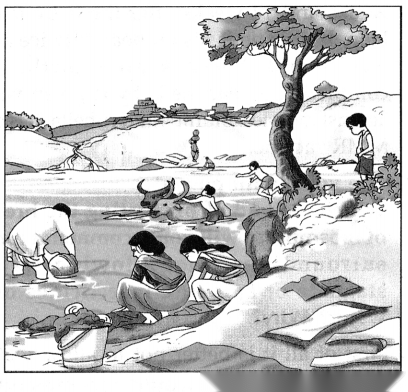
What different activities are going on in the above picture.
Solution & Step-by-Step Answer:
Women are washing clothes in the river. A boy is urinating in the water. A man is washing utensil and filling it with water. Buffaloes are being washed in the water. Children are swimming and a lady is filling pots with water to use for drinking purpose.
Question 5
Maharashtra Board Solution
What do you see in the picture below above?
Solution & Step-by-Step Answer:
Food is kept open. People are being served this uncovered food and they are eating it. The man serving the food is wearing dirty colthes. There is no cleanliness maintained in the restaurant.
Question 6
Maharashtra Board Solution
What steps will you take to ensure that dust and flies do not settle on the food in your house?
Solution & Step-by-Step Answer:
The food will be covered properly to see that no dust and flies settle on it. It will be kept in clean and closed utensils in the kitchen. Care will be taken to see that the kitchen is kept clean. So that no flies will sit there.
Question 7
Maharashtra Board Solution
Why should you not go to school if you have conjunctivitis?
Solution & Step-by-Step Answer:
Conjunctivitis causing germs spreads through air. If we go to school many other children will also get this disease. To prevent the spread of this disease, we should not go to school when suffering from conjunctivitis.
Glossary: |