Maharashtra State Board Class 6 English Solutions Chapter 3.5 The Donkey
Class 6 English Chapter 3.5 The Donkey Textbook Questions and Answers
1. Rewrite the poem in the form of a prose passage.
His face looked serious, almost as if he was thinking of something that life longed for. He unsteadily moved around, as if on a daring, adventurous quest. Just when he lay down to relax, the poet realized how puny he was and hoped that the world treated the frail foal with care.
2. List the pairs of rhyming words in the poem.
3. What does the poet pray for? Why?
4. Have you seen a newborn of an animal?
5. Talk to your parents and family members and write what you could do when:
6. Form groups and hold debutes on the following topics. Make bulleted lists of points in favour (pros) and those against (cons) the given statement. Let the whole class vote on who won the debate.
Question 1
Maharashtra Board Solution
Form groups and hold debutes on the following topics. Make bullcted lists of points in favour (pros) and those against (cons) the given statement. Let the whole class vote on who won the debate. a. Man should use animals for his own needs. b. Contact with ‘flan has helped animals to survive.
Solution & Step-by-Step Answer:
block bg-white dark:bg-slate-900/80 border-l-4 border-emerald-500 rounded-r-xl p-5 my-3 shadow-xs border border-slate-200/60 dark:border-slate-800">
Solution & Step-by-Step Answer:
PROS:
CONS: 7. Find what the young ones of the following animals are called.
Question 1
Maharashtra Board Solution
Find what the young ones of the following animals are called. |
donkey – foal | swan – cygnet |
horse – foal | eagle – eaglet |
lion – cub | duck – duckling |
tiger – cub | peacock – peachick |
elephant – calf | kangaroo – joey |
sheep – lamb | deer – fawn |
cow – calf | frog – tadpole |
pig-piglet | butterfly – caterpillar |
whale – calf | goose – gosling |
owl – owlet | goat – kid 8. Complete the following using your own ideas. Question a. Question b. Question c. Question d. Question e. Question f. 9. Write a conversation between: (One is done for you. Write dialogues for the other two.) Question a. Question b. Question c.
Question 10
Maharashtra Board Solution
If you saw someone ill-treating an animal, what would you do? Write about it in 5 lines.
Solution & Step-by-Step Answer:
If I were to see someone ill-treating an animal, the first thing I would do is calmly but firmly suggest the person to stop his misbehavior act. I will explain to him that these vulnerable animals can’t speak for themselves. I will tell him that it is our duty to protect them and not harm them. If he continues the ill-treatment, I would call the Animal Protection Services.
11. Visit a library, find poems about animals. Copy them and recite them to your friends. (To be done by the students)
Question 1
Maharashtra Board Solution
Visit a library, find poems about animals. Copy them and recite them to your friends. (To be done by the students) |
Class 6 English Chapter 3.5 The Donkey Additional Important Questions and Answers
Reading Skills and Poetic Device.
Question 1
Maharashtra Board Solution
I saw a donkey which was year old.
Solution & Step-by-Step Answer:
block bg-white dark:bg-slate-900/80 border-l-4 border-emerald-500 rounded-r-xl p-5 my-3 shadow-xs border border-slate-200/60 dark:border-slate-800">
Solution & Step-by-Step Answer:
False
Question 2
Maharashtra Board Solution
He tried to gambol and frisk but could not do it confidently.
Solution & Step-by-Step Answer:
True
Answer the following.
Question 1
Maharashtra Board Solution
How were the legs of the foal?
Solution & Step-by-Step Answer:
The legs of the foals were shaky, long and loose.
Question 2
Maharashtra Board Solution
Describe the coat of the foal.
Solution & Step-by-Step Answer:
The foal had a queer, little coat, which was soft and grey and it curled at his neck making I look lovely.
Poetic Device.
Question 1
Maharashtra Board Solution
Give the rhyme scheme of the first four lines.
Solution & Step-by-Step Answer:
abac
Question 2
Maharashtra Board Solution
Pick out a pair of rhyming words from the second stanza.
Solution & Step-by-Step Answer:
bit – it, grey – way
Question 3
Maharashtra Board Solution
I saw a donkey one day old. (Name the figure of speech)
Solution & Step-by-Step Answer:
The figure of speech is Alliteration. The sound of ‘d’ has been repeated for better poetic effect.
Personal Response.
Question 1
Maharashtra Board Solution
Which animal/bird do you like? Why?
Solution & Step-by-Step Answer:
I like the peacock a lot. It is so beautiful to look at. It has wonderful colours on its body and when it spread out its plumage, it creates an awesome sight. The peacock is a royal bird and also our National Bird. These are the reasons why I love the peacock very much
Language Study.
Question 1
Maharashtra Board Solution
Project Work
Solution & Step-by-Step Answer:
Visit a library, find poems about animals. Copy them and recite them to your friends. (To be done by the students)
Question 2
Maharashtra Board Solution
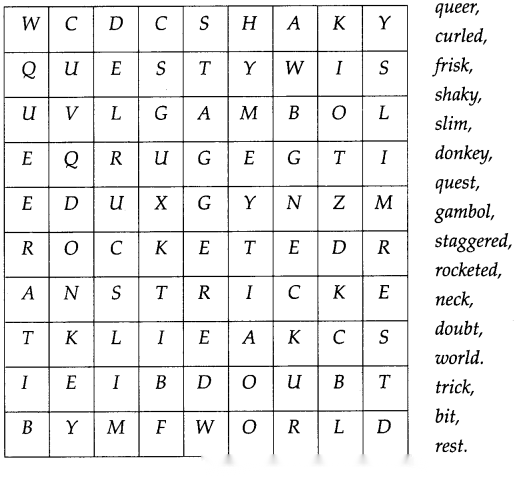
From the following grid, find the words gievn below.
Solution & Step-by-Step Answer:
The Donkey Summary in English The one-day old foal tries to explore his surroundings, but his shaky legs and large head render his steps rather clumsy rather than normal. He tries to frolic and leap but doesn’t quite know how to do it. His head, just like human babies, is too heavy for his weak neck to firmly hold it. He adorned with a rather strange coat in the guise of soft, grey fur in a lovely way around his neck. His face looked serious, almost as if he was thinking of something that life longed for. He unsteadily moved around, as if on a daring, adventurous quest. Just when he lay down to relax, the poet realized how puny he was and hoped that the world treated the frail foal with care. Introduction: The poem ‘The Donkey’ describes the behaviour of a newborn donkey for whom life is a new experience as he is taking the first steps of his life. He clumsily tries to walk around, his huge head and shaky loose legs making it all the more difficult for him to do so. The poem ends with the poet hoping that the world around the foal (baby donkey) would treat him with care. Glossary: |