Latest Maharashtra State Board (SSC & HSC) 2026-27 Syllabus Digest & Solutions Updated!
Class 6Geography2026-27 Syllabus

Chapter 8 Natural Resources Solutions

Complete Maharashtra State Board Balbharati & Yuvakbharati textbook solutions for Chapter 8 Natural Resources. Step-by-step solved exercises, numerical problems, and digest answers.

50 Solved Questions7 Diagrams1534 words

Maharashtra Board Class 6 Geography Solutions Chapter 8 Natural Resources

Class 6 Geography Chapter 8 Natural Resources Textbook Questions and Answers

A. What is the use of the following resources?

Question 1 Maharashtra Board Solution
Water
Solution & Step-by-Step Answer:
Question 2 Maharashtra Board Solution
Forests
Solution & Step-by-Step Answer:
Question 3 Maharashtra Board Solution
Animals
Solution & Step-by-Step Answer:
Question 4 Maharashtra Board Solution
Minerals
Solution & Step-by-Step Answer:
Question 5 Maharashtra Board Solution
Land.
Solution & Step-by-Step Answer:

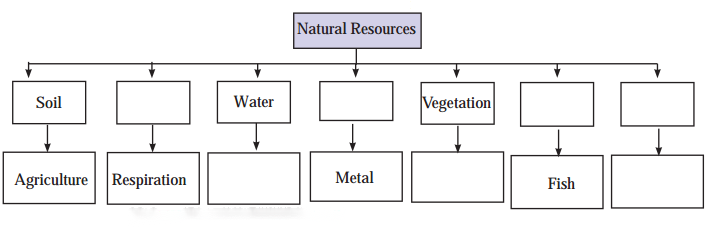
B. Complete the following flow chart:

Answer:
C. Answer the following questions:

Question 1 Maharashtra Board Solution
What factors influence the formation of soil?
Solution & Step-by-Step Answer:
The formation of soil mainly depends on the original rock, climate, organic components, slope of the land and time.
Question 2 Maharashtra Board Solution
Which products are obtained from forests?
Solution & Step-by-Step Answer:
We obtain products like wood, rubber, resin, fruits, medicinal plants, etc. from forests.
Question 3 Maharashtra Board Solution
What are the uses of minerals?
Solution & Step-by-Step Answer:
Metallic minerals are used for obtaining different metals such as iron, bauxite, etc. and non-metallic minerals are used in obtaining various chemicals like gypsum, rock salt, calcite, etc.
Question 4 Maharashtra Board Solution
What are the purposes for which land is used?
Solution & Step-by-Step Answer:
Question 5 Maharashtra Board Solution
Why are various living things found on the land in different proportions?
Solution & Step-by-Step Answer:
Depending on the characteristics of land and climate, various living things are found on land in different proportions.

Activity:

Collect the pictures of and information about the sources of freshwater.

Class 6 Geography Chapter 8 Natural Resources Textbook Questions and Answers

Can you tell?

Observe the picture given in figure 8.1. and answer the following question.

Question 1.
What do you see in the pictures?
Answer:
I can see different animals and plants in the given pictuers.

Question 2 Maharashtra Board Solution
How many of these animals or plants do you know?
Solution & Step-by-Step Answer:
I know all these animals and plants in the given picture.
Question 3 Maharashtra Board Solution
Which of these things have you seen in reality?
Solution & Step-by-Step Answer:
I have seen all the cotton ball, mango and horse in reality.
Question 4 Maharashtra Board Solution
Have you ever used these things or seen them being used?
Solution & Step-by-Step Answer:
Yes, I have.
Question 5 Maharashtra Board Solution
Which of our needs do some of these fulfill?
Solution & Step-by-Step Answer:
Question 6 Maharashtra Board Solution
What probable use of the unused things can you think of?
Solution & Step-by-Step Answer:

Observe all the figures and discuss them in the class:


Can you tell?

Question 1 Maharashtra Board Solution
What different activities are the individuals in the pictures engaged in?
Solution & Step-by-Step Answer:
The different activities that the individuals in ; the pictures are engaged in are: agriculture, ; fishing, collection of honey, drawing water, ! gathering wood, mining, masonry, extraction i of salt, collection of rubber latex, gathering of resin from trees, converting wind into usable energy, transportation by pack animals.
Question 2 Maharashtra Board Solution
What things will they obtain through these activities?
Solution & Step-by-Step Answer:
They will obtain foodgrains, fish, honey, water, wood, minerals, house to live, salt, rubber, resin and energy which can be used for various purposes.
Question 3 Maharashtra Board Solution
What are the animals in the picture doing?
Solution & Step-by-Step Answer:
While the bullocks are ploughing the fields, j the donkey is used as a pack animal, for transporting heavy loads.
Question 4 Maharashtra Board Solution
What is the use of the tall device in figure 8.12 raised on the ground?
Solution & Step-by-Step Answer:
The tall device is a windmill which converts i wind into usable energy through the rotation ; of wheel which are adjustable. The energy thus i created can be used for a variety of purposes I such as generating electricity, grinding grains or spices, pumping water, sawing wood, aerating ponds, etc.
Question 5 Maharashtra Board Solution
What is being loaded in the truck? What are we going to get from it?
Solution & Step-by-Step Answer:
is being loaded into a truck from the mining area. We get minerals from the same.
Question 6 Maharashtra Board Solution
Where are all these human activities being performed other than fishing?
Solution & Step-by-Step Answer:
All these human activities are being performed on land.

Think a little!

Question 1 Maharashtra Board Solution
List the various things for which we use water. Identify the things that lead to wastage of water.
Solution & Step-by-Step Answer:
(a) Use of water.

(b) Identify the things that leads to wastage of water.

Question 2 Maharashtra Board Solution
Name the different metals from which the things in your house are made. Make a chart of things and metals.
Solution & Step-by-Step Answer:

Things

Metals

Cupboard

Stainless steel

Furniture

Iron

Idols of worship

Bronze

Lantern

Silver

Electrical wiring

Copper

Utensils

Copper and steel

Question 3 Maharashtra Board Solution
List the occupations carried out on land.
Solution & Step-by-Step Answer:

Observe figure (Textbook Page no. 48) and answer the following questions:

Question 1.
Which vegetations do you find in the following location.
Answer:
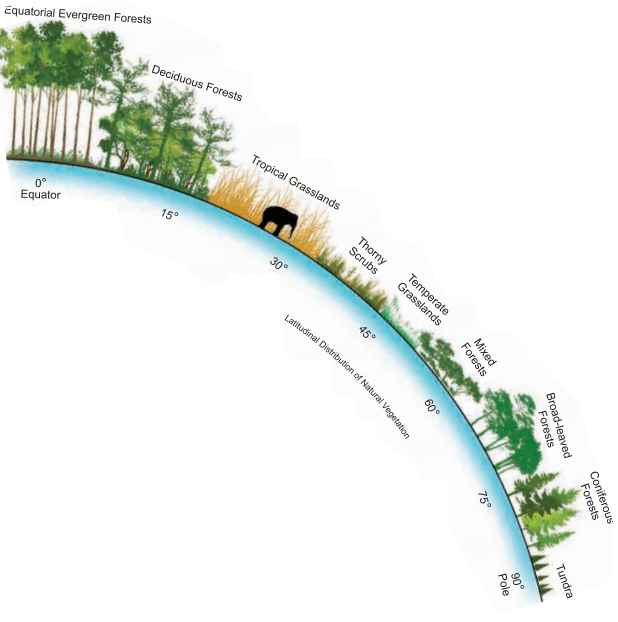
Latitudes

Vegetation

(1) 90° Pole

Tundra

(2) 0° Equator

Equatorial evergreen

(3) 30°

Tropical Grasslands

(4) 60°

Mixed Forest

(5) 75° – 90°

Coniferous

(6) 15°

Deciduous

Question 2 Maharashtra Board Solution
In which forest do we find tall trees?
Solution & Step-by-Step Answer:
Equatorial Evergreen forest.
Question 3 Maharashtra Board Solution
Name the grassland shown in the picture.
Solution & Step-by-Step Answer:
Tropical grassland and temperate grassland.
Question 4 Maharashtra Board Solution
Which vegetation indicate hot deserts?
Solution & Step-by-Step Answer:
Thorny scrubs

Class 6 Geography Chapter 8 Natural Resources Textbook Questions and Answers

Complete the following statements using appropriate options:

Question 1 Maharashtra Board Solution
_____ is a resource which never depletes. (Air, ‘Water, Animals)
Solution & Step-by-Step Answer:
Air
Question 2 Maharashtra Board Solution
Formation of mature soil is a very ______ process. (sudden, fast, slow)
Solution & Step-by-Step Answer:
slow
Question 3 Maharashtra Board Solution
Rock is a mixture of ________ (stone, black pebbles, minerals)
Solution & Step-by-Step Answer:
minerals
Question 4 Maharashtra Board Solution
The proportion of land on earth is ________%.
Solution & Step-by-Step Answer:
29.20
Question 5 Maharashtra Board Solution
_______ are the habitats for many animals. (Grassland, Vegetation,Thorny scrubs)
Solution & Step-by-Step Answer:
Grassland

Match the pairs correctly:

Question 1 Maharashtra Board Solution

Column A

Column B

(1) Horses and oxens

(a) used for hauling logs

(2) Cows and buffaloes

(b) transportation of goods

(3) Water available on the earth for use

(c) milk animals

(4) Settlements flourished

(d) 0.003%

(e) Huang He

Solution & Step-by-Step Answer:

1 – b
2 – c
3 – d
4 – e

Name the following:

Question 1 Maharashtra Board Solution
The natural things that man uses:
Solution & Step-by-Step Answer:
Natural resources.
Question 2 Maharashtra Board Solution
A resource that is available in plenty:
Solution & Step-by-Step Answer:
Air.
Question 3 Maharashtra Board Solution
The basins along which man began to live a settled life in the past:
Solution & Step-by-Step Answer:
Question 4 Maharashtra Board Solution
Habitats of animals:
Solution & Step-by-Step Answer:
Forest or grasslands.
Question 5 Maharashtra Board Solution
Any two products we get from animals:
Solution & Step-by-Step Answer:
Question 6 Maharashtra Board Solution
Metallic minerals used for obtaining different metals:
Solution & Step-by-Step Answer:
Question 7 Maharashtra Board Solution
Non-metallic minerals used in obtaining various chemicals:
Solution & Step-by-Step Answer:

Answer the following questions in one sentence each:

Question 1 Maharashtra Board Solution
Why are natural resources invaluable?
Solution & Step-by-Step Answer:
Most of the natural resources are limited in nature and therefore they are invaluable.
Question 2 Maharashtra Board Solution
What do we need air for?
Solution & Step-by-Step Answer:
We need air for various purposes right from breathing to burning.
Question 3 Maharashtra Board Solution
Why do the farmers plough the soil?
Solution & Step-by-Step Answer:
The farmers plough the soil to make the land cultivable.
Question 4 Maharashtra Board Solution
How are plants classified?
Solution & Step-by-Step Answer:
Plants are broadly classified into grass, shrubs and trees.

Give geographical reasons for the following statements:

Question 1 Maharashtra Board Solution
Soil is a very important resource for agriculture.
Solution & Step-by-Step Answer:
Question 2 Maharashtra Board Solution
Man began to live a settled life.
Solution & Step-by-Step Answer:
Question 3 Maharashtra Board Solution
It is necessary to conserve the natural resources.
Solution & Step-by-Step Answer:
Question 4 Maharashtra Board Solution
Land is an invaluable resource.
Solution & Step-by-Step Answer:

Answer the following questions in short:

Question 1 Maharashtra Board Solution
Why are various living things found on the land in different proportions?
Solution & Step-by-Step Answer:
Depending on the characteristics of land and climate, various living things are found on land in different proportions.
Question 2 Maharashtra Board Solution
Which are the various geographical conditions which all living things try to adapt to?
Solution & Step-by-Step Answer:
All living things try to adapt to various geographical conditions like rocky terrain, steep slopes, flat plains, mountainous regions, forest-covered areas, river basin, etc.