Maharashtra Board Class 6 History Solutions Chapter 3 The Harappan Civilization
Class 6 History Chapter 3 The Harappan Civilization Textbook Questions and Answers
1. Answer in one sentence:
2. What will you do when you visit an ancient site to obtain more information about it, to conserve it, etc ?
3. Draw a picture of the Great Bath at Mohen-jo-daro.
Answer:
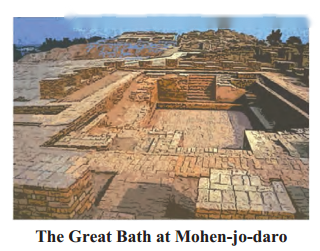
4. In the following chart, fill in the details regarding human life during the Harappan period.
Major crops | Clothes | Ornaments |
Answer:
Major crops | Clothes | Ornaments |
Wheat, | Knee length cloth worn by both men and women. Cloth that makes an upper garment. | Gold |
Barley | A cloak with a beautiful trefoil, pattern draped across the shoulder. | Copper |
Ragi | Precious | |
Cotton | stone, Shells |
5. Answer in one word and frame similar questions. Write their answers:
6. On an outline map of the world, show the other civilizations that existed in other parts of the world during the Harappan period.
Activity:
Class 6 History Chapter 3 The Harappan Civilization InText Questions and Answers
Can you tell?
Fresh water is then added to the pool, with right amount of chlorine tablets. We then have a pool with sparkling water. The Harappahs too, were hygienic as they too had provisions made for draining, cleaning and re-filling the Great Bath.
Class 6 History Chapter 3 The Harappan Civilization Additional Important Questions and Answers
Complete the sentence by choosing the correct option:
Match The following:
Column A | Column B |
(1) Harappan civilization | (a) Built with baked bricks |
(2) Houses | (b) Had separate fortification |
(3) Streets | (c) Banks of river ravi |
(4) Mohen-jo-daro | (d) Had covered drains |
(5) Towns | (e) South of Harappa |
1 – c
2 – a
3 – d
4 – e
5 – b
Question 2
Maharashtra Board Solution
Solution & Step-by-Step Answer:
1 – c
2 – a 3 – d 4 – b Answer in one sentence:
Question 1
Maharashtra Board Solution
Where was the excavation of Mohen-jo-daro carried out?
Solution & Step-by-Step Answer:
The excavation of Mohen-jo-daro was carried out about 650 km to the south of Harappa in the Indus valley.
Question 2
Maharashtra Board Solution
With what were the houses and other structures in Harappan civilization built?
Solution & Step-by-Step Answer:
The houses and other structures in Harappan civilization were built with baked bricks.
Question 3
Maharashtra Board Solution
What were the Harappan seals made from?
Solution & Step-by-Step Answer:
The Harappan seals were made from a stone called steatite.
Question 4
Maharashtra Board Solution
What were the seals used for?
Solution & Step-by-Step Answer:
The seals were used as stamps.
Question 5
Maharashtra Board Solution
Which pictures were depicted on seals?
Solution & Step-by-Step Answer:
Pictures of animals like bulls, buffaloes, oxen, elephants, rhinos, tigers, unicorn, etc., were depicted on seals.
Question 6
Maharashtra Board Solution
What occupation did the Harappan practise?
Solution & Step-by-Step Answer:
The Harappans practised agriculture.
Question 7
Maharashtra Board Solution
What crops did the Harappans grow?
Solution & Step-by-Step Answer:
The Harappans grew crops like wheat, barley, ragi, peas, sesame and lentils (masoor).
Question 8
Maharashtra Board Solution
How did the people in Harappa dress?
Solution & Step-by-Step Answer:
The dress of both men and women in Harappa consisted of knee length cloth and an upper garment.
Question 9
Maharashtra Board Solution
What were their ornaments made up of?
Solution & Step-by-Step Answer:
Their ornaments were made up of gold, copper, precious stones as also shells, cowries, seeds, etc.
Question 10
Maharashtra Board Solution
What is the Indus valley known for?
Solution & Step-by-Step Answer:
The Indus valley was known for its high quality cotton.
Question 11
Maharashtra Board Solution
To which countries was the cotton exported?
Solution & Step-by-Step Answer:
The cotton was exported to regions like west Asia, southern Europe and Egypt.
Question 12
Maharashtra Board Solution
Where was the Harappan dockyard discovered?
Solution & Step-by-Step Answer:
A huge dockyard was discovered at Lothal.
Question 13
Maharashtra Board Solution
What was the reasons for the decline of the Harappan civilization?
Solution & Step-by-Step Answer:
Frequent floods, invasions by foreign tribes, decline in trade were some of the reasons for the decline of Harappan civilization.
Question 14
Maharashtra Board Solution
Why did the people migrate to other places?
Solution & Step-by-Step Answer:
Some regions became arid due to weakening of monsoon, drying up of river basins, earthquakes, changes in sea-level, etc. This led the people to migrate to other places.
Answer the following questions in short:
Question 1
Maharashtra Board Solution
Which similar characteristics are seen in all the places of Harappan civilization?
Solution & Step-by-Step Answer:
Similar characteristics that are seen in all the places of Harappan civilization are town planning, roads, construction of houses, drainage system, seals, pots, toys and burial customs.
Question 2
Maharashtra Board Solution
Describe the houses built in Harappa.
Solution & Step-by-Step Answer:
Question 3
Maharashtra Board Solution
Explain why the drainage system excelled in Harappa.
Solution & Step-by-Step Answer:
Question 4
Maharashtra Board Solution
Describe the streets in Harappan town planning.
Solution & Step-by-Step Answer:
Question 5
Maharashtra Board Solution
What ritual did the people in Harappa follow for their burial?
Solution & Step-by-Step Answer:
Question 6
Maharashtra Board Solution
Describe the Great Bath of Mohen-jo-daro.
Solution & Step-by-Step Answer:
Question 7
Maharashtra Board Solution
Describe the statue found at a Harappan site.
Solution & Step-by-Step Answer:
Question 8
Maharashtra Board Solution
Comparison between today’s modem town planning with that of the Harappan periods.
Solution & Step-by-Step Answer:
Harappan houses were built in rectangular blocks and had excellent roads and drainage system. In comparison, the older cities in India do not have the Harappan style of town planning. There are places in these older cities where hutmen live in congested areas with open drainages. But today, changes are being made.
Open drainages are being replaced by underground drainage system. Rain water is diverted to avoid floods and hutmen’s areas are getting transformed into tall high-rise buildings. Cities now in India are getting transformed with broad roads, well interstate connecting highways, bridges, railway, metro, airports, etc. |