Maharashtra State Board Class 6 Science Solutions Chapter 14 Light and the Formation of Shadows
Class 6 Science Chapter 14 Light and the Formation of Shadows Textbook Questions and Answers
1. Choose an appropriate word and fill in the blanks.
Question a.
A ……………. is a natural source of light.
Answer:
star
Question b.
A ………….. is an artificial source of light.
Answer:
candle
Question c.
When light passes through a prism, it gets separated into ………….. colours.
Answer:
seven
Question d.
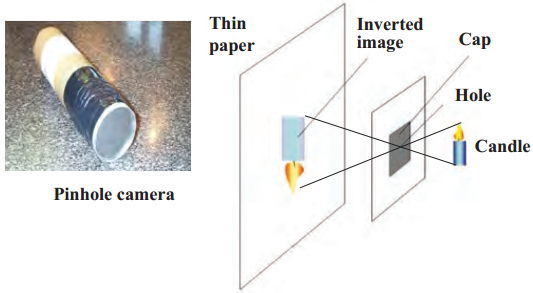
The image obtained in the pinhole camera is …………..
Answer:
inverted
Question e.
A shadow is formed when an …………… object comes in the way of light.
Answer:
opaque
Question f.
When a ………….. object comes in the way of light, light passes …………… it. options : seven, star, through, transparent, opaque, colors, shape, erect, inverted, luminous, candle.
Answer:
transparent, through
2. Write whether the following objects are luminous or non-luminous.
Question a.
Answer:
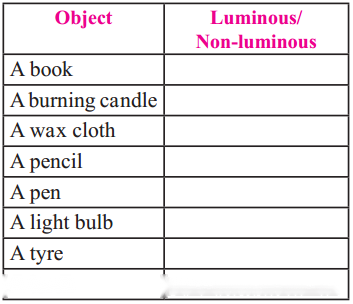
Object | Luminous /Non-luminous |
A book | Non-luminous |
A burning candle | Luminous |
A wax cloth | Non-luminous |
A pencil | Non-luminous |
A pen | Non-luminous |
A light bulb | Luminous |
A tyre | Non-luminous |
A torch | Luminous |
Stars | Luminous |
The planets | Non-luminous |
A satellite | Non-luminous |
The Moon | Non-luminous |
3. Match the following.
Question a.
Natural sources of light | Man-made sources of light |
The Sun | Tubelight |
Stars in the night sky | Light bulb |
Fireflies | Torch |
Anglerfish | Burning candle |
Honey mushroom | Oil lamps |
Answer:
Transparent | Opaque | Translucent |
Piece of glass Water | White plastic | Tinted glass |
4. Write the answers to the following.
Question a.
What things are necessary for the formation of a shadow?
Answer:
Things necessary for the formation of a shadow are:
Question b.
When can an object be seen?
Answer:
We can see an object when reflected rays reach our eyes.
Question c.
What is a shadow?
Answer:
Project:
Question 2
Maharashtra Board Solution
Find out how to save electricity with the help of the sunlight we receive during the day. |
Question 3. Read a biography of Sir C. V. Raman and find out about the discoveries he made. |
Class 6 Science Chapter 14 Light and the Formation of Shadows Important Questions and
Fill in the blanks.
Question 1
Maharashtra Board Solution
The ……………. is the main natural source of light.
Solution & Step-by-Step Answer:
block bg-white dark:bg-slate-900/80 border-l-4 border-emerald-500 rounded-r-xl p-5 my-3 shadow-xs border border-slate-200/60 dark:border-slate-800">
Solution & Step-by-Step Answer:
Sun
Question 2
Maharashtra Board Solution
The light emitted by an electric torch is more …………….. than that obtained from a candle.
Solution & Step-by-Step Answer:
intense
Question 3
Maharashtra Board Solution
The left and right sides of the original object appear to be …………….. in the mirror.
Solution & Step-by-Step Answer:
exchanged
Question 4
Maharashtra Board Solution
The image is as far behind the mirror as the object is in ……………… of it.
Solution & Step-by-Step Answer:
front
Question 5
Maharashtra Board Solution
The …………….. of the image is the same as that of the object.
Solution & Step-by-Step Answer:
height
Question 6
Maharashtra Board Solution
The materials through which light passes is said to be …………….
Solution & Step-by-Step Answer:
transparent
Question 7
Maharashtra Board Solution
The materials through which light does not pass is said to be …………...
Solution & Step-by-Step Answer:
opaque
Question 8
Maharashtra Board Solution
The materials through which light passes partially is said to be …………...
Solution & Step-by-Step Answer:
translucent
Question 9
Maharashtra Board Solution
If an ………….. object comes in the way of a light source, light does not pass it.
Solution & Step-by-Step Answer:
opaque, through
Question 10
Maharashtra Board Solution
The shadow of an object formed due to sunlight is ………….. in the mornings and evenings and ……………. in the afternoon.
Solution & Step-by-Step Answer:
long, short
Question 11
Maharashtra Board Solution
The shadow of an object is formed only when ………….. does not pass through the object.
Solution & Step-by-Step Answer:
light
Question 12
Maharashtra Board Solution
Stars are …………...
Solution & Step-by-Step Answer:
luminous
Question 13
Maharashtra Board Solution
Planets, satellites are …………...
Solution & Step-by-Step Answer:
non-luminous
Question 14
Maharashtra Board Solution
The largest sundial is at ………….., New Delhi.
Solution & Step-by-Step Answer:
Jantar Mantar
Question 15
Maharashtra Board Solution
………….. is celebrated as National Science Day.
Solution & Step-by-Step Answer:
28th February
Question 16
Maharashtra Board Solution
Light travels in a straight line. This is called …………...
Solution & Step-by-Step Answer:
linear propagation of light
Question 17
Maharashtra Board Solution
The image formed on the diaphragm of the pinhole camera is …………...
Solution & Step-by-Step Answer:
inverted
Question 18
Maharashtra Board Solution
The kind of shadow an object forms depends upon the ………….. between the ………….., the object and the ………….. or the ………….. on which the shadow is formed.
Solution & Step-by-Step Answer:
relative distance, source of light, surface, screen
State whether following statements are True or False.
Question 1
Maharashtra Board Solution
Light travels in a straight line.
Solution & Step-by-Step Answer:
True
Question 2
Maharashtra Board Solution
Stars are luminous.
Solution & Step-by-Step Answer:
True
Question 3
Maharashtra Board Solution
Image in a pinhole camera is inverted.
Solution & Step-by-Step Answer:
True
Question 4
Maharashtra Board Solution
In the afternoon, shadows are long.
Solution & Step-by-Step Answer:
False
Question 5
Maharashtra Board Solution
Fireflies are a natural source of light.
Solution & Step-by-Step Answer:
True
Question 6
Maharashtra Board Solution
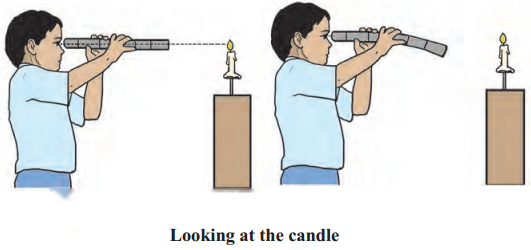
We see the candle clearly when we bend the tube.
Solution & Step-by-Step Answer:
False
Question 7
Maharashtra Board Solution
We can see our image clearly in running water.
Solution & Step-by-Step Answer:
False
Question 8
Maharashtra Board Solution
Tracing paper is transparent.
Solution & Step-by-Step Answer:
False
Question 9
Maharashtra Board Solution
The light obtained from an electric torch is more intense than that obtained from a candle.
Solution & Step-by-Step Answer:
True
Question 10
Maharashtra Board Solution
28tn February is celebrated as “National Science day” since 1987 in India.
Solution & Step-by-Step Answer:
True
Question 11
Maharashtra Board Solution
Classify the following into natural and man-made/artificial sources of light. (tubelight, light bulb, torch, burning candle, the sun, fireflies, anglerfish, honey mushroom, stars in the night sky, oil lamps, lanterns)
Solution & Step-by-Step Answer:
Question 12
Maharashtra Board Solution
Identify the transparent, opaque and translucent objects from among the following. (piece of glass, wax paper, tinted glass, oil paper, white plastic, a tea kettle, a notebook, cloth, water, a wooden cupboard, sheet of notebook.)
Solution & Step-by-Step Answer:
Question 13
Maharashtra Board Solution
Classify the following into the type of images they form: Clear image, faint image, no image. (still clear water, cemented wall, wooden surface, new steel dish, flower, glossy granite cladding of a wall, mirror, butter paper).
Solution & Step-by-Step Answer:
Question 14
Maharashtra Board Solution
Relate images formed with the surfaces.
Solution & Step-by-Step Answer:
Answer in one sentence.
Question 1
Maharashtra Board Solution
What are luminous objects?
Solution & Step-by-Step Answer:
The objects which emit light i.e. which themselves are a source of light, are called luminous objects.
Question 2
Maharashtra Board Solution
What determines the intensity of light?
Solution & Step-by-Step Answer:
The intensity of light is determined by the extent to which the objects emit light.
Question 3
Maharashtra Board Solution
What are non-luminous objects?
Solution & Step-by-Step Answer:
The objects that are not sources of light themselves are called as non-luminous objects.
Question 4
Maharashtra Board Solution
What are artificial sources of light?
Solution & Step-by-Step Answer:
Man-made objects which emit light are artificial sources of light.
Question 5
Maharashtra Board Solution
What are natural sources of light?
Solution & Step-by-Step Answer:
Natural substances, materials which emit light are called natural sources of light.
Question 6
Maharashtra Board Solution
What is linear propagation of light?
Solution & Step-by-Step Answer:
Property of light travelling in a straight line is linear propagation of light.
Question 7
Maharashtra Board Solution
What is reflection of light?
Solution & Step-by-Step Answer:
The rays of light falling on an object from a source of light are thrown back from the substance of that object. This is reflection of light.
Question 8
Maharashtra Board Solution
How do we see objects around us?
Solution & Step-by-Step Answer:
The rays of light falling on an object from a source of light are thrown back from the surface of that object. This is called reflection of light. We see the object when the reflected rays reach our eyes.
Question 9
Maharashtra Board Solution
What is moonlight?
Solution & Step-by-Step Answer:
Sunlight reflected from the surface of the moon reaching us, in which we see the moon is called the moonlight.
Question 10
Maharashtra Board Solution
What type of image is formed in the mirror?
Solution & Step-by-Step Answer:
The image formed in the mirror is ‘laterally inverted’ i.e. right side appears as left side and left side appears as right side.
Question 11
Maharashtra Board Solution
What change do you see in the image if you decrease or increase your distance from the mirror?
Solution & Step-by-Step Answer:
When the distance between object and mirror is increased the size of image decreases where as, when the distance is decreased the image size increases.
Question 12
Maharashtra Board Solution
What difference do you find in the height of the image in the mirror and yourself?
Solution & Step-by-Step Answer:
The size of the image in the mirror is the same as that of the object.
Question 13
Maharashtra Board Solution
What is the image on the diaphragm of the pinhole camera?
Solution & Step-by-Step Answer:
An inverted or an upside down image of the candle is seen on the diaphragm of the pinhole camera.
Question 14
Maharashtra Board Solution
What do you mean by transparent object?
Solution & Step-by-Step Answer:
The objects / materials through which light passes are said to be transparent.
Question 15
Maharashtra Board Solution
What do you mean by opaque materials?
Solution & Step-by-Step Answer:
The materials through which light does not pass are said to be opaque.
Question 16
Maharashtra Board Solution
What do you mean by translucent materials?
Solution & Step-by-Step Answer:
The materials through which light passes partially are said to be translucent.
Question 17
Maharashtra Board Solution
How is the shadow in the morning, afternoon and evening?
Solution & Step-by-Step Answer:
The shadows are long in the mornings and evenings and short in the afternoon.
Question 18
Maharashtra Board Solution
What is shade of a tree?
Solution & Step-by-Step Answer:
The shade of a tree is its shadow.
Question 19
Maharashtra Board Solution
How many colours is sunlight made up of?
Solution & Step-by-Step Answer:
Sunlight is made up of seven colours.
Give reasons for the following.
Question 1
Maharashtra Board Solution
When we see in the mirror, we see our image in the mirror.
Solution & Step-by-Step Answer:
When we see our face in the mirror, the light reflected from our face falls on the mirror and gets reflected back again. Hence, we see our image in the mirror.
Question 2
Maharashtra Board Solution
Opaque materials cast shadow.
Solution & Step-by-Step Answer:
An opaque material does not allow light to pass. Hence, it casts a shadow.
Question 3
Maharashtra Board Solution
Transparent and translucent object do not cast a shadow.
Solution & Step-by-Step Answer:
Translucent objects cast a faint shadow whereas transparent objects do not cast a shadow at all because they allow light to pass through them.
Use your brain power!
Question 1
Maharashtra Board Solution
Why is the image on the diaphragm of the pinhole camera inverted?
Solution & Step-by-Step Answer:
1. The pinhole camera works on the principle of light travelling in a straight line. 2. The rays of light from the candle flame go in all directions. 3. We consider only two rays that pass through the hole and fall on the screen. 4. The rays intersect at the pinhole. 5. Since the rays cross over at that point, the top of the object appears at the bottom of the image and the bottom of the image appears at the top. Thus, we see an inverted image of the candle.
Question 2
Maharashtra Board Solution
How will you light up a dark room using reflected light?
Solution & Step-by-Step Answer:
Focusing on the wall with torch light. Mirrors or reflectors can be used to get light from outside.
Question 3
Maharashtra Board Solution
Try to start the TV by operating the remote control from behind it.
Solution & Step-by-Step Answer:
T.V will not start.
Question 4
Maharashtra Board Solution
In which step is the flame of the candle seenclearly? Why?
Solution & Step-by-Step Answer:
In step 1 the flame of the candle is seen clearly because light travels in straight line.
Can you tell?
Question 1
Maharashtra Board Solution
Can we see anything in total darkness?
Solution & Step-by-Step Answer:
No, we cannot see anything in total darkness.
Question 2
Maharashtra Board Solution
What helps us to see the objects around us?
Solution & Step-by-Step Answer:
Reflected light helps us to see objects around us.
Question 3
Maharashtra Board Solution
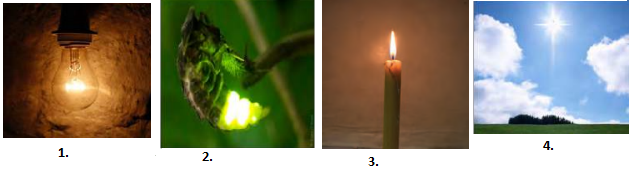
What does the light in each one of the pictures originate form?
Solution & Step-by-Step Answer:
1. Bulb 2. Firefly 3. Candle 4. Sun
Question 4
Maharashtra Board Solution
Name the natural sources of light.
Solution & Step-by-Step Answer:
Sun, Fireflies
Question 5
Maharashtra Board Solution
In which objects do we see our reflection?
Solution & Step-by-Step Answer:
All objects reflect light rays, but the best reflectors of light are mirrors, still water in a lake, new steel dish i.e. smooth shiny surfaces.
Question 6
Maharashtra Board Solution
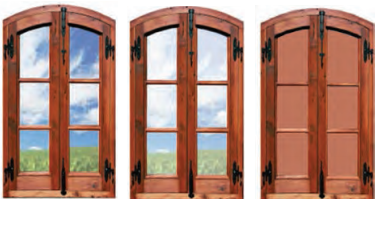
What difference do you notice on looking through the windows in the picture? What causes the difference? The picture shows transperant, opaque, translucent window panes. Spot them.
Solution & Step-by-Step Answer:
Answer the following questions in brief.
Question 1
Maharashtra Board Solution
List factors on which shadow depends.
Solution & Step-by-Step Answer:
Shadow depends on relative distance between the source of light, the object and the surface on which the shadow is formed.
Question 2
Maharashtra Board Solution
How we can see that light travels in straight line.
Solution & Step-by-Step Answer:
Question 3
Maharashtra Board Solution
What is the difference between an object and its reflection? What causes the difference?
Solution & Step-by-Step Answer:
Question 4
Maharashtra Board Solution
List characteristics of images in a plane mirror.
Solution & Step-by-Step Answer:
Question 8
Maharashtra Board Solution
State the characteristics of image formed by a pinhole camera.
Solution & Step-by-Step Answer:
Characteristics of an image formed by a pinhole camera are as follows:
Try this.
Question 1
Maharashtra Board Solution
Make your friend stand in between the torch and the wall. What happens?
Solution & Step-by-Step Answer:
Friend’s Shadow forms on the wall.
Question 2
Maharashtra Board Solution
Place a glass filled with water on a sheet of paper in the window so it receives direct sunlight. What is seen on the paper?
Solution & Step-by-Step Answer:
We see rainbow colours on the paper.
Question 3
Maharashtra Board Solution
Can we do the same in a dark room with the help of a prism and a torch? What do we learn from this?
Solution & Step-by-Step Answer:
yes, we can. Light gets seperated into seven colour. From this we learn that white light contains seven colours.
Question 4
Maharashtra Board Solution
If you dip the wire loop in the soap water and then blow it, soap bubbles are formed. Are the beautiful colours of the rainbow seen in these bubbles?
Solution & Step-by-Step Answer:
Yes, splitting of white light into different colours takes place.
Question 5
Maharashtra Board Solution
What do you see on holding a CD in the sun?
Solution & Step-by-Step Answer:
CD reflects rainbow colours, and interesting : patterns.
Question 6
Maharashtra Board Solution
Raise your right hand. In mirror which hand of the mirror image is raised?
Solution & Step-by-Step Answer:
Left hand of the mirror image is raised.
Question 7
Maharashtra Board Solution
Is there any difference between your height and height of the mirror image?
Solution & Step-by-Step Answer:
The height remains the same.
|