Maharashtra State Board Class 6 Science Solutions Chapter 8 Our Skeletal System and the Skin
Class 6 Science Chapter 8 Our Skeletal System and the Skin Textbook Questions and Answers
1. Fill in the blanks with the proper word.
Question a.
The place where two or more bones are connected is called a …………….
Answer:
joint
Question b.
Cells of epidermis contain a pigment called ………….
Answer:
melanin
Question c.
…………… and ……………. are the two layers of the human skin.
Answer:
epidermis, dermis
Question d.
The human skeletal, system is divided into ………….. parts.
Answer:
two
2. Match the pairs.
Question a.
Column ‘A’ | Column ‘B’ |
1. Ball and socket joint | a. Knee |
2. Hinge joint | b. Wrist |
3. Gliding joint | c. Shoulder |
Answer:
Column ‘A’ | Column ‘B’ |
1. Ball and socket joint | c. Shoulder |
2. Hinge joint | a. Knee |
3. Gliding joint | b. Wrist |
3. Right or wrong? If wrong, write the correct sentence.
Question a.
Bones are soft.
Answer:
Wrong: Bones are hard.
Question b.
The human skeleton protects the internal organs.
Answer:
Right
4. Put a [✓] mark at the proper places.
Question a.
The system which gives our body. a definite shape to
(a) Excretory system [ ]
(b) Respiratory system [ ]
(c) Skeletal system [ ]
(d) Circulatory system [ ]
Answer:
(c) Skeletal system [✓]
Question b.
The ………… joint is seen in fingers and toes.
(a) Hinge joint [ ]
(b) Ball and socket joint [ ]
(c) Immovable joint [ ]
(d) Gliding joint [ ]
Answer:
(a) Hinge joint [✓]
5. Answer the following questions in your words.
Question a.
What are the functions of your skin?
Answer:
The functions of the skin are :
Question b.
What should you do to keep the bones strong and healthy?
Answer:
To keep the bones strong and healthy:
Question c.
What are the functions of human skeletal system?
Answer:
The functions of human skeletal system are:
Question d.
Which are the various reasons due to which our bones might break?
Answer:
The bones in our body might break due to:
Question e.
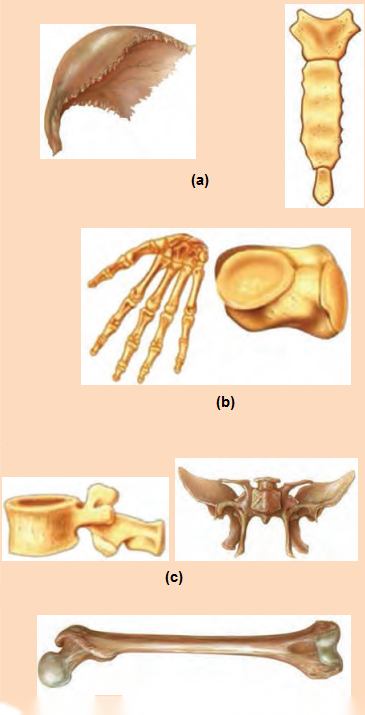
What are the different types of bones? How many types are there? Give example of each.
Answer:
There are four types of bones in our body:
Types of Bone | Example |
1. Flat bones | Sternum in the chest |
2. Small bones | Stirrup in each ear |
3. Irregular bones | Vertebra posterior (back side) of the body |
4. Long bones | Femur or thigh bone |
Types of Bone Example
6. What will happen if?
Question a.
There are no joints in our body.
Answer:
If there are no joints in our body, we will be standing like a tree without any movement, we can move only because of joints.
Question b.
There is no melanin pigment in our body.
Answer:
We will not have protection from ultraviolet rays. Our skin will become whitish.
Question c.
Instead of 33 vertebras in our body, we had one single and straight bone.
Answer:
We cannot bend down at our will.
7. Draw diagrams.
Question a.
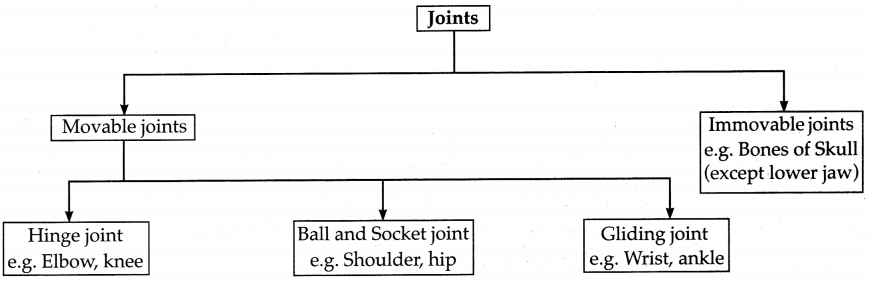
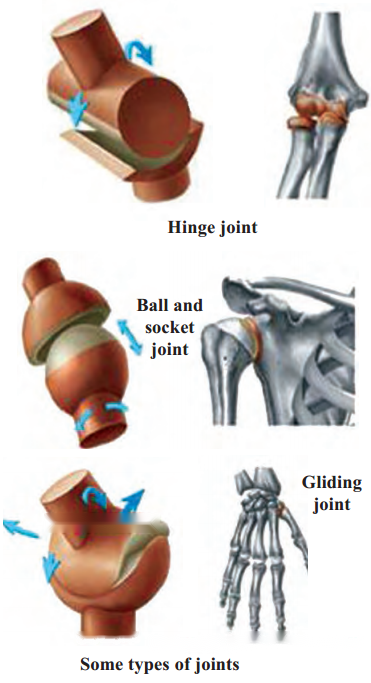
Types of joints.
Answer:
Question b.
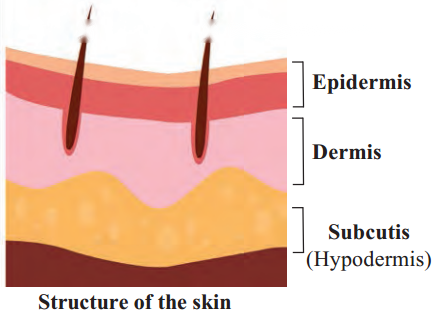
Structure of skin
Answer:
Activity:
Question 2
Maharashtra Board Solution
Collect the pictures, newspaper cuttings, etc. which show the skeletal systems of various animals and observe the differences between them. |
Class 6 Science Chapter8 Our Skeletal System and the SkinImportant Questions and
Choose the correct alternative:
Question 1
Maharashtra Board Solution
The ………………….. protects the brain. (a) skull (b) rib cage (c) spine (d) none of above
Solution & Step-by-Step Answer:
block bg-white dark:bg-slate-900/80 border-l-4 border-emerald-500 rounded-r-xl p-5 my-3 shadow-xs border border-slate-200/60 dark:border-slate-800">
Solution & Step-by-Step Answer:
(a) skull
Question 2
Maharashtra Board Solution
X-rays were discovered by …………………... (a) Sir C.V.Raman (b) Galileo (c) Sir Isaac Newton (d) Roentgen
Solution & Step-by-Step Answer:
(d) Roentgen
Question 3
Maharashtra Board Solution
The bones of ………………….. are immovable. (a) hand (b) leg (c) spine (d) skull
Solution & Step-by-Step Answer:
(d) skull
Question 4
Maharashtra Board Solution
We can move the bones of ………………….. in a 360° angle. (a) elbow (b) knee (c) shoulder (d) wrist
Solution & Step-by-Step Answer:
(c) shoulder
Question 5
Maharashtra Board Solution
Our body temperature usually remains constant at ………………….. °C. (a) 32 (b) 35 (c) 37 (d) 40
Solution & Step-by-Step Answer:
(c) 37
Question 6
Maharashtra Board Solution
The part of the skin which maintains body temperature is …………………... (a) Epidermis (b) Dermis (c) Subcutaneous layer (d) Network of blood vessels and nerve fibers
Solution & Step-by-Step Answer:
(c) Subcutaneous layer
Fill in the blanks:
Question 1
Maharashtra Board Solution
Except for the …………….., none of the bones of the skull can move.
Solution & Step-by-Step Answer:
lower jaw
Question 2
Maharashtra Board Solution
The spinal cord originates from the …………….
Solution & Step-by-Step Answer:
brain
Question 3
Maharashtra Board Solution
The longest and the strongest bone in the human body is …………….
Solution & Step-by-Step Answer:
femur
Question 4
Maharashtra Board Solution
…………….. is the smallest bone in our body.
Solution & Step-by-Step Answer:
stirrup
Question 5
Maharashtra Board Solution
The vertical, flat bone in the chest is called the ……………….
Solution & Step-by-Step Answer:
sternum
Question 6
Maharashtra Board Solution
The …………… joint moves in a 180° angle.
Solution & Step-by-Step Answer:
hinge
Match the columns:
Question 1
Maharashtra Board Solution
|
Column ‘A’ | Column ‘B’ |
1. Skull | a. 25 bones |
2. Rib cage | b. 6 bones |
3. Spine | c. 22 bones |
4. Both ears | d. 33 bones |