Maharashtra Board Class 7 Civics Solutions Chapter 3 Features of the Constitution
Class 7 Civics Chapter 3 Features of the Constitution Textbook Questions and Answers
1. Prepare a table to show the separation of powers in a Federal Government.
Answer:
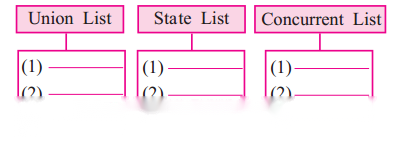
Union List | State List | Concurrent List |
Defence, foreign relations, war and peace, currency, international trade, etc. | Agriculture, law and order, local government, health, prison administration etc. | Employment, environment economic and social planning, personal law, education, etc. |
2. Find one word for:
3. Answer the following questions.
(ii) In countries with large territories and huge populations, the Government is run by a Federal System.
(iii) Ruling a large territory from a single capital city is not only difficult but may also lead to the neglect of some far-flung areas.
(iv) People residing there cannot participate in the affairs of the Government. Therefore, the governments function at two levels in a § Federation.
(ii) The first list is called Union List. It contains 97 subjects on which the Union Government makes laws.
(iii) The State List is for the State Governments to legislate upon. It contains 66 subjects.
(iv) Apart from these two lists, there is a Concurrent List which contains 47 subjects.
(v) Both governments can make laws on subjects included in this list. If a subject comes up that is not included in any of the lists, the Union Government is entitled to make laws on it. These powers are termed as ‘Residuary Powers’.
(ii) It is separate from the Executive and Legislative bodies of the Indian Government.
(iii) The Supreme Court is the guardian of the Constitution which ensures that the Fundamental Rights of the citizens are not violated.
(iv) To carry out its duties without fear or favour or external pressure, the Judiciary in India is independent.
4. Hold a group discussion on the merits and demerits of an independent judicial system.
Answer:
Merits of an independent judicial system:
Demerits of an independent judicial system:
5. Find out about the Electronic Voting Machine (EVM) and discuss the advantages of conducting elections with EVM.
Answer:
Activity:
Establish an Election Commission in your class, decide upon the positions you would like to fill through elections. Then conduct elections under the guidance of this Commission.
Class 7 Civics Chapter 3 Features of the Constitution InText Questions and Answers
Do this:
State | Capital |
Arunachal Pradesh | Itanagar |
Assam | Dispur |
Meghalaya | Shillong |
Manipur | Imphal |
Mizoram | Aizwal |
Nagaland | Kohima |
Tripura | Agartala |
Find out:
Class 7 Civics Chapter 3 Features of the Constitution Additional Important Questions and Answers
Complete the sentence by choosing the appropriate words from the options given below:
Match the following:
Column ‘A’ | Column ‘B’ |
(1) War and peace | (a) State Government |
1 – c
2 – a
3 – b
State whether the following statements are true or false with reasons:
Question 1
Maharashtra Board Solution
Defence is a subject on which the State Government makes laws.
Solution & Step-by-Step Answer:
False:
Question 2
Maharashtra Board Solution
The Union List contains 97 subjects and defence is one of the subjects included in it.
Solution & Step-by-Step Answer:
True.
Question 3
Maharashtra Board Solution
Chandigarh is controlled by the State Government.
Solution & Step-by-Step Answer:
False: Chandigarh is one of the seven Union Territories of India. The Union Government controls the Union Territories.
Question 4
Maharashtra Board Solution
In India, the Executive has the highest decision-making power.
Solution & Step-by-Step Answer:
False: The Indian Constitution has provided for a Parliamentary System of Government. In such a system the Parliament, i.e. the Legislature has the highest decision-making power.
Name the following:
Question 1
Maharashtra Board Solution
The system which is an important feature of our Constitution.
Solution & Step-by-Step Answer:
Federalism
Question 2
Maharashtra Board Solution
The Government that oversees the administration of the place we live.
Solution & Step-by-Step Answer:
State Government
Question 3
Maharashtra Board Solution
Number of subjects in the Union List on which the Union Government makes laws.
Solution & Step-by-Step Answer:
97 Subjects
Question 4
Maharashtra Board Solution
The list with 66 subjects which the State government legislates upon.
Solution & Step-by-Step Answer:
The State List
Question 5
Maharashtra Board Solution
The powers of the Union Government to make laws on a subject which comes up and is not mentioned in any list.
Solution & Step-by-Step Answer:
Residuary Powers
Question 6
Maharashtra Board Solution
Any two subjects with the Union Government.
Solution & Step-by-Step Answer:
Defence, Currency
Question 7
Maharashtra Board Solution
Subjects with the State Government
Solution & Step-by-Step Answer:
Health, Prison
Question 8
Maharashtra Board Solution
Subjects with both the governments.
Solution & Step-by-Step Answer:
Employment, Education
Question 9
Maharashtra Board Solution
2 Union Territories in India.
Solution & Step-by-Step Answer:
Daman and Diu, New Delhi
Question 10
Maharashtra Board Solution
Answerable to the Lok Sabha
Solution & Step-by-Step Answer:
The Council of Ministers.
Question 11
Maharashtra Board Solution
An example to show that the Indian Judiciary is independent.
Solution & Step-by-Step Answer:
Appointment of Judges by the President
Question 12
Maharashtra Board Solution
The type of citizenship granted to the citizens by the Indian Constitution.
Solution & Step-by-Step Answer:
Single citizenship
Answer in one or two sentences:
Question 1
Maharashtra Board Solution
Write any one of the important features of our Constitution.
Solution & Step-by-Step Answer:
Federal system is one of the important features of our Constitution.
Question 2
Maharashtra Board Solution
In which countries are governments run by the Federal System?
Solution & Step-by-Step Answer:
In countries with large territories and huge population, the Government is run by a Federal System.
Question 3
Maharashtra Board Solution
What is the problem faced while ruling a large territory from a single capital?
Solution & Step-by-Step Answer:
Ruling a large territory from a single capital city is not only difficult but may also lead to neglect of some far-flung areas.
Question 4
Maharashtra Board Solution
Explain the term Union Government.
Solution & Step-by-Step Answer:
The Government at the centre carries out tasks like defence of the entire country, foreign policy, establishing peace, etc. It is called ‘Union Government or ‘Federal Government’.
Question 5
Maharashtra Board Solution
What do you mean by State Government?
Solution & Step-by-Step Answer:
The Government that oversees the administration of the region that we live in is called State Government.
Question 6
Maharashtra Board Solution
What is called ‘Federalism’?
Solution & Step-by-Step Answer:
The system of running the administration of a country cooperatively by the Governments at two levels, making laws about different subjects is called ‘Federalism’.
Question 7
Maharashtra Board Solution
Which are the three lists into which the Constitution has divided subjects for making Laws?
Solution & Step-by-Step Answer:
The three lists into which the Constitution has divided subjects for making laws are State List, Union List and Concurrent List.
Question 8
Maharashtra Board Solution
Which powers are termed as Residuary Powers?
Solution & Step-by-Step Answer:
(a) If a subject comes up that is not included in any of the three Lists, the Union List, the State List or the Concurrent List, the Union Government is entitled to make laws on it (b) These powers are termed as residuary powers.
Question 9
Maharashtra Board Solution
Which are the seven Union territories in India?
Solution & Step-by-Step Answer:
The seven Union Territories in India are New Delhi, Daman and Diu, Puducherry, Chandigarh, Dadra and Nagar Haveli, Andaman and Nicobar Islands and Lakshadweep.
Question 10
Maharashtra Board Solution
In the Parliamentary system of Government, who has the highest decision-making power?
Solution & Step-by-Step Answer:
In the Parliamentary system of Government, the Parliament has the highest decision-making power.
Question 11
Maharashtra Board Solution
What does the Indian Parliament include?
Solution & Step-by-Step Answer:
The Indian Parliament includes the President, the Lbk Sabha or the House of the People and the Rajya Sabha or the Council of States.
Question 12
Maharashtra Board Solution
Whom is the Council of Ministers answerable to, for all its decisions?
Solution & Step-by-Step Answer:
The Council of Ministers is answerable to the Lok Sabha for all its decisions.
Question 13
Maharashtra Board Solution
What have great significance in Parliamentary Democracy?
Solution & Step-by-Step Answer:
In Parliamentary Democracy, the discussion and debates that take place in the Parliament have great significance.
Question 14
Maharashtra Board Solution
Which disputes are referred to the Judiciary?
Solution & Step-by-Step Answer:
The disputes that cannot be resolved mutually are referred to the Judiciary.
Question 15
Maharashtra Board Solution
Which are the two provisions in the Constitution which ensures that the Judiciary remains more independent?
Solution & Step-by-Step Answer:
The two provisions in the Constitution which ensures independence of Judiciary are that the judges are appointed by the President and not by the Government, and it is not easy to remove the Judges from their office.
Question 16
Maharashtra Board Solution
Why is it necessary to amend the Constitution?
Solution & Step-by-Step Answer:
There comes up a need to make changes or amendments in the provisions of the Constitution due to the changing circumstances.
Question 17
Maharashtra Board Solution
What can frequent amendments in the Constitution lead to?
Solution & Step-by-Step Answer:
Frequent amendments in the Constitution may lead to instability.
Question 18
Maharashtra Board Solution
Write a short note on Parliamentary System of Government.
Solution & Step-by-Step Answer:
(i) The Indian Constitution has provided for a Parliamentary System of Government.
(ii) In such a system, the Parliament, i.e. the Legislature has the highest decision-making power. (iii) The Indian Parliament includes the President, the Lok Sabha or the House of the People and the Rajya Sabha or the Council of States. (iv) The Council of Ministers that run the administration emerge from the Lok Sabha and is answerable to the Lok Sabha for all its decisions. In Parliamentary Democracy, the discussion and debates that take place in the Parliament have great significance. |